
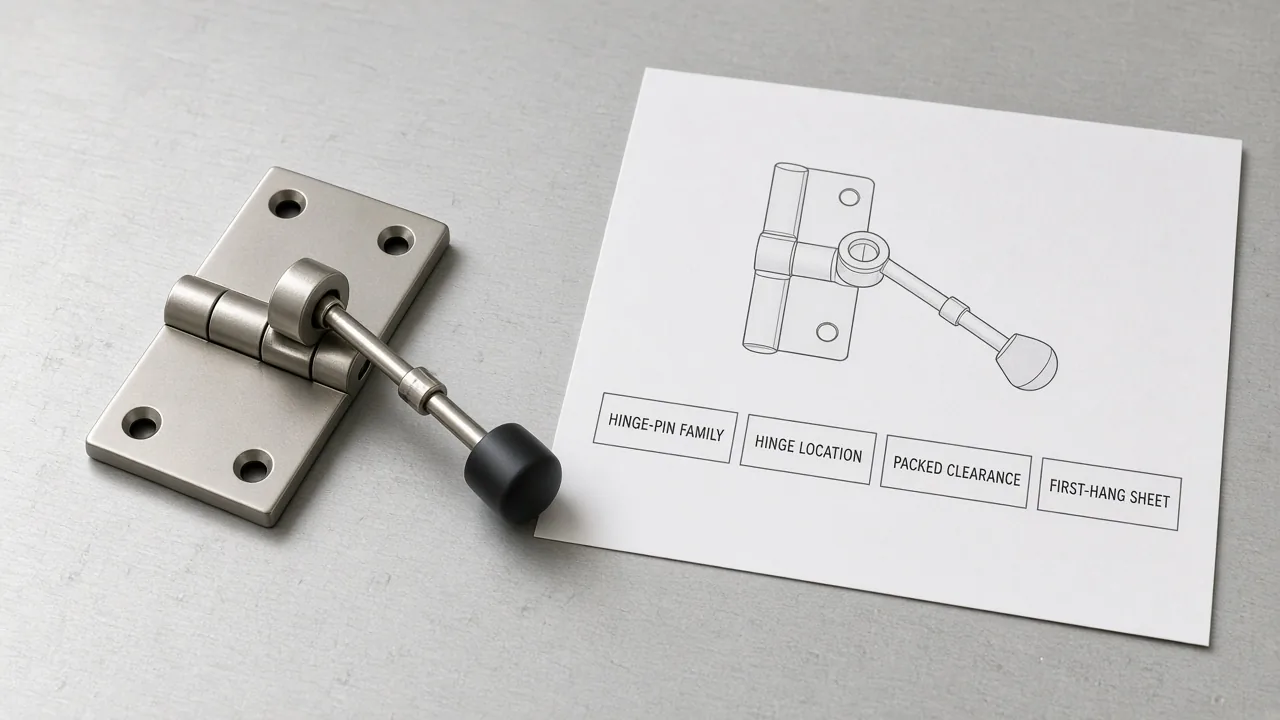
An install sheet can tell a buyer how to install a hinge pin door stop only after the packed hinge-pin family, the allowed hinge location, and the packed door or frame clearance are named from the supplier’s sheet. The family is a stop that replaces or fits the hinge pin, not a floor spring stop and not a wall bumper.
The hinge location and the packed clearance are the conditions the supplier’s sheet actually documents, or named fields left honestly blank. This file is a first-hang leaflet for that hinge-pin family. It is not a types-of-door-stops map, and it is not a floor-stop height RFQ.
Identification of door-stop families belongs on the types-of-door-stops file. Height and contact questions for floor stops belong on the live floor-door-stop-height RFQ. Those neighbors are named in prose only because the official lock-copy of the internal-link list omits those hrefs. This leaflet must not mix floor, wall, and hinge-pin families into one sequence.
This guide is for importers, distributors, and private-label teams approving a first-hang leaflet for hinge-pin door stops already in the live door-stop library. Koitor Hardware is a family-owned China OEM manufacturer of custom metal bathroom and home storage hardware.
That published-library context is not a claim that Koitor currently manufactures a named hinge-pin-stop SKU as a default. Send the stop drawing or install sheet, the intended hinge, and the door or frame condition. We can review the wording. We will not issue a universal which-hinge rule, a clearance chart, or a fire-door approval.
What does a how to install a hinge pin door stop file actually freeze?
It freezes the packed hinge-pin family, the documented hinge location, and the packed clearance, or an explicit exclusion for those fields. It does not freeze a types map, a floor-stop height RFQ, a wall-bumper leaflet, or a holding-only device.
Searchers often arrive under a generic door-stop install question because a carton arrived without a named hinge location, or because a floor-stop video was the first result they saw. That demand is real. For an importer, the usable decision is whether a listing may say the stop is easy to install, and which packed family, hinge location, and clearance that sentence is allowed to assume.
A stop that drops over or replaces a hinge pin is not a spring floor stop, even when both have a rubber tip. It is not a wall-mounted bumper, and it is not a door wedge. If the sheet does not say which family shipped, an easy-to-install line will be applied to the wrong door and the wrong hardware.
A custom bathroom hardware manufacturer can review whether a first-hang sentence and a packed hinge-pin family stay together. Matching a finish to a collection is not the same as inventing a default top-hinge rule, a default clearance, or a hollow-core repair method.
A published easy-to-install claim is only as complete as the named family, the named hinge location, and the named packed clearance. If the photograph shows a hinge-pin stop and the bag holds a floor spring, the sheet has already failed. The same is true of a missing clearance note, or of a wall bumper packed into the wrong first-hang panel.
This file can precede a first-hang review. It should not be turned into a types essay, a floor-height chart, or a fire-door opinion. Those jobs already have, or should keep, their own files.
Which packed hinge-pin family, hinge location, and clearance must be named first?
Name the packed hinge-pin family first, in the supplier’s terms: a stop that fits over or replaces the hinge pin, with the arm or tip the data actually shows. Do not start with a generic door-stop sequence, and do not start with a floor or wall bumper question that has not been excluded.
Name which hinge the sheet allows, from the supplier’s current data, or keep the field named and honestly blank. This page must not invent a factory-universal use-the-top-hinge rule. If the data leaves the location to the buyer, the sheet should say that the location comes from that data, not from this page.
Name the packed door or frame clearance, again from the cited sheet, or keep the field named and blank. Do not invent a clearance chart, a door-thickness table, or a borrowed blog list of gaps. A missing clearance note is a wording defect, not a reason to print a remembered number.
If the program packs more than one stop family in the same assortment, the sheet must say which family each bag belongs to. A mixed photograph that shows a hinge-pin stop and a floor spring in the same first-hang panel is how the wrong leaflet is promised for the wrong SKU.
Holding-only devices, magnetic catches, and similar door hardware stay off this family line unless the packed kit is documented as that product. This file is a hinge-pin stop first-hang, not a catch or holder leaflet.
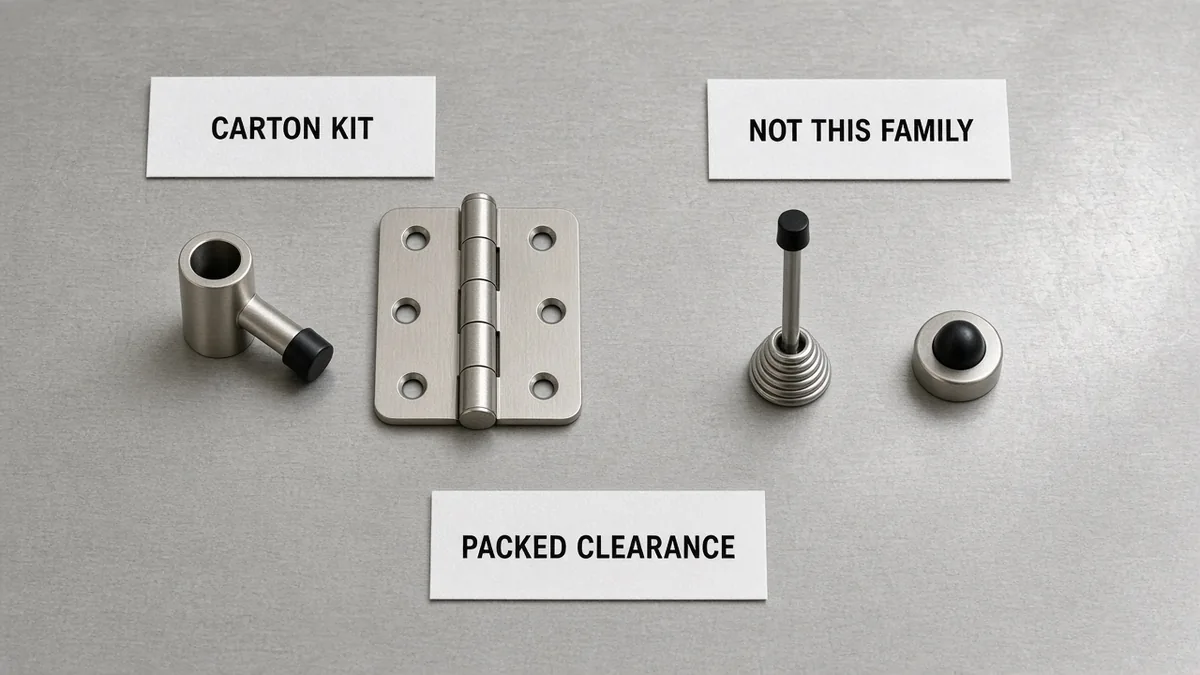
What belongs in the first-hang kit list, and what must stay out?
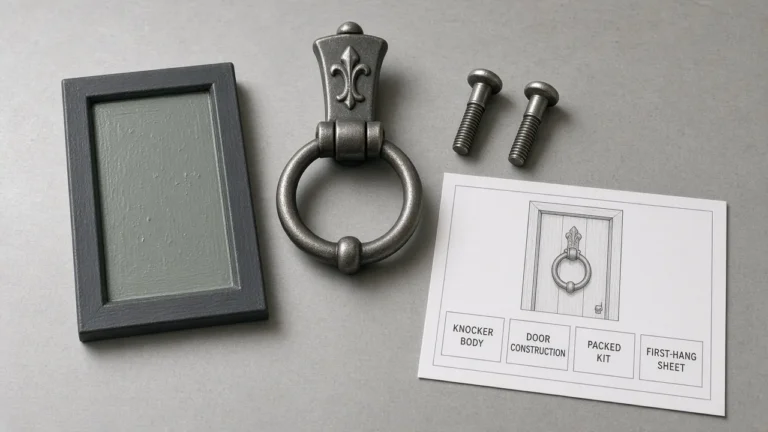
The kit list should name what the carton actually ships for this first hang, and what the cited sheet requires the buyer to supply. It is not a shopping list, and it is not a place to merchandize a spare hinge as the thesis of the page.
If the stop, a hinge-pin, or a clearance card ships in the carton, say so in those terms. If a related part is sold separately, the sheet should say so on its own line. A hardware kit packing inspection checklist is useful only for that packing-honesty check, not as a substitute for the named family.
Floor stops and wall bumpers stay off this kit list except as a clearly labeled exclusion. Informal questions about how to install a door stop, a floor door stop, or a wall door stop were not officialed as this page’s target and are not this leaflet.
Fire-door approvals and hollow-core repair methods stay off the list. This file must not invent a fire-door standard, and it must not present a hollow-core repair as a Koitor method.
| Field or claim | What must be named | What belongs in the kit or data | What this row is not |
|---|---|---|---|
| Packed hinge-pin family | The stop family the carton actually ships, in the supplier’s terms | The packed stop and the matching first-hang instructions | A floor spring stop, a wall bumper, a door wedge, or an invented Koitor SKU |
| Hinge location | The hinge or hinges the cited sheet allows, or a named field left blank | Only the location the cited data actually supplies | A factory-universal use-the-top-hinge rule, or a borrowed blog rule |
| Packed clearance | The door or frame clearance taken from that sheet, or a named field left blank | Only the values the cited data actually supplies | A factory-universal clearance chart, or a hollow-core repair method |
| Easy to install | The family, hinge location, and clearance the sentence is allowed to assume | Nothing beyond that named list and cited data | A fire-door approval, or a mixed floor-and-wall sequence |
The table is a decision map for the first-hang leaflet. It is not a clearance standard, a fire-door certificate, or a claim that floor and wall bumpers share this leaflet. If a row cannot be filled from the supplier’s current data, leave the field named and blank rather than inventing a number.
Why are floor-stop and wall-bumper tutorials not this first-hang method?
Many search results under a generic door-stop question teach a floor spring or a wall bumper. That volume is a real demand signal. It is not a method this sheet may teach, and it is not a reason to merge three stop families into one leaflet.
A first-hang leaflet that prints a floor-stop sequence will be copied onto hinge-pin cartons that never intended it. The buyer then treats a floor-height note as if it were the packed clearance for a hinge-pin stop. When the door or frame is wrong, the listing still said the stop was easy to install.
The honest response is to name the packed hinge-pin family and the allowed hinge location, and to exclude floor and wall families in plain language. If the buyer’s job is actually a floor stop, this sheet should say it is the wrong file rather than improvising a height chart.
Specialist blogs may also print a use-the-top-hinge rule or a hollow-core repair story. Those sources can explain why a buyer arrived with a how-to question. They are not a factory standard for this leaflet, and they are not a license to invent a Koitor clearance, a timed hang, or a fire-door claim.
Live metal door-wedge or wall-bumper pages that may exist in the official lock-copy list are still not this thesis. Do not link those pages as if they were this hinge-pin leaflet. Name floor and wall neighbors in prose, and keep this file on the packed hinge-pin family.
Which neighboring door-stop files should stay out of this sentence?
The types-of-door-stops identification file should stay a types file. It can help a buyer name the family they are looking at. It should not be reprinted here as a first-hang sequence, and it is named in prose only because the official lock-copy list omits that href.
The live floor-door-stop height or contact RFQ should stay a floor-stop procurement file. Clearance values on this sheet come from cited hinge-pin data, or they stay named and blank. This page must not become a second floor-height chart.
Informal questions about how to install a door stop, a floor door stop, or a wall door stop were no-data for officialing and are not this page’s target. If the packed kit is actually a floor or wall family, the question belongs on a different file.
Holding-only devices and magnetic catches belong elsewhere. A hinge-pin stop first-hang should not settle a catch or holder selection argument in an install sentence.
If a later file owns hinge replacement, door handing, or frame repair, keep those questions there. A first-hang sentence that tries to settle every neighboring RFQ will be wrong for the carton that actually shipped.
What should be checked before a listing tells a buyer how to install a hinge pin door stop?
Use the list as a first-hang review, not as a shop sequence and not as a pass-fail audit grade. If a line cannot be answered from the drawing, the carton, or the cited sheet, keep the field named and unresolved rather than inventing a value.
- Name the packed hinge-pin family in the supplier’s terms before any install sentence is printed.
- Name the allowed hinge location from cited data, or keep the field named and blank; do not invent a universal top-hinge rule.
- Name the packed door or frame clearance from that data, or keep the field named and blank; do not invent a clearance chart.
- State clearly whether a pin, a card, or a related part is in the carton or sold separately; do not merge those states on one label.
- Exclude floor spring stops and wall bumpers from this leaflet except as a clearly labeled not-this-family note.
- Keep types-of-door-stops and floor-stop height questions on their neighboring files, named in prose when the lock copy omits those hrefs.
- Do not print a fire-door approval or a hollow-core repair method presented as a Koitor standard.
- Do not official generic how-to-install-a-door-stop phrasing as this page’s target.

If the listing still wants an easy-to-install line after this review, the line may only assume the family, the hinge location, and the clearance that were just named. A sentence that cannot point to those fields is not ready to print.
A missing hinge-location note is a data or wording defect, not a reason to publish a remembered top-hinge rule. The same is true of a photograph that shows a floor stop, or of a bag that mixes a hinge-pin stop with a wall bumper.
A first-hang program that later changes the stop family must revise the install card as well. A sentence written for a hinge-pin stop will not travel safely onto a floor spring or a wall bumper, even when the rubber tip looks familiar. Stop the easy-to-install line until the new family is named from the revised data.
Door weight, handing, and frame condition can all change how a packed clearance is reached. Those conditions may be named as conditions if the cited sheet actually addresses them. They are not a license to invent a Koitor clearance chart, and they are not a license to print a hollow-core repair sequence.
If two stop families share a collection photograph, keep the first-hang map tied to the kit that actually shipped. A shared finish does not make a hinge-pin stop and a floor spring share a leaflet. The photograph should separate the exclusion, just as a review layout separates a carton kit from a not-this-family group.
Sales teams sometimes want a single sentence that covers types, floor-stop height, and hinge-pin first hang together. Resist that merge. The types file owns identification. The floor-height file owns floor-stop contact questions. This file owns the packed hinge-pin family as an install-sheet decision.
The question how to install a hinge pin door stop is a first-hang question about a packed hinge-pin family. It is not a second types file, not a second floor-height RFQ, and not a wall-bumper tutorial. Keep those neighbors in their own sentences, even when this official lock-copy list cannot yet carry their hrefs.
If incoming inspection is part of the program, inspect against the named family, the named hinge location, and the named clearance, not against a remembered floor-stop video. A rubber tip that looks familiar can still be packed on the wrong family.
Do not let a hinge catalog rewrite this leaflet as a types-of-hinges file. The stop uses a hinge pin, but this page is not an identification file for hinge families, and it should not be linked as if it were one.
When the official lock-copy list omits the types or floor-height hrefs, name those neighbors in prose and stop. Do not invent a URL, and do not paste a floor-height chart into this leaflet to make up for the missing link.
A replacement stop later in the program still needs the same named family, hinge location, and clearance. A spare bag that drops those fields will recreate the original wording defect, even if the first carton was correct.
If the intended product is a fire-door hardware set, this sheet is the wrong file for an approval and should say so. Point the buyer off this leaflet rather than improvising a fire-door conclusion.
Hardware finish and tip material should be named only as packed-kit fields, not as a substitute for the family. A matching color chip does not tell the buyer which stop family shipped, and it does not replace a missing hinge-location note.
If a project later asks for a different door thickness or a different handing, treat that as a data-revision question, not as permission to stretch an old clearance note. The first-hang sentence has to be rewritten against the new sheet, or it should stay off the listing until that sheet is named.
Pin wear, loose hinge knuckles, and painted-over pins can all change how a packed family is reached. Those conditions may be named as conditions if the cited data actually addresses them. They are not a license to invent a Koitor repair method, and they are not a license to print an unofficial which-hinge rule.
A private-label team can still use this page when the stop is already in the live door-stop library rather than being introduced as a new named SKU. The usable service is a wording and kit-scope review. The unusable request is a fire-door approval or a universal clearance chart.
If the carton includes both a hinge-pin stop and a sold-separately spare pin, those two states must stay visually and verbally separate. A merged label that reads as if the spare pin were already in every carton is the same class of defect as a merged kit photograph.
Do not link a live door-wedge page or a wall-bumper page as a shortcut to this leaflet. Those parts may be honest neighbors in a broader door-hardware conversation, but they are not this first-hang thesis, and using them as if they were this file would mix families the pack required us to keep apart.
When a hotel, project, or multi-door program wants one sentence for every opening, resist that shortcut. Each packed family still needs its own named location and clearance, or the easy-to-install line will be applied to the wrong door.
A sample door used in a review photograph is not a clearance standard. The photograph can show the family on a hinge. It cannot invent a gap, a door thickness, or a timed install for this leaflet.
If a later file owns hinge-pin replacement as a wear part, keep that spare-part conversation there. This first-hang leaflet may say that a pin is packed or sold separately. It should not become a hinge-rebuild manual in order to fill a missing clearance note.
Project documents that mention several stop families in one schedule should still point each family to its own install sheet. A schedule is not a license to merge floor, wall, and hinge-pin instructions into the paragraph that will be printed on this carton.
Frequently asked questions
Can the listing say the hinge pin door stop is easy to install?
Only after the packed hinge-pin family, the allowed hinge location, and the packed clearance are named or honestly pointed to cited data, and only if floor and wall families are excluded. An easy-install line is not a substitute for a missing hinge-location note.
Does this sheet also cover a floor stop or a wall bumper?
No. Those are different families. This leaflet may name them as not this kit. It should not become a floor-height RFQ or a wall-bumper first-hang, and it should not invent hrefs if the official lock-copy list omits those neighbors.
Can the sheet say to use the top hinge?
Only if the cited supplier sheet actually says so. This page must not invent a factory-universal which-hinge rule. If the data leaves the location to the buyer, keep the field named and blank, or point back to that data.
Is this a fire-door approval?
No. This file will not issue a fire-door approval or a code determination. If the buyer’s job is a labeled fire door, this first-hang leaflet is the wrong place for that conclusion.
What about a hollow-core door that was damaged by a previous stop?
This sheet must not present a hollow-core repair method as a Koitor standard. If the cited data addresses a door condition, name it as a condition. Otherwise, keep the unofficial repair off the leaflet.
Is a generic how to install a door stop the same article?
No. That broader phrase was not officialed as this target and would mix families this page is required to keep apart. Name the packed hinge-pin family. Do not open this leaflet as a catch-all door-stop tutorial.
Work With Koitor Hardware
Review a hinge-pin door-stop first-hang sheet
Send the stop drawing or install sheet, the intended hinge, and the door or frame condition. We can review the wording and the named hinge-pin family. We will not issue a universal which-hinge rule, a clearance chart, or a fire-door approval.
OEM / PRIVATE LABEL
Turn this sourcing guide into a product brief
Share your target product, size, finish, order quantity and packaging requirements. Your team receives a practical manufacturability review before quotation.
 English
 Español
 Português
 Français
 Deutsch
 العربية