

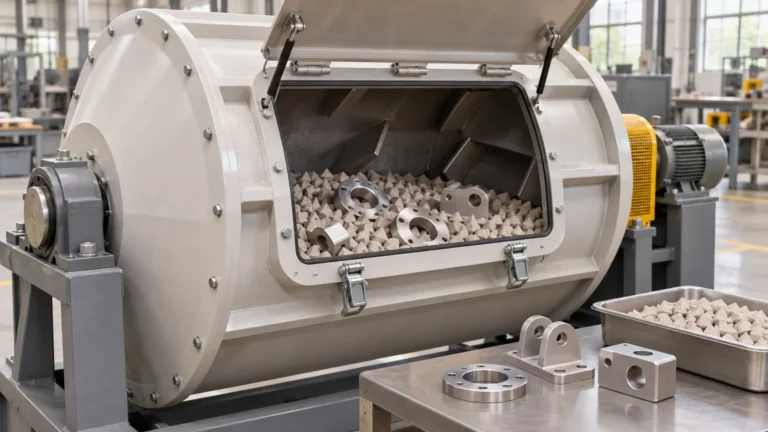
Mechanical galvanizing applies zinc to steel parts through a mechanical impact process. In the descriptions reviewed from coating processors and a fastener maker, parts move in a barrel with zinc powder, glass impact media, water, and process chemicals. The moving media helps transfer and consolidate zinc onto the prepared part. The defining distinction is mechanical deposition, rather than electrical deposition in electroplating or immersion in molten zinc for hot-dip galvanizing.
The barrel alone does not define the process. Zinc powder supplies the coating metal; the glass media provides impact and contact action; and the prepared steel part receives the deposit. A buyer should identify the actual coating route and the exact component before treating “galvanized” as a complete finish specification. A process name does not establish thread fit, coating coverage, corrosion life, or suitability for a particular assembly.
What is mechanical galvanizing?
Mechanical galvanizing, also called mechanical plating in some industry descriptions, is a route for depositing zinc onto steel components by mechanical action. The process descriptions reviewed include parts tumbling with zinc powder and impact media in a barrel, with water and process chemicals also involved. The exact sequence and inputs depend on the processor’s method and the component being treated.
The word “mechanical” describes how the zinc is deposited. It does not mean that the coating is produced by a structural weld. Some suppliers use “cold welding” as an industry description for particle deposition. That phrase should not be read as evidence that the steel parts are fusion-welded together or that welding inspection criteria apply to the coating. Ask the supplier what it means by the term and which part of its documented process the phrase describes.
The coating metal and impact media have different roles. Zinc powder is the source of the coating metal. Glass beads or other impact media move with the parts and help transfer and consolidate zinc on the prepared surfaces. The parts themselves must be appropriate for the process. A rotating barrel can also be used in unrelated mass-finishing operations, so “barrel processed” alone does not tell a buyer whether the intent was to deposit zinc, remove burrs, or change appearance.
The American Galvanizers Association’s explanation describes a barrel route involving glass media and zinc powder, while Plateco describes mechanical impact deposition. These sources support the basic mechanism. They do not establish that one recipe or one process sequence applies to all finishers, part sizes, or steel products.
How does impact media help deposit zinc?
The process relies on movement and repeated contact between the prepared parts, zinc powder, and impact media. As the charge moves, the media strikes and contacts part surfaces, supporting the transfer and consolidation of zinc particles. This is a different central action from passing electric current through an electroplating bath or immersing steel in molten zinc.
The inputs should be described by their function rather than collapsed into one generic “barrel treatment.” A conceptual input-action-result map makes the distinction clear:
| Process element | Role in the mechanical route | What the buyer should not infer |
|---|---|---|
| Zinc powder | Supplies zinc coating metal | The exact layer thickness or composition |
| Glass impact media | Provides mechanical contact and impact | A specific media size, ratio, or recipe |
| Prepared steel part | Receives the deposited coating | That every surface or recess is covered equally |
| Water and process chemicals | Part of the processor’s controlled route | A universal chemistry or operating sequence |
| Rotating barrel | Moves the processing charge | That every barrel operation is mechanical plating |
This is an explanatory map, not an operating instruction or standardized process specification. A buyer should not prescribe the media mix, chemical bath, cycle, or coating target by copying an unrelated supplier example. The responsible finisher confirms its method for the named component and the buyer’s actual requirement.
The geometry and movement of the part matter because components must move and the media must contact the surfaces that are meant to receive coating. Portland Bolt discusses how part motion and long fastener geometry can affect processing. That supports asking the finisher about the actual component; it does not establish a universal size limit for all fasteners or small hardware.
For example, a generic short steel fastener and a long, slender component may not interact with the charge in the same way. The buyer should not assume that a finish accepted on one shape proves coverage or fit on another. A part with recesses, threads, cavities, or assembled features may require specific supplier review. The actual drawing, sample, and finish specification should control the conversation.
How does this route differ from electroplating and hot-dip galvanizing?
The main difference is the mechanism used to deposit zinc. Mechanical plating uses mechanical impact from a moving charge. Electroplating deposits material through an electrochemical process in a plating bath. Hot-dip galvanizing immerses steel in molten zinc. These are distinct routes even when buyers use broad language such as “zinc coated” or “galvanized.”
| Route | Central mechanism | Buyer question to resolve |
|---|---|---|
| Mechanical galvanizing | Impact and contact help deposit zinc powder onto prepared parts | Which part, processor, and coating specification apply? |
| Electroplating | Electrical/electrochemical deposition from a plating bath | What coating route and product-specific evidence are specified? |
| Hot-dip galvanizing | Immersion in molten zinc | Is the named component and application intended for this route? |
| Mass finishing | Abrasive or other media modifies a surface | Is the process depositing coating metal or changing/removing surface material? |
The table describes high-level mechanisms, not a complete finish selection guide. It does not rank corrosion performance, coating thickness, adhesion, cost, or suitability. The right purchasing question is not “Which route is always best?” It is “Which route does this quotation actually specify, and does the supporting documentation match the part and intended use?”
The term “galvanized” can be used broadly in commercial communication. If a purchase order only says “galvanized steel fastener,” the buyer may not know which zinc route is intended. Ask the supplier to name the process and provide the applicable drawing, finish code, or product documentation. If the buyer has an approved reference or standard, identify its exact edition and scope; this article does not assert a current standard class or compliance.
An existing Koitor article, Does Zinc Rust? How Zinc Corrosion Differs from Red Rust, covers a separate question about zinc corrosion. That discussion does not make this process name a corrosion-life guarantee. A buyer should keep mechanism identification separate from a performance conclusion for a specific component.
What does the phrase “cold welding” mean here?
Some supplier explanations use “cold welding” to describe the way zinc particles are mechanically transferred and consolidated onto a part. In this context, preserve it as a coating-process description. It is not proof that two structural components are joined by a fusion weld, and it does not make the coating subject to the same acceptance criteria as a load-bearing welded joint.
This distinction matters because a familiar manufacturing term can trigger the wrong questions. A buyer reviewing a coated fastener may be tempted to ask for weld size or weld continuity. Those measures address a different process. The appropriate inquiry is how the named coating is applied, which surfaces are covered, which product specification applies, and what test or inspection evidence the supplier provides for the stated requirement.
The phrase should also not be treated as proof of a complete pretreatment or post-treatment sequence. Plateco describes preparation and later treatment stages in its own process explanation. The American Galvanizers Association describes a specific mechanical-plating route. These examples do not mandate one universal order for all processors. A buyer should ask the chosen processor to state its actual process and responsible documentation.
The article avoids claims about universal hydrogen-embrittlement risk, zero risk, or the suitability of every steel grade. Those conclusions depend on the material, part, full processing route, and relevant technical evidence. If the component is susceptible or safety-critical, obtain qualified review and project-specific documentation rather than infer a conclusion from the generic coating label.
What should a buyer confirm for an actual fastener or hardware part?
Identify the exact component, substrate, process, and requirement before approving a sample or quote. The buyer should make sure that the coating route is connected to the correct part number and revision. The supplier should confirm which processor applies the coating and what documentation is available. A broad finish name without those details can leave substitution and acceptance questions unresolved.
Start with the application and geometry. Is the item a purchased fastener, a mounting component, or a part incorporated into a larger bathroom or home-storage assembly? Which surfaces matter to thread engagement, mating fit, contact, or appearance? Are there cavities or long dimensions the processor should review? The article does not say that every such feature prevents coating; it says the actual shape should be evaluated by the responsible supplier.
Then confirm the intended coating route. If the buyer needs mechanical galvanizing, state that rather than relying on “zinc plated” or “galvanized” as interchangeable terms. Ask the supplier to identify any project-specific finish designation and the record or test result that supports the agreed property. The buyer should not copy a thickness, temperature, or cycle from an old article or an unrelated processor.
Finally, review the sample and the functional requirement separately. A visually gray surface does not establish process identity. A coating name does not prove thread dimensions or friction. An accepted sample can show the actual appearance under the buyer’s review conditions, but it does not establish corrosion life, structural capacity, or compliance unless separate evidence supports those claims.
| Specification field | Buyer should identify | Supplier should confirm |
|---|---|---|
| Part | Drawing, part number, revision, and substrate | Coating route is intended for that component |
| Process | Mechanical deposition, if required | Processor’s actual route and terminology |
| Coverage | Surfaces or features relevant to the design | Scope and limitations for the geometry |
| Fit | Threads, mating surfaces, assembly interface | Applicable evidence for the specified fit requirement |
| Performance | Specific corrosion or other claim, if required | Test or documentation applicable to the part and condition |
| Change control | Approved sample and revision | Whether process or supplier changes require reapproval |
This table is a buyer’s clarification aid, not a standard inspection plan. The project documents and qualified supplier determine the appropriate inspection and acceptance method.
How should buyers interpret coating and corrosion claims?
A process explanation and a performance claim are separate kinds of information. Knowing that zinc powder was mechanically deposited does not by itself establish coating thickness, coverage, adhesion, corrosion life, or suitability for a bathroom environment. Each claim must be supported by evidence relevant to the specified component and conditions.
Processor websites may describe benefits, application ranges, or comparisons with other routes. Those statements are not automatically universal. The sources reviewed for this guide include exclusions: do not adopt old thickness or density figures as a current specification; do not repeat blanket uniformity, long-life, “zero hydrogen risk,” or universal-superiority claims; and do not transfer a specific processor’s treatment sequence to all suppliers.
When a buyer needs corrosion evidence, define the part, substrate, finish system, test method, acceptance basis, and relevant exposure conditions with the responsible technical parties. A test report for a different part or process may not answer the buyer’s question. Likewise, a surface appearance or a statement that a coating is zinc-based does not establish how an assembled product will perform in a particular environment.
Koitor Hardware can discuss the approved product drawing, component scope, and manufacturing communication for custom bathroom and home-storage hardware. The buyer should obtain coating-specific process and performance evidence from the supplier responsible for that coating. No certification, lab capacity, test result, or guaranteed life is claimed here.
How should a buyer review part geometry and movement?
A buyer should give the coating processor the actual component rather than rely only on a generic fastener name. The part’s length, shape, cavities, threads, and intended orientation can affect how the processing charge moves and how the media reaches the relevant surfaces. Portland Bolt’s discussion of long fasteners supports this component-specific question. It does not define a universal maximum length or establish that one shape cannot be processed. The processor needs to assess the real part and its own equipment.
For a small mounting fastener used in a metal storage assembly, the buyer can identify the threaded region, the head or contact face, and the surfaces that must mate with the rest of the product. These features may have different functional roles. The coating route should be reviewed against the actual requirement, not just the visible color of the sample. If thread engagement or another dimension is controlled, the buyer should name the specification and ask the responsible supplier how it verifies that requirement. No tolerance or acceptance limit should be invented for the project.
The same principle applies to mixed lots. A processor may receive components with different dimensions or materials, but the buyer should not assume that one setup and record covers all variants. List the part numbers and confirm which ones are represented by the sample. If the parts are grouped, ask the supplier to state the scope in a way that can be traced back to the purchase order and revision.
Which records make a coating proposal reviewable?
A useful proposal ties together the component identity, named zinc route, processor, sample, and any project-specific evidence. The purchase order or drawing can state the required finish route, while a supplier’s process description identifies its own responsibility. A sample approval should reference the same part and revision that will be ordered. If the supplier provides a test report, check that it identifies the relevant material and process and that its stated result corresponds to the claim being made.
This does not mean that every purchase needs the same report or that a general article can prescribe a test. The correct evidence depends on the buyer’s requirement and the applicable product documentation. The key is to avoid substituting a broad promotional statement for a component-specific record. “Mechanically galvanized” tells the reader the type of route being discussed; it does not itself state the test condition, acceptance result, or approval status of a particular part.
If the supplier changes a coating source, processing route, or material, the buyer can ask whether the original approval still applies. A change can affect which document, sample, or review is relevant. It should not be treated as equivalent merely because the new part looks gray or retains the same broad finish description. The responsible parties decide whether requalification is needed for that project’s requirement.
Which conclusions remain outside a process definition?
A process definition does not calculate assembly strength, determine a fastener’s corrosion life, establish a steel grade’s susceptibility, or confirm a legal compliance obligation. Those topics need their own component-specific evidence and qualified review. The mechanical route’s basic mechanism can help a buyer ask a more precise question, but it cannot replace design validation or a test requirement.
A buyer should also distinguish the coating system from any later treatment or topcoat. A processor may offer additional steps, but the article does not make any one of them mandatory or suitable for all parts. If a supplier quotes a post-treatment, record it as part of that proposal and ask how the sample and documentation reflect the complete finish system. A change to that system should not be hidden by reusing a generic galvanized label.
How does the process relate to OEM hardware sourcing?
Mechanical galvanizing can be relevant when an OEM design uses a bought-in steel fastener or small component and the quotation identifies this zinc route. The importer needs to know the process so that a broad finish label does not hide a substitution. The actual coating may be applied by a specialist processor or component supplier; the factory coordinating a larger product should not be presumed to own the coating line.
For an OEM bathroom or storage project, the buyer can share the actual drawing or sample, component list, finish description, fit requirements, and target quantity. Koitor Hardware is a family-owned custom metal hardware manufacturer focused on bathroom and home-storage products. It can discuss product structure and manufacturing scope supported by confirmed project information. It is not presented as a mechanical-galvanizing processor, a fastener certification body, or a structural fastener design authority.
The project team can maintain a simple handoff: the product buyer defines the required component and finish route; the fastener or coating supplier confirms the process and evidence; the OEM manufacturer confirms how the component fits the approved product and BOM; and the importer approves the documentation for the order. If a route or supplier changes, recheck the part-specific evidence and whether the existing sample still represents the proposed product.
Buyer checklist before approving a mechanically galvanized component
- What exact part number, drawing revision, and steel substrate are in scope?
- Does the quotation mean mechanical impact deposition, electroplating, or hot-dip galvanizing?
- Which supplier and processor are responsible for the coating?
- What does the supplier mean by “cold welding,” if that phrase appears?
- Which part surfaces, threads, holes, and recesses require review?
- Which finish designation or project document controls the coating?
- What evidence supports any corrosion, thickness, fit, or compliance statement?
- Is the submitted sample tied to the part revision and stated process?
- Which properties remain unverified by visual inspection?
- Does a process or supplier change require a new sample or buyer approval?
- Which facts belong to the OEM product supplier, and which belong to the coating processor?
This checklist is for clarification and sample review. It is not a chemical recipe, a coating specification, or a substitute for qualified engineering review.
Frequently asked questions
Does impact plating use electricity to deposit zinc?
No. The central mechanism differs. Mechanical deposition uses impact and contact in a moving charge, while electroplating uses an electrochemical process. A buyer should identify the route in the quotation and confirm the applicable documentation for the specified part.
Does a barrel automatically mean the part was mechanically galvanized?
No. Rotating barrels can be used in different manufacturing operations. A barrel can move abrasive media to modify a surface or can be part of a route that mechanically deposits zinc. The actual process inputs and intended result determine what operation is being described.
Does “cold welding” mean the coated component has a structural weld?
No. Some suppliers use that term to describe particle deposition. It should not be treated as evidence of a fusion weld or a structural joint. Ask the processor to explain its use of the phrase and identify the actual coating method.
Does the process name guarantee coating on every feature?
No. Coverage and fit depend on the actual part and process. A finisher should review the component geometry and the buyer’s requirement. The process name alone does not prove all recesses, threads, or hidden surfaces meet a specified condition.
Does mechanical deposition guarantee zero hydrogen risk or a certain service life?
No universal conclusion follows from the name. Material susceptibility, processing, part geometry, and intended use require project-specific evidence. Do not treat supplier promotional wording as a guarantee for a different component.
Work With Koitor Hardware
Share the actual product drawing or sample, the component and finish requirement, the assembly interface, and the target quantity. Koitor Hardware can discuss the OEM product and manufacturing scope; the responsible coating or fastener supplier should confirm the process route and coating-specific evidence.


Discuss the component in your hardware design
Share the drawing or sample, finish requirement, fit-critical features, order quantity, and packaging scope for an OEM project review.
OEM / PRIVATE LABEL
Turn this sourcing guide into a product brief
Share your target product, size, finish, order quantity and packaging requirements. Your team receives a practical manufacturability review before quotation.


 English
 Español
 Português
 Français
 Deutsch
 العربية