
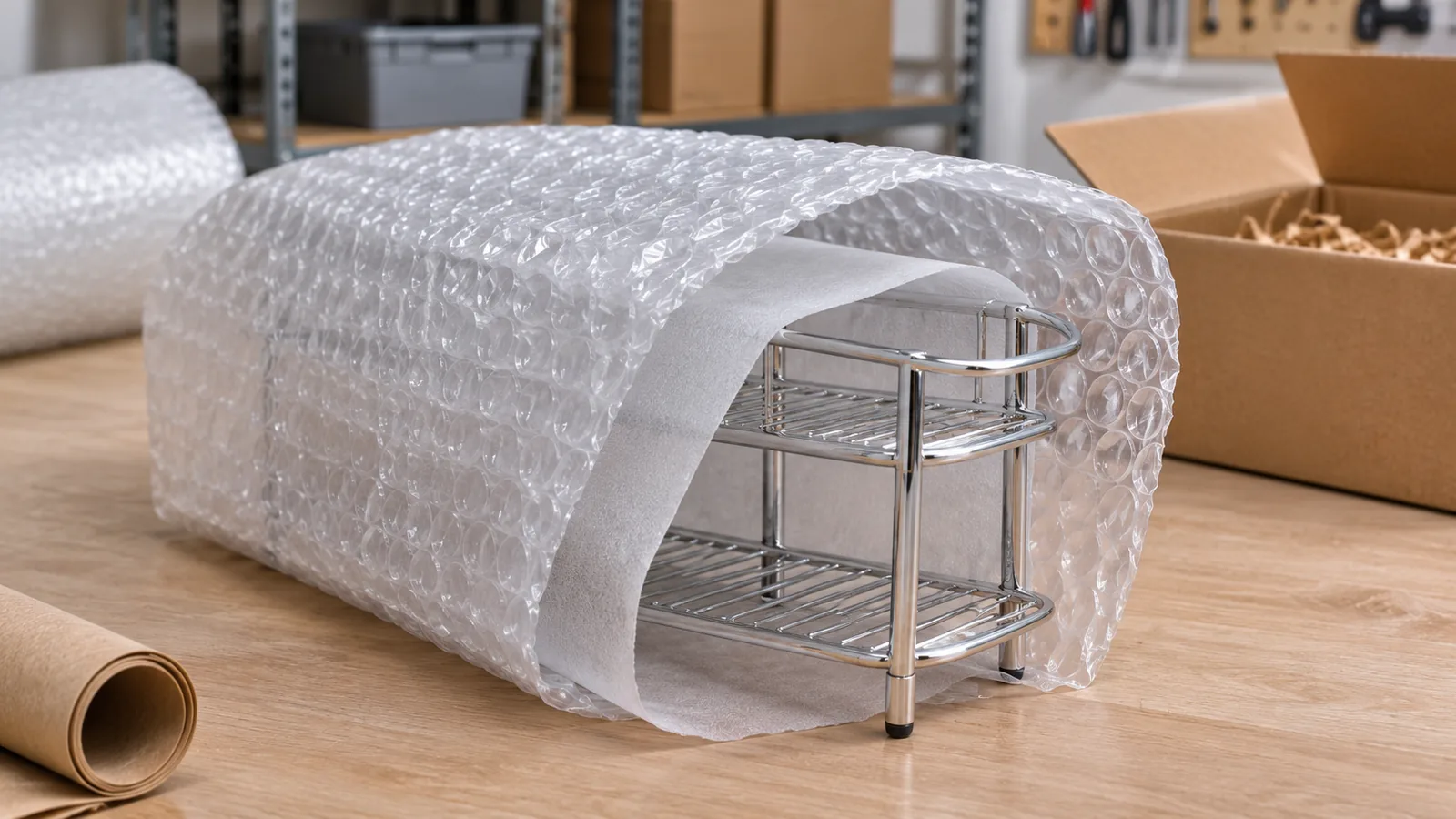
For conventional one-sided bubble film described by packaging suppliers, the usual orientation is bubbles facing inward toward the wrapped item and the smooth film facing outward. The question “bubble wrap bubbles in or out” concerns that orientation, not which material touches a delicate finish. That direction rule does not mean the bubbles must press directly against every finished surface. If the product’s finish needs an approved contact barrier, the bubbles still face inward but contact that barrier instead of the bare finish: item → approved interlayer → inward-facing bubbles → smooth outer film. Orientation and contact material are separate decisions.
This distinction matters when an importer packs a metal storage product or a coated bathroom accessory. “Bubbles in” identifies which way the protrusions point; it does not determine what surface they touch. A buyer should identify the product face, bubble protrusions, flat film face, any approved interlayer, and the seam or tape on the wrap. Then the buyer can review the actual finish and pack-out rather than treating the direction phrase as a complete protection specification.
Which Way Should Conventional Bubble Wrap Face?
For the conventional one-sided bubble film described in the cited packaging guides, position the bubble face toward the item and the smoother face outward. This is a common orientation instruction for that type of film. It is not a universal rule for every packaging material called “bubble wrap,” every product, or every finished surface.
The two faces have different geometry: one side carries the bubbles and the other side is comparatively flat. If the wrap is oriented around a product, the direction determines which face is inward. A packing instruction can state this directly, for example: “Wrap the approved bubble film with bubbles facing the product and the smooth side outward.” If the finish needs a separate barrier, name the barrier and place it between the product and bubble film.
| Arrangement | Product-to-outside layer order | What it describes |
|---|---|---|
| Direct contact, when approved | Product → inward-facing bubbles → smooth outside film | Bubble protrusions contact the product surface |
| Interlayer, when specified | Product → approved barrier → inward-facing bubbles → smooth outside film | The barrier contacts the product; bubble orientation remains inward |
| Reversed wrap | Product → smooth film → outward-facing bubbles | A different orientation; do not treat it as a substitute for an approved contact barrier |
This is a layer map, not a protection rating. It does not state that either direct contact or an interlayer is suitable for every surface. The packaging material instructions and the actual product finish determine whether direct contact is permitted.
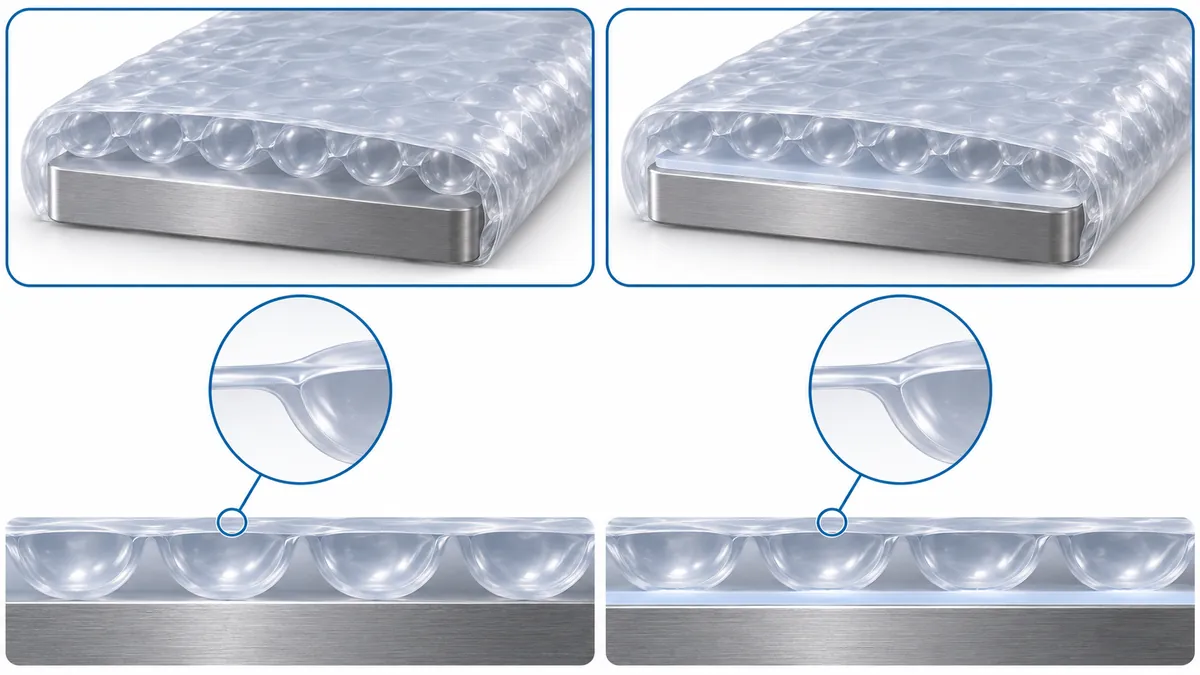
Does “Bubbles In” Mean the Bubbles Touch the Bare Product?
No. It means the bubble face points toward the wrapped item. If a suitable interlayer is part of the approved package, that layer sits between the product finish and the bubble protrusions. The bubble face is still oriented inward; its immediate contact is with the barrier.
This distinction is useful for delicate, glossy or newly finished parts. RAJA’s business packing guide notes a finish-related caveat and discusses using a separating layer for delicate surfaces. PackBros also describes inward-facing bubbles and an interlayer example. These sources support separating orientation from the contact surface. They do not identify one universally compatible paper, film or textile barrier for all finishes.
A buyer should therefore avoid a shorthand that can be misunderstood, such as “bubble wrap against the product,” if the approved plan actually requires a barrier. The pack instruction should state both the direction and the contact sequence:
- Product’s identified face.
- Whether direct bubble contact is approved for that face.
- The named or otherwise specified contact barrier, if required.
- Bubble face toward the item or barrier.
- Smooth outer face and wrap seam location, if relevant to the pack-out.
An interlayer is not a guarantee against marks, scratches, pressure or movement. Its material, surface, placement and interaction with the product need to be reviewed for the exact package. Do not assume that any paper or film is chemically or mechanically suitable merely because it separates two layers.
Why Should Metal Hardware Buyers Review the Contact Surface?
Bathroom and home-storage hardware may contain several surfaces in one product: a visible coating, a polished or plated area, an uncoated edge, a weld region, a wire contour or an accessory. The wrap orientation question should be answered for the product face that will be contacted. One packaging arrangement may touch different regions as the wrap is folded or taped.
This does not mean bubble film inherently damages metal. It means a buyer should not claim compatibility based solely on direction. The actual finish, packaging materials and approved sample are the relevant evidence. A contact barrier may be part of the pack-out, but it should be identified and reviewed rather than assumed to solve every contact or transit concern.
A practical sample review can distinguish:
- The surface at risk: Name the component face or finish area, not only “the product.”
- The contact layer: Identify whether the bubble film itself or an interlayer touches that area.
- The wrap orientation: Record bubble side inward and smooth side outward for conventional one-sided film.
- The seam and restraint: Note where the wrap closes and whether other packing components restrain the item.
- The wider package: Check that the product, wrap, inner supports and carton are reviewed as a system.
These fields prevent the team from treating a single wrap-direction label as a complete packing design. A tape seam can contact a different area from the bubble face. An insert can shift the product within an inner box. A carton can add compression or restraint. The guidance in this article does not establish those performance results; they need separate review.
Koitor’s bubble wrap versus packing paper guide discusses material roles and the broader package. For air transport and reduced-pressure package considerations, the separate air-transport packaging article addresses another part of the system. A comparison of a bubble mailer and a poly mailer is also distinct from loose bubble wrap; see poly mailer versus bubble mailer.
How Should a Two-Case Contact Diagram Be Read?
A cross-section is useful because it shows the order of layers that a short instruction can hide. Start by drawing the product face as a boundary. Then draw either the bubble protrusions directly against that surface or an approved barrier between them. The smooth film face stays on the outside in both inward-facing arrangements. The drawing should label the product, the contact barrier if present, the bubble film, and the outer film face. Without those labels, an illustration can be mistaken for a performance test or a universal materials recommendation.
In the direct-contact case, the buyer has approved the particular bubble film to contact the identified surface on the representative sample. This is a project decision; it does not follow merely from the phrase “bubbles in.” In the interlayer case, the buyer has approved a particular barrier to contact the product, and the bubble film is oriented toward that barrier. The barrier itself can have its own surface, cleanliness and placement considerations. Naming it is better than leaving “paper” or “protective sheet” undefined.
A seam can create another contact point. Tape, an overlapping film edge or a folded wrap may touch a different part of the product than the bubble cells. A diagram can show where the seam closes, but it cannot establish that the tape adhesive is compatible with a finish or that the wrap remains in place during shipment. Record those points separately if they matter to the project.
| Diagram label | Buyer should identify | Do not infer |
|---|---|---|
| Product face | Exact surface, finish or component area | That all faces share one contact rule |
| Bubble side | The protruding side of the specified one-sided film | A named brand or protection rating without product evidence |
| Smooth side | The relatively flat outer film face | That it cannot mark a product if reversed |
| Interlayer | The approved material and its position | Universal compatibility or guaranteed protection |
| Seam/tape | The closure location and material if relevant | Adhesive or finish compatibility by appearance alone |
This is a way to make packaging communication explicit. It does not replace validation of the complete inner pack and carton. The actual packaging supplier and product owner should decide what contact arrangement to approve.
How Can Buyers Review the Wrap on an Actual Sample?
Use a representative sample of the product finish and the exact materials proposed for the pack. Confirm the film type, any contact barrier and the wrapping orientation against the written instruction. Record the sample version and the party approving it. A sample review can establish what was observed under those conditions; it does not show that another finish, product shape or carton will behave identically.
The comparison should keep one question in focus. If the buyer wants to decide between direct bubble contact and an interlayer, use those as the alternatives and keep other package elements as consistent as the project requires. If the film supplier or barrier changes, record that change. If the carton or restraint arrangement changes, treat it as another package variable rather than assuming the earlier contact review covers it.
For a project with several SKUs, identify the variants that actually share the same finish and geometry. A wrap instruction that works for a simple flat part may need review when the item has projecting wires, sharp corners or a new coating. This is not because a specific failure is predicted, but because the area of contact and the pack arrangement are different. A qualified buyer can decide whether the existing approval covers the variant or whether another sample is needed.
Keep an image or diagram attached to the packaging revision when it helps the packing team see the intended layer order. Pair it with text that says where the smooth face belongs and which material contacts the product. Images should clarify those instructions; critical direction and contact details should remain in readable written text so they can be retrieved and checked independently.
What Does Bubble-Wrap Direction Not Prove?
Direction alone does not establish how well an item is protected, whether it will remain in place, or what will happen in a particular shipment. It does not prove shock, vibration or compression performance, and it does not set a universal number of wrap layers. Those questions depend on the complete packaging system and the actual product.
“Bubbles in” is not permission to let protrusions touch a surface that has not been approved for that contact. Reversing the wrap to put the smooth side against the product is also not automatically a better protection choice. If a finish needs an interlayer, define the barrier and verify it rather than treating reversed orientation as a replacement.
Do not assume that a brand name applies to generic bubble film. The instructions discussed here describe conventional one-sided bubble film from the cited suppliers; they are not an attribution to a specific branded product unless the exact branded material is documented. Different cushioning products may have different face structures and handling instructions.
The wrap does not replace the package’s other protective functions. Sharp-edge protection, product restraint, carton design, void fill, and transport qualification are separate decisions. A layer-order diagram helps make the local contact clear; it is not a substitute for validating the full pack-out.
How Can Buyers Write a Clear Pack-Out Instruction?
When answering “bubble wrap bubbles in or out” for a product sample, a clear instruction names the surface and materials instead of relying on an unqualified phrase. For example, a buyer might write: “For the identified finish, use the approved interlayer between the product and the conventional one-sided bubble film; orient bubble protrusions toward the interlayer and the smooth face outward. Confirm this exact arrangement on the approved sample.” This is an illustrative wording pattern, not a universal product recommendation.
Where a project does not require an interlayer, say that the direct-contact configuration is the one approved for the sample. Where the exact film or barrier is not yet approved, record it as pending. Do not create an implied approval simply because a sample was wrapped once.
A pack-out review can capture:
- Product name, part number and revision.
- Finish or surface region being protected.
- Bubble-film type as specified by the responsible supplier.
- Whether bubble-to-product contact is allowed.
- Interlayer type and position, if applicable.
- Orientation of the bubble and smooth faces.
- Wrap seam or tape location when it could contact the part.
- Other inner packaging that holds the product.
- Carton and transport conditions being evaluated separately.
- Approved sample identifier and reviewer.
This record is especially helpful when a product has several finishes or when the pack-out changes between SKUs. If the team reuses one instruction across multiple products, verify that the surface and packaging assumptions truly match. A new coating, geometry or barrier can change the contact question and deserves review under the project’s change process.
What Should Buyers Avoid When Wrapping a Finished Product?
Avoid stating that bubbles must always touch the finish. The direction rule concerns orientation, while an approved interlayer can change the immediate contact surface. Do not treat a smooth outer face as proof that the inner contact is harmless.
Avoid assuming a specific interlayer works for every product. Material compatibility and contact behavior need evidence tied to the actual product. Avoid promising a no-mark, no-scratch or no-damage result based only on wrap orientation. No such universal result is established by the sources.
Avoid confusing loose one-sided bubble film with a mailer that has built-in cushioning. A bubble mailer and a separate sheet of bubble film have different constructions and packaging roles. Avoid substituting one for another in a pack-out record without review.
Avoid using bubble-wrap orientation as shorthand for all protection. It does not answer restraint, carton strength, void filling, sharp-edge protection, or transit performance. The complete package should be reviewed for the intended shipment, with the relevant project criteria set by the responsible buyer and supplier.
How Does Wrap Orientation Fit the Complete Package?
Wrap orientation is one local packaging decision inside a larger system. The product can still move within the package; edges may contact other components; an insert or carton may provide restraint; and the shipment may encounter conditions the orientation rule does not address. If a buyer needs to understand package performance, the whole package and the intended distribution context must be considered separately. Neither a one-layer diagram nor a general bubble-wrap guide assigns a transport rating.
When a package specification is revised, record what changed: film orientation, barrier, material, fold, seam, insert, carton or product configuration. The change record lets the buyer decide whether the previous approved sample remains representative. Avoid writing that the product is protected simply because it was wrapped with bubbles facing inward. State only the arrangement that was reviewed and the other package questions that remain open.
Buyer Checklist for Bubble-Wrap Orientation
Before approving a pack-out, record:
- Which product surface or finish is being wrapped.
- The exact bubble-film construction or supplier description.
- Which face has the bubbles and which face is smooth.
- Whether direct bubble contact is approved for the actual surface.
- Whether an interlayer is required and which material was reviewed.
- The sequence of product, barrier, bubble film and outer wrap.
- Where the wrap seam or tape sits.
- The other inner packaging and restraint components.
- The product and packaging revisions used for the sample.
- Who approved the contact arrangement.
- What transport or whole-package qualification remains separate.
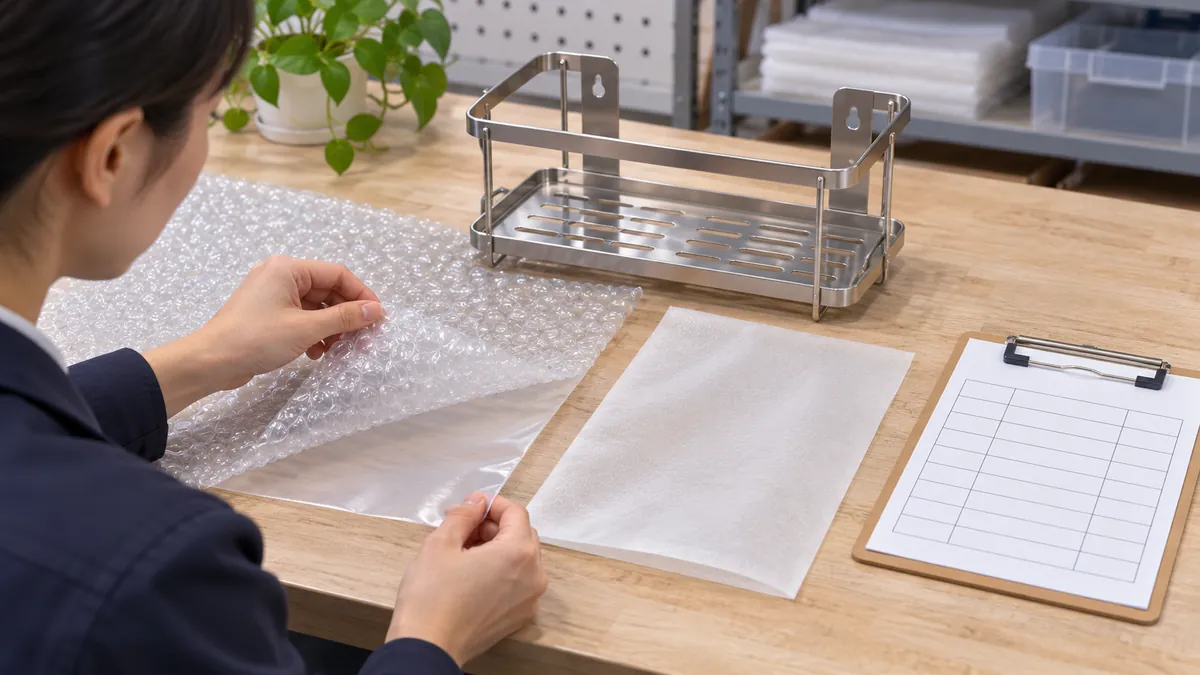
How Can a Packaging Instruction Make the Orientation Testable?
A RAJA business packing guide and a PackBros orientation guide both describe the conventional arrangement with bubbles facing toward the item and the smoother film outside. The RAJA discussion also calls out delicate or glossy surfaces where a separating layer may be appropriate. These are general packing explanations, not proof that direct contact is approved for a named coating or that a particular bubble film protects a product under transport conditions.
Write the pack-out as an explicit layer sequence: identified product face, named or approved interlayer if required, bubble film with its bubble side inward, then the smooth outer film and closure. State whether direct bubble contact is permitted for the exact finish. During sample approval, inspect the product after the agreed handling simulation and record any visible transfer or contact marks using the project’s acceptance criteria. Do not infer performance from “bubbles in” alone; bubble orientation describes one layer, while the complete package also depends on restraint, cushioning, carton design and the actual route.
For related protective layers and package development, see Koitor’s packaging insert design guide, and protective-film selection guide.
Frequently Asked Questions
Bubble wrap bubbles in or out: which way should it face?
For conventional one-sided bubble film covered by the cited packaging guides, place bubbles toward the wrapped item and the smooth face outward. Check the exact material instructions and the product surface.
Do the bubbles have to touch the product?
No. If the actual finish requires an approved barrier, place that interlayer between the product and the inward-facing bubbles. The bubbles still point inward but touch the barrier.
Should I put the smooth side against a delicate finish?
Do not assume that reversing the film is an approved solution. Use a product-specific packaging instruction and a suitable interlayer if the responsible parties require one.
Does bubble direction prevent scratches?
Direction alone does not prove a scratch-free result. Contact material, surface condition, movement and the complete pack-out matter. Review the actual product and sample.
Is bubble film enough to protect a metal bathroom accessory?
This article does not establish that. Restraint, sharp-edge protection, carton design and transport conditions are separate factors in the complete package.
Can I use the same wrap instruction for every finish?
Do not assume so. Identify the finish and contact surface for the actual product, and confirm the approved arrangement for that sample or project.
Is a bubble mailer the same as loose bubble wrap?
No. A bubble mailer has a different package construction from loose one-sided bubble film. Compare the actual material and package before applying an instruction.
Does adding an interlayer mean the bubbles should face outward?
No. In the described arrangement, the bubbles remain inward-facing but contact the approved interlayer rather than the product finish.
Orientation should be a controlled field in the packing instruction. It should never replace the actual sample approval.
Work With Koitor Hardware
Reviewing Packaging for a Metal Hardware Product?
Share the product drawing or sample, finish details and pack-out proposal. Koitor can discuss the confirmed bathroom and home-storage hardware scope and the project information needed to review packaging with the responsible supplier.
OEM / PRIVATE LABEL
Turn this sourcing guide into a product brief
Share your target product, size, finish, order quantity and packaging requirements. Your team receives a practical manufacturability review before quotation.


 English
 Español
 Português
 Français
 Deutsch
 العربية