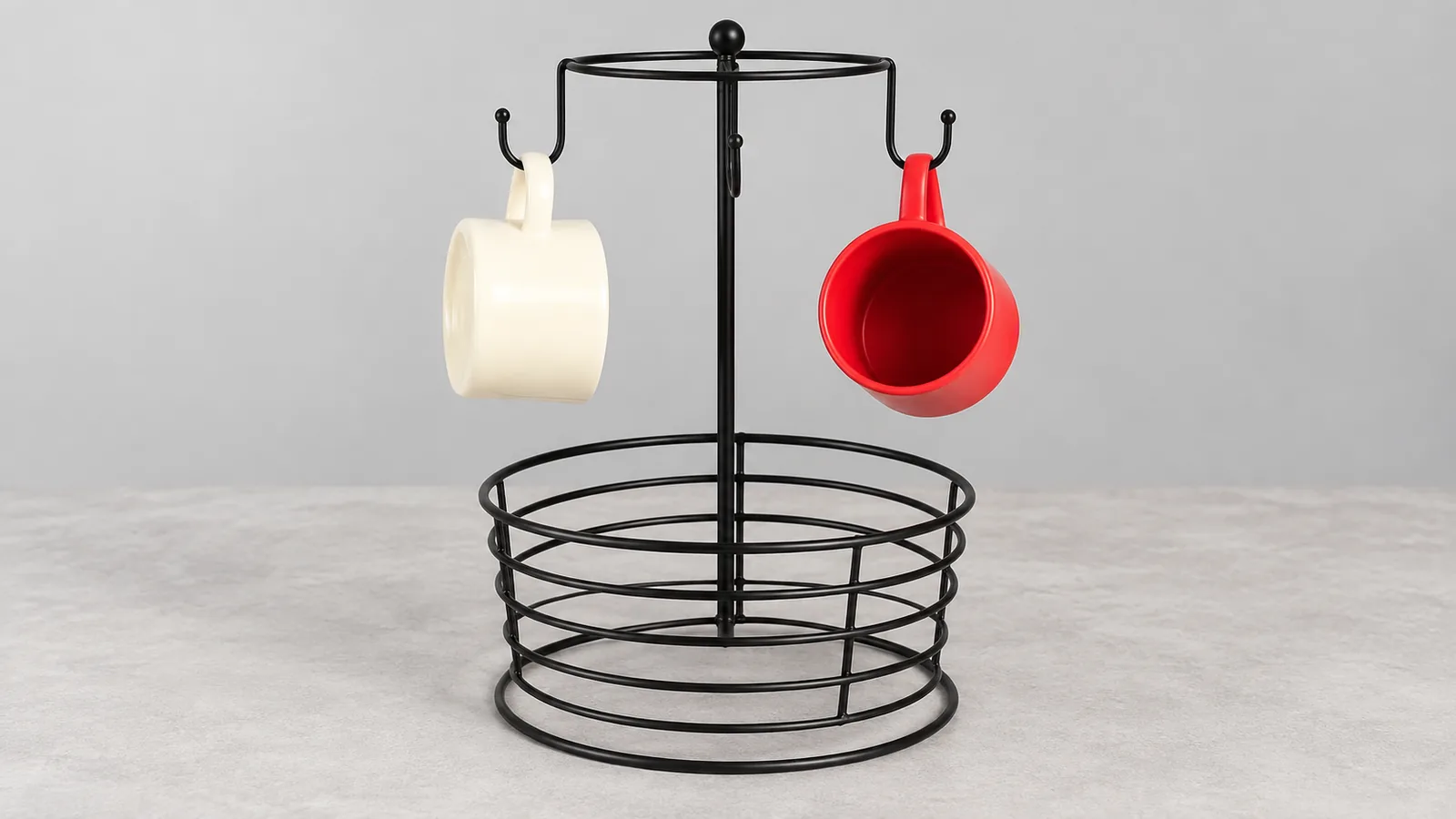
Metal coffee cup holder handle clearance should be approved using the complete movement of a real mug: approach the hook, pass the tip through the handle, settle the mug and remove it again. Check handle thickness and opening shape together with mug body clearance, neighboring positions and access around the stand. For an OEM order, record compatible mug samples against a finished holder revision rather than relying on advertised hook count. A holder with several hooks is not automatically compatible with the same number of every mug style.
This is a practical sourcing issue for home organization importers, retail category managers and private-label product developers. A product photograph can show a tidy display while hiding an awkward entry path or a handle that only fits at one angle. The supplier needs a defined mug assortment and repeatable approval tasks. This guide concerns freestanding metal holders with hooks; wall rails, under-shelf racks and inverted glass stands require their own interface review.
Which mug and handle measurements should buyers provide?
Provide actual mugs or dimension sheets that describe handle openings, handle thickness and the body envelope. Mug volume alone does not identify the space available for a metal hook or the clearance around a hanging cup.
The handle opening is the internal space through which a hook must pass. Its narrowest usable region can differ from its largest visible width. A handle may be broad near the top but narrow where it joins the body, or curved so that a straight approach is not possible. Record the profile rather than reducing every handle to a single rectangular measurement.
Handle thickness is a separate characteristic. The opening might admit the hook tip while the thick handle section cannot settle into the resting curve. A buyer therefore needs both the empty space and the solid section that occupies the hook. Include the handle’s relationship to the mug body because it affects approach angle and hanging orientation.
The body envelope includes the rim, base, widest outside diameter and any decoration that could contact the stand. A large body with a generous handle opening can still encounter the central post or a neighboring mug. Finished production mugs are preferable to a sketch when these relationships are important.
| Mug feature | Buyer input | Sample-review question |
|---|---|---|
| Internal handle profile | Side photograph and physical sample | Can the hook tip enter along a practical path? |
| Handle section thickness | Actual finished handle | Can it settle on the hook without wedging? |
| Body diameter and depth | Complete mug, including protrusions | Does the body clear the post and adjacent mugs? |
| Handle-to-body relationship | Whole mug profile | What orientation occurs when the mug hangs? |
| Rim and base position | Loaded sample photographs | Does either contact the upper ring or lower basket? |
| Assortment variation | Mandatory and excluded sample codes | Which positions are usable for the intended set? |
Primary manufacturer information illustrates why compatibility must be product-specific. Yamazaki’s Branch Glass & Mug Tree page supplies separate geometry and usage information for its own stand. That product has a different construction from a metal wire holder. Its dimensions, materials and ratings should not be transferred to Koitor Hardware or used as an acceptance rule for another design.
Give every mug a neutral sample identifier and state whether it must fit every hook or only designated positions. If the intended assortment includes unusually thick or decorative handles, include those samples before drawing approval. Excluding a difficult handle can be a valid commercial decision, but it must be reflected in the product description rather than discovered after shipment.
How should the hook entry path and resting contact be reviewed?
Review hook entry as a three-dimensional movement, then inspect the contact after the mug settles. A front-view gap can look adequate even when the hook tip, handle curve or nearby ring obstructs the actual approach.
The hook tip envelope is the outside shape of the end feature, including a ball tip or protective part where present. Do not measure only the wire stem if a larger tip must first pass through the handle. A finished tip should be reviewed in the orientation used by the customer, not positioned artificially to make one sample fit.
For each mandatory mug, identify a practical approach angle. The handle should pass around the intended hook without requiring the reviewer to force the ceramic against metal or deform the holder. If several rotations are needed, record that movement and ask whether it is reasonable for the intended retail product. A difficult path is not made acceptable simply because a skilled operator can reproduce it once.
After entry, examine where the handle rests. The contact should match the approved arrangement and not depend on wedging the handle between adjacent members. Note whether the mug hangs toward the post, rotates outward or rests with its body touching another part of the stand. These observations help distinguish hook geometry issues from mug assortment limitations.
Removal deserves its own check. A mug that hangs comfortably may have insufficient upward travel to clear a ring or neighboring cup. Observe the reverse path and whether the reviewer must move another mug first. The intended product instructions should agree with any accepted loading or removal sequence.
Metal coffee cup holder handle clearance is not a single universal gap to copy between models. Tip size, hook curve, handle profile and body position act together. Agree any numerical allowance against the actual finished samples and drawing locations. Do not invent a minimum clearance or a scratch-resistance promise without suitable product evidence.
Avoid correcting a fit complaint by instructing users to bend finished hooks with pliers. An informal alteration changes the controlled geometry and may affect the finish or other interfaces. For an OEM project, the appropriate route is a documented design review and revised sample, followed by repeat approval of the affected mugs.
How do adjacent mugs, the central post and base affect usable positions?
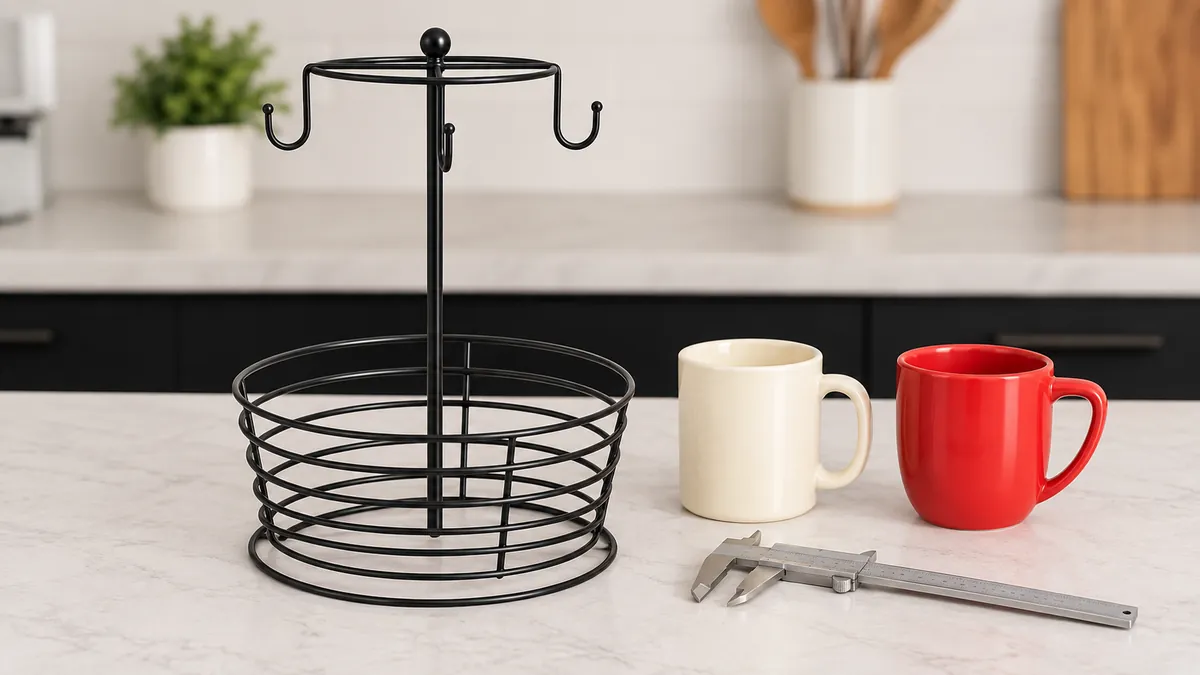
The usable layout depends on mug-to-mug and mug-to-frame clearance, not hook count alone. Approve a defined arrangement with the surrounding stand features present, including a lower basket where the design has one.
Begin with one mug at each relevant position and identify the hanging orientation. Check the central post, the upper ring, neighboring hooks and the lower basket rim. A body may clear the post at rest but contact it during insertion. Another body may hang lower and encounter the basket even though its handle fits well.
Next, fill the intended neighboring positions. Use the larger mandatory bodies beside smaller ones and compare the available hand path. A full display made from identical compact mugs does not demonstrate compatibility with a mixed retail assortment. Where specific positions are reserved for larger mugs, state the restriction clearly and review whether customers can understand it.
Consider the interaction with lower storage separately. If a holder includes a basket for another product, first approve mug access with that basket empty, then review the intended contents without assuming that any loose item is suitable. The holder’s additional storage function should not silently become a condition that prevents mugs from being removed.
Freestanding behavior must also be considered in the agreed sample plan. A photograph showing mugs evenly distributed does not establish acceptable behavior with only one side occupied. Buyers should specify relevant partial-loading arrangements and observations, using appropriate handling precautions and agreed review conditions. The results should not be converted into a general load rating without supporting evidence.
Keep the terminology clear in retail and sourcing documents. “Six hooks,” for example, would describe physical positions on a model with six confirmed hooks; it would not necessarily mean six oversized mugs can hang together. Use the actual approved hook count for the selected product, then separately describe the compatible assortment and usable arrangement.
For buyers developing OEM home storage hardware, a cup-by-position matrix provides a concise way to communicate this distinction. Rows identify mugs, columns identify positions, and notes record any neighboring conditions. The matrix should travel with the sample approval, not remain in an isolated design discussion.
What should a finished sample approval sequence include?
Identify the holder revision, review every mandatory mug individually, approve the mixed arrangement and record unresolved exceptions. Use the finished product rather than an unfinished wire structure for the final compatibility sign-off.
First, document sample identity and arrival condition. Photograph the stand without mugs so that the ring, hooks, post and base are visible. Record signs of distortion before deciding that a difficult handle indicates a design problem. A bent transport sample and an incorrectly specified hook require different corrective actions.
Second, perform the entry, resting and removal sequence for individual mugs. Use the same handling approach and agreed review surface. Describe interference by location and movement stage: tip entry, resting curve, body contact or upward removal. This makes the feedback actionable for the factory.
Third, review the intended mixed layout. Check neighboring body separation and the practical hand path at occupied positions. Include the defined partial-loading arrangements, but do not improvise a hazardous loading demonstration or present an informal observation as certified testing.
Fourth, compare observed geometry with the drawing. Mark the relevant tip envelope, hook opening, ring elevation and basket relationship. If a change is needed, identify which features will change and which must remain controlled. Repeat the affected fit observations on the revised finished sample rather than accepting a photograph of the alteration.
Finally, issue an approval record with compatible sample codes, restrictions, drawing revision, finish and packaging configuration. Keep styling approval and functional approval distinct. A color sample may satisfy appearance while the metal holder still requires a coffee mug handle fit review.
Common mistakes include selecting mugs solely by capacity, checking only empty hook spacing, forgetting the ball tip, inspecting entry but not removal and accepting all hooks as equivalent without observing the actual layout. Another mistake is turning one successful demonstration into a claim that the stand accepts all mugs. A defined approval matrix avoids that unsupported generalization.
How can OEM drawing, finishing and packaging review preserve cup fit?
Control the finished hook geometry and its relationship to the post, ring and basket through the drawing and approved sample. Recheck compatibility after changes to wire size, bends, joints, end features or finish that affect those interfaces.
Koitor Hardware is a family-owned custom metal hardware factory focused on bathroom and home storage hardware. Its approved processes include bending, welding, polishing, surface finishing, assembly and packaging preparation. Direct factory communication can help buyers discuss a wire cup holder OEM design in terms of manufacturability and sample requirements, rather than relying on decorative sketches alone.
A practical drawing identifies where a dimension is measured. “Hook width” is ambiguous unless the buyer and factory know whether it means the outside curve, clear entry space or distance between neighboring hooks. Include a view that explains the intended mug path and connect each requirement to the approved sample.
Finish review should include the actual contact regions. The visible color is only one aspect of the sample; local surface condition and the finished tip shape also matter to fit. Do not assume that powder coating, a plated appearance or another finish automatically provides a verified non-scratch property. Such claims need suitable project evidence and a clearly defined mug surface.
Packaging should protect the geometry without pressing thin hooks toward the central post or flattening the ring. Review restraint points and unpacking access, then compare the arrival sample with its pre-pack condition. Photograph and record any distortion rather than broadening every hook to compensate for a shipping issue.
Koitor’s custom metal storage rack manufacturing service can discuss the structure, finish and packaging as one sample-development brief. MOQ can start from 100 pieces depending on the product, finish and packaging. Samples usually take 5–7 working days after details are confirmed, with bulk production usually taking 4–6 weeks depending on the project. Confirm the particular schedule after fit-critical requirements are settled.
What should buyers include in a cup-holder quotation checklist?
Provide the intended mugs, holder architecture and acceptance observations before asking for a production quotation. A complete brief should distinguish required compatibility from optional display styling.
- Identify mandatory, optional and excluded mug sample codes.
- Supply complete mug profiles, including handle openings and thickness.
- Include body dimensions and any raised or decorative features.
- Describe the preferred entry direction and practical removal path.
- Mark hook tip shape, resting curve and clear dimension locations.
- Define neighboring positions and the mixed loading arrangement.
- Confirm the central post, ring and lower basket relationships.
- State the counter footprint and any overhead access restriction.
- Agree partial-loading observations and separate performance evidence requirements.
- Specify material preference, finish appearance and packaging concept.
- Confirm the drawing revision, quantity, sample schedule and approval owner.
- Align retail capacity wording with the compatible arrangement actually approved.
Ask the supplier to identify assumptions in its quotation. If only photographs are available, state which sample checks remain open. This keeps an estimated design proposal from becoming a fully approved production specification and makes later revisions easier to trace.
Frequently asked questions about metal cup-holder clearance
Metal coffee cup holder handle clearance should be approved for particular mugs and a particular finished stand. The following answers help buyers avoid universal fit assumptions.
Does a larger handle opening always make a mug compatible?
No. Handle thickness, curve, hook tip shape and body position also matter. A large opening may admit the tip but leave the mug contacting the post or lower basket. Review the complete entry, resting and removal sequence.
Can the wire diameter alone establish hook fit?
No. A ball tip or other end feature may be wider than the wire stem, and the hook curve controls where the handle settles. Check the finished outside envelope at the actual entry points.
Should buyers check all positions using one mug?
One mug is useful for an initial comparison, but it does not represent a mixed assortment. Review mandatory handle shapes and body sizes across relevant positions and neighboring conditions. Record any position-specific restriction.
Can a factory adjust hooks without a new sample review?
Fit-critical geometry changes should trigger review of the affected mugs and loading arrangements. A revised drawing and finished sample are preferable to an informal adjustment with no revision record.
Is a product photograph evidence of a safe load limit?
No. A styled display demonstrates appearance, not a verified load rating or all partial-loading conditions. Define performance requirements separately and obtain suitable product-specific evidence before making a claim.
How can buyers begin a mug-fit project with Koitor Hardware?
Send representative mugs and the intended holder concept so the sample discussion starts with the actual interface. Koitor can review the metal structure and small-batch development options before a production quotation.
Review Mug Handle Fit Before Your OEM Order
Send Koitor mug samples or profile drawings, your holder concept, finish preference, quantity and packaging idea. Our factory team can discuss hook access, manufacturability and sample options for your private-label storage project.
OEM / PRIVATE LABEL
Turn this sourcing guide into a product brief
Share your target product, size, finish, order quantity and packaging requirements. Your team receives a practical manufacturability review before quotation.

 English
  Español
  Português
  Français
  Deutsch
  العربية