
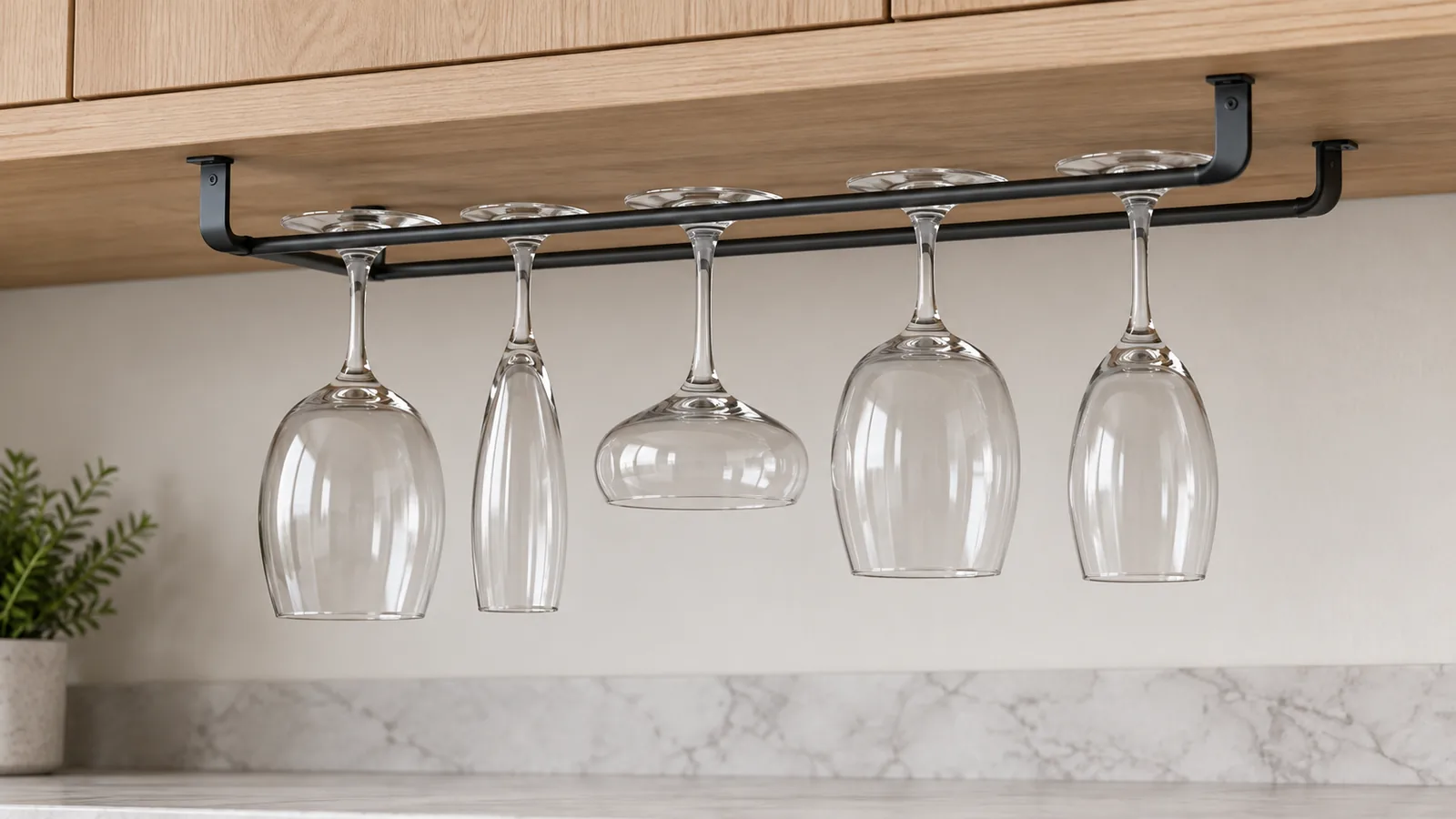
Under cabinet stemware rack rail spacing should be set from the buyer’s actual glass profiles, not copied from a generic rack photo or treated as one universal dimension. For an OEM project, record the glass foot, stem and bowl envelopes, then check the rail opening, loading direction and cabinet clearance on a representative sample. That turns “will these glasses fit?” into a measurable drawing and approval task.
What does under-cabinet rail spacing control?
Rail spacing controls whether a glass foot can enter and remain supported while its stem passes between the rails and its bowl hangs below without interference. The gap is only one part of fit: the holder also needs an entry path, adequate rail engagement, enough cabinet drop for the bowl, and a practical way to slide the glass into and out of position.
In a common two-rail concept, the rails support the foot near its outer area while the narrower stem occupies the gap. The foot must not pass through the opening, and the stem must not bind. At the same time, the shape of the foot varies: some glass bases are nearly flat and wide; others have a raised center, a pronounced bevel, or a stem-to-foot transition that changes the contact area. A drawing that gives only one rail-to-rail distance may miss that geometry.
The buyer should treat under cabinet stemware rack rail spacing as one part of a full fit envelope, not as a stand-alone number. Think of fit as three linked envelopes:
| Envelope | What to measure | Why the buyer needs it |
|---|---|---|
| Foot support | Maximum foot diameter, thickness and underside shape | Confirms that the foot is retained on the rails |
| Stem passage | Stem diameter and any flare near the foot | Checks that the stem can slide between the rails |
| Bowl and cabinet | Bowl diameter, overall glass height and cabinet underside | Checks adjacent glass clearance and hanging space |
A commercial glass-rack guide from Carlisle uses the largest glass diameter to select rack compartments and separately considers glass height. That is not a direct dimension standard for an under-cabinet holder, but it reinforces the useful principle: size the product against the largest or most difficult item in the intended assortment, rather than a nominal average. See the Carlisle glass-rack sizing guide.
Which glass profiles should buyers measure before requesting a quote?
Buyers should measure the assortment that creates the hardest fit, not only the most familiar wine glass. A private-label set may include a narrow flute, a wide-bowled glass, a short-stem cocktail glass and a glass with a broad foot. Those profiles can demand different rail spacing or usable length even when a product listing calls them all stemware.
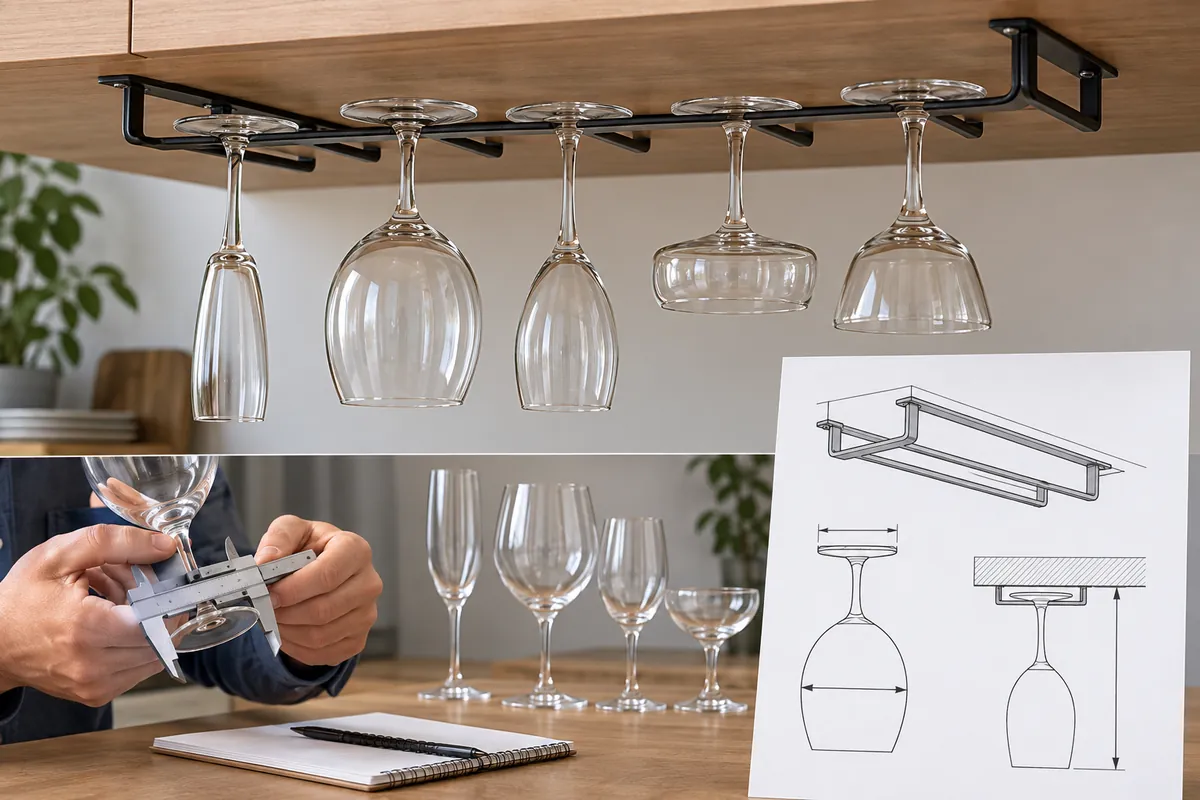
Start with a product matrix. Identify each glass family and record the maximum foot diameter, stem diameter immediately above the foot, any foot-to-stem flare, maximum bowl diameter and total height. Note whether the glass is straight, tapered or irregular. Measurements should use the same unit and datum across every sample. If the product is intended for a limited assortment, say so explicitly; if it is marketed for mixed stemware, select several extremes for fit review.
Do not rely only on online product descriptions. Published dimensions may refer to the bowl, rim, height or packaging, and may be rounded. Where feasible, use physical samples. If glass samples are not available during quotation, ask the buyer for a drawing or a dimensioned profile and label the status as provisional until the real assortment is checked.
Useful measurement practices include:
- Measure the largest foot across its widest points, including any decorative edge.
- Measure the stem at the narrowest passage and at the transition into the foot.
- Record bowl width at its widest point and the total hanging height.
- Note fragile coatings, etched patterns or decorative details that should not rub against the rail.
- Include more than one glass from the assortment if manufacturing variation is expected.
- Keep sample identity and revision with the measurement sheet.
A single product listing may state its own rail gap and maximum foot diameter; those are attributes of that model, not universal specifications. For example, one under-cabinet holder seller describes a 30 mm gap and a particular base-size limit. Treat that as a comparison point only, not a ready-made Koitor or buyer specification. The example holder description illustrates why buyers should distinguish a seller’s stated envelope from their own assortment.
How should a buyer translate glass measurements into a drawing?
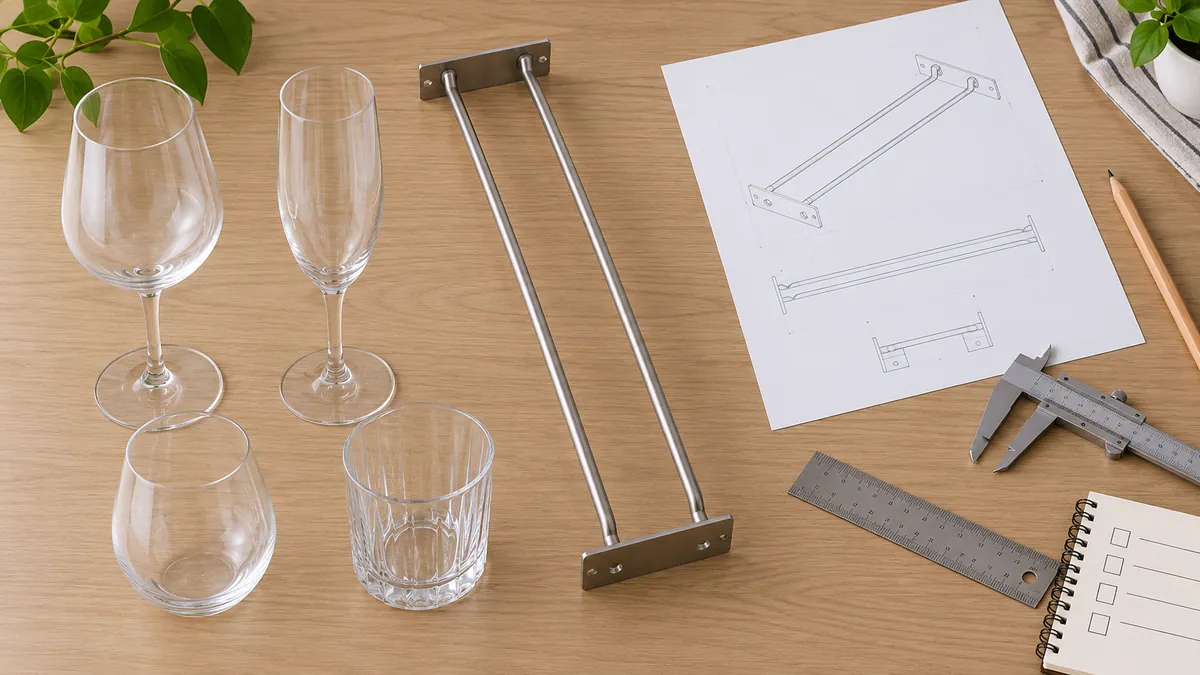
A buyer’s drawing should show the gap, rail section, rail parallelism, opening direction, support length and installation envelope together. It should also identify the glass profiles used for review. “Fits wine glasses” is not an engineering instruction; a controlled drawing explains which glasses, where they contact the rails, and what dimensions the supplier is expected to hold.
The drawing should mark the clear distance between the two rails and define where that distance is measured. If rails are not perfectly parallel by design, show dimensions at relevant points. Add the contact geometry: rail diameter or width, edge radius or smooth transition, stop location and usable support length. Avoid asking for a value without agreeing whether it refers to the inside faces, centerlines or another datum.
Show the installed orientation and the user’s loading path. A rack may have an open end for sliding glasses into place, an end stop, or a mounting shape that leaves one end more accessible. The drawing should specify which side faces the user and how far the holder projects below the cabinet. Add the cabinet underside thickness and any nearby trim or light fixture that affects the mounting footprint.
A useful specification table can separate confirmed inputs from items still requiring sample approval:
| Drawing field | Buyer input | Approval question |
|---|---|---|
| Intended glass set | Named sample IDs or controlled profile drawings | Are all target families represented? |
| Clear rail gap | Dimension and measurement datum | Does the smallest stem pass while the foot remains retained? |
| Support length | Usable rail length, excluding end features | Can the planned glass count be loaded without collision? |
| Cabinet envelope | Available depth, thickness and nearby obstructions | Do fasteners and rack clear the real installation area? |
| Finish/contact detail | Buyer-selected visual and contact requirements | Are edges and contact points acceptable on real glass samples? |
The table should not invent tolerance values. The buyer and supplier should agree tolerances based on drawing capability, product function and sample measurement method. Any later change to glass style, rail geometry or mounting pattern should be recorded as a revision, not handled as an informal photo message.
How do cabinet clearance and installation change the fit decision?
A rack can match glass dimensions and still fail in use if cabinet clearance or installation access is ignored. Buyers should review the installed glass envelope below the cabinet, the rack’s projection and mounting footprint, the front-to-back loading path, and any obstruction such as a door frame, cornice, under-cabinet light or adjacent appliance.
Measure cabinet depth and underside thickness at the intended position. Confirm that the chosen fastener location has suitable material behind it; the product supplier should not assume that all cabinets have identical construction. If the buyer’s product is meant to be mounted under different shelves, distinguish the mounting variants or state which substrate and thickness range are in scope. Do not let a photo substitute for a dimensioned underside view.
Check the complete hanging envelope using the tallest glass and the widest bowl. A wide bowl can touch a backsplash or neighboring object even when the foot and stem fit correctly. Consider how glasses are removed: the user may need to slide the foot along the rails before lowering it. A nearby cabinet side or wall can block that motion. A sample review should therefore include a hand-access check as well as a stationary fit check.
Packaging also belongs in the design conversation. Long rails can be susceptible to abrasion or distortion if loose in a carton; projecting mounting plates can rub against other parts. Buyers should state whether protective separators, a bag, individual wrapping, or a formed insert is needed, then approve the actual pack configuration. Do not promise that packaging eliminates damage; inspect a representative packed sample and confirm the retailer’s handling needs.
How should importers review the first sample?
A first sample should be evaluated with the target glasses and a representative cabinet mock-up or installation surface. Buyers should record the sample revision, glass IDs, measurements taken, installation orientation and the result for each fit question. “Looks fine” is difficult to reproduce across revisions; a brief acceptance sheet supports clearer communication with an OEM factory.
A practical sequence is:
- Confirm the sample matches the current drawing revision and finish request.
- Install it using the specified orientation and mounting points on a representative surface.
- Load the largest-foot and widest-bowl glasses first, then test the narrowest stem.
- Slide each glass through the intended entry path and remove it using a normal hand motion.
- Check whether adjacent glasses touch when the planned arrangement is loaded.
- Photograph contact points and note any snag, wobble, obstruction or unwanted interference.
- Record accepted changes and request a revised sample when geometry changes materially.
A gauge can help when physical glasses are unavailable, but it must reproduce the relevant shape and be linked to a revision. A simple circular plate may check foot diameter but cannot show a flared stem, bevel or bowl interference. Use it only for the dimensions it represents, then complete a real-glass check before final approval where practical.
For repeat orders, preserve the approved sample or its measurement record and link it to the purchase specification. If the buyer later changes the assortment, do not assume the old rack still fits. Recheck the new maximum and minimum profiles and decide whether the existing design remains appropriate. Koitor Hardware’s OEM process can begin from a buyer drawing or physical sample; the buyer should provide the glass family, target installation envelope and revision-controlled acceptance notes before quoting or sample changes. See OEM home storage hardware development.
What common sourcing mistakes create fit problems?
The most common mistake is approving one attractive glass and assuming the whole assortment will work. The least favorable foot, narrowest stem, widest bowl or tallest glass may be a different model. Another mistake is copying a competitor’s published distance without confirming its measurement datum or product shape. A dimension is useful only when the buyer knows what surfaces define it.
Other avoidable misses include:
- Specifying only overall rack length while omitting the usable support length.
- Ignoring how the glass enters and exits the rail opening.
- Checking the foot but not the bowl, cabinet drop or neighboring glass spacing.
- Using a photo instead of an underside drawing for mounting and cabinet clearance.
- Changing glass samples after approval without reopening the fit review.
- Approving a finish visually but not checking whether the contact edges are smooth and consistent.
- Treating a seller’s maximum glass dimension as a universal fit guarantee.
- Leaving packaging protection and drawing revision out of the approval record.
These omissions do not prove a product is defective; they create ambiguity that can lead to a sample mismatch or difficult repeat-order discussion. A short, controlled fit matrix is often more useful than adding speculative dimensions. It tells both parties which real products were checked, which questions remain open, and which revision was approved.
For a buyer managing several product families, keep the stemware-holder specification separate from bottle-rack spacing or mug-hook clearance. These products may all belong to kitchen storage, but each has different support contacts, loading paths and fit variables. Clear topic boundaries also help internal product teams route drawings to the right reviewer.
What should the buyer checklist include?
Before requesting a quotation, prepare the inputs below. If an item is not yet known, mark it as open rather than letting the supplier guess. A clear RFQ lets the factory identify what can be quoted from the current drawing and what must wait for samples or clarification.
- Primary and secondary glass families, with sample IDs or profile drawings.
- Maximum foot diameter and underside shape.
- Stem diameter and any foot transition or flare.
- Maximum bowl diameter and glass height.
- Target quantity and intended glass arrangement.
- Required rail gap with a stated measurement datum.
- Usable rail length, open end or stop details, and loading direction.
- Cabinet depth, underside thickness and nearby obstructions.
- Installation method and intended mounting surface.
- Finish appearance, contact-edge expectations and packing requirements.
- Sample count, approval owner and revision-control method.
- Any target-market instructions or documentation supplied by the buyer.
The sample checklist should distinguish product fit from broader compliance or performance questions. Do not add unsupported claims about glass protection, carrying capacity or durability. If those claims are commercially necessary, define a separate evidence plan and obtain appropriate project-specific validation before using them in packaging or marketing.
Frequently asked questions
Can under cabinet stemware rack rail spacing use one standard number?
No. Rail spacing depends on the actual foot and stem profiles, rail shape and loading approach. A buyer should specify the glass assortment and approve a sample rather than copy one seller’s dimension.
Should the buyer measure the glass foot or the bowl?
Both, plus the stem and overall height. The foot determines support and retention, the stem passes through the opening, and the bowl affects clearance and neighboring-glass contact.
Can a product page’s maximum base diameter be used as the design target?
Only if the buyer’s actual assortment and the product’s measurement definition match. Treat published limits as model-specific, and confirm them against samples or dimensioned drawings.
What if the glass samples are not available during the first quotation?
Provide controlled dimensional profiles and label assumptions as provisional. Reopen the fit gate when actual samples arrive, especially for decorated or unusually shaped glasses.
What should change trigger a new sample review?
Changes to glass family, rail gap, rail section, support length, end stop, mounting footprint or cabinet envelope should be assessed. Record the approved revision so repeat orders use the same basis.
Review Your Stemware Rack Sample
Share your glass profiles, installation envelope or current drawing with Koitor Hardware to discuss an OEM sample review.
OEM / PRIVATE LABEL
Turn this sourcing guide into a product brief
Share your target product, size, finish, order quantity and packaging requirements. Your team receives a practical manufacturability review before quotation.
 English
  Español
  Português
  Français
  Deutsch
  العربية