
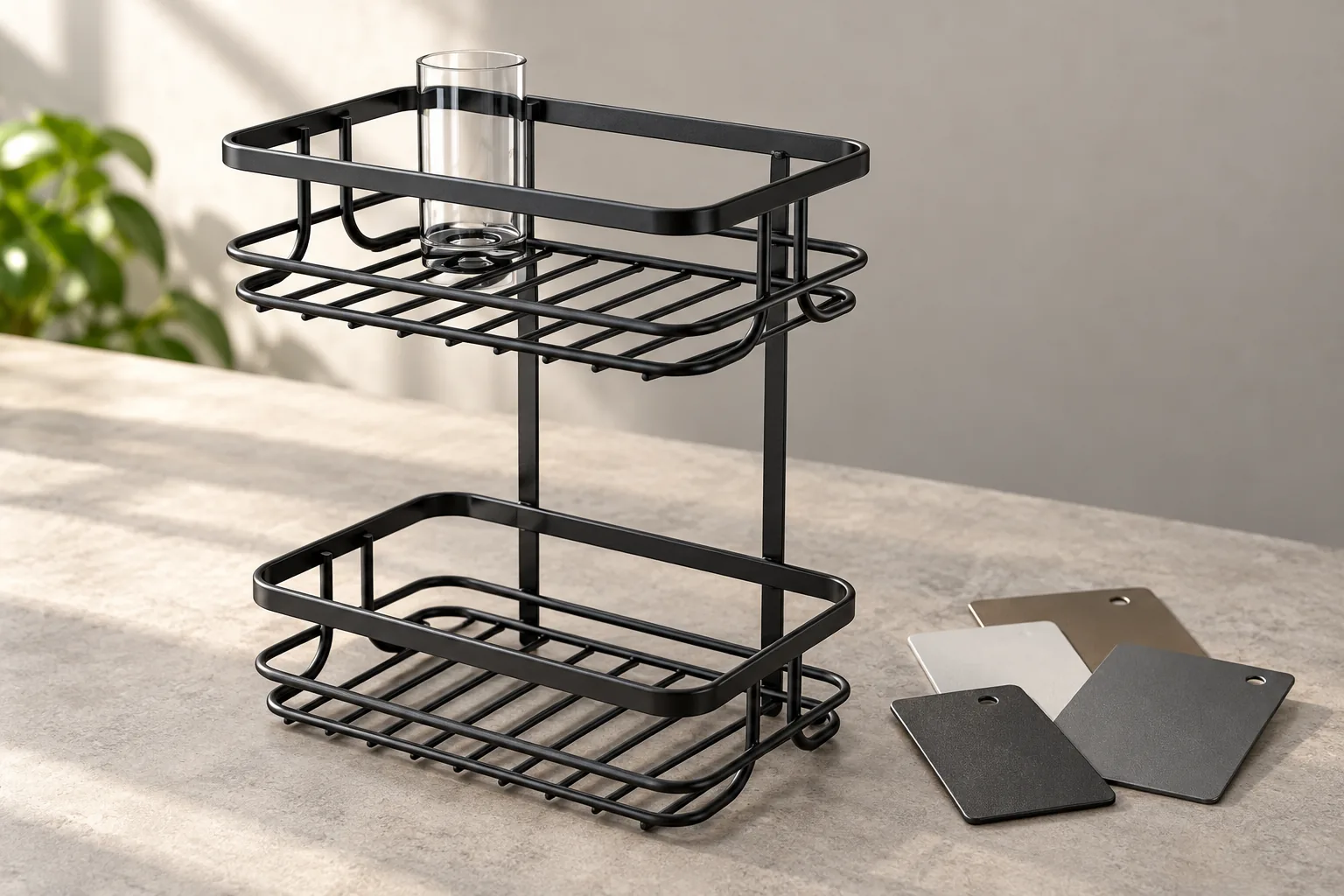
Powder coating polyester superdurable weathering specification should be tied to the product’s real exposure, substrate, pretreatment, cure and appearance requirements—not selected from a resin label alone. For a bathroom or home-storage hardware buyer, the practical question is whether the proposed coating system is suitable for the intended environment and whether the supplier can show relevant evidence on a representative finished sample. “Superdurable” is a coating-family or product description, not a universal service-life promise for every steel basket, weld, edge or bathroom installation.
Start with the environment, not the coating adjective
Before comparing powder products, describe where the finished hardware will be used. “Bathroom” can mean a dry guest washroom, a frequently used family shower, a humid room with limited ventilation, or a product placed near a window or in a covered outdoor area. Those conditions do not create the same exposure. Cleaning chemicals, water retention, ventilation, condensation, handling and distance from coastal air can also change the buyer’s priorities.
A specification should distinguish expected use from a marketing description. Ask the product team to record the target market, installation location, cleaning routine, expected appearance, and any known exposure to direct sunlight or persistent moisture. If the rack is strictly an indoor bathroom accessory, the buyer should not automatically pay for an exterior architectural coating grade. If the product may be installed in a sun-exposed or semi-outdoor location, the coating supplier’s weathering evidence becomes more relevant—but it still needs to be connected to the selected substrate and complete coating system.
This distinction prevents two common sourcing errors. The first is choosing a premium-sounding resin without identifying the actual exposure. The second is treating an outdoor weathering result as proof against corrosion at welds, cut ends or damaged edges. Weathering and corrosion are related finish questions, but they are not interchangeable acceptance claims.
What “superdurable” can and cannot tell a buyer
Coating suppliers may use terms such as durable, superdurable, weather-resistant or exterior grade to distinguish formulations and intended applications. The exact meaning depends on the supplier’s product family and supporting technical documentation. The word alone does not tell an importer which test method was used, on what substrate the coating was tested, how the sample was pretreated, what film build was applied, or which appearance change counted as acceptable.
A technical data sheet is more useful than a label because it connects a product to stated conditions. For example, an IGP powder-coating data sheet identifies a particular product and reports film-property and weathering information under specified methods. That is evidence for that coating formulation under the listed conditions—not a transferable guarantee for every bathroom rack or every production line. Buyers should compare the exact product code and current document revision, then ask whether the proposed use and substrate match the evidence. See the IGP-HWFclassic technical data sheet as an example of product-specific documentation.
The same caution applies to accelerated weathering methods. ASTM’s weathering committee references different practices, including fluorescent UV/condensation and xenon-arc approaches. A reported result from one method should not be casually converted into years of field service or compared directly with a result from another method. The buyer should request the method, specimen preparation, exposure conditions, evaluation criteria and report scope—not just a headline number. ASTM’s Committee G03 material is a useful starting point for understanding the variety of weathering practices.
Compare coating choices and the complete finish system
Powder is only one part of the finished surface. A sourcing review should identify the base material and surface condition, the pretreatment route, coating application, cure conditions and final appearance. If any of these inputs changes between the tested sample and the production hardware, the relevance of the evidence may change too.
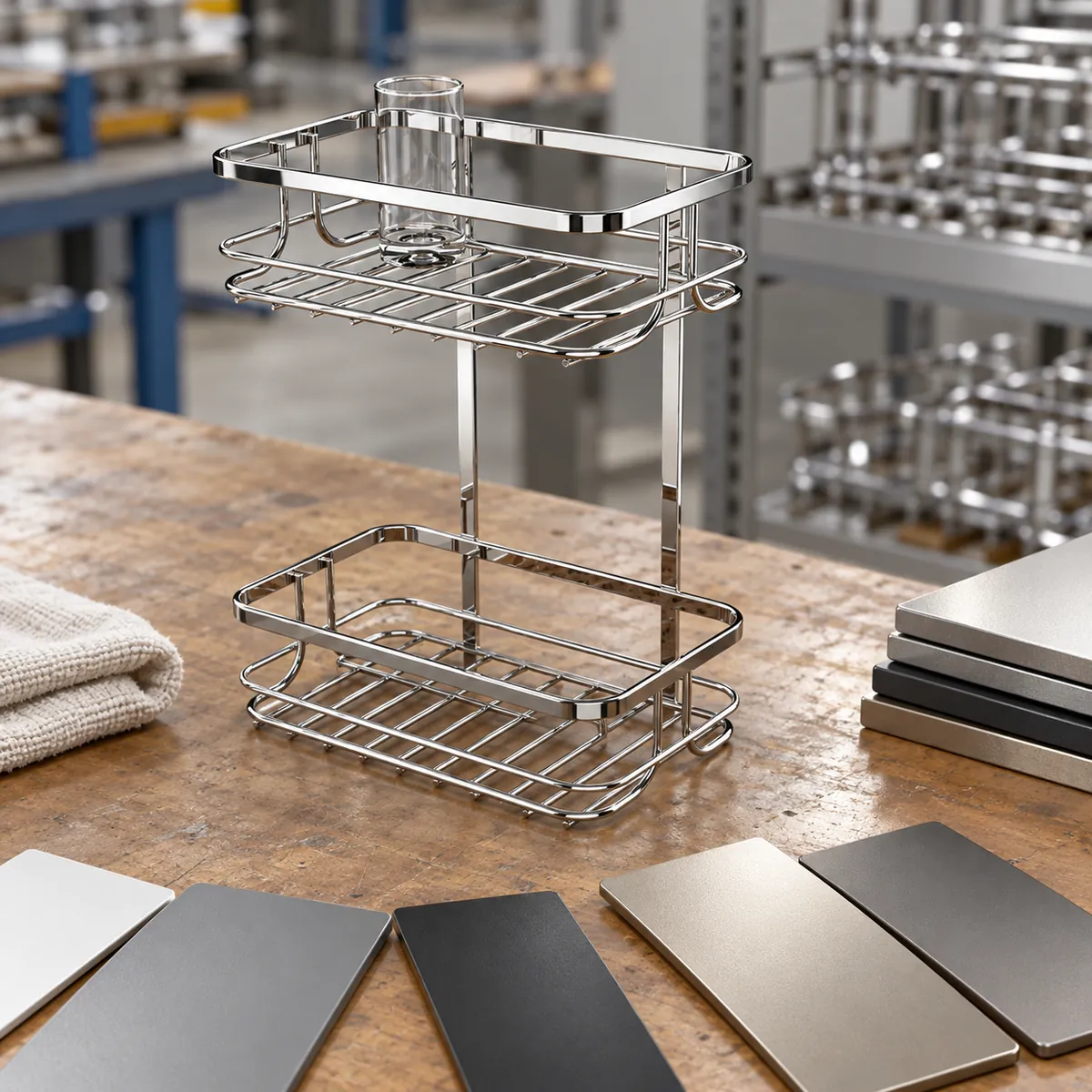
For a metal storage basket, the geometry creates practical differences across the part. Flat or accessible surfaces, tight wire intersections, weld zones, inside corners and cut ends do not necessarily receive or retain coating in the same way. The buyer should therefore ask the supplier to identify the representative product geometry used for sample approval. A flat coupon can help compare color or appearance, but it cannot by itself show every edge and joint on a formed basket.
Pretreatment also belongs in the discussion. Oil, oxide, handling residue or inconsistent preparation can affect the interface between metal and coating. A coating supplier’s data sheet may state a recommended substrate and pretreatment, but the hardware buyer still needs to confirm that the selected finishing route is appropriate for the actual component. Do not infer that a result on one alloy or test panel proves identical performance on a welded steel rack.
Cure is another controlled input. Buyers should ask how the supplier confirms that the part—not only the oven air—reaches the coating product’s required cure conditions. The answer should describe the supplier’s process control and records without inventing a universal time or temperature. If the supplier changes the coating product, pretreatment, line or cure profile after the approved sample, the change should be reviewed before mass production.
Compare resin families against the stated exposure
A buyer may be offered standard polyester, superdurable polyester, an epoxy-polyester hybrid or another system. These labels are useful for opening a technical discussion, but they do not replace a use-case review. Ask the supplier to explain why the proposed coating is being offered for this product, what exposure it is intended to address, and what evidence supports that recommendation.
For outdoor-facing applications, weathering performance and color/gloss retention may receive more attention. For indoor hardware, appearance, cleanability, adhesion and resistance to the actual cleaning environment may matter more. A hybrid system may be appropriate for some indoor uses, while a particular polyester formulation may be selected for weather exposure. These are conditional comparisons, not universal rules: the product code, substrate, pretreatment, application and buyer acceptance criteria determine whether the choice fits.
Avoid approving solely from a color card. A color card may show a shade under one viewing condition; it does not demonstrate coating coverage at welds, surface texture on formed wire, appearance under different lighting, or consistency across a production batch. If the finish is metallic, textured or otherwise visually sensitive, define how the buyer and supplier will compare representative production samples.
Define evidence, sample and RFQ requirements
Ask the supplier or coater to provide a concise evidence package before sample approval:
| Review item | What the buyer should confirm | Why it matters |
|---|---|---|
| Product identity | Exact powder product name, code and current data-sheet revision | Similar labels can refer to different formulations |
| Intended exposure | Indoor bathroom, humid room, sun exposure or other defined use | Determines which evidence is relevant |
| Test specimen | Substrate, pretreatment, geometry and coating application | Shows whether the evidence resembles the purchased part |
| Weathering method | Method, exposure conditions and evaluation criteria | Prevents unlike results from being compared as equivalent |
| Appearance target | Color, gloss, texture and viewing/lighting conditions | Makes sample approval repeatable |
| Production control | How coating product, pretreatment and cure changes are recorded | Protects repeat orders and change control |
| Finished sample | Representative basket or rack with welds, edges and formed sections | A flat coupon alone does not represent the full product |
The table is a buyer review framework, not a claim that Koitor performs accredited weathering tests. If a specific laboratory or certification is required, the buyer should define that requirement and verify the provider’s scope directly.
Approve a representative sample and interpret weathering evidence
The approved sample should match the intended material, geometry, finish, mounting details and packaging as closely as practical. Record the drawing revision, coating product identity if available, color/texture reference, sample date and any approved deviations. Keep one accepted sample or a clearly identified reference set so the next production run can be compared against the same baseline.
Look at the places where visual and functional differences are most likely to matter: weld intersections, inside corners, cut ends, basket edges, mounting interfaces and contact points. Check whether the finish changes the fit of parts that assemble together. If the product includes screws, clips or other hardware, confirm that the selected finish and assembly process do not create an unplanned fit issue.
The sample review is also the right time to identify a change-control trigger. A different powder code, pretreatment supplier, base-metal grade, coating line or cure process may require a documented review. Not every change requires a full requalification, but the buyer and supplier should agree which changes need a new sample or supporting evidence. That decision is better made before the first large order than after a visible mismatch appears.
Do not turn accelerated weathering into a service-life promise
A weathering test is a controlled comparison tool, not a direct clock for the customer’s bathroom. Exposure devices use specified conditions and cycles; actual products experience a different combination of light, moisture, temperature, cleaning and handling. A test report may support a choice between coating options when the product, substrate and evaluation criteria are understood. It does not automatically predict a fixed number of years in an uncontrolled installation.
The same limit applies to corrosion claims. Weathering evidence may address color or gloss change, while corrosion performance can depend on pretreatment, substrate, edges, welds, damage and the test method used. Ask the supplier which property the evidence covers and which it does not. If the buyer needs both appearance retention and corrosion-related evidence, specify those as separate questions and review the relevant methods separately.
For a private-label program, this distinction protects both product planning and marketing. Avoid phrases such as “never fades” or “rust-proof.” Instead, describe the specified coating system, the intended use conditions, the approved sample and the evidence available for the project. Any public performance statement should be limited to what the supporting documentation actually establishes.
Put coating questions in the RFQ
A practical RFQ does not need an oversized technical specification, but it should give suppliers enough information to quote the same requirement. Include the target product drawing or physical sample, base-material expectations if known, target finish, intended use environment, color or texture references, packaging needs and order volume. Ask the supplier to identify any assumptions rather than silently choosing them.
For the coating section, request the proposed powder product and data-sheet revision, intended substrate and pretreatment, evidence relevant to the use environment, sample approval plan and change-control approach. If the supplier cannot provide a particular test report, record that as an open item and decide whether it is actually required. Do not substitute a general certificate or unrelated test result for the evidence needed to answer the buyer’s specific question.
Koitor’s approved role is practical OEM manufacturing and sample-based development for bathroom and home storage hardware. A buyer can share a drawing or physical sample to discuss structure, finish and packaging needs before quotation. See Koitor’s OEM home-storage hardware manufacturing information for the product scope. The exact coating product, substrate and testing scope still need project-specific confirmation with the relevant supplier or coater.

Questions buyers commonly ask
Is superdurable polyester automatically right for a bathroom rack?
No. The buyer should first describe the use environment and appearance target, then compare the exact coating product and relevant evidence. A premium label alone does not show that the system suits every substrate, pretreatment or bathroom condition.
Can a flat coating coupon approve a wire basket?
It can help assess color, gloss or texture, but it does not represent every weld, edge, corner or formed section. Use a representative finished sample when geometry and coverage matter.
Do accelerated weathering hours equal years of outdoor or bathroom use?
Not directly. A laboratory exposure method is a defined test condition. Do not convert it to a guaranteed service-life statement unless a qualified source supports that interpretation for the exact system and use.
Should buyers request both weathering and corrosion evidence?
Only when both are relevant to the intended use and product requirements. They answer different questions. Define what property matters, which method is acceptable and how the result will be interpreted.
What should trigger a new coating review?
A change to coating identity, substrate, pretreatment, cure route, product geometry or appearance requirement may affect the approved baseline. Agree the review triggers with the supplier before repeat production.
Buyer takeaway:
A reliable powder coating polyester superdurable weathering specification connects the coating product to the actual hardware, use environment, substrate and approval evidence. Buyers should request the exact product documentation, understand the limits of each test, approve a representative finished sample and record the changes that require renewed review. That creates a clearer sourcing decision without treating a coating label as a guarantee.
The final powder coating polyester superdurable weathering specification should therefore be stored with the approved drawing and sample record, not reduced to a resin-family name on a purchase order.
Work With Koitor Hardware
Need Help With a Custom Bathroom Hardware Project?
Send Koitor your drawing, sample, finish requirement or packaging idea. Our team can review the structure and manufacturability of a bathroom or home-storage hardware project before quotation. Coating products and test requirements are confirmed project by project.
OEM / PRIVATE LABEL
Turn this sourcing guide into a product brief
Share your target product, size, finish, order quantity and packaging requirements. Your team receives a practical manufacturability review before quotation.

 English
 Español
 Português
 Français
 Deutsch
 العربية