
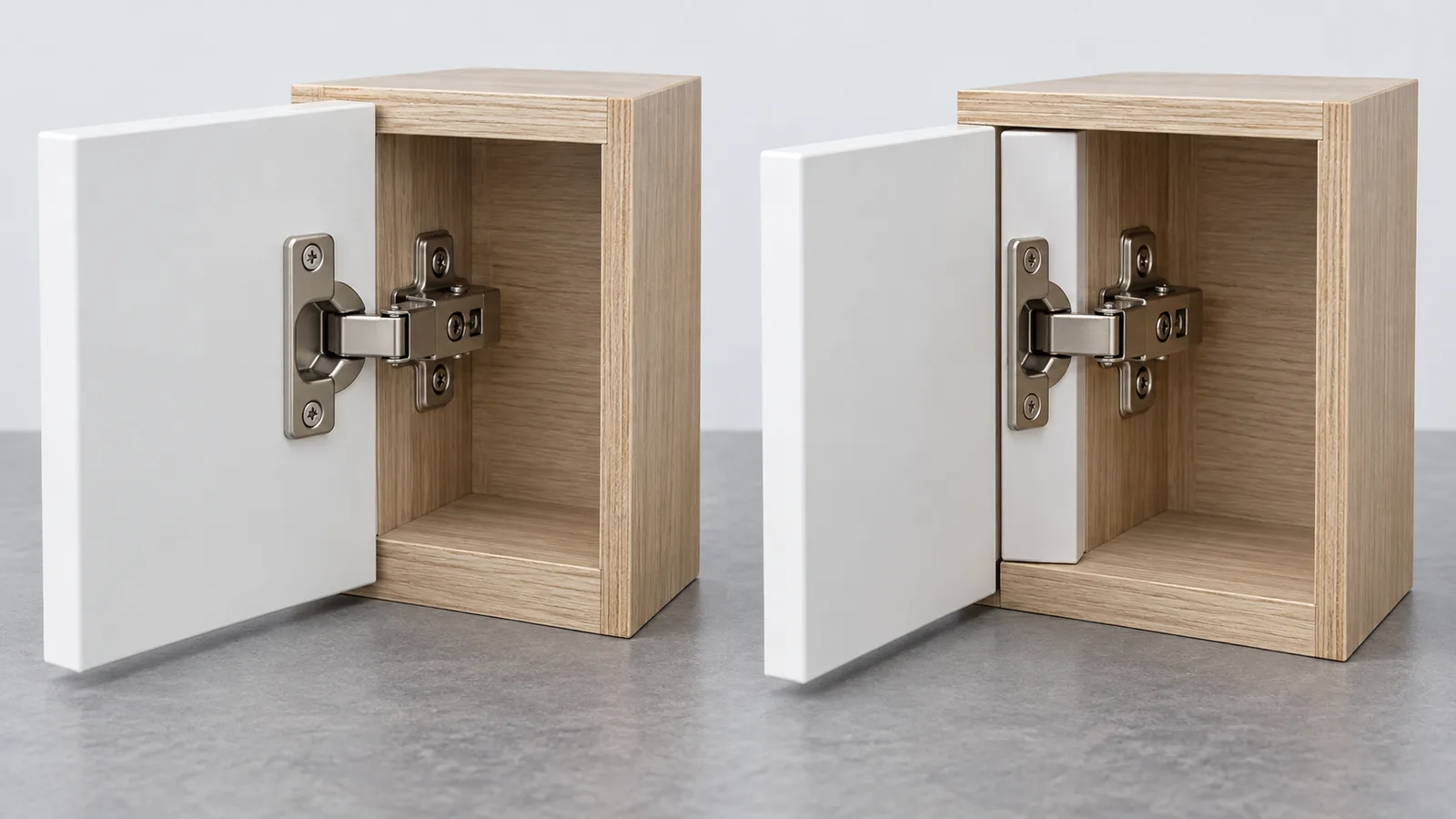
Concealed hinge overlay vs inset is a cabinet-door geometry decision, not simply a choice between two hinge shapes. Buyers should define how the door sits relative to the cabinet side, then confirm the hinge model, mounting plate, drilling pattern, reveal, opening envelope, and finished assembly as one compatible system. A supplier quotation that names only a hinge type is incomplete if it does not identify the mating cabinet construction and the approved reference drawing.
For a concealed hinge overlay vs inset comparison, freeze the door-to-cabinet relationship before asking suppliers to select the fitting. That keeps the discussion about the finished interface rather than a label in a parts catalog.
What Does Overlay or Inset Describe?
Overlay describes how far the closed door covers the cabinet side or face frame. In an inset arrangement, the door sits within the cabinet opening, so its outside face is generally aligned with the surrounding frame or cabinet front. The terms describe the relationship between the door and cabinet, not a guarantee that every hinge marketed for one arrangement will fit every cabinet.
The hinge arm and mounting plate establish the geometry that connects those parts. A full-overlay, half-overlay, or inset arrangement can require a different arm shape, plate height, drilling pattern, or adjustment range. The exact combination is model-specific. Hettich’s technical catalog illustrates this point by presenting separate overlay and inset configurations, with related base positions and reveal data for a named hinge family. Those values apply to the listed model and construction; they are not universal dimensions for all concealed hinges. See the Hettich concealed-hinge technical catalog.
For a buyer, the practical distinction is the finished interface. Overlay changes the door’s coverage of the cabinet side and the relationship among neighboring fronts. Inset places the door inside the opening and makes the surrounding gaps and alignment especially visible. Both may be valid. The right choice depends on cabinet construction, adjacent doors or drawers, the required appearance, internal clearance, and the selected hinge’s published application limits.
Which Inputs Should a Buyer Freeze Before Quotation?
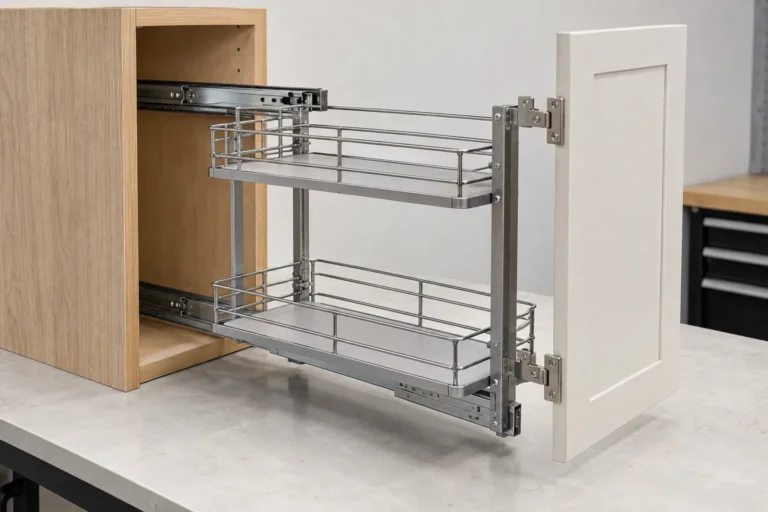
Start with the cabinet, not with a generic hinge name. Record whether the cabinet uses a face frame or frameless construction, the side-panel thickness, door thickness, edge profile, door width and height, and the required overlay or inset condition. Include neighboring fronts and any pull-out accessory that could intersect the door during opening.
Then identify what the supplier is expected to provide. Is the hinge being purchased as a complete fitting, is the buyer choosing among supplier models, or is the supplier only assembling a supplied hinge into a metal storage product? This distinction matters because Koitor’s verified expertise is in metal bathroom and home-storage hardware, drawing and sample review, basic assembly, and supplier communication—not specialist hinge design or certification. A qualified hinge supplier should confirm model selection and its technical limits.
| Buyer input | What to state or provide | Why it matters |
|---|---|---|
| Cabinet construction | Face frame or frameless; side-panel material and thickness | Determines the mounting surface and plate arrangement |
| Door geometry | Width, height, thickness, edge radius, and finished mass if known | Affects hinge compatibility, reveal, and number/configuration review |
| Mounting condition | Overlay amount or inset position; left/right handing if applicable | Prevents the supplier from assuming a different door position |
| Adjacent parts | Neighboring door, drawer, pull-out shelf, handle, or wall clearance | Reveals collisions that a single-door drawing may miss |
| Hinge identity | Manufacturer, model, arm type, plate, opening angle, and revision | Makes the proposed fitting traceable and replaceable |
| Approval evidence | Dimensioned drawing and representative assembled sample | Gives both parties one controlled reference |
Do not convert a catalog dimension into a blanket specification. Ask the hinge supplier to identify the exact model and the catalog or installation document used for its proposal. If the project changes door thickness, plate, panel position, edge radius, or cabinet construction, require a fresh compatibility check rather than assuming the previous approval remains valid.
How Do the Two Arrangements Change the Assembly Review?
Review overlay assemblies for coverage and interaction. Check the closed door against the cabinet side and neighboring fronts. Confirm the intended overlay is achieved without relying on a last-minute adjustment at the end of the fitting range. Open the door through its intended motion and check whether the edge, handle, adjacent front, wall, or pull-out accessory interferes.
For inset assemblies, pay close attention to the opening dimensions and the visible gaps around the door. The sample should sit without rubbing or binding and should align consistently with the approved cabinet reference. A hinge adjustment feature may help tune an assembly, but it cannot compensate for the wrong hinge, plate, drilling position, or cabinet geometry. Ask the supplier to state which dimensions are fixed by the design and which are adjustable during assembly.
The opening angle is also a system characteristic. A hinge’s published angle does not, by itself, prove that the installed door can reach that angle in a particular cabinet. A nearby wall, thick door, projecting handle, shelf, pull-out frame, or adjacent front may stop the actual movement earlier. Record the required usable opening and verify it on the representative assembly.
Do not compare samples from different cabinet constructions as though only the hinge changed. To make a meaningful comparison, keep the side panel, door dimensions, edge condition, mounting positions, and adjacent components constant. Change one planned variable at a time and record the result. That approach helps the buyer distinguish a hinge-model difference from a panel or installation difference.
What Should the Representative Sample Prove?
A sample should answer a defined approval question. It does not automatically prove every production lot or every cabinet variant. Identify the sample by hinge manufacturer and model, plate, door and cabinet revisions, mounting pattern, finish, and any accessory that affects movement. Photograph the closed front, hinge side, open position, and relevant clearance points.
For overlay, record whether the planned cover amount and neighboring alignment are achieved. For inset, record the gap on each side, top, and bottom and whether the door remains free through its intended travel. For either arrangement, inspect screw seating, mounting-plate location, adjustment range, closure behavior where relevant, visible finish compatibility, and any contact between the hinge and the cabinet interior.
An approval record should say what was checked, what was not checked, who approved it, and which drawing revision it represents. If the hinge supplier changes the model, plate, drilling pattern, or installation instruction, treat that as a change requiring review. A visually similar fitting may have different arm geometry or adjustment range. Keep the model identifier on the approved sample record and purchase specification.
When documenting concealed hinge overlay vs inset approval, attach the representative assembly drawing and identify which neighboring doors or accessories were included in the fit review.
These checks are project-specific. Do not claim a universal load capacity or service life from a static sample. If load, cycling, safety, or regulatory performance is important, specify the relevant test method and acceptance criteria with the component supplier and qualified test provider. A showroom sample is useful for interface approval but is not a substitute for a defined verification plan.

Which Common Sourcing Mistakes Create Avoidable Rework?
The first mistake is ordering by a broad label such as “inset hinge” without confirming the arm and plate combination. The second is approving a hinge alone, without the actual cabinet side, door edge, and neighboring parts. Both can produce a component that is correct in isolation but wrong in the finished assembly.
Another common gap is an incomplete drawing. A front view can show overlay but may not show the cup position, panel thickness, edge radius, or swing clearance. A side view and assembly section are often needed to show the relationship clearly. Use a controlled drawing revision and call out the intended mounting position.
Buyers also sometimes treat adjustment as a cure for incorrect geometry. Adjustment may support installation alignment within a model’s intended range, but it does not make incompatible components compatible. Ask the supplier what adjustment is available and what nominal position is required before adjustment. If the sample reaches the desired position only at the limit of its adjustment, record that as a risk and confirm with the component manufacturer.
Finally, avoid allowing substitutions without approval. A lower-priced fitting may use a different arm, plate, opening angle, or fixing method. If substitutions are allowed, define the interface and the evidence required to demonstrate equivalence. Otherwise, list the approved manufacturer and model as controlled purchasing information.
How Can an OEM Hardware Supplier Support the Review?
A custom metal hardware manufacturer can help organize drawing review, sample identification, assembly sequence, finish coordination, packaging, and change communication when metal baskets, brackets, racks, or other components interface with the cabinet. That support is useful when the buyer needs several purchased parts to fit a shared layout. It does not replace the hinge manufacturer’s responsibility for its own component specifications.
Koitor Hardware is a family-owned factory focused on bathroom and home-storage hardware. For a project that combines a metal storage component with a cabinet door or purchased hinge system, the buyer can share the relevant drawing or physical sample and ask for a practical review of the metal part’s mounting location, fit-up, finish contact, and packaging protection. The project team should keep specialist hinge selection and performance confirmation with the qualified fitting supplier.
This division of responsibility makes the approval process clearer: the cabinet or fitting supplier confirms hinge compatibility; the buyer owns the intended use and cabinet requirements; and the metal hardware supplier confirms the dimensions and assembly of the components it supplies. The buyer’s purchase order should preserve those interfaces and revisions.

Buyer Checklist Before Requesting a Quotation
- State face-frame or frameless cabinet construction and side-panel thickness.
- Provide door width, height, thickness, edge profile, and intended position.
- Specify overlay or inset geometry and any neighboring front relationships.
- Identify the hinge model and mounting plate, or ask the specialist supplier to propose both.
- Include relevant handles, shelves, pull-out accessories, and nearby obstructions.
- Request a dimensioned assembly drawing and identify the drawing revision.
- Review the assembled sample through the full intended opening path.
- Record clearances, visible gaps, adjustment range, and any deviations.
- Confirm who approves a model substitution or revised drilling pattern.
- Specify packaging protection for finished doors, hinges, and metal components.
- Identify any load, cycle, safety, or compliance evidence that must come from the component manufacturer or a qualified test provider.
Before releasing a purchase order, attach the approved assembly drawing, component schedule, and sample record to the same specification packet. This makes overlay, inset position, clearances, fitting identity, and revision history auditable by the buyer, supplier, and incoming-quality team. If a later production lot uses a changed cabinet panel or hinge plate, the team can identify which compatibility checks need to be repeated instead of relying on memory or an informal email thread.
Frequently Asked Questions
Is overlay the same as a full-overlay hinge?
No. Overlay describes how the door covers the cabinet side or frame. “Full overlay” is one arrangement, but the hinge model and plate still need to match the cabinet and target geometry. Confirm the actual overlay on a drawing and sample.
Does an inset door always need a different hinge?
Not universally. Some hinge families have configurations for multiple mounting conditions, while others are designed for a narrower application. Use the model’s official documentation to identify compatible arm and plate combinations.
Can a hinge adjustment screw correct an incorrect overlay?
Only within the adjustment range and intended geometry of the fitting. If the proposed assembly requires an extreme adjustment or cannot achieve the drawing condition, ask the supplier to review the model, plate, and drilling position.
Should buyers choose the largest opening angle available?
Not automatically. The useful opening depends on adjacent doors, walls, handles, shelves, and accessories. Define the access required and verify the actual assembly rather than choosing by the catalog angle alone.
Who should approve a hinge substitution?
The buyer should control the substitution, with compatibility evidence from the hinge supplier and a representative sample review where the change can affect fit or movement. Record the replacement model and revision before repeat orders.
Work With Koitor Hardware
If your cabinet project includes metal storage hardware alongside purchased hinges or fittings, send Koitor the relevant drawing or sample and identify the interface that needs review. Koitor can discuss the metal component, assembly coordination, finish contact, and packaging requirements without representing itself as the hinge designer or test authority.
Review the complete hardware interface
Share the cabinet-side drawing, purchased hinge model, and metal accessory sample so the relevant fit and approval questions are clear before a repeat order.
OEM / PRIVATE LABEL
Turn this sourcing guide into a product brief
Share your target product, size, finish, order quantity and packaging requirements. Your team receives a practical manufacturability review before quotation.


 English
 Español
 Português
 Français
 Deutsch
 العربية