
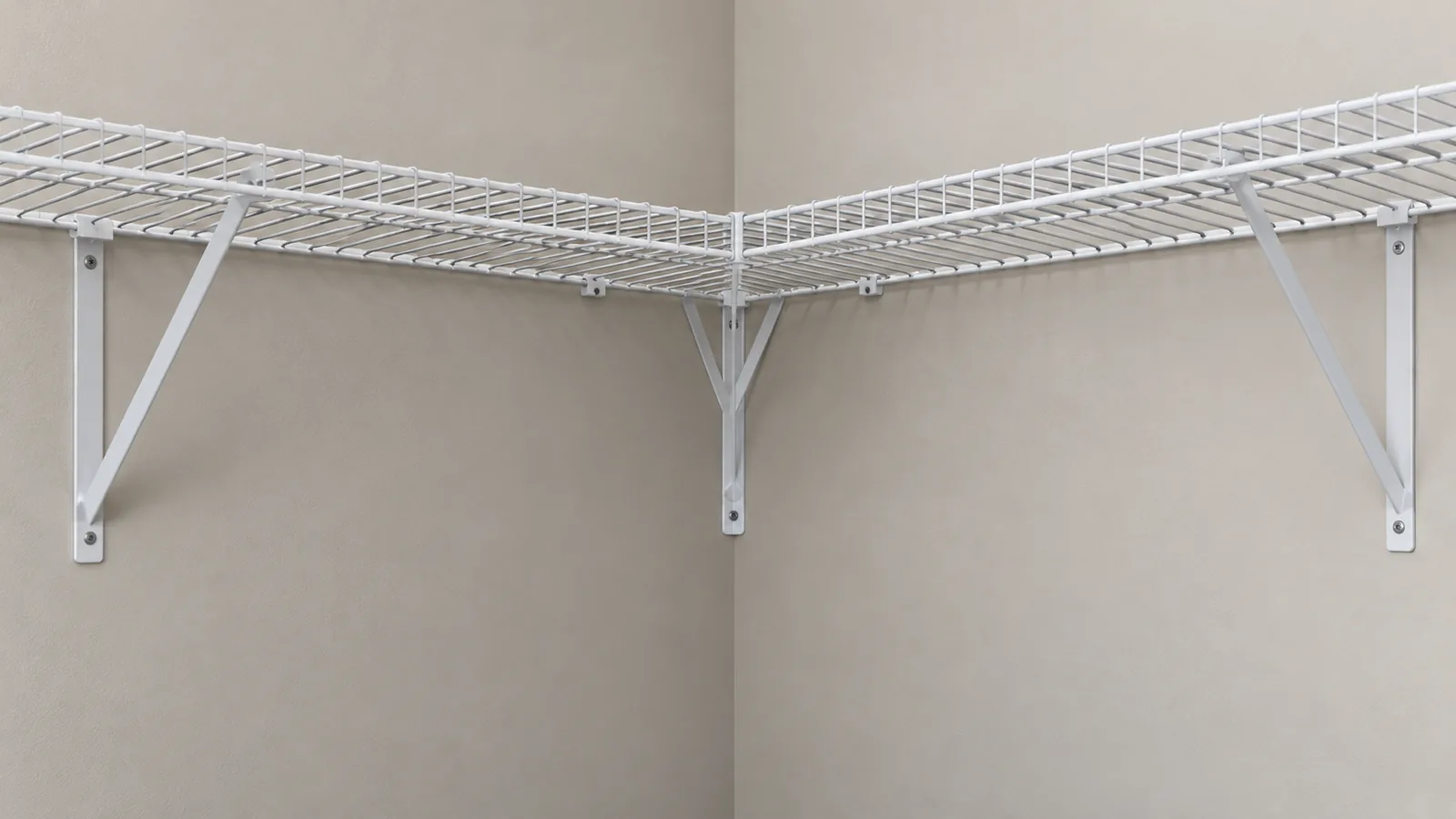
A wire shelving corner support bracket may be needed when two shelf runs meet and their joint cannot be supported by standard end brackets alone. The correct solution depends on shelf profile, corner geometry, wall channels, connection method and the system supplier's instructions. Buyers should show both shelf sections and the joint in one drawing, then approve the assembled corner on a representative sample. A generic L shape does not establish that the bracket fits either shelf.
This short video shows the product or manufacturing context discussed in this guide.
What makes a corner joint different from a straight run?
At a corner, two shelf sections approach from different directions and may share a support location, overlap or connect through a supplier-defined part. The joint can change how each section transfers load into its brackets and wall fixing. A support that works along a straight run may not capture both shelf ends. Buyers need to know which member carries the joint and how the bracket prevents movement during installation and intended use.
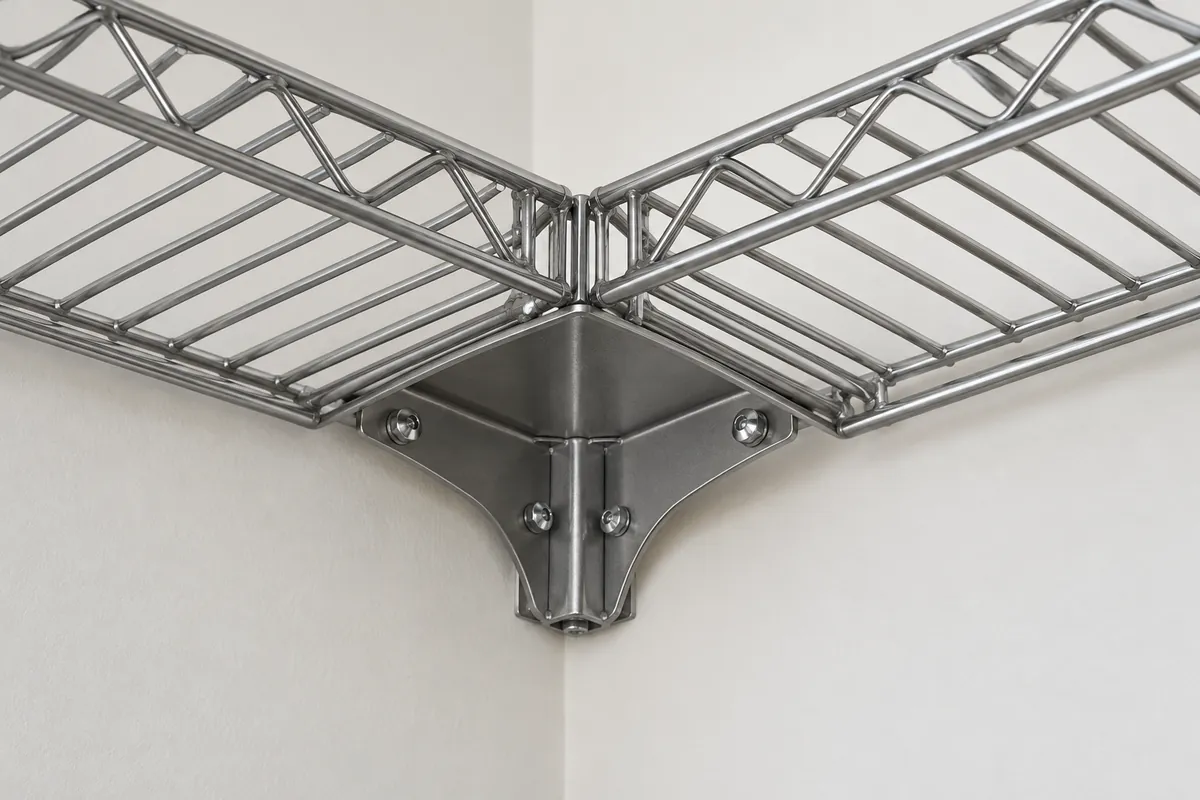
ClosetMaid's installation materials include instructions for its shelf system and corner arrangements. They show that corner support is a product-specific installation question, not a universal bracket dimension. Another wire shelf may use different end cuts, front lips, rear channels or corner hardware. Ask the selected supplier for its own drawing rather than adapting a retail image from a different profile.
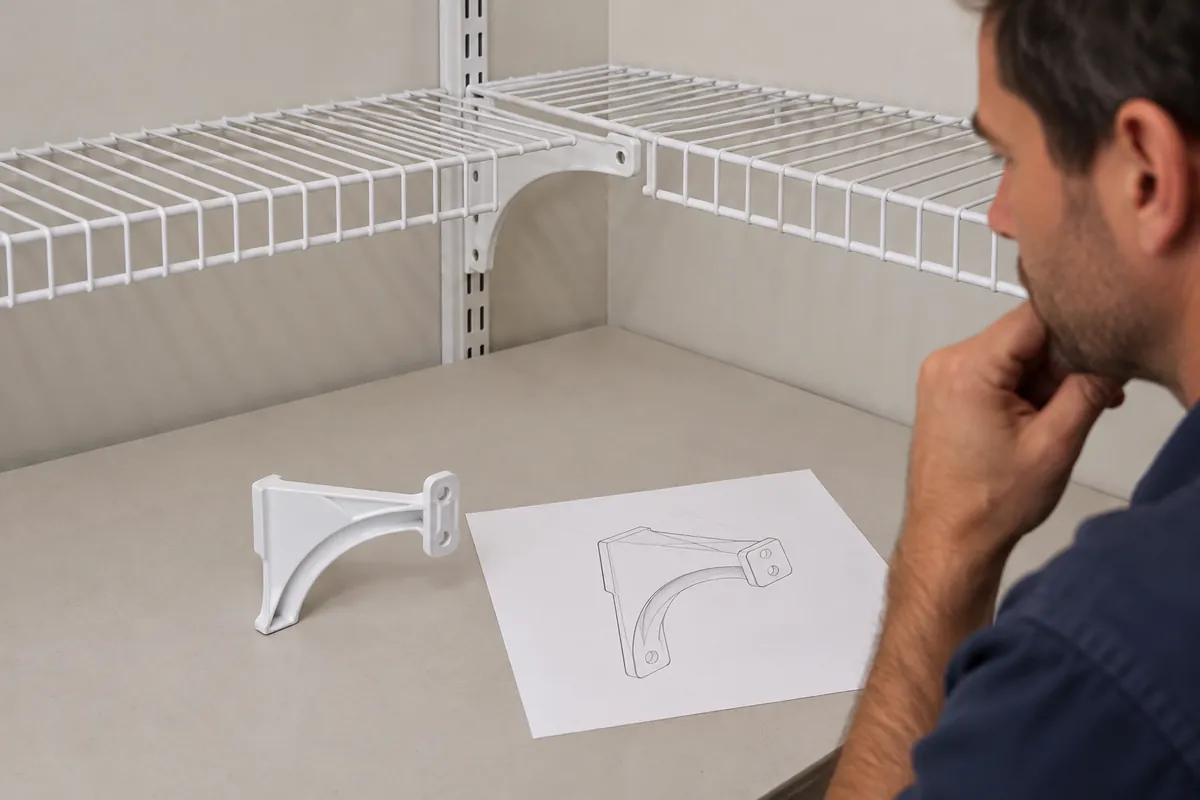
A dedicated support can locate two shelf ends, connect a corner module or provide a mounting point below the joint. The precise function needs documentation. Do not infer that every corner needs a center post or that adjacent wall brackets always support the joint. Geometry, wall substrate and system design determine which arrangement is suitable.
The two shelves can differ in length, depth or orientation. A symmetrical corner may look balanced, while an offset can put the joint away from a stud or conflict with a door. A plan and underside view make those constraints visible. Include the wall angle, channel positions, nearby fixtures and installation access before comparing bracket proposals.
Which shelf and corner details should the RFQ freeze?
Identify both shelf families and revisions, lengths, depths, end profiles, front edges and rear wire arrangements. State whether the sections meet as a butt joint, overlap, connect through a corner piece or terminate separately. Match terms to the supplier drawing. Show the wall angle and corner conditions; do not assume a room corner is square or that a shelf can be adjusted after installation without affecting fit.
Ask the supplier to specify the corner support part number, mounting face, fixing points and assembly order. Clarify whether the support is shared by both shelves or belongs to one side. Request a section or perspective view showing how the joint is retained and which wires or frame members make contact. If adjustment is available, document the supplier's permitted setup rather than inventing a range.
Include both wall channels or standards, fixings and any adapter. A bracket can fit the shelf yet miss the planned channel. Substrate and fastener responsibility should be clear on each wall. If sold as a kit, list included components and whether an installer needs a separate anchor or connector. Retain the installation guide revision with the quotation.
Define intended use along both runs. Note whether concentrated items may sit near the joint and whether the shelves form continuous storage or separate sections. If a capacity or deflection requirement exists, it must come from the qualified supplier and apply to this corner configuration. Do not assume a straight-shelf rating transfers to an L-shaped assembly.
How should buyers compare dedicated and shared supports?
A dedicated corner support may provide an explicit connection under the joint; an alternative may use separate end brackets or an integrated corner piece. Compare only supplier-approved configurations. Ask for an assembly view and an explanation of how both shelf sections are held, which fasteners are needed and whether the corner part can be serviced.
A shared support may reduce visible hardware or simplify a kit, but can require more precise alignment between shelf ends. Separate supports may allow independent positioning yet add parts and wall penetrations. These are conditional layout trade-offs. Compare installation sequence, fastener access, adjustment, packaging and replacement availability along with price.
Check whether the proposed bracket contacts the shelf frame or only one wire. That contact may be intentional, but the buyer should not assume it spreads load across both sections. Request the supplier's explanation and applicable technical data. A substantial-looking bracket does not prove capacity, and a compact part is not automatically inadequate.
Ensure the joint does not depend on an unapproved field cut or bent wire. If trimming is required, the supplier should state the method, edge treatment and effect on the corner connection. If a custom bracket is needed, distinguish it from a stock accessory so the quote reflects development and approval work.
What should the assembled corner sample demonstrate?
Build with both shelf sections, selected support, correct channels and a representative wall-corner fixture. Record wall angle and substrate. Verify that all revisions match the quote and install in the supplier's stated sequence. A loose bracket beside shelf samples helps review components but cannot show the installed joint or wall fixing.
Observe whether each shelf end seats fully on its intended support and whether the corner stays aligned without forcing one run out of level. Check for interference between front rails, side wires and bracket. Photograph the joint from above and below, and record any adjustment, shim or alternate fastener; a temporary correction must not silently become production design.
If loading or deflection matters to the buyer, follow a written protocol agreed with the supplier. Specify load locations, wall conditions and measurements. A hand push or a person leaning on the sample is not a rated test. State the fixture, hardware, shelf revisions and result; do not generalize observations to other corner sizes.
After installation, check that normal shelf placement and removal do not dislodge the corner connection. Review fastener access and serviceability. If movement appears, note the side and location, then inspect shelf ends, support, channels and wall attachments. Ask the system supplier to assess the evidence before changing bracket position or cutting a member.
How should corner joints and support engagement be sampled?
A wire shelving corner support bracket must match the specific post, shelf collar or corner connector used by the system. Before evaluating a sample, identify the post profile, shelf corner geometry, bracket or collar part number, orientation and adjustment sequence. Corner systems may use different ways to transfer load or prevent rotation, so a familiar-looking part is not enough to establish interchangeability. Ask the system supplier to identify which contact surfaces are intended to carry the shelf.
Build the sample with the production-intent post and all adjacent shelves that influence corner access. Verify that the bracket can be installed in the documented order and that the shelf reaches its stop or seat without forcing. Observe whether adjacent shelves collide, whether the support shifts during assembly and whether the final corner is level. Photograph the setup from two directions and keep the part labels visible in the record.
If a test is needed, define whether it evaluates seating, movement, load response or repeated assembly. Choose a fixture that represents the named post and connection; a test on a flat bench may omit the contact geometry that matters. Agree who approves the method and how a result will be interpreted. One sample observation cannot establish a general rating, and a supplier's claimed rating should be linked to the exact configuration and method.
When a bracket rocks or slips, inspect the mating post and shelf corner before altering the bracket. A dimensional difference, finish buildup, part orientation or incomplete assembly could produce similar symptoms. Record which part was measured and the location of contact. Route a proposed change to the system owner and repeat the relevant fit review on the revised parts rather than filing the original symptom as resolved by appearance alone.
How can buyers control compatibility across system revisions?
Maintain a parts list that names post, shelf, corner support and any locking or leveling component together. Include revisions and the approved supplier source. If components are sourced from separate manufacturers, request written confirmation of the intended pairing and keep the responsibility for final system approval with the buyer or designated product owner. This prevents a later purchasing substitution from silently changing the support interface.
During incoming checks, verify identity and the characteristics linked to fit: post dimensions or profile, bracket opening, shelf corner features and visible damage. Define inspection tools and datums with the supplier. A pass on a dimensional sample does not prove a loaded assembly, while a successful one-time assembly does not prove all dimensions are in control. Use the evidence that matches the risk and keep its scope explicit.
Packaging should protect small corner parts from being mixed or distorted. Use labeled compartments or bags when left-right or model variants exist, and make the instruction identify the same parts as the kit. For a complaint, preserve the returned bracket and its package label so the part can be traced. Missing identity makes it difficult to distinguish a supplier change from a field assembly error.
A clear RFQ should state the corner-shelf system, post profile, shelf configuration, material and finish expectations, adjustment method, packaging, sample approval and any agreed test. Ask vendors to list exclusions and assumptions. The phrase wire shelving corner support bracket is only a starting point; the commercial specification must identify the system interface and what evidence will release it for repeat orders.
How should the corner system be released for repeat orders?
Release the wire shelving corner support bracket together with its post profile, shelf corner and locking parts, all tied to revisions and an approved sample. The purchase specification should state the intended system and identify who confirms compatibility if one supplier is substituted. Include pack-out identification so visually similar brackets are not mixed across models. This makes the corner connection review reproducible and keeps future orders within the evidence actually collected.
What evidence supports incoming acceptance?
Tie incoming checks to the agreed interface characteristics: part identity, dimensions at named datums, visible damage and assembly seating when the check plan calls for it. Record the gauge or drawing revision and sample selection. If a part fails to seat, quarantine the affected identity and compare it with the approved sample before modifying it. This process helps the buyer separate a supplier change from an assembly issue without claiming that a visual check proves load performance.
Buyer comparison table
| Corner element | Question to resolve | Evidence |
|---|---|---|
| Shelf ends | How do the profiles meet? | Plan and underside views |
| Corner bracket | Which part supports the joint? | Supplier part number and drawing |
| Wall channels | How does each side attach? | Installation guide for substrate |
| Sequence | Which run is installed first? | Representative sample observation |
| Use condition | Any corner-specific load assumption? | Supplier data for this configuration |
Buyer checklist
- Show both shelf runs and wall corner
- Identify joint style and end profiles
- Match a support to the exact shelf system
- Confirm channels, anchors and wall responsibility
- Review installation access and alignment
- Freeze kit, revisions and instructions
For a project-specific detail, consult the manufacturer or technical reference. Its information applies to the stated system and conditions.
See related OEM sourcing information or contact Koitor for a metal-product drawing discussion.
Frequently asked questions
Does every wire shelf corner need its own bracket?
Not necessarily. Use the system supplier's approved layout for the actual profiles and wall conditions.
Can a straight-run bracket support an L-shaped joint?
Only if the supplier documents that configuration.
Can a straight-shelf rating apply at the corner?
Do not assume so. Request evidence for the exact assembly and conditions.
What if the wall corner is not square?
Record the project geometry and ask the shelf supplier how its system handles it before approval.
Discuss a project-specific sourcing question
Koitor Hardware is a family-owned custom metal hardware factory focused on bathroom and home storage products. Share the product drawing or physical sample, the purchased fitting identity, the intended application and the buyer decision that still needs evidence. Specialist drawer runners, closet shelf fittings and coating systems must be confirmed by their responsible suppliers.
OEM / PRIVATE LABEL
Turn this sourcing guide into a product brief
Share your target product, size, finish, order quantity and packaging requirements. Your team receives a practical manufacturability review before quotation.
 English
  Español
  Português
  Français
  Deutsch
  العربية