

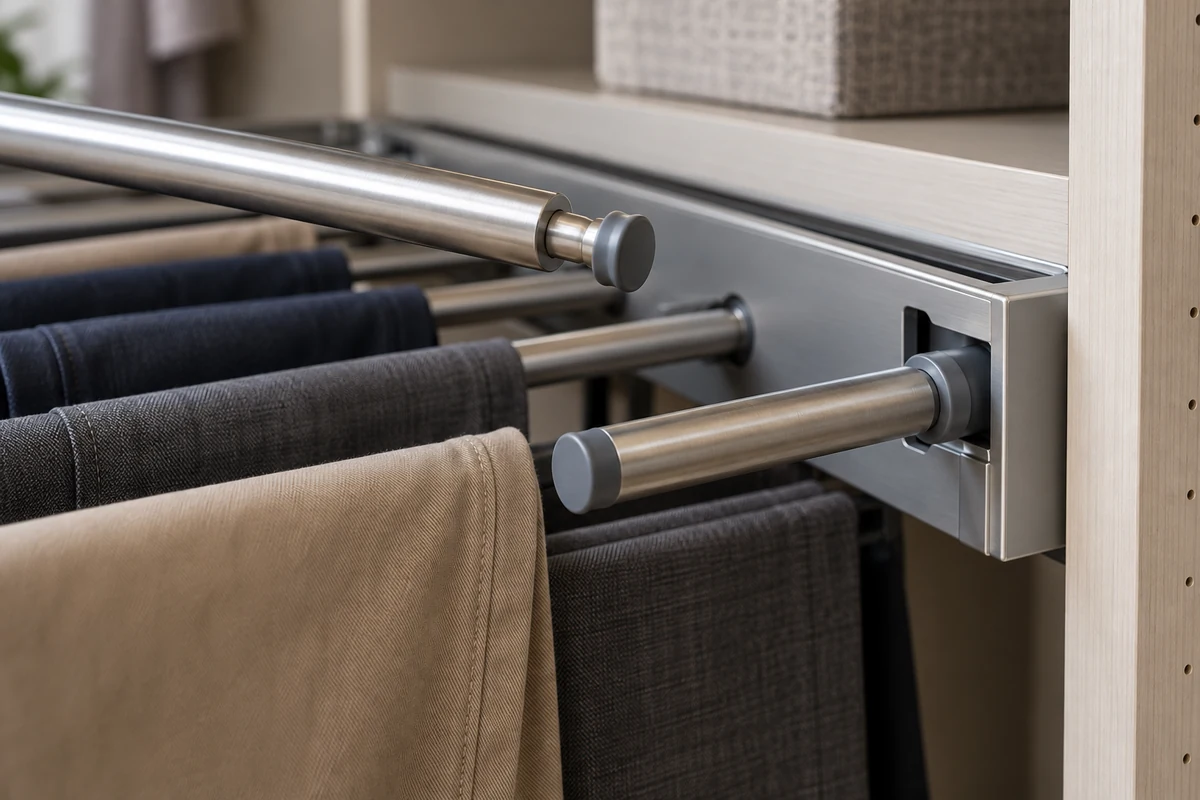
Pull out trouser rack removable rods should be specified by their intended behavior, not left ambiguous in the product name. Some wardrobe systems use rods fixed to the frame while garments slide off them; other systems intentionally use lift-out rods that the user removes together with the trousers. These configurations create different end-cap, support, instruction and sample-approval requirements. Buyers should identify which behavior the product is designed for and confirm it on the complete frame.
For a pull out trouser rack, that behavior affects both the component interface and the instructions buyers provide to end users.
This guide is for importers and private-label buyers specifying a wardrobe accessory. Emuca product examples below are model-specific: its Hack rod set describes a non-fixed rod and a recommended removal sequence, while its Self product family describes another configuration. They are not universal standards or evidence of Koitor production. The images in this article are generic concepts, not Koitor SKUs.
Why must rod movement be specified explicitly?
When a user pulls trousers off a rod, the rod may remain in place, slide in its support, or lift out with the garment. A buyer who assumes one behavior while the supplier designs for another may receive a product whose instructions feel counterintuitive or whose rod can be displaced during use. The issue is not automatically a defect: an intentionally removable component may work as designed when the user follows the intended sequence.
Emuca’s Hack trouser-rod FAQ states that the rods are not fixed to the frame and may move if a user tries to remove only the trousers. Its recommended sequence is to lift the rod together with the trousers, separate the garment, and return the rod to the frame. The same product page describes rods placed on top of a compatible frame. By contrast, Emuca’s Self double trouser rack belongs to a different product family and should be checked against its own documentation. See Emuca’s Hack rod set and operating FAQ and the Self pullout rack page.
These product-specific examples help buyers ask the right question, but do not prove that all trouser racks behave alike. The RFQ should state whether the rod is fixed, captive-but-sliding, or intentionally lift-out, then identify the expected removal and replacement sequence.
What are the main rod-behavior options?
A fixed rod remains attached to the frame during ordinary garment removal. The garment is slid, lifted or otherwise removed according to the product’s design, while the rod stays seated. A fixed design may use an end support, fastener or other retained interface; the exact structure depends on the product family.
A lift-out rod is meant to be removed from its support as part of garment handling. In that case, the end shape and support opening need to allow intentional removal while reducing unintended displacement during the defined use. The buyer must ensure the instructions explain the sequence and that the user can return the rod to the correct position.
Some systems may allow another movement, such as a captive rod that slides but cannot be fully lifted out. Avoid reducing these options to a vague “movable” label. Ask the supplier to define what moves, what remains attached, and which action is intended when garments are loaded or removed. A product sheet, drawing and demonstration sample should all describe the same behavior.
Which interface details belong in the drawing?
The assembly drawing should show the rod end, support pocket or seat, frame spacing, rod orientation and any cap or insert that affects engagement. Identify whether the rod is attached, retained, freely seated or otherwise constrained. If the supplier uses a bought-in end cap or polymer trim, list the component and revision in the BOM and define who owns compatibility.
Dimension the interfaces that control fit and operation. The rod’s overall length, end geometry, support spacing and installation direction can affect whether it seats correctly. Avoid inventing universal clearances or tolerances; the design owner should define values for the selected system. If different frame widths or accessory configurations are offered, identify which rods fit each frame and whether any position is not interchangeable.
The drawing should also show how the pullout frame attaches in the cabinet, the usable access envelope and the rod layout. A frame that fits the cabinet can still be awkward if the user cannot reach the rod end or if adjacent rods obstruct garment removal. Record the intended wardrobe opening and sample orientation without claiming compatibility with every cabinet.
| Drawing or BOM item | What to identify | Buyer reason |
|---|---|---|
| Rod behavior | Fixed, retained movement or lift-out | Aligns product expectations and instructions |
| Rod end | Cap, plug, shoulder or other support feature | Determines how the rod engages its frame seat |
| Frame support | Seat shape, spacing and opening direction | Shows what must match across variants |
| Rod layout | Number, position and spacing | Helps review garment access and product configuration |
| Bought-in parts | End caps, inserts, slides and fasteners | Assigns compatibility and revision responsibility |
| User sequence | Remove, separate, return and verify seating | Makes the operating behavior understandable |
If the design includes multiple rod lengths or accessory kits, create distinct item identifiers. Do not depend on color or appearance alone to distinguish parts in production or after-sales service.
How should garment removal and reinsertion be tested?
Use representative garments and the complete intended rack configuration. Identify the frame revision, rod set and instruction version. Follow the supplier’s stated sequence to remove a garment, then repeat the process to return the rod and confirm it is seated as designed. Record whether a rod is intended to come out, whether it remains captive, and what the user should do if it is displaced.
For a fixed system, verify that routine garment removal does not require the user to detach a component contrary to the instructions. For a lift-out system, check that the rod can be removed using the intended grip and then replaced in its correct location without confusing neighboring positions. If the garment bunches, catches or blocks access, note the configuration and observation rather than assuming the cause is the rod itself.
The sample review should cover at least the positions most likely to have restricted access, such as end rods or those adjacent to a frame wall. If the rack is part of a pullout, extend it to the intended operating position and check access in the wardrobe layout. This is an observation of the sampled product and use sequence, not a cycle-life test or durability claim.
What should the supplier’s instructions and package communicate?
The product instructions should show how the rod is loaded, removed and returned. If a rod is intentionally lift-out, say whether the user should remove it with the trousers rather than pulling only on the garment. If a rod is fixed, explain the intended garment-removal action without implying the rod should detach. Drawings or simple component views should match the shipped parts.
The product package should identify which rod count, frame and accessories are included. Separate fixed and lift-out variants in the product data and sales order if their instructions or parts differ. If a product is sold as a replacement rod kit, state its compatible frame family and revision. Do not use one generic instruction sheet across configurations unless the supplier confirms it applies to all included versions.
The buyer should compare the sample, packaging and digital product information before approving production. If the product page calls the rods “removable” but the supplied instructions describe fixed use—or the opposite—pause approval and resolve the difference with the supplier. Consistent terminology is especially important for e-commerce listings, where a customer may only see a short phrase and an image.

How should the assembled sample be accepted?
Write acceptance around the intended operation and component identity, not a generic statement such as “rod works.” Record the frame revision, rod and cap identifiers, garment used, position tested, instruction revision and the observed removal/reinsertion sequence. For a lift-out configuration, state whether the rod was expected to move with the garment and how it was returned. For a fixed configuration, state that it remained seated during the intended garment-removal action.
Inspect the rod ends and support points for obvious mismatch, incomplete seating, interference or inconsistent fit across positions. Compare representative units if the set has multiple rods. If a rod feels loose or difficult to operate, report the observation and ask the supplier to assess the design; do not alter the support or end part without approval.
Do not copy a product-specific load figure or instruction into another SKU. Emuca’s cited Hack page includes its own materials and operational details, but those do not establish the load, strength, finish or durability of a different rack. Any performance criterion should be assigned to the exact product and verified using a defined method by the responsible supplier or evaluator.
Which changes require renewed approval?
Changes to rod ends, support geometry, frame width, rod material or finish, end caps, accessory count or instructions can affect fit and behavior. A substitute cap may alter the way a rod seats; a frame revision may change support spacing; and a changed user sequence can alter what the product listing promises.
| Change | Potentially affected interface | Buyer follow-up |
|---|---|---|
| Rod length or end form | Frame support engagement | Request revised drawing and sample fit check |
| End cap or trim material | Seat fit, retention and contact | Record supplier and revision; compare on the frame |
| Frame width or support spacing | Rod position and interchangeability | Confirm compatible rod set and variant mapping |
| Rod count or layout | Garment access and ordering sequence | Update BOM, instructions and listing |
| Finish or coating | Fit at end support and appearance | Review the finished sample, not a bare component |
| Fixed/lift-out behavior change | User action and acceptance basis | Revise product data, instructions and sample approval |
Keep the approved drawing, sample record, BOM, user instructions and product copy linked to the same variant. This makes repeat-order comparison clearer and prevents an accessory from being substituted based only on similar appearance.
What should buyers include in an RFQ?
State the intended rod behavior, frame family, wardrobe opening, rod count, garment type and expected user sequence. Attach the cabinet or frame drawing, identify support spacing and list any preferred finish or end-cap requirements. If the supplier is asked to develop a new rod-to-frame interface, identify which party controls dimensions and who approves the final sample.
For pull out trouser rack removable rods, the critical RFQ request is a clear written answer to whether the rods are expected to stay fixed or lift out with the garment. Ask the supplier to provide a sample and instructions that demonstrate the chosen behavior. Request a component list that distinguishes rods, caps, frame and slides where those are separate sources.
Koitor Hardware is a family-owned custom metal hardware factory focused on bathroom and home-storage hardware. Metal rod and frame-forming knowledge can support a discussion of fabricated components within confirmed scope, but current production of trouser racks, proprietary wardrobe slides, aluminum extrusion or plastic end caps is unconfirmed. A home-storage OEM discussion can clarify possible metal-part scope; buyers can also contact Koitor about a project. Do not assume the complete system is within a metal supplier’s scope without confirmation.
Frequently asked questions
Do removable trouser rods always move with the trousers?
No universal rule applies. Emuca’s Hack FAQ describes its own rods as not fixed to the frame and recommends removing each rod with the garment. Other product families may use fixed rods or another retained arrangement. Follow the selected supplier’s documentation.
Is a rod that moves during garment removal necessarily defective?
Not if it is designed to lift out and the product instructions explain that behavior. The buyer should check whether movement matches the intended configuration and whether the operating sequence is clear.
What should a sample approval record contain?
Record the frame and rod revisions, end-cap or trim details, garment position tested, removal action, return sequence and instruction version. Describe the observation rather than claiming a universal performance result.
Can two visually similar trouser rods be interchanged?
Do not assume so. Compare end geometry, support spacing, frame family and the selected supplier’s compatibility documentation. Record any approved interchangeability by part number.
Should buyers specify a load rating for every rod?
Only if the product requirement needs one and the responsible design authority supplies a method and criterion. Do not transfer a figure from another manufacturer’s product page or a different frame configuration.
What happens if a supplier changes the end cap?
Review the fit on the actual frame and determine whether the rod remains fixed or lift-out as specified. Update the BOM and sample approval if the interface or user operation changes.
Review a Metal Storage Component With Koitor
Share your frame drawing, rod-end details, intended fixed or lift-out behavior, finish and component scope. Confirm complete wardrobe-system responsibilities with each relevant supplier.
OEM / PRIVATE LABEL
Turn this sourcing guide into a product brief
Share your target product, size, finish, order quantity and packaging requirements. Your team receives a practical manufacturability review before quotation.
 English
 Español
 Português
 Français
 Deutsch
 العربية