
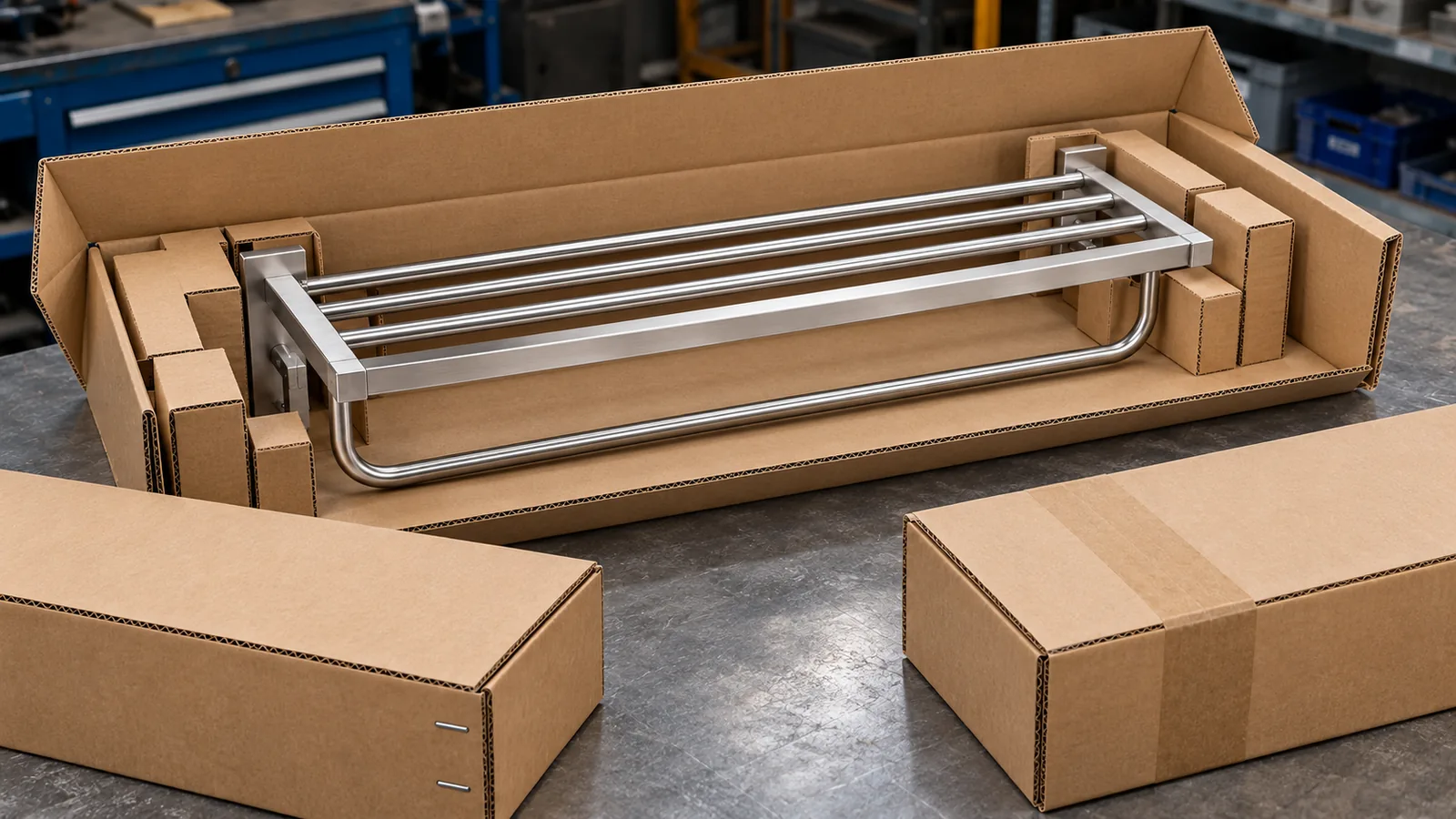
Carton staples vs tape for heavy products is not a universal strength contest. For an importer shipping metal bathroom or home-storage hardware, the first question is whether the receiving customer, marketplace, distributor or shipping program permits the proposed closure. The next questions concern carton-flap design, how the closure is applied, possible contact with the product, handling and the packed-product evidence needed for approval. A staple may suit one permitted heavy-duty pack-out and be unacceptable in another channel; tape may be practical in one carton construction and inadequate for a different product or route. Decide from the actual package and written destination requirements, not from a general claim that one closure is always stronger.
What does a stapled or taped carton closure mean?
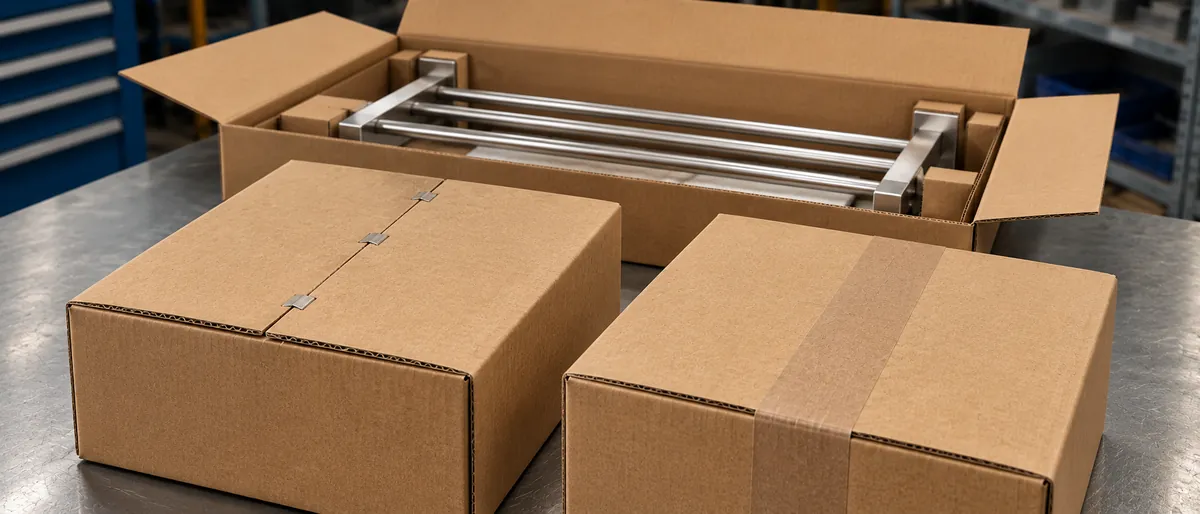
Closure means joining or securing the carton after loading. Staples are metal fasteners driven through overlapping corrugated material and clinched; tape bridges and adheres to carton panels or flaps. These are different closure mechanisms, and the carton design must be suitable for the method. Stapling a flap configuration that was not designed for it can create a poor joint; applying tape over dusty, damaged, damp or unsuitable surfaces may also fail to meet the buyer’s intended criteria.
The carton supplier should distinguish a manufacturer’s joint—the seam used to form the carton blank or body—from the closing-flap method used after the product is packed. These may use different methods. A box can have a glued or stitched manufacturer’s joint and then be closed with tape, for example. This article concerns the closure of loaded cartons, not whether the box maker’s side seam is glued, taped or stitched. Ask for the words and drawings to identify each joint clearly.
Packaging equipment supplier Better Packages describes tape, glue and staples as separate carton-sealing options and notes that staples require suitable overlapping flaps or a liner in its guidance. That is useful as a description of methods, not a universal specification for every box or product. The supplier’s recommended design, recipient rules and a representative packed sample should determine the project decision.
Why must the receiving channel approve the method first?
Packaging rules often belong to the recipient or distribution program. A retailer, warehouse, marketplace, parcel provider or industrial customer can set its own requirements for closure, opening, palletization, handler safety or recycling. Those requirements may differ by location, product family or shipment type and can change. Do not assume that a rule found in one company’s manual applies to another buyer, to all carriers or to a whole country.
For example, a Nexteer Automotive manual published in 2016 says that for its containers, taping or gluing is accepted and staples should be avoided. That statement demonstrates a named recipient’s packaging rule; it does not establish a current general rule for bathroom-hardware importers. Similarly, a packaging equipment supplier may describe applications for staples, but that does not override the receiving customer’s written instruction.
Before comparing quotations, request the latest written packaging specification from the actual receiving organization. Record the document name, revision or date, covered facility or channel, product family and any exception-approval process. If the buyer’s document is silent, ask the buyer or packaging approver to confirm acceptance in writing rather than treating silence as permission. If a shipment has several destinations, check each channel or create a controlled packaging variant for the ones with different requirements.
What should a hardware buyer compare before approving closure?
Compare the closure in the context of the filled box. The decision includes flap overlap, carton board, product orientation, closure placement, inner protection, packed mass, pallet or parcel route and expected opening method. A staple’s metal legs or crown could be a contact or handling concern if placed close to a finished surface or opened without suitable care; this is a design risk to inspect, not proof that every stapled carton will scratch a product. Tape can cover a seam or span a flap joint, but the package still needs the construction and method specified for the SKU.
| Buyer field | Stapled proposal | Taped proposal | Evidence to request |
|---|---|---|---|
| Recipient permission | Written confirmation that this staple type and application are allowed | Written confirmation of accepted tape or sealing method | Current customer/channel rule and approved exceptions |
| Carton geometry | Flap overlap, liner if needed, staple line and carton orientation | Flap arrangement, seam position and tape path | Drawing of the erected carton and closure details |
| Product clearance | Staple crown and clinched legs kept away from the product and handling zones | Tape and flap edges do not interfere with components or opening | Representative packed sample and contact-point review |
| Application control | Staple specification, spacing or pattern, equipment and inspection method | Tape specification, width, placement and application method | Supplier proposal and repeatable work instruction |
| Receiving and opening | Safe method to open and handle the fasteners; packaging disposition | How to remove tape without damaging contents or creating residue | Receiving-team feedback and opening trial |
| Distribution evidence | Appropriate complete-pack check for the intended route | Same scope and comparable acceptance criteria | Test or trial record tied to the exact package revision |
Do not let the closure line alone stand in for the complete packaging specification. Ask who supplies and applies the closure, which box revision is covered, whether the pack is a single unit or master carton, and whether the quote includes any liner, reinforcement, tape dispenser, stapling equipment or extra labor. If these inputs vary, identify the differences before comparing cost or performance.
How can staples create product-contact or handling risks?
Staples introduce metal at the carton seam. Depending on fastener length, carton layers, clinching, placement and how the carton is opened, sharp or protruding portions may be accessible. For metal bathroom racks, baskets and rails, buyers should inspect the distance between the closure and polished or coated faces, wire ends, hooks, mounting hardware and any bag or sleeve. The packaging supplier should show the actual staple application on an assembled sample, not only on a flat drawing.
Check that a staple cannot pierce an inner bag or protection layer and expose a finished component to rubbing or snagging during movement. Also check the external surface for an exposed point, a crown that may catch during handling, or a position that makes safe opening unclear. The risk depends on the fastener, board thickness, overlap and application; do not claim a defect will occur without a sample or inspection finding. If the proposed design cannot maintain a clear separation from the product, ask the supplier to revise the seam, use an approved liner or consider a different permitted method.
Tape has different considerations. The selected adhesive, width, number of strips, surface condition and application pressure can affect the seal. The closure should not be treated as proven simply because it looks neat on one sample. Ask the carton supplier for a repeatable instruction and identify what the buyer will inspect, such as tape position, continuity, carton damage or flap lift under the agreed handling conditions. Avoid importing tape adhesion claims from a different substrate, temperature or packing line.
What should a paired pack-out trial include?
If both methods are allowed and the buyer needs a comparison, use the same product revision and define what the trial is meant to answer. A loading and opening trial is different from a transit simulation. Keep the carton construction, packed orientation, dunnage, product quantity and route assumptions as comparable as possible. If a change is necessary—such as adding a liner to the stapled carton—record it as part of the package design rather than attributing all differences to the closure alone.
- Freeze the inputs. Identify the SKU and drawing revision, product finish, packed dimensions, measured mass if available, accessories, quantity per carton and known fragile or cosmetic areas.
- Confirm permission. Attach the current receiving rule or written approval for both proposed closure methods, including any exception or opening requirement.
- Review each drawing. Show carton style, board construction, flap overlap, closure location, liner or protection, and the relationship between the seam and the packed product.
- Observe packing. Use representative product and trained operators; note whether the carton closes consistently, whether the product shifts, and whether any tool or closure contacts the product or protection.
- Review opening and receiving. Have the intended receiving or warehouse team use the proposed opening method where possible. Record exposed fasteners, damage, delays or handling concerns without generalizing from one trial.
- Choose route-relevant tests if needed. Agree on a method and acceptance criteria for the complete filled package, not just a coupon of tape or a single carton flap.
- Approve a defined revision. Identify the exact product and packaging versions and require review when the closure or internal pack changes.
The International Safe Transit Association explains its procedures by intended use and test objective: some are screening tools, while others simulate hazards associated with specific shipment types. This reinforces a useful distinction: a closure comparison or sample review does not prove that the finished package will survive every route. Select a test with the qualified packaging team for the product-package system and channel in question, then document what the result does and does not establish.
How should buyers handle cost, labor and recyclability claims?
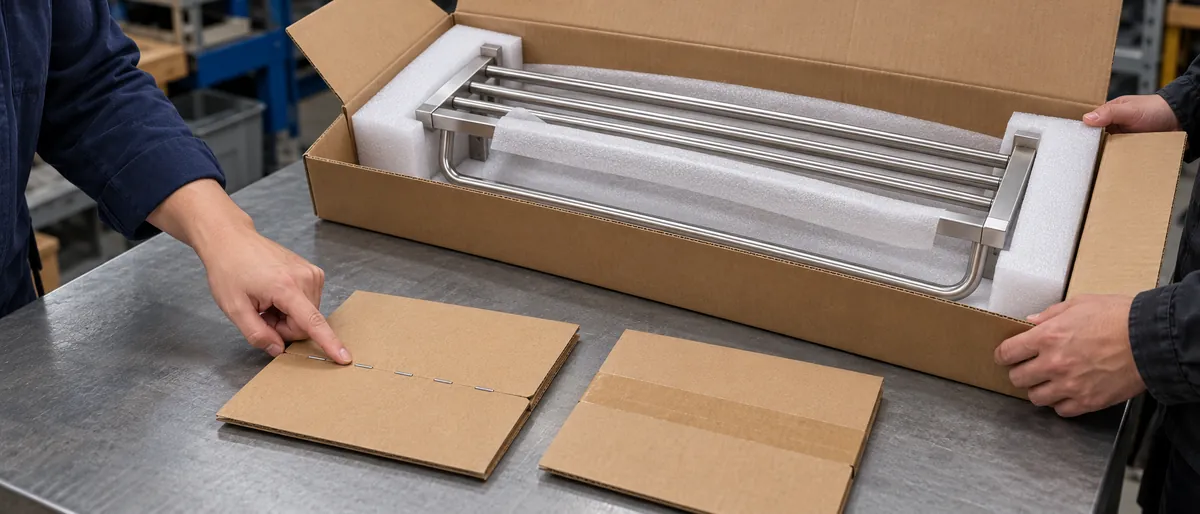
Staples and tape can affect materials, equipment, labor, opening and disposal, but the result is project-specific. A supplier may need a different flap design, a liner, a dedicated tool or extra inspection for one method. Tape application may be manual or machine-assisted and may use different tape constructions. These facts can affect a quotation, but a buyer should compare actual supplier proposals rather than assume that staples are always cheaper, tape is always faster or either method always reduces damage.
Ask for separate cost lines where the decision matters: carton material and conversion, closure consumables, equipment or setup, packing labor, inspection and any one-time tooling. Specify pack quantity and annual or trial volume as applicable, and state whether the quoted method is manual, semi-automatic or automated. A one-off sample price should not be treated as the recurring production cost without clarification.
Environmental claims also need a defined scope. The FEFCO 2025 recyclability factsheet discusses corrugated packaging collection, sorting and recycling systems. It does not grant every staple or tape combination automatic acceptance in every local waste stream. Ask the recipient, carton supplier and local waste handler about the specific carton, closure materials and destination instead of claiming a universal recyclability advantage.
What should the supplier quote and record in the approval file?
An effective packaging RFQ asks for comparable, reproducible proposals. State the SKU, product drawing or representative sample, intended shipping configuration and known recipient constraints. Ask the packaging supplier to identify any carton design or closure details not yet fixed, and to label unknowns as assumptions. Do not make up a load rating, closure strength or damage result based on appearance.
For each permitted option, request:
- Carton drawing and revision, including flap overlap, joint locations and closure path.
- Board construction, dimensions and any liner, insert or protective sleeve.
- For staples: fastener type and length, application location, clinch condition, and how the buyer will inspect exposed metal or contact clearance.
- For tape: tape type and width, application pattern, equipment or hand method, and agreed placement checks.
- Pack quantity, product orientation, included accessories and measured gross mass if available.
- Packing sequence, opening method and any special handling instruction.
- Recipient/channel approval, exception document if applicable, and any destination-specific recycling requirement.
- The proposed sample or test plan, sample count, conditioning and acceptance criteria where established by the buyer.
- Quoted material, consumable, labor, equipment and one-time setup assumptions.
Keep the approval record with the product and packaging revision. A later change to a staple type, tape, flap overlap, carton board, liner, product geometry or packing sequence can change the package. Route that change through the buyer’s review process and decide whether the existing sample or transport evidence still applies. Do not assume the approval transfers automatically to a different SKU or destination.
What is the buyer’s decision rule for carton staples vs tape for heavy products?
Use a simple gate rather than a universal ranking. First, confirm the receiving organization allows the method. Second, confirm the carton and flap design were prepared for it. Third, inspect the packed sample for product clearance, closure consistency and safe opening. Fourth, compare equivalent proposals on the same SKU and route. Fifth, choose additional complete-package testing if the buyer needs evidence beyond fit and assembly. If any gate is unresolved, keep the closure as a supplier question or hold the packaging approval; do not convert an unverified assumption into a production instruction.
For metal hardware, the useful outcome is a documented packaging choice tied to a real SKU, receiving channel and sample revision. The supplier should explain its proposed carton construction and application method, while the buyer owns confirmation of destination requirements and acceptance criteria. This approach lets carton staples vs tape for heavy products be evaluated for its actual use without claiming that staples always outperform tape or that tape is suitable for every heavy carton.
Koitor Hardware is a family-owned custom metal hardware factory focused on bathroom and home-storage hardware. Product geometry, hooks, brackets and finished surfaces can influence how a metal item is separated and protected in a package. Buyers can share a drawing or representative sample to discuss product-side pack-out inputs. Koitor does not claim to manufacture corrugated cartons, operate a stapling line or provide accredited transit-testing services; carton closure construction and performance evidence should be confirmed with the packaging supplier and qualified testing provider where needed.
For broader context, see our information on custom bathroom hardware manufacturing and private-label bathroom accessories. Share the packed SKU, receiving requirements and closure proposal to begin a project-specific discussion.
Review a Hardware Pack-Out
Send the product drawing, packaging revision, destination channel and closure requirements. Koitor can discuss how the metal product geometry affects practical OEM packaging preparation.
OEM / PRIVATE LABEL
Turn this sourcing guide into a product brief
Share your target product, size, finish, order quantity and packaging requirements. Your team receives a practical manufacturability review before quotation.

 English
 Español
 Português
 Français
 Deutsch
 العربية