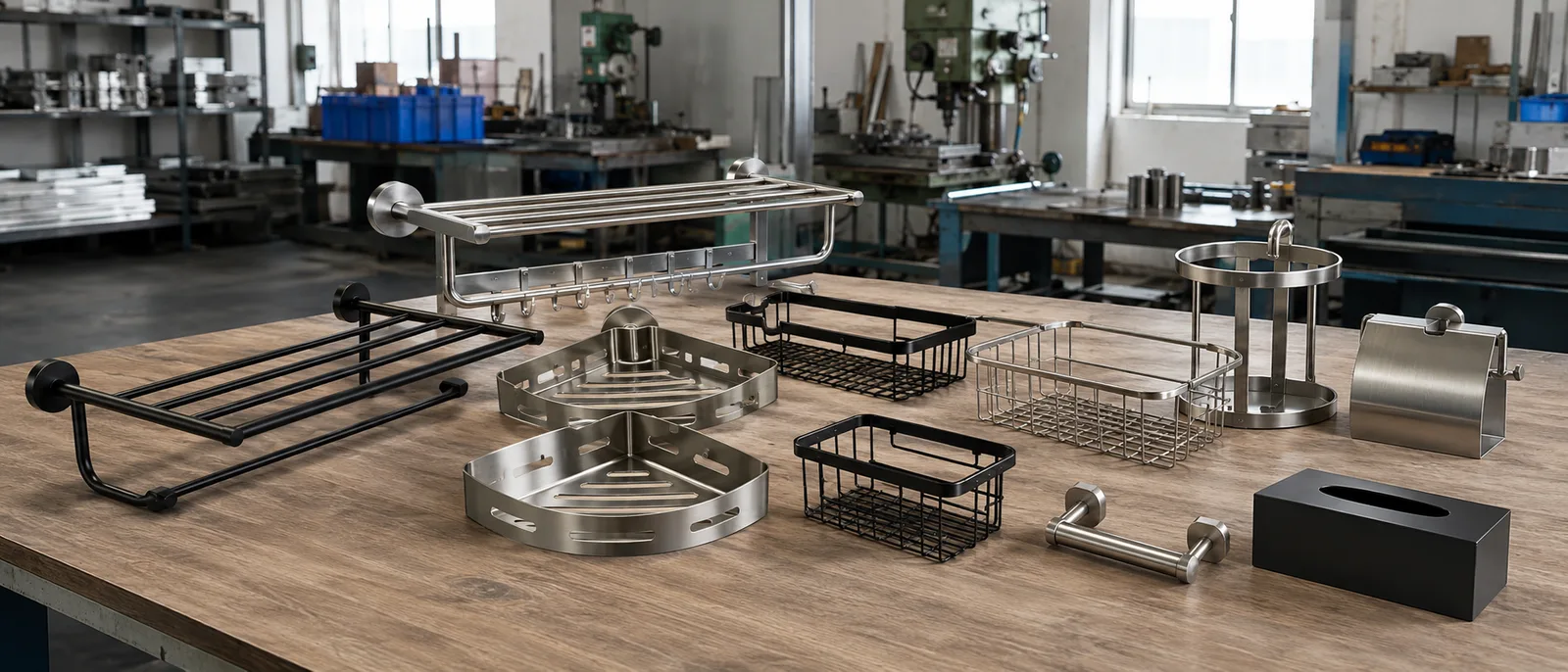
To choose a bathroom hardware manufacturer China importers can work with, check whether the supplier can review product structure, material, finish, sample development, packaging and small-batch OEM needs before quoting. A suitable supplier should not only offer a low unit price; it should help you reduce sourcing risk by asking practical questions about towel racks, shower caddies, tissue holders, wall baskets and other bathroom storage hardware. For overseas buyers, the strongest signal is clear factory communication around drawings, samples, MOQ, lead time and manufacturability.
Bathroom hardware looks simple from the outside, but small design and production details can decide whether the product feels stable, resists daily bathroom moisture better, packs safely and fits the buyer’s target price. A towel rack with weak mounting points may wobble. A shower caddy with poor drainage may collect water. A wire basket with rough welds may look unacceptable on a retail shelf. A carton layout that ignores product edges may create damage during shipping.
This guide is written for importers, distributors, wholesalers, private-label brands and e-commerce sourcing teams that need to compare suppliers for OEM bathroom accessories. It explains what to check before choosing a factory, how to compare direct workshop communication with catalog-only sourcing, and how Koitor Hardware can support practical custom bathroom hardware projects as a small family-owned Chinese OEM workshop.
What Buyer Problem Does This Article Solve?
The main buyer problem is supplier uncertainty. Many overseas buyers can find bathroom hardware photos online, but it is harder to know whether the supplier can turn a drawing, sample or private-label idea into a stable repeatable product. Price lists do not show how the supplier handles welding points, powder coating, polishing, packing pressure, carton layout, sample corrections or small trial orders.
A buyer searching for a bathroom accessories supplier China usually wants answers to several questions at once. Can the supplier make the product category I need? Can it adjust size and structure? Can it work from my sample? Can it discuss finish options without overpromising? Can it support a trial order before a larger program? Can it communicate directly enough that problems are found before bulk production?
For products such as bathroom towel racks, shower caddies, hook bars, hair dryer holders, tissue holders and metal storage baskets, the sourcing risk is often practical rather than theoretical. The buyer needs a supplier that understands how bathroom humidity, wall mounting, daily handling, retail packaging and transportation all affect the final product. That is why supplier evaluation should start with manufacturing questions, not only with catalog style or price.
What Should Importers Check First?
Start with product focus. A supplier that mainly sells unrelated goods may still offer bathroom accessories, but it may not understand the common details of bathroom and home storage hardware. Ask whether the supplier regularly works with towel racks, shower caddies, tissue holders, wire baskets, hook bars and related products. A focused manufacturer is more likely to understand issues such as structure stability, finish consistency, weld appearance, drainage, assembly and packaging protection.
Next, check the quotation input process. A serious supplier should ask for more than a product name. Before a useful quotation, buyers should prepare product size, material preference, surface finish, expected quantity, target market, packaging style, logo or private-label needs and reference photos or drawings. If a physical sample is available, it can help the factory understand proportions, welding positions and finish expectations more quickly.
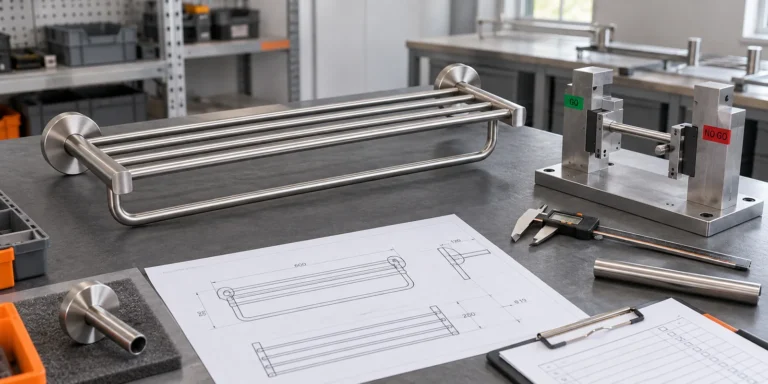
Third, check whether the supplier can discuss manufacturability. In custom bathroom hardware, manufacturability means whether the product can be produced with practical bending, welding, polishing, finishing, assembly and packing steps. A good-looking drawing may still need adjustment if a wire angle is difficult to weld cleanly, a mounting plate is too thin, or the carton plan does not protect exposed corners.
Finally, check response quality. A useful supplier will often ask follow-up questions before confirming price. For example, it may ask whether the towel rack will be wall-mounted or freestanding, whether the basket needs drainage, whether powder coating or stainless steel is preferred, and whether retail packaging or bulk packing is required. These questions are not delays; they are part of reducing production risk.
How Should Buyers Compare Supplier Types?
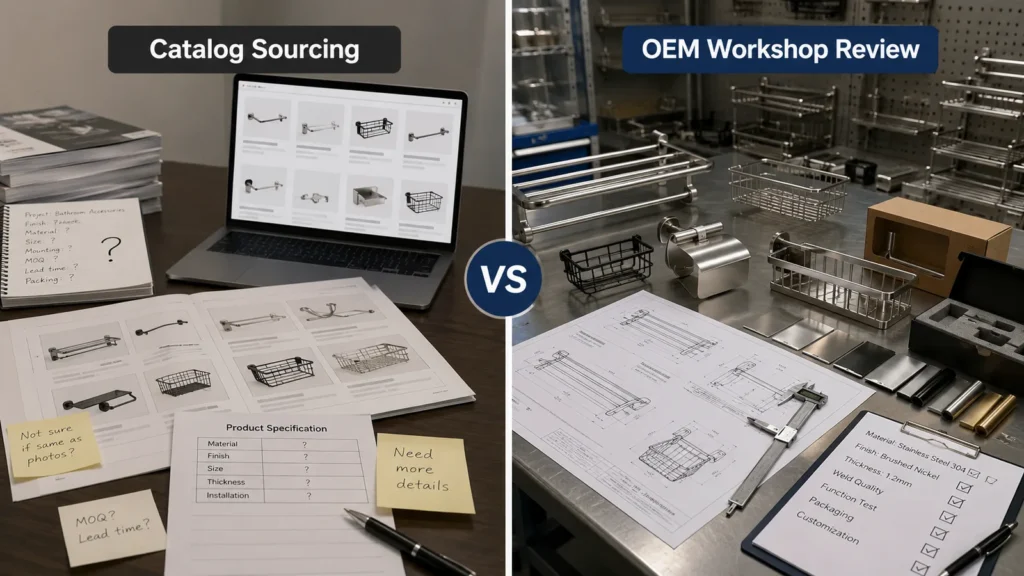
Importers often compare direct manufacturers, trading companies and catalog resellers. Each can be useful in some situations, but the right choice depends on the buyer’s product development needs. When the project involves OEM bathroom accessories, small-batch customization or private-label packaging, direct manufacturing communication becomes more important.
| Supplier Type | Typical Strength | Main Risk for OEM Buyers | Better Fit |
|---|---|---|---|
| Direct small OEM workshop | Practical discussion of structure, sample changes, finish and packaging | May require clearer buyer input before quotation | Custom bathroom hardware, trial orders, drawing or sample-based projects |
| Trading company | Broad product sourcing across many categories | Communication may pass through extra layers before reaching production | Buyers needing many unrelated products from one contact |
| Catalog reseller | Fast product selection from existing items | Limited customization and weaker control over product changes | Simple repeat purchases with minimal changes |
| High-volume mass-production factory | Strong fit for stable high-volume repeat orders | Less flexible for early testing or small custom changes | Mature products with established demand and large order plans |
For a buyer developing a new bathroom line, the question is not only which supplier has more scale. The better question is which supplier can support the current stage of the project. A new towel rack design may need sample adjustment. A private-label shower caddy may need packaging tests and carton review. A wall-mounted basket may need discussion about mounting points and wire spacing. In these cases, a flexible workshop can be a practical starting point.
Koitor Hardware presents itself as a small family-owned Chinese OEM workshop. That positioning matters because the value is in flexible communication, small-batch OEM support and practical review of product details. Buyers can learn more about Koitor’s category focus on the custom bathroom hardware manufacturer page.
How Do Materials, Structure and Finish Affect Bathroom Hardware?
Bathroom hardware is used in humid spaces, handled frequently and often installed on walls or inside showers. Material, structure and finish therefore affect not only appearance, but also buyer complaints, shelf perception and repeat orders.
Material choice should fit the target price level, market expectation and product use. Stainless steel may be chosen for certain bathroom accessories, while powder-coated steel can be practical for many metal storage products when the finish and structure are suitable. The right choice depends on product design, target retail price, finish expectation and buyer requirements.
Structure is equally important. A towel rack should have suitable mounting support. A shower caddy should allow drainage and avoid weak hanging points. A wire basket should have reasonable wire spacing and weld positions. A tissue holder should allow smooth use without sharp edges or unstable movement. These details are often easier to discuss before sampling than after the first bulk order.
Finish should be reviewed carefully because it affects both appearance and perceived quality. Powder coating, polishing and other surface finishing steps can help improve product presentation, but the result depends on preparation, product shape and process control. Buyers should ask how the supplier reviews visible surfaces, welding areas, edges and packing contact points.
Koitor can discuss product structure, welding points, surface finish and packaging method before sample production. For buyers developing towel racks, the custom bathroom towel rack manufacturing page is relevant because towel products often require careful review of mounting, tube or wire size, finish and retail presentation.
What Are Common Mistakes When Sourcing Bathroom Hardware?
The first common mistake is choosing only by price. Price matters, but a very low quotation may hide thinner material, weaker packing, limited finish review or a product structure that does not fit the target market. A better comparison looks at price together with material, finish, sample process, carton plan and communication quality.
The second mistake is sending incomplete RFQ information. If the buyer only sends a product name and asks for the lowest price, the supplier may make assumptions. Later, the buyer may discover that the finish, size, packaging or order quantity does not match expectations. Clear drawings, photos, size targets and packaging notes help avoid this problem.
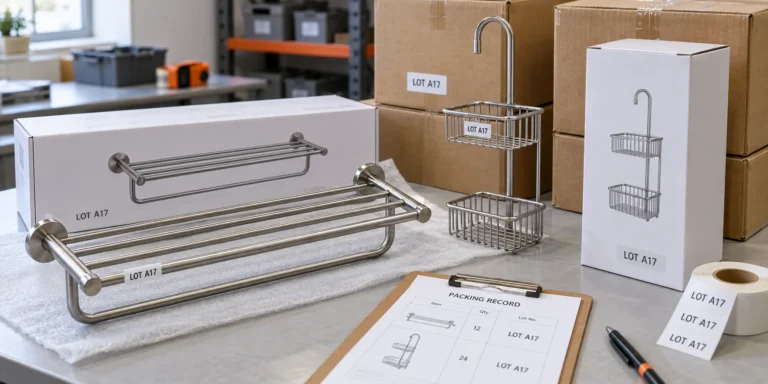
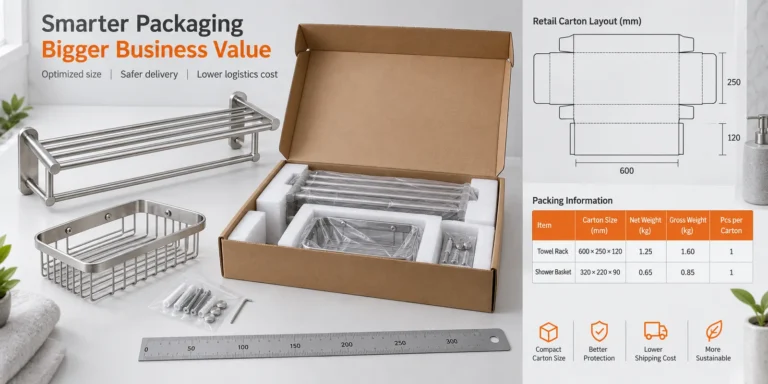
The third mistake is ignoring packaging until the end. Bathroom hardware often has protruding hooks, corners, tubes or baskets. If inner packing is weak, products may scratch each other or press against the carton during transportation. Private-label and retail buyers should discuss color boxes, hang cards, protective inserts, carton quantity and shipping handling before bulk production.
The fourth mistake is treating samples as decoration only. A sample should be reviewed for size, assembly, finish, stability, welding appearance, drainage, edges and packaging fit. If a sample is approved too quickly, small issues may become expensive after production starts.
The fifth mistake is using vague quality language. Instead of asking for a product to be perfect, buyers should define practical checkpoints: visible weld appearance, surface finish consistency, stable assembly, packaging protection and correct size. These checkpoints are easier for both sides to understand and review.
How Can Koitor Support OEM Bathroom Accessories Development?
Koitor Hardware supports bathroom and home storage hardware projects through practical discussion of product details. As a small family-owned OEM workshop, Koitor is suitable for buyers who need direct communication, sample-based development and small-batch customization rather than only an existing catalog product.
For a new shower caddy, Koitor can review basket shape, drainage, hanging method, welding points, coating coverage and packaging. For a towel rack, the discussion may include tube or wire size, mounting plate, screw position, finish, polishing and retail packing. For a metal basket, the review may include wire spacing, basket depth, welding strength, coating area and carton layout.
This kind of review is useful before sampling because it helps identify details that affect cost and production practicality. A buyer may request a small size change, but that change may affect bending, welding, packing or carton quantity. A buyer may request a finish, but the final result depends on material and product shape. A buyer may want a private-label package, but the package must still protect the product during shipping.
Koitor can work from drawings, clear photos or physical samples. MOQ can start from 100 pieces depending on product structure, material, finish and packaging, and sample timing usually depends on confirmed details. These points should be discussed project by project rather than treated as fixed promises.
For buyers developing a broader private-label line, Koitor’s private label bathroom accessories page is a relevant internal reference because packaging, trial orders and repeat supply planning often matter as much as the product itself.
Buyer Checklist Before Requesting a Quotation
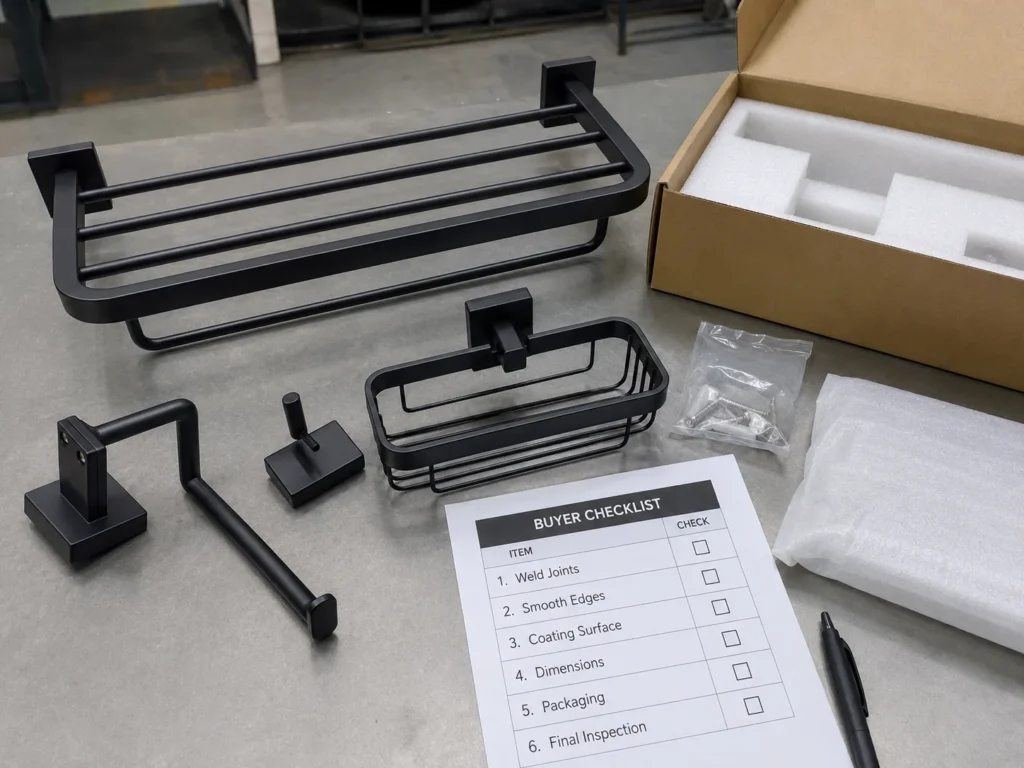
Before asking any supplier for a quotation, prepare enough information for a useful reply. A clear RFQ saves time and helps the factory give practical feedback instead of guessing.
Use this checklist before contacting a bathroom hardware manufacturer China supplier:
- Product type: towel rack, shower caddy, tissue holder, basket, hook bar or other item.
- Product size: length, width, height, tube size or wire diameter if available.
- Product structure: wall-mounted, freestanding, hanging, adhesive, screw-fixed or assembled.
- Material preference: stainless steel, steel wire, tube or other practical option.
- Finish requirement: powder coating, polishing or another surface finish to review.
- Target quantity: sample quantity, trial order quantity and possible repeat order range.
- Packaging requirement: bulk pack, color box, hang card, mail-order pack or private-label pack.
- Logo requirement: product marking, packaging logo or no logo.
- Target market: importer, distributor, retail shelf, e-commerce or project supply.
- Reference files: drawings, photos, physical sample notes or previous supplier problems.
- Quality concerns: rust risk, wobbling, rough welds, coating marks, scratches or carton damage.
- Timeline: sample target date and expected bulk order schedule.
The more specific the RFQ, the easier it is for the supplier to identify cost drivers. For example, a small structure change may be simple, but a special finish or complex packaging requirement may affect MOQ, sample time and production planning. Clear information also helps buyers compare suppliers fairly.
Frequently Asked Questions
What is the most important thing to check when choosing a bathroom hardware supplier?
The most important thing is whether the supplier can discuss manufacturing details before production. Product photos are not enough. Buyers should check whether the supplier can review structure, material, welding points, finish, sample process, packaging and target order quantity.
Is a small OEM workshop suitable for overseas importers?
Yes, a small OEM workshop can be suitable when the buyer needs flexible communication, sample-based development, small-batch trial orders or practical customization. It may be especially useful for new product testing, private-label bathroom accessories and custom bathroom hardware projects.
What information should I send before asking for price?
Send product photos or drawings, target size, material preference, finish requirement, expected quantity, packaging idea, target market and any quality concerns. If you have a physical sample, explain which details should be copied and which should be improved.
Can Koitor help with private-label bathroom accessories?
Koitor can discuss private-label bathroom accessory projects involving products such as towel racks, shower caddies, metal baskets and tissue holders. Packaging, logo needs, sample development and trial order planning should be reviewed according to the project details.
How should buyers reduce risk before bulk production?
Buyers should confirm a sample, review visible finish and welding areas, check assembly or mounting, discuss packaging protection and make sure both sides understand the final specification. For new products, a small trial order can help test the market before a larger program.
Work With Koitor Hardware
Choosing the right bathroom hardware manufacturer China partner is about finding a supplier that can communicate clearly, review practical details and support the buyer’s sourcing stage. For importers, distributors and private-label teams, a strong next step is to prepare a clear RFQ with product drawings, photos, size targets, finish requirements, packaging ideas and expected order quantity.
Looking for a flexible OEM partner for bathroom or home storage hardware? Contact Koitor to send your drawing, sample, size requirement, finish requirement or packaging idea. Koitor can help review manufacturability and prepare a practical quotation for towel racks, shower caddies, metal baskets, tissue holders and other custom bathroom hardware projects.
OEM / PRIVATE LABEL
Turn this sourcing guide into a product brief
Share your target product, size, finish, order quantity and packaging requirements. Your team receives a practical manufacturability review before quotation.
 English
  Español
  Português
  Français
  Deutsch
  العربية