
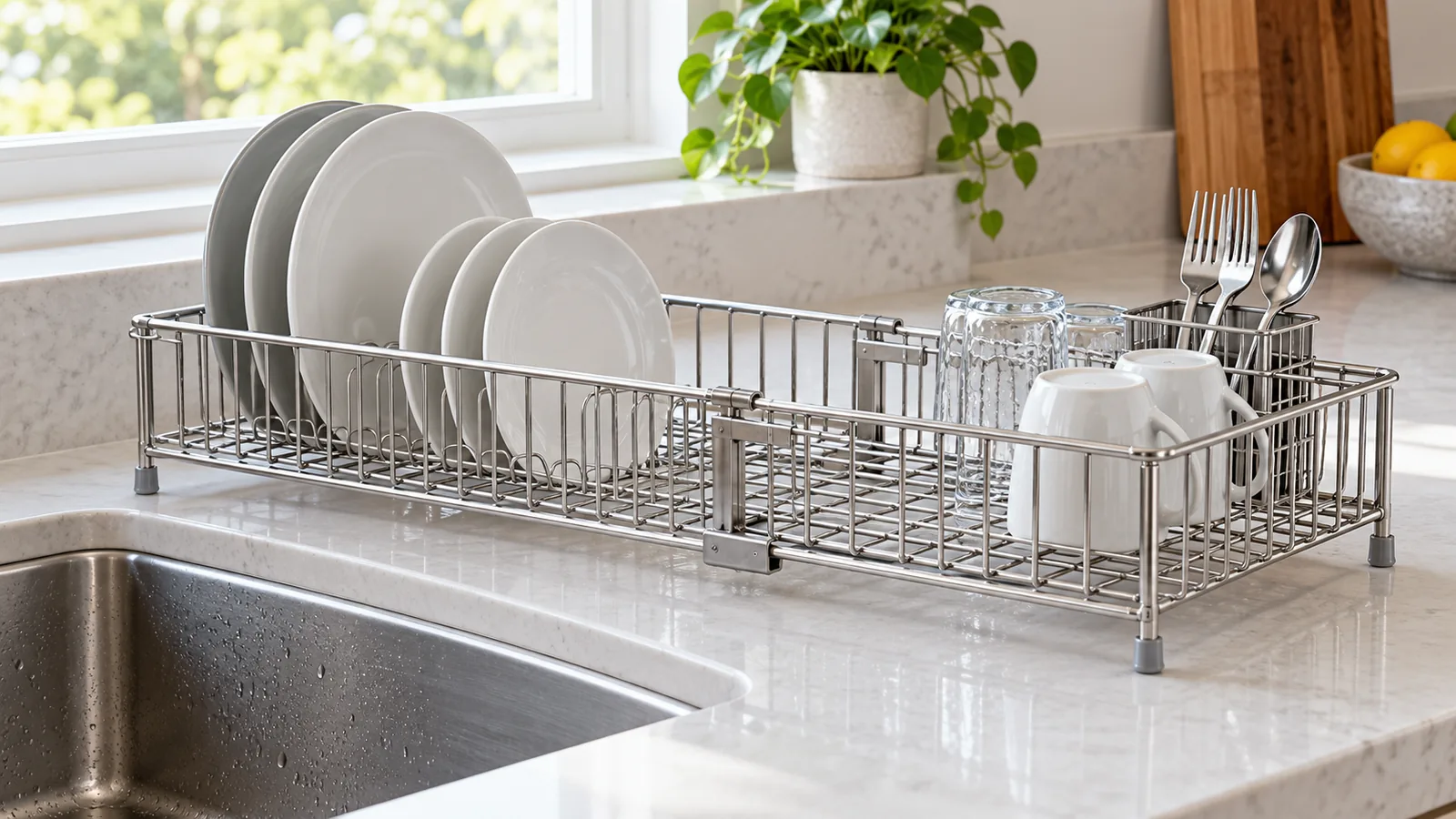
An expandable dish rack design specification should define how the product fits at its minimum and maximum width, how much sliding overlap remains, and what prevents the sections from separating unintentionally. Buyers should also check binding, skew, drainage interference and retention through the full adjustment travel—not only when the sample is stationary in one position. The exact mechanism varies by design, so confirm it from the supplier’s drawing or sample before writing acceptance criteria. This is a buyer-development guide, not a claim that Koitor currently manufactures a particular expandable rack mechanism.
Why does an adjustable rack need a different specification?
A fixed rack has a defined footprint. An expandable model introduces an interface that moves, changes overlap or adjusts support position. A product may fit a wider range of sinks or counters, but only if the adjustment remains controlled and the rack behaves as intended throughout that range.
The buyer’s decision is therefore more specific than “What is the rack’s width?” Clarify the usable minimum and maximum dimensions, the path between them, and what holds the parts together at both extremes. A retailer review of one expandable dish rack reports that the sections can slide apart and become misaligned; this is one user observation, not evidence of a widespread defect or a failure rate. It does, however, illustrate why suppliers and buyers should discuss retention and alignment explicitly. See the Argos product listing and review for that individual signal.
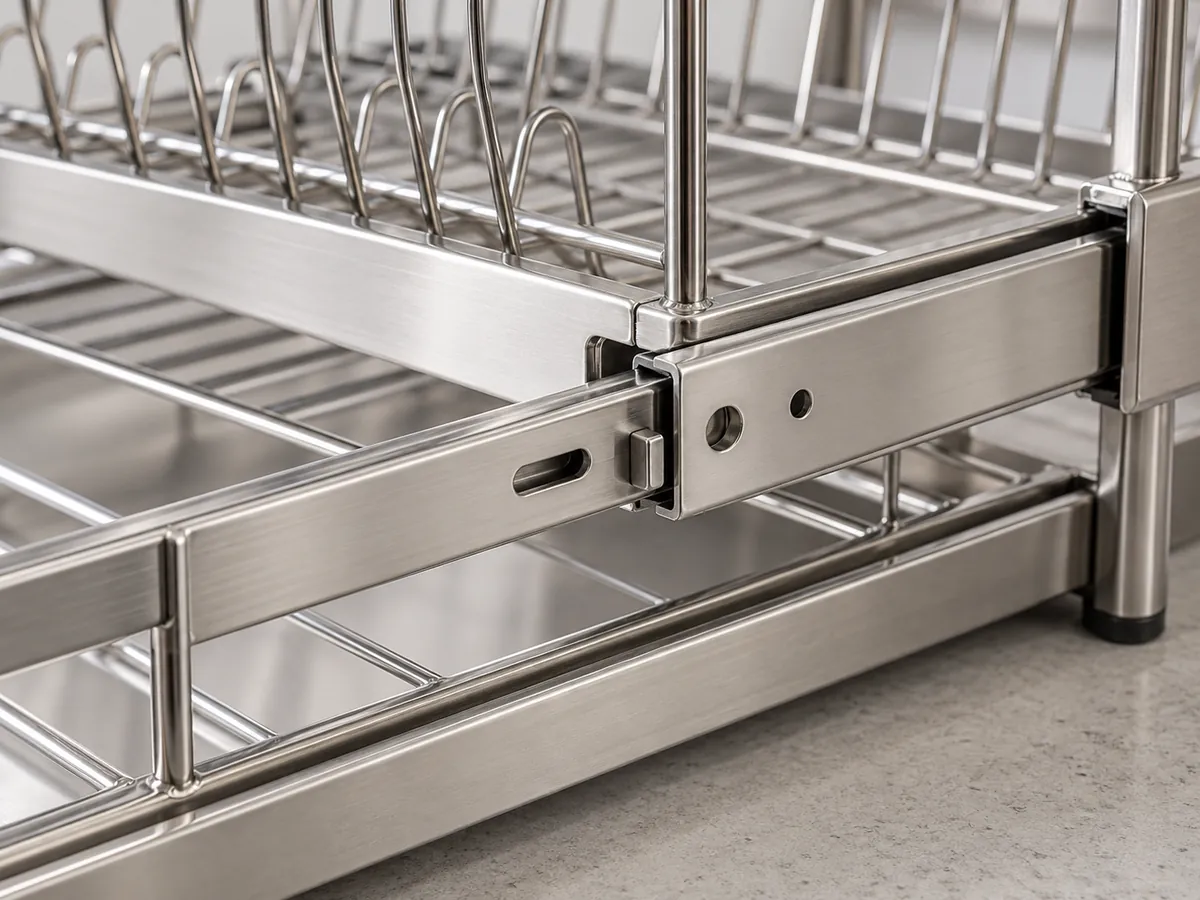
Different products use different arrangements: nested rails, sliding trays, movable supports, telescoping tubes or other mechanisms. Do not assume a particular construction from the word “expandable.” Ask the supplier to identify the moving components and show their relationship in a drawing, exploded view or physical sample. Where the mechanism is not documented, treat it as an open design question rather than filling in the gaps with a guessed engineering solution.
What should the RFQ drawing define?
A useful expandable dish rack design specification starts by describing the product in at least two configurations. The drawing or controlled specification should identify the overall width at minimum and maximum extension, the reference points used for those measurements, the usable travel, and any positions that are not intended for normal use.
The drawing should also distinguish fixed structure from moving sections. Mark critical interfaces, contact surfaces, visible faces and any dimensions that control parallel movement. For a nested rail, this could include the parts that overlap and the feature that limits travel. For an adjustable support design, it could instead identify slots, locking features or support positions. The supplier should confirm which dimensions they can control and which are buyer-defined acceptance features.
Clarify whether the rack is intended to sit over a sink, on a counter, or in another location. Sink rim, faucet, backsplash and counter geometry may affect the usable range. The buyer should specify the intended footprint and clearances rather than assume one rack fits every sink. A broad consumer search may surface shopping listings, while an OEM discussion needs drawing inputs and product-specific fit criteria; the target here is the latter.
How should buyers evaluate sliding fit, overlap and retention?
The sliding action should be reviewed in three ways: stationary at each end of travel, during movement, and under the product’s intended configuration. At minimum extension, check whether the sections remain aligned and whether the stop or joint is fully engaged. At maximum extension, confirm that enough engagement remains to guide the moving section and prevent unintended separation. During movement, observe whether it binds, twists, lifts or requires an awkward operation.
Clearance is a design trade-off. Too little running clearance can make movement sensitive to dimensional variation, surface finish, assembly alignment or debris. Too much can make the product feel loose or allow the sections to skew. The acceptable range depends on the chosen mechanism, geometry, material, finish and intended use. Avoid copying a generic number from another rack into the drawing without checking that it applies to this design.
Retention may be provided by a stop, a latch, geometry, friction or a combination. More friction is not automatically better: a tight slide can be difficult to adjust, while a weak stop may not prevent separation. Ask the supplier to show the retention feature and define how it will be checked. If the design relies on a removable stop or fastener, confirm how it is assembled and whether packaging or user adjustment could dislodge it.
| Buyer decision | What to define or inspect | Why it matters | Limitation |
|---|---|---|---|
| Adjustment range | Minimum and maximum usable width with measurement datums | Prevents ambiguity about intended sink or counter fit | Does not prove stability at either position |
| Sliding engagement | Overlap or guide engagement at extension extremes | Helps maintain alignment through travel | Required amount depends on mechanism and load |
| Running fit | Movement, skew, binding and looseness against agreed criteria | Captures the user-facing feel of adjustment | A sample observation is not a universal tolerance |
| Retention | Stop/latch/geometry and its inspection point | Reduces risk of accidental separation | Does not prove all-use durability |
| Drainage and clearance | Tray, spout, rack and accessory positions through range | Prevents an adjustment from blocking intended drainage or access | Sink and countertop geometry vary |
| Sample identity | Drawing revision, construction and supplier sample record | Connects approval to the part actually reviewed | Does not by itself establish bulk consistency |
What else can change when the rack is extended?
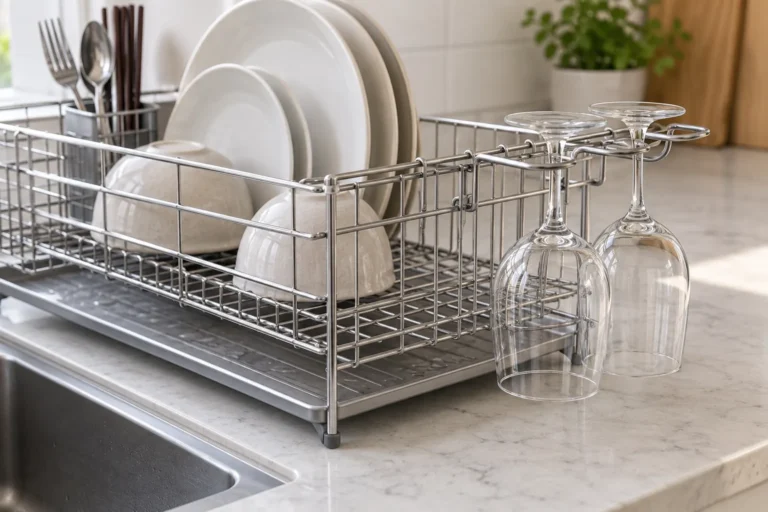
The adjustment can affect more than width. Check whether the rack remains level, whether its feet or supports contact the counter consistently, and whether an off-center arrangement causes one side to lift or twist. If accessories such as a cutlery cup, plate holder or drainage tray move with one section, check their positions in every intended configuration.
Drainage deserves its own review. A spout or sloped tray may align with the sink in one position but miss it in another. Water flow, tray coverage and the location of joints should be assessed for the actual product geometry. Do not claim that an expandable design drains well simply because the sample has a drainage feature; confirm where water travels at minimum and maximum settings.
The contacting surfaces also matter. A finish, coating edge, weld bead, burr or fastener can affect the sliding interface or cause wear if it rubs during adjustment. Identify which surfaces should remain smooth or protected, and ask how the supplier will prevent cosmetic damage during assembly and packing. This is a product-specific design review, not a statement that one material or coating is always suitable.
How should a buyer review a development sample?
Review the sample against the drawing revision and intended use—not as a generic showroom display. Begin at minimum extension, then move through the travel and finish at maximum extension. Repeat from the opposite direction. Note binding, sudden looseness, uneven movement, skew, interference, unintended separation and any stop that fails to engage. Record observations with the condition in which they occurred.
If loading is part of the intended use, the buyer and supplier should agree the load location, distribution, adjustment position and evaluation method before testing. A static check in one position cannot establish behavior during adjustment or prove a service life. Do not invent a universal load value or test duration; product geometry and market requirements differ. For formal safety or regulatory requirements, use the applicable qualified test plan rather than informal sample handling.
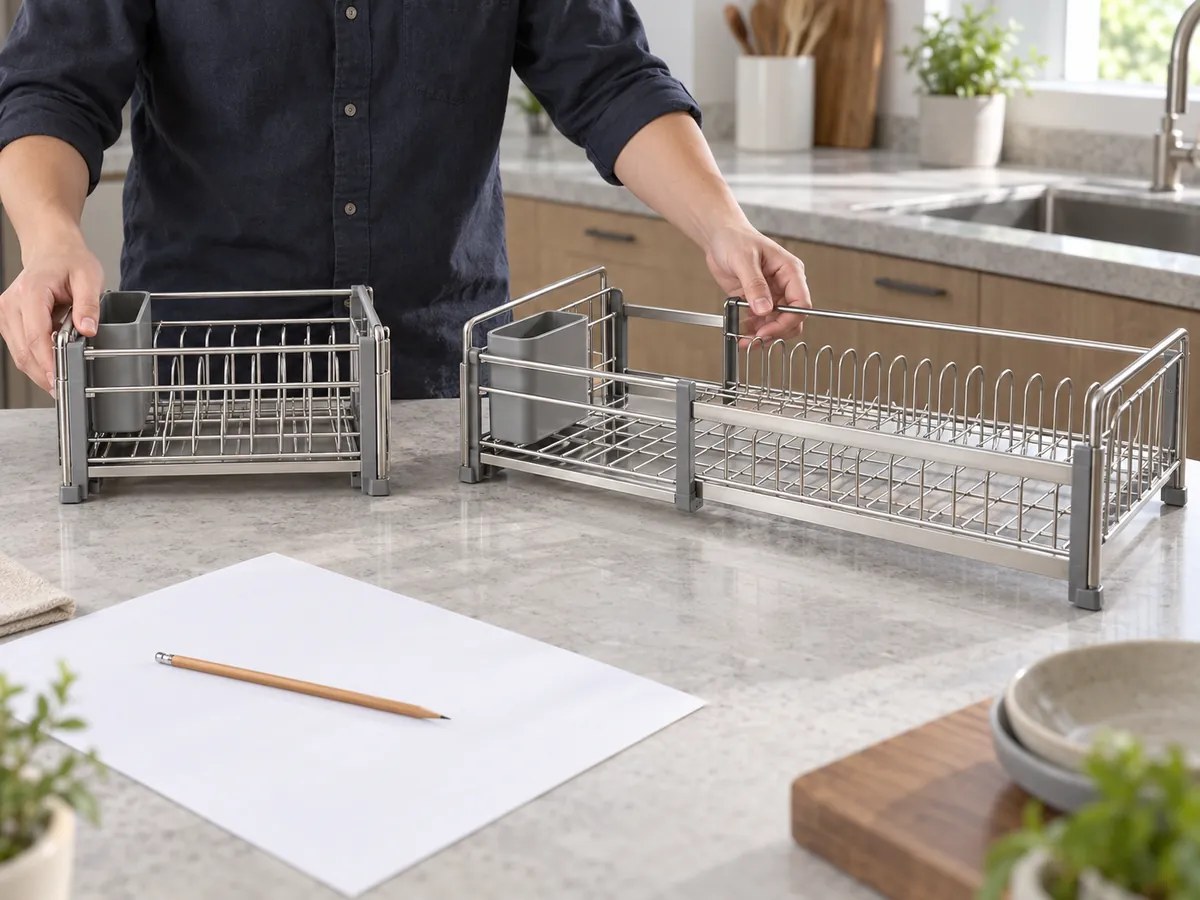
Keep a sample record that identifies the supplier, drawing revision, material/finish assumptions where known, date and unresolved items. If the sample is only a prototype, ask what differs from planned production. A prototype can answer a shape or motion question without proving production tooling, process capability or repeatability.
How can buyers prevent sample-to-production drift?
Approval should attach to an identifiable design and configuration. Record which adjustment range, interface, stop, finish and accessories were reviewed. If the supplier later changes the rail section, stop geometry, fastener, finish or assembly method, determine whether the change affects movement, overlap, retention or drainage—and whether a new sample review is needed.
The change-control list should be practical. It does not need to treat every cosmetic revision as a full redesign, but it should prevent a supplier from replacing a critical sliding feature without buyer visibility. Ask the supplier to document the proposed change and the features it may influence. Then decide whether drawing review, sample comparison or another check is proportionate.
Packaging should preserve the approved adjustment configuration and protect sliding surfaces from impact or abrasion. Confirm how the rack is restrained in the carton, whether moving parts can collide during transit, and whether the end stop can be damaged or disengaged. Packaging tests, when required, should be specified for the actual package and distribution conditions; a generic carton claim does not prove the rack will arrive undamaged.
What should buyers include in the approval checklist?
What mistakes make expandable-rack approval unreliable?
- Checking one width only. A stable-looking rack at the midpoint may bind or separate near an end of travel.
- Leaving travel undefined. “Adjustable” does not say the required minimum and maximum footprint.
- Relying on feel without criteria. Record the buyer’s acceptance observations and the sample condition rather than using only “smooth” or “tight.”
- Assuming all stops work alike. Identify the actual retention feature from the design.
- Ignoring drainage and accessory position. Extension can change where a tray, spout or holder sits relative to the sink.
- Approving an unidentified prototype. Connect the sample to a revision and note differences from planned production.
- Treating one review as proof of a general defect. Individual consumer feedback helps surface questions, not establish prevalence.
These checks help buyers make the review repeatable without implying that a stop, tighter clearance or heavier structure automatically solves every stability concern.
What should an importer put on the approval checklist?
- Product placement and intended sink/counter range.
- Overall width and measurement references at minimum and maximum extension.
- Type of moving interface and the parts that slide or adjust.
- Overlap/engagement and the travel stop or retention feature.
- Agreed observations for binding, skew, looseness and unintended separation.
- Drainage, accessory and faucet/backsplash clearance in intended positions.
- Sample identification, drawing revision and differences from production intent.
- Load/use condition and the test method, if applicable.
- Finish/contact-zone requirements and packaging protection.
- Changes that require notification or renewed approval.
A complete expandable dish rack design specification should connect the drawing, adjustment range, retention feature and sample observations in one approval record. A qualified metal hardware supplier can review drawings, samples, fabrication and assembly constraints in the context of its actual capability. Koitor’s published scope supports general custom metal bathroom and home-storage hardware development, but the company’s current manufacture of this specific expandable dish-rack mechanism is unconfirmed. Do not treat this guide or a generic image as proof that a supplier offers a particular design.
Frequently asked questions
Is there one standard clearance for every expandable dish rack?
No. Clearance depends on the mechanism, dimensions, finish, manufacturing variation and intended movement. Define the interface and have the supplier propose criteria for the specific design, then confirm them with a representative sample.
Does an end stop guarantee that the sections cannot separate?
Not by itself. The buyer should inspect how the stop engages, whether it can be assembled incorrectly or damaged, and what happens at maximum extension. The required check depends on the design and use.
Should an expandable rack be tested only at its widest position?
No. Check the minimum and maximum settings and the movement between them. Intermediate positions may reveal binding or skew that is not obvious at the endpoints.
Does an approved prototype prove mass-production quality?
No. It confirms only the reviewed sample and revision. Clarify its tooling and production differences, then agree appropriate production controls and change notifications.
Does Koitor currently manufacture expandable dish racks?
The available company information does not confirm this specific product or mechanism. Koitor’s profile supports metal bathroom and home-storage hardware OEM discussion; buyers should confirm exact product capability during supplier qualification.
Work With Koitor Hardware
Review a Kitchen Rack Drawing or Sample
Share your drawing or physical sample, adjustment range, intended installation, finish and packaging needs. Koitor can discuss metal storage hardware requirements and OEM fit review; a specific expandable mechanism or product capability must be confirmed.
OEM / PRIVATE LABEL
Turn this sourcing guide into a product brief
Share your target product, size, finish, order quantity and packaging requirements. Your team receives a practical manufacturability review before quotation.

 English
 Español
 Português
 Français
 Deutsch
 العربية