
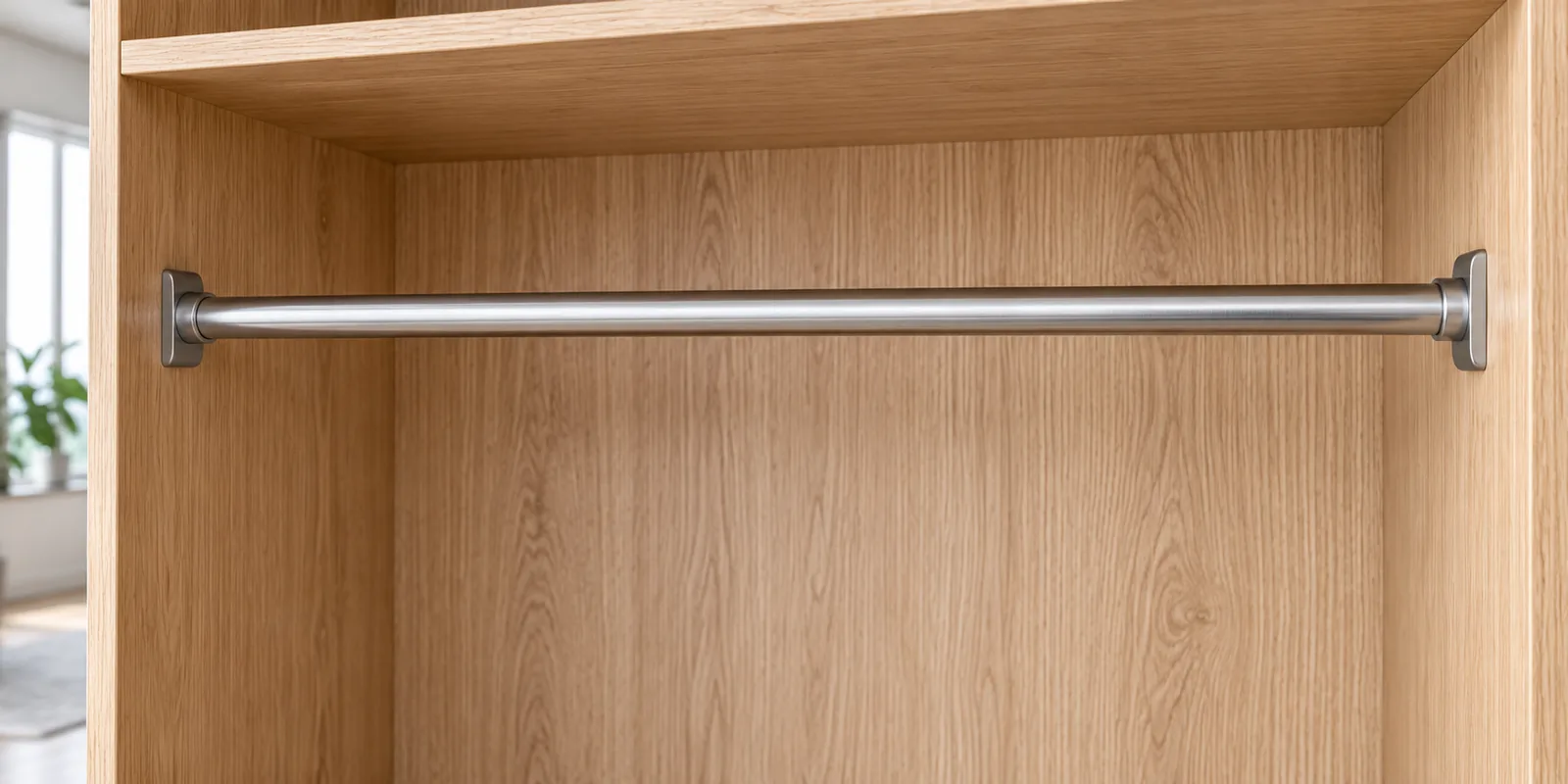
A closet rod weight capacity figure is meaningful only when it describes a defined rail assembly and a stated test condition. For importers comparing suppliers, the number by itself does not tell you the rail profile, unsupported span, support type, mounting condition, load distribution, test duration or measured deflection. Ask for those details before approving a product-page claim or treating two capacity figures as comparable.
This guide is about buyer-side specification and evidence review for wardrobe and closet rails. It is not installation, structural or legal advice. It does not state that Koitor currently manufactures wardrobe rails, tests them, or has validated a load rating. Confirm product scope, engineering ownership, test method and acceptance criteria for each project.
Why a capacity number is not a complete specification
A rail is one part of an assembly. Its response depends on its section shape and dimensions, material and temper where applicable, clear span, end supports, joint fit, cabinet construction, fasteners and the way the load is applied. Two products with the same advertised weight can have different geometry and boundary conditions. A result from one cannot automatically be transferred to the other.
A “maximum load” may also refer to different things: a short static demonstration, a test to a defined deflection, a load held for a specified period, a distributed load across the span, or a product-system test that includes the surrounding cabinet. Unless the supplier names the method and the measured outcome, the figure is difficult to interpret and harder to substantiate.
For procurement, the practical question is not simply “How much can this rod hold?” It is: “What exact product revision was tested, in what assembly and mounting condition, under which loading sequence, for how long, and against what buyer-defined acceptance criteria?”
Define the rail, span and supports first
Put the physical configuration into the RFQ and drawing package. Identify the rail’s section or profile, outside dimensions, wall thickness or material section as relevant, material specification, finish and revision. A round tube, oval tube and folded or extruded profile do not behave as interchangeable parts merely because each is called a wardrobe rail.
Define the clear distance between the effective support points, not just the overall cabinet width. Record the number, position and type of supports and how they attach to the rail and furniture. If a center support is part of the intended system, include it in the approved configuration; if it is not, do not allow a test report to quietly add one. Support spacing guidance published for a particular supplier’s product is product-specific, not a universal rule for every rail.
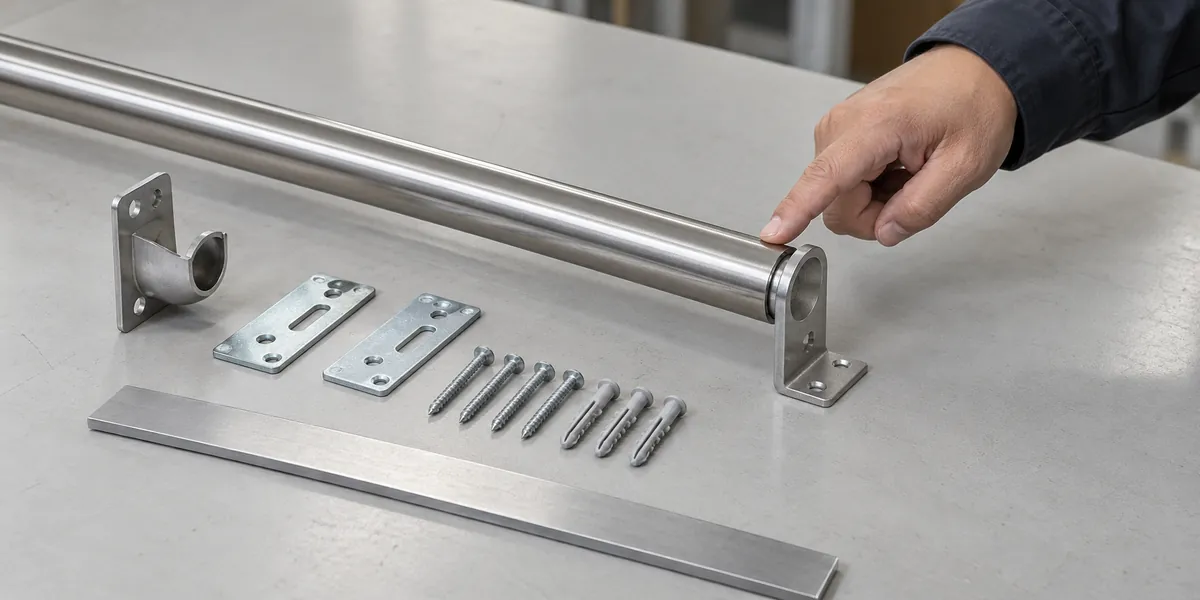
The mounting condition matters as well. A test using a rigid laboratory fixture may isolate rail behavior, while the marketed product may depend on a cabinet side panel, a socket, a screw, an insert or another connection. If the product claim covers the complete wardrobe system, the relevant assembly and mounting interfaces need to be represented or separately assessed.
Separate rail bending from support and cabinet failures
When a loaded assembly moves, several different failure locations are possible. Buyers should ask the supplier to identify which part was evaluated and what was observed.
| What is being evaluated | What to define or observe | Why it is a separate question |
|---|---|---|
| Rail bending and deflection | Rail section, clear span, load distribution, measurement position and residual deformation after unloading | A rail can bend while both supports remain fixed |
| Rail-to-support interface | Socket or bracket type, engagement, rotation or slip, and any visible movement | A sound rail may still loosen at its end connection |
| Support or fastener | Support geometry, fastener, substrate or test fixture, pullout or movement observations | The end support can move before the rail reaches its own limit |
| Furniture or cabinet structure | Panel material and thickness, joint layout, fixing location and cabinet condition | A cabinet-side failure is not a rail-capacity result |
| Finish and appearance | Cosmetic acceptance areas and inspection conditions | Cosmetic change does not by itself establish structural performance |
This separation prevents a buyer from attributing every assembly problem to “weak metal.” It also makes corrective action more useful: a rail profile change, a support redesign and a cabinet reinforcement are different engineering responses.
Specify how load is applied and measured
A comparable test record should state whether the load is distributed along the rail or concentrated at selected points, how the load is introduced, how the rail is supported, and whether the test uses the production-intent assembly. It should identify the measurement locations and the instrument or method used to measure movement. Note the initial position, the loaded reading, the duration at load, the unloaded reading and any visible damage or looseness.
Do not assume that uniform loading represents every use case, or that a concentrated load represents all garment arrangements. The intended customer use and the product claim should determine the test setup. Where more than one loading condition is relevant, define them as separate tests rather than combining unlike results into one headline figure.
A test method may also distinguish immediate deflection from residual deflection after removal of the load. Those are different observations. A rail may move while loaded and return close to its original position, or it may retain a permanent set. Buyers should specify which observation matters to the product requirement and ask that the report preserve the actual readings and setup.

The Japanese Standards Association listing for JIS S 1200:2012 covers strength and durability testing of storage units, including storage furniture attached to buildings or other structures. Its published scope excludes evaluation of aging and deterioration, and the listing shows a confirmation date of 2021. It is not automatically a universal wardrobe-rail requirement for every market or product. Confirm applicability and the current status with the responsible market specialist or test laboratory.
BOKEN’s overview of clothes-rail deflection testing describes a test using the storage-unit support arrangement, a uniformly applied load, a stated duration for metal rails, and measurement of deflection and residual deflection. This is an example of a laboratory’s method and reported evaluation; it is not a Koitor test, a universal pass criterion or proof that a different product system meets a requirement. Buyers should obtain the applicable standard or method, confirm the exact edition and define acceptance with their engineer, customer or chosen laboratory.
Compare supplier claims on the same basis
When a supplier provides a capacity figure, request the supporting record and compare it against the approved drawing and sample. A useful evidence request includes:
Treat each closet rod weight capacity value as a claim tied to one defined configuration, not a transferable property of the product name.
- Product name, drawing number, revision and material or section specification.
- Rail length and unsupported span used in the test.
- Number, position and type of end or intermediate supports.
- Support-to-rail connection and the mounting fixture or furniture substrate.
- Load amount and placement pattern, including whether it was distributed.
- Loading sequence, hold duration and any repeated cycles.
- Measurement locations, method, loaded deflection and residual deflection.
- Observed rail movement, interface slip, fastener movement, damage or permanent set.
- Test date, responsible organization, report identifier and any deviations from the requested setup.
- The exact product claim the buyer intends to make and the acceptance rule used to approve it.
If a report omits a detail, mark it “not stated” and ask for clarification. Do not fill the gap with an assumption based on a supplier’s catalog, a different rail size or a test image. A test report should be traceable to the same drawing revision, support kit, finish or other feature that can affect the tested assembly.
Make sample approval representative of the order
A hand-selected prototype may differ from production in dimensions, joints, material, finish or assembly. During sample approval, record the sample identifier and configuration and agree which characteristics must remain controlled in bulk production. If a rail section, support, fastener, furniture interface or source material changes, assess whether the evidence still applies before continuing with the original claim.
The production-intent sample should use the intended rail and support arrangement. The buyer and supplier should agree who provides the fixture, who conducts or witnesses the test, which measurements are recorded and who approves the report. Formal testing or numeric acceptance criteria should come from the buyer’s market requirements and the responsible engineering or test source; they should not be improvised from a consumer guide.
Change control is important after approval. A shorter span, an added center support or a thicker section may sound like an improvement, but it changes the tested configuration. A change can require a new assessment, drawing revision, claim review or customer approval. Keep the decision and its reason with the sample and order records.
A concise RFQ and claim-review checklist
Before requesting quotes, send a drawing or clear dimensional specification that identifies the rail profile, intended clear span, support layout, mounting condition, finish and revision. Ask suppliers to state what they can manufacture and what they would need clarified. Do not ask for one free-standing “capacity” value without defining the configuration it applies to.
Before approving a supplier claim, confirm that the evidence represents the product revision and assembly being sold. Compare span, support placement, load pattern, test duration and measurement method across suppliers. If those conditions differ, label the claims “not directly comparable” rather than ranking the larger number as automatically better.
Before release, define the product’s intended market and the acceptance criteria with the relevant engineer, customer or laboratory. Confirm whether the claim applies to the rail alone or the complete wardrobe assembly. Keep the approved drawing, sample record, test evidence, product-copy wording and later changes linked by revision.
For teams sourcing adjacent home-storage metal hardware, Koitor’s OEM home-storage hardware overview explains its established product scope. Wardrobe rails are an adjacent category; confirm project fit and capability directly instead of assuming this article describes a current Koitor SKU. For a project-specific manufacturing discussion, contact Koitor with the drawing, support arrangement and evidence requirement.
Practical takeaway for importers
Keep a version-specific evidence folder for each approved rail configuration. It should link the drawing and bill of materials to the sample identification, support hardware, test setup photographs, raw readings, final report and the wording authorized for the catalog or package. Record who approved each item and when. If a supplier later changes the tube source, section dimensions, support socket, fastener or cabinet interface, compare that change with the test scope and determine whether engineering review or retesting is needed. A report without a reliable product-revision link may still describe a test, but it cannot safely substantiate a different configuration by assumption.
Can I compare two suppliers by the higher load figure?
Only if the evidence shows that the tested configurations and measurement conditions are sufficiently comparable for the buyer’s purpose. Compare rail profile and dimensions, clear span, support arrangement, mounting fixture, load distribution, hold time and measured outcomes. If one supplier reports a rail-only test and another reports a complete cabinet assembly, their headline values answer different questions. Mark the comparison inconclusive and request aligned evidence instead of treating the larger number as proof of a better product.
Does adding a center support automatically make the claim better?
An added support changes the rail’s effective spans and the assembly load path, so it may change measured movement. It also changes the product configuration, installation requirements, component count and potentially cost or appearance. That does not mean a center support is always necessary or that it validates an existing claim. Evaluate the intended design and test the configuration that will actually be sold; keep any supported and unsupported versions clearly distinguished in the product record.
What should a buyer do when a supplier provides a result but no method?
Ask for the test method or protocol, product revision, fixture description, support and mounting details, load placement, duration, measurement locations and observed loaded and unloaded condition. If some details are confidential, ask for a suitable summary or independent report that still identifies the tested configuration and limitations. Do not create a pass threshold from an incomplete report. Have the responsible engineer, customer or laboratory define what evidence and acceptance criteria are appropriate for the target market and product claim.
A defensible closet rod weight capacity claim is tied to a defined product and test setup—not a number copied from a similar rail. Specify the profile, span, support and mounting arrangement; define load placement, duration and measurements; separate rail deflection from support and furniture failure; then verify that the report matches the approved sample and production revision.
Where the method, market requirement or acceptance limit is uncertain, hold the claim for review by the responsible engineer or test laboratory. This disciplined comparison helps buyers make supplier decisions without turning one product-specific result into a promise for every wardrobe rail.
Review a Home-Storage Hardware Brief
Share a drawing, sample configuration and required evidence. Koitor can discuss established bathroom and home-storage metal hardware scope; wardrobe-rail capability and testing must be confirmed for each project.
OEM / PRIVATE LABEL
Turn this sourcing guide into a product brief
Share your target product, size, finish, order quantity and packaging requirements. Your team receives a practical manufacturability review before quotation.

 English
 Español
 Português
 Français
 Deutsch
 العربية