

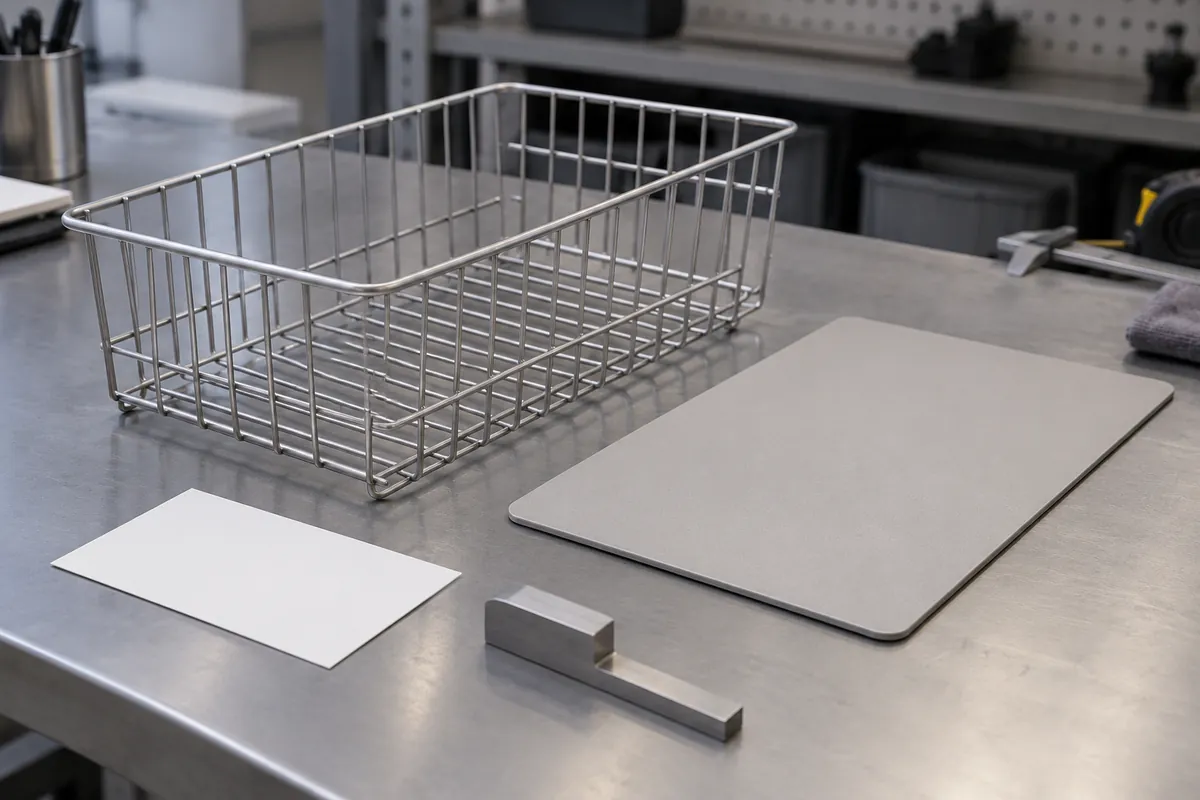
A solid base insert for pull out wire basket should be approved as a matched accessory for one identified basket revision, not selected by nominal width alone. Before a buyer adds it to a kitchen-storage range, the basket supplier and insert supplier need to agree on usable inside dimensions, edge shape, retention, moving-part clearance, intended contents and who owns the finished combination. A representative sample should be checked inside the actual basket and cabinet or drawer envelope. The insert may change what small items can sit on the basket floor, but it does not by itself change the basket’s rated capacity or establish any food-contact, temperature or cleaning suitability.
Why Add a Rigid Base to an Open-Wire Pull-Out Basket?
Open wire construction can make a storage basket visually light and leave gaps through which very small objects, crumbs or loose packaging may pass. A buyer may therefore consider a removable rigid base as an accessory, or compare it with a basket model supplied with a solid bottom. These are separate product configurations. A wire basket with a loose insert is not automatically equivalent to a basket designed and manufactured with a permanent or integrated solid floor.
The difference matters commercially as well as technically. The insert could be bought from the basket manufacturer, sourced from a second component supplier, or omitted from the range. Each arrangement changes quotation scope, packaging, replacement responsibility and sample approval. The buyer should describe the complete offer to the customer and state whether the insert is included, optional or sold as a separate SKU. Product photography, assembly instructions and carton contents should all agree with that decision.
There is a real user question behind this configuration: one household discussion described small items and food debris slipping through a wire pull-out basket and asked whether a solid-base liner existed. That single discussion is a problem signal, not evidence that the issue is widespread or that all wire baskets need an insert. For a B2B buyer, the useful next step is to check the intended merchandise and the exact basket design rather than turning one anecdote into a universal product requirement. See the example buyer question.
Define the problem before choosing the accessory. Is the goal to keep small packaged items from dropping through, create a flatter shelf for containers, protect a cabinet surface, simplify cleaning, or offer a different appearance? Those goals can point to different insert boundaries and material requirements. If the buyer has not identified the intended contents and use conditions, the supplier cannot meaningfully assess coverage, edge clearance or handling.
Which Basket and Insert Dimensions Belong in the RFQ?
A nominal basket width is a product-family label, not necessarily the usable floor dimension. Wire position, corner radius, side-wall angle, welds and manufacturing variation can reduce the flat area available to support an insert. For the solid base insert for pull out wire basket configuration, issue the basket drawing or a clearly identified physical sample and mark the surfaces or datums from which dimensions should be taken.
Record at least the basket SKU and revision, the usable floor length and width, corner shape, side-wall taper, wire locations near the floor, and the intended insert coverage. State whether the insert should sit inside the perimeter, overlap a supporting rail, or be retained by a feature. These are design options, not interchangeable assumptions. An insert that is too small may move or expose gaps; one that is too large may bow, catch on the sides, or prevent the basket from moving through its normal travel.
Also capture the complete motion envelope. A pull-out basket may move on slides, runners or another cabinet interface. The added base can raise the stored goods and change clearance to a shelf above, a cabinet frame, a neighboring basket or a closing door. Ask the system supplier to confirm the available clearance from the actual installation drawings or sample. Do not assume that a tray fitting inside the basket will also clear every surrounding cabinet part.
| Buyer input | What to identify | Sample-review question |
|---|---|---|
| Basket identity | SKU, drawing revision and sample reference | Is this insert matched to the approved basket version? |
| Usable floor | Inside length, width, corners and wire supports | Does it sit flat without rocking or forced bending? |
| Movement envelope | Slide travel, cabinet opening and overhead clearance | Does the loaded configuration move without interference? |
| Accessory ownership | Responsible supplier, material specification and replacement route | Who approves changes to the insert or basket interface? |
Use a dimensioned drawing for the repeatable requirements and annotate the sample for visible features that are difficult to communicate in a simple outline. If the basket and insert come from different suppliers, send both suppliers the same controlled interface data. Keep the buyer or brand owner responsible for choosing the required outcome; do not ask one supplier to infer another supplier’s undocumented dimensions.
How Should Buyers Compare Coverage, Edge and Retention?
Coverage is a balance between useful flat area and drainage, cleaning, weight, access and movement. A full-floor insert may cover more openings but can also conceal wire intersections and collect residue if its shape does not allow the intended cleaning method. A partial insert may leave some openings exposed but can be easier to remove or may preserve access to the basket structure. The correct choice depends on the product brief, not on a universal rule that full coverage is always better.
Define the edge condition explicitly. Buyers can ask suppliers to show whether the perimeter is flat, turned, radiused, hemmed or otherwise finished, and whether any edge is intended to locate against the basket. Specify acceptable exposed edges and contact points, especially where users may lift or remove the accessory. A close-fitting lip may help locate an insert in one design but could snag on a basket wire or reduce the usable opening in another. Treat geometry as a proposal for review until the actual sample is tested in the intended basket.
Retention can range from a simple gravity fit to a designed clip, tab, molded feature or separate fastener. Each approach has different assembly and replacement implications. A loose insert may be simplest to remove, yet may shift when the drawer accelerates or when products are taken out. A positive retention detail may improve location but add components, assembly steps or cleaning crevices. Ask for the proposed method and agree how it will be evaluated; do not rely on a photograph to establish that the accessory remains positioned during use.
Material should be selected by the accountable supplier and buyer against the intended environment, contact requirements, cleaning routine, appearance, temperature exposure and packaging. Do not assume that a rigid insert is plastic, acrylic, wood or any other particular material just because similar retail products use one. Koitor’s verified manufacturing scope is metal bathroom and home-storage hardware; manufacture of this rigid insert material is not confirmed. Koitor can discuss the metal-basket interface and project coordination, while the responsible insert supplier should provide material information and any evidence needed for the buyer’s requirements.

When the buyer’s goal is to hold a particular class of items, test with representative package dimensions and orientations. A flat insert does not guarantee that goods will remain in place, and the presence of an insert does not establish a load rating. Any structural or performance statement should come from the supplier responsible for the complete configuration and from an agreed, documented test where needed.
What Should the Complete Sample Check Cover?
Approve the insert with the identified basket, not as a loose component on a desk. Record the basket revision, insert sample identity, reviewer, date and any open issues. Start with an unloaded fit check, then repeat the relevant checks with representative contents and the actual cabinet or drawer setup when available. The purpose is to observe this project’s chosen configuration, not to imply that a brief sample exercise proves long-term performance under every condition.
- Seating: Does the insert rest at the intended level and contact the planned support points without rocking or being forced into shape?
- Edge fit: Are the edges accessible for removal, free of unwanted catching, and consistent with the approved drawing or sample?
- Movement: Does the basket move through the intended travel without the insert contacting cabinet parts or neighboring products?
- Retention: Does the chosen method keep the insert in the intended location during the buyer-defined handling check?
- Use: Do the representative items fit as intended, and are any limits on size, orientation or use documented?
- Cleaning and care: Has the responsible material supplier provided suitable instructions for the buyer’s intended cleaning conditions?
- Packaging: Does the pack protect the insert from scratches, deformation, contamination or movement against the metal basket?
- Identification: Can the buyer distinguish the approved basket/insert combination from other sizes and revisions?
For repeated evaluations, use a short record sheet with pass/fail or open/closed responses and an observation field. Do not record “fits” without identifying which basket, which revision and which sample were used. If the insert is trimmed, bent or otherwise adjusted to fit during review, the adjusted version must be treated as a new sample; it is not evidence that the original design was acceptable.
Review packing as part of the sample. A rigid part can rub against a finished wire surface or shift inside a carton. A protective film, separator, bag, formed insert or other method may be considered, but the chosen material and arrangement depend on the component supplier and package design. Confirm the retail unit contents, orientation and removal sequence, then assess the actual packed sample. Do not assume that more packaging is automatically safer or more economical.
How Should Two Suppliers Share Responsibility?
When the basket and insert are sourced separately, nominate an interface owner. The brand or importer should control the product brief and final approval; each supplier should confirm its own part, process and supporting information. One supplier should not silently change the other supplier’s dimensions or material. Send the same approved drawing, change notice and sample photographs to both parties, and record who must be notified if either component changes.
Clarify the commercial scope in the RFQ and quotation. List whether the basket supplier is quoting only the metal basket, a complete basket-and-insert set, or project coordination with a sourced accessory. Identify who packages the pair, who supplies replacement parts, and how the insert will be ordered and identified. If the second supplier cannot work to the buyer’s packaging or revision system, resolve that before the first production release.
Use a configuration record that binds the basket part number, insert part number, drawing revisions, packaging version and approval date. At a minimum, a purchase order or controlled specification should identify the exact combination. Treat the solid base insert for pull out wire basket as a configuration-specific line item, not an interchangeable accessory without revision control. If the insert changes but the basket does not, confirm whether fit, movement, instructions, pack arrangement or product photography need review. If the basket changes, check whether the insert supplier needs a new sample or dimensional confirmation.
For an OEM metal basket program, a buyer can share the basket drawing or physical sample and explain the intended accessory arrangement with the custom metal storage basket team. This is a metal-basket review and coordination conversation, not a claim that Koitor manufactures every insert material or pull-out cabinet system. The Koitor contact page can be used to send the project brief.
What Mistakes Make the Configuration Hard to Reorder?
- Buying by nominal size alone: Confirm usable dimensions, corners, supports and revision before ordering.
- Treating a retail image as a specification: Photographs do not establish dimensions, material, fit tolerance or included parts.
- Assuming an insert is included: State whether it is supplied, optional or excluded in the SKU and quotation.
- Approving the insert separately: The complete basket-and-insert combination is the relevant fit sample.
- Ignoring movement: Basket-only fit does not prove clearance inside the actual cabinet envelope.
- Assuming an insert changes capacity: Keep basket capacity and insert performance as separate claims unless the responsible supplier verifies the complete configuration.
- Leaving material and cleaning assumptions unstated: Ask the accountable insert supplier for project-specific material and care information.
- Failing to control revisions: A replacement insert or revised basket can change the fit even when the marketing name remains the same.
- Letting pack artwork outrun the sample: The package should show and list the approved configuration, not a proposed option that has not been released.
These controls are particularly useful for trial orders and small-batch programs. A smaller order does not remove the need to identify the approved version. It can make a concise interface record more valuable because product development, purchasing and packaging decisions may be handled by a limited team. Keep the record practical: the objective is to make the next order comparable, not to create paperwork that does not affect the buyer’s decision.
Buyer Checklist and Frequently Asked Questions
- Identify the basket model, drawing revision and representative sample.
- Measure the usable floor and mark the dimension datums.
- Define insert coverage, edge form, support and retention expectations.
- Confirm the cabinet, slide and neighboring-product movement envelope.
- Describe intended contents, handling and cleaning conditions.
- Assign insert material documentation and supply responsibility.
- Approve fit, movement, retention, packaging and identification as one configuration.
- Record the approved part numbers, revisions and change-notification route.
Does a solid insert make every wire basket suitable for small items?
No. The fit, coverage, edge gaps and retention depend on the actual basket and insert design. Buyers should evaluate the intended contents in a representative sample and specify any limits that matter.
Can buyers use a universal insert size?
A nominal size may help screen options, but it does not establish fit. Confirm the basket’s usable interior, corners, support locations and revision before release.
Does the insert increase the basket’s load capacity?
Not by itself. Keep the metal basket’s capacity and the insert’s intended use separate unless the supplier responsible for the complete configuration provides applicable evidence.
Who should provide material and cleaning information?
The supplier responsible for the insert material should provide information relevant to the intended use and cleaning conditions. A buyer should not infer suitability from appearance alone.
What should a buyer send for a quotation?
Send the basket drawing or sample, target insert coverage, dimensions, intended contents, movement envelope, material expectations, packaging needs and required approval records.
Is a photograph enough to approve a sample?
A photograph can document a condition, but it cannot replace a physical fit and movement review when those interfaces are the buyer’s decision criteria.
Work With Koitor Hardware
Review a Wire Basket and Insert Interface
Share the metal-basket drawing or sample, basket revision and intended rigid-insert configuration. Koitor can review the metal basket and discuss the project interface within its supported manufacturing scope.
OEM / PRIVATE LABEL
Turn this sourcing guide into a product brief
Share your target product, size, finish, order quantity and packaging requirements. Your team receives a practical manufacturability review before quotation.
 English
 Español
 Português
 Français
 Deutsch
 العربية