

A folding laundry drying rack should be compared in three separate states: its usable open drying layout, its folded storage envelope, and the export carton for the exact packed SKU. A product photo or one overall dimension cannot answer all three. For an importer, the practical approval method is to define the intended laundry assortment, record open and folded dimensions on the same configuration, and confirm how that configuration is protected and packed before purchase-order release.
What problem does this comparison solve?
Catalogs often describe drying space with different measures. One listing may show total wire length, another the outside width, and a third the size after folding. These numbers answer different questions. The buyer needs enough usable positions for the intended assortment, a footprint that fits the planned room or sales channel, and a packed unit that matches warehouse, parcel, pallet, or container assumptions.
A buyer may compare two quotations and think one model offers more capacity because it is wider. Yet a wider frame can use a different number of bars, have a different height, or fold into a thicker bundle. If the supplier quotes an assembled sample but packs production partially disassembled, the carton can change again. Make the comparison about one named configuration rather than a category-level claim.
The method in this article is for freestanding folding airers. It is not a consumer ranking, a universal product standard, or evidence that one design dries clothes faster. Koitor’s current approved product information does not confirm a clothes-airer product. The article therefore presents a buyer-side specification process rather than a claim about Koitor’s product range.
Which open dimensions describe usable drying space?
Start with the load the retailer expects the customer to hang or lay flat. For each folding laundry drying rack offered, record which configuration provides that usable layout. A compact apartment assortment may prioritize shirts and towels; a family-oriented model may need longer garments or more bars. Translate the intended use into observable layout questions before comparing offers.
Record the overall open width, depth, and height for the exact sample. Then ask the supplier to identify the usable length of each bar or rail, how many bars are available in each position, which wings or arms move, and whether accessories are included in the quoted SKU. Overall outside dimensions describe the footprint, not the usable drying surface.
Use a simple drawing or annotated product photo to distinguish:
- outside width, depth, and height when fully opened;
- usable length on each drying bar or wire;
- number and position of bars, wings, shelves, or accessory rails;
- clearance for the intended garment length and hanger type;
- any setup position that must be used to reach the quoted layout.
Avoid using the maximum open configuration as the default if it requires optional extensions or a different SKU. A model-specific product page from IRIS USA, for example, describes extendable rods and a folded profile for that particular rack. Those details illustrate why the configuration must be named; they are not category requirements or a benchmark for another supplier.

When comparing a foldable clothes airer, separate the usable layout from advertising language such as “large capacity.” If a supplier provides a capacity number, ask which model, test setup, load distribution, and use conditions support it. Do not infer a buyer-acceptable rating from a product image, number of rails, or a broad product-family page.
How should buyers compare open size, folded size, and carton size?
Keep the product dimensions and package dimensions in separate rows. A folded product may still be too long for a selected retail carton; a compact product may require disassembly, protective inserts, or a different pack count. Ask for measurements from the actual proposed arrangement, rather than calculating package size from a product photograph.
| Comparison item | Record for the approved model | Buyer decision it supports |
|---|---|---|
| Open footprint | Width × depth × height in its normal setup | Does it fit the intended use and retail positioning? |
| Usable layout | Bar count and usable length by position | Does the arrangement match the target garment assortment? |
| Folded envelope | Height × width × thickness, with removable parts noted | Can it be stored or handled as represented? |
| Packed unit | Carton length × width × height, pack count, net/gross weight if supplied | Does the actual SKU fit shipping and warehouse assumptions? |
| Pack configuration | Assembled, partly disassembled, nested, or accessory-packed | Does the buyer understand the assembly and protection steps? |
| Revision reference | Model code, drawing revision, finish, accessory set | Does the quotation match the approved sample? |
An OEM catalogue or supplier page may show open dimensions, folded dimensions, carton size, and pack quantity in one specification. Treat each entry as a model-specific declaration. Ask the supplier to confirm which values apply to the offered version and whether a carton measurement includes the retail box, master carton, or another pack level.
For a usable comparison, ask for a dimensional drawing or a marked-up sheet with the rack shown open and folded. The buyer and supplier should agree where each measurement starts and ends. For example, specify whether a protruding cap, caster, wing, handle, or locking tab is included. If the buyer will stack cartons, the carton’s outer dimensions and orientation matter more than an assumed folded thickness.
Do not calculate final freight or container quantity from a nominal unit box alone. Confirm the shipping pack level, master-carton quantity, pallet pattern if relevant, and whether protective pieces alter the outer dimensions. A supplier’s case pack may depend on the order’s finish, logo, accessory set, or assembly state. These variables should be resolved in the quotation and packing specification, not inferred after production.
What should the buyer inspect on the sample?
The sample review should use the same configuration, revision, finish, hardware, and intended carton plan as the quotation. Record whether the sample arrived assembled, partly assembled, or flat-packed. If the sales sample differs from the planned production pack, note the difference and request a representative packed sample or documented pack-out review before approval.
A practical review can include:
- Confirm identity. Match the sample label to the model code, drawing revision, finish, accessory set, and quotation line.
- Measure the open state. Record the agreed outside dimensions and confirm the intended positions can be used without adding an unquoted extension.
- Measure the folded state. Fold the sample using the supplied instructions. Record any removable parts and the resulting envelope in its normal storage orientation.
- Check the intended layout. Use a small, agreed set of representative garments or hangers to see whether the listed bars and positions are accessible. This is a fit review, not a drying-performance test.
- Observe the joints and feet. Check that the sample opens and folds as instructed, that the supplied components are present, and that floor-contact points sit as intended on the agreed surface. Define any acceptance limits with the supplier; the check alone does not establish long-term life or safety compliance.
- Review protection. Inspect any contact points where metal parts may rub in the planned carton. Confirm how caps, separators, bags, or inserts are placed and whether the sample can be repacked as documented.
- Reconcile the carton. Compare the packed sample and packing list with the declared carton dimensions, quantity, and part count. Record unresolved differences before artwork or order release.
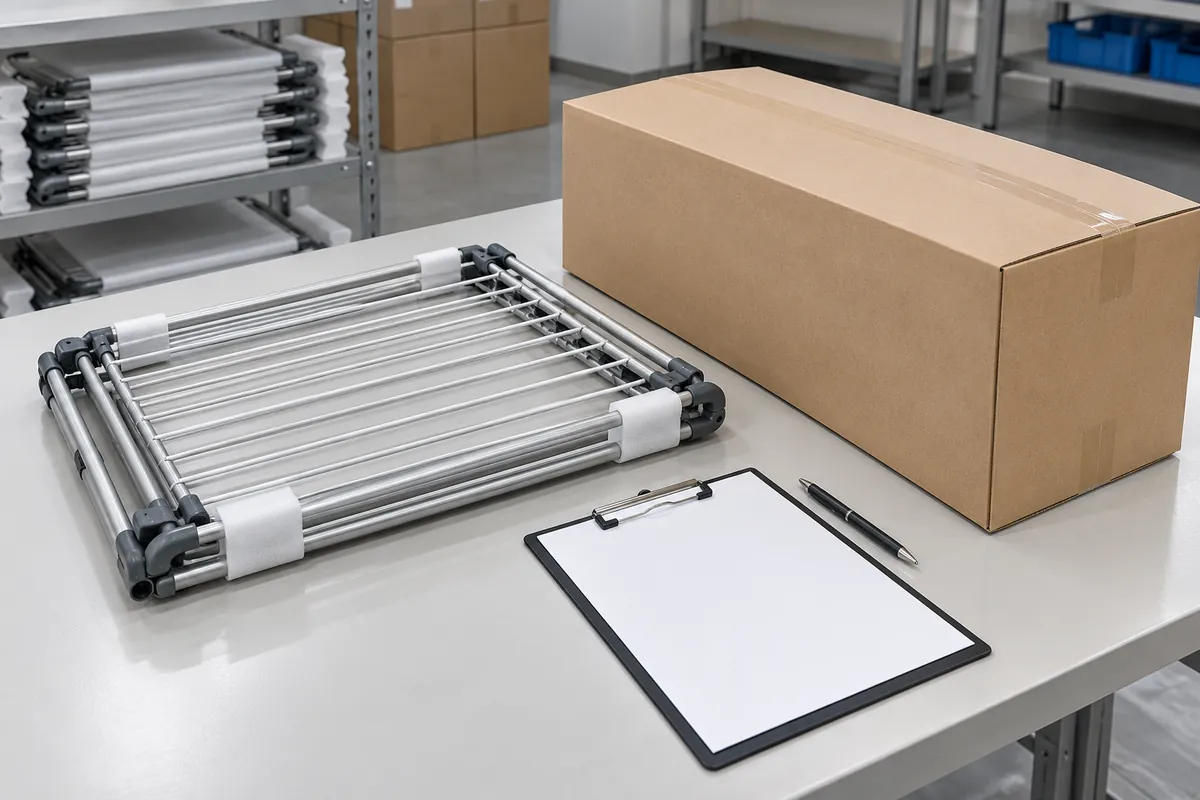
A folding laundry drying rack sample approval record should include photos of the open and folded states, key measurements, the packed configuration, and any agreed corrective action. If the supplier proposes a change after sample approval, ask whether the change affects the product envelope, usable arrangement, carton, protective material, assembly steps, or SKU identification. Then decide whether a new sample, revised drawing, or packing check is needed.
Common sourcing mistakes
Comparing different configurations. One offer may include extensions or extra rails while another does not. Put the model code and included components beside each dimension.
Treating “drying length” as outside width. Linear wire length, open footprint, and usable garment positions are separate measures. Ask the supplier to define the number and length of the bars represented by a quoted drying-space figure.
Using folded dimensions as carton dimensions. Packaging adds protection and may require a different orientation or partial disassembly. Request the actual outer carton dimensions for the quoted pack.
Approving a display sample that is not the production pack. A fully assembled sample can validate operation but may not show how the product will be packed for shipment. Keep the sample and packing review linked to the same revision.
Assuming a feature claim proves performance. A product page may state a load limit or outdoor use for a named model. The buyer should request the test or evidence basis for a claim they plan to repeat. A visual check cannot prove load capacity, corrosion resistance, or cycle life.
Changing the SKU after packaging approval. A new finish, added accessory, different fastener pack, label, or assembly state may affect carton contents or identification. Confirm the change-control record before approving production artwork and packing documents.
Buyer checklist before requesting a quotation
Send a supplier a compact brief with:
- target channel and country, planned assortment, and intended use context;
- preferred open layout, overall footprint, and required usable drying positions;
- folded storage envelope and whether parts may be removed;
- requested material and finish, if already defined, without assuming an unverified grade;
- accessories, caps, wheels, fasteners, or instructions included in the quoted SKU;
- target order quantity and whether mixed colors or configurations are being considered;
- sample configuration, measurement points, revision identification, and approval record;
- carton dimensions, pack count, pack level, protection method, and any pallet requirements;
- buyer-owned capacity or use claims and the evidence needed before those claims are published.
For a drawing-based RFQ, attach open and folded views and mark the measurement datums. For a sample-based RFQ, label the sample and list every feature the supplier is expected to quote. Ask the supplier to state exceptions and assumptions in writing, so an apparent price comparison does not conceal a different accessory set or pack configuration.
How can a home-storage OEM discussion help?
A family-owned custom metal hardware factory can discuss how drawings, sample revisions, assembly choices, finish, and packaging affect a proposed metal-storage project. The actual product scope and relevant production capability must still be confirmed for each request. Koitor Hardware focuses on bathroom and home-storage hardware and supports buyer-led OEM discussions from drawings or physical samples; its approved product information does not confirm manufacture of clothes airers.
If a project involves a product within Koitor’s verified scope, send the intended configuration, buyer drawing or sample, target quantity, finish, and packaging brief through the OEM home-storage hardware overview. The factory can first review fit with its established capabilities; no airer quotation or capability should be assumed from this article.
Frequently asked questions
What is the difference between open size and folded size?
Open size records the rack’s outside envelope in its setup position. Folded size records the envelope after the supplier’s documented folding steps, with removable parts identified. Neither value is the same as the export-carton size.
Should a buyer specify total drying length?
It can be one useful comparison when the supplier defines how it is calculated and identifies the model. Keep it beside bar count, usable length by position, open footprint, and sample configuration. Do not treat a length figure as proof of load capacity or drying speed.
How can an importer check carton size before bulk production?
Request the actual pack configuration, outer-carton dimensions, pack count, and part list for the quoted model. Compare those declarations with a representative packed sample or a documented packing review, then link the result to the approved SKU and revision.
Does sample approval prove the rack’s load or service life?
No. A fit and pack review records what was checked on a specific sample. If a load, cycle, corrosion, or safety claim matters, agree on a separate method, conditions, and acceptance criteria and request evidence for the model being sold.
[Sources reviewed: IRIS USA folding rack; Wideny OEM foldable rack; WIDEMEX product data catalogue. Specifications and claims describe the named models only.]
Discuss a Home-Storage Project
Have a metal home-storage product brief?
Share the drawing or sample and required product scope. Koitor can first confirm whether the request fits its current verified manufacturing capabilities.
OEM / PRIVATE LABEL
Turn this sourcing guide into a product brief
Share your target product, size, finish, order quantity and packaging requirements. Your team receives a practical manufacturability review before quotation.


 English
 Español
 Português
 Français
 Deutsch
 العربية