
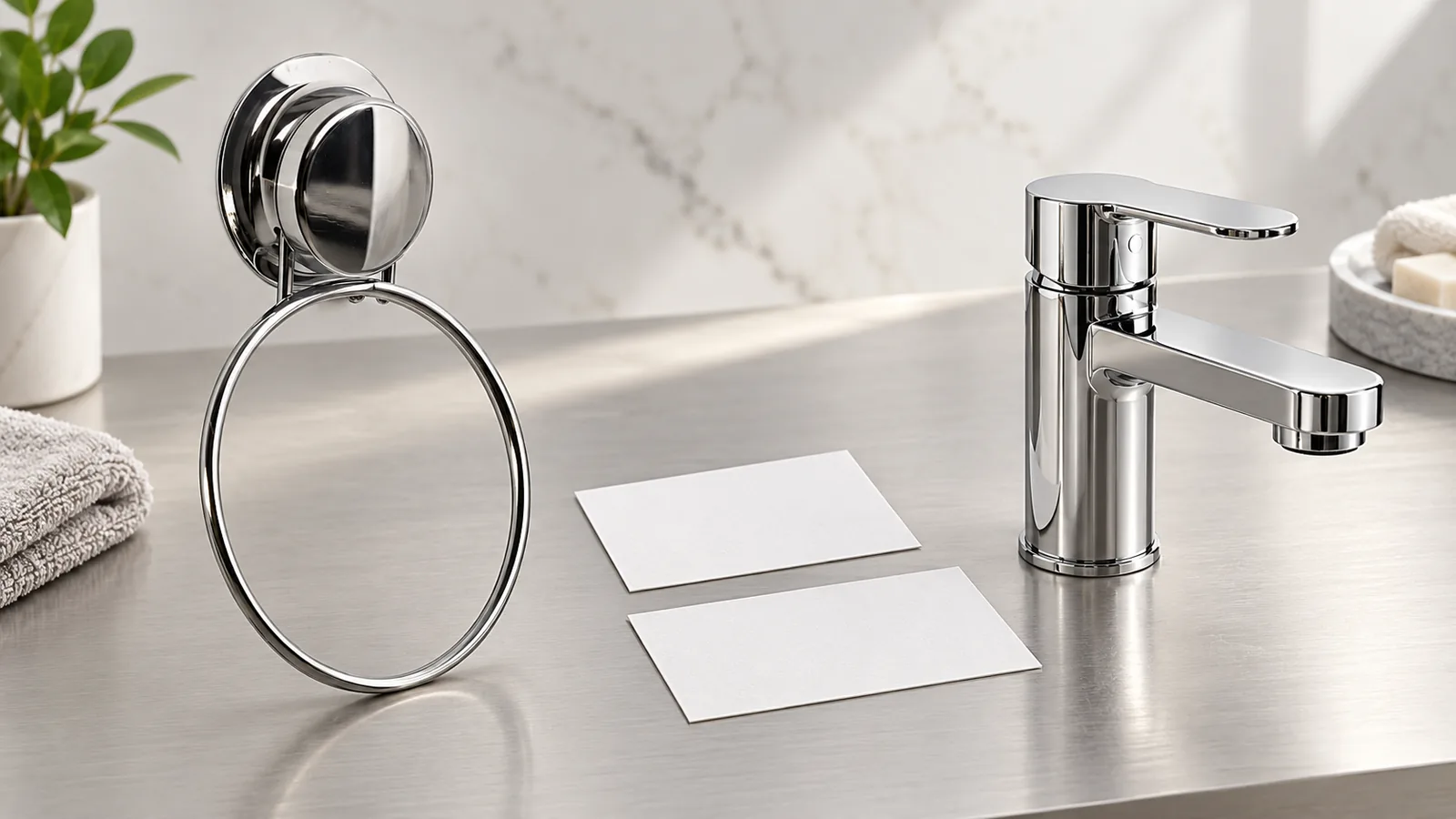
EN 248 bathroom accessories is a question of product function, coating and the exact requirement a buyer is applying. EN 248:2002 is titled Sanitary tapware — General specification for electrodeposited coatings of Ni-Cr. National standards-body summaries describe its scope around exposed tapware surfaces and metallic nickel-chromium coatings on sanitary fittings that supply or discharge water. A chrome appearance by itself does not show that a towel ring, shelf or basket falls within that product scope, and it does not prove that the product is legally required to comply. Buyers should identify the SKU, coating system, market, contract clause and evidence requested before accepting a supplier reference.
Use this sourcing checklist for screening, not as a legal opinion or substitute for the complete standard. Check national adoption and the current edition with the relevant standards body when a legal or conformity decision depends on it.
What does EN 248 cover?
The published title gives the first useful clue: EN 248 concerns sanitary tapware and electrodeposited nickel-chromium coatings. The Swedish Institute for Standards describes the standard as addressing exposed tapware surfaces, coating characteristics such as corrosion resistance and adherence, and tests used to check those characteristics. Its public scope summary says it applies to sanitary fittings for water supply or waste with metallic Ni-Cr coatings, whatever the substrate. NEN’s catalogue for NEN-EN 248:2002 gives a matching scope summary. These descriptions point buyers toward a defined combination of product function and coating, rather than toward every metal item installed in a bathroom.
The SIS catalogue entry lists SS-EN 248 as valid and identifies the 2002 edition. The NEN entry lists NEN-EN 248:2002 as current. The BSI listing identifies BS EN 248:2002 as current and under review. Those are the statuses shown in those national catalogues when checked on 26 October 2026. They should not be combined into a claim that one status automatically applies in every country or that the text has the same legal effect everywhere.
For a definitive product decision, obtain the complete applicable edition; catalogue summaries do not provide every definition or test condition.
Record why EN 248 appears in the project: it may be tied to product scope, a tender, a private contract, a voluntary test reference or supplier marketing. Identify the claim and its owner before treating it as mandatory or irrelevant.
The title does not make EN 248 a complete product specification for mounting strength, stability, fit, packaging or instructions. Keep those product checks separate from coating evidence.
EN 248 bathroom accessories: which products should buyers distinguish?
Start with what the item does, not where it is used. A tap, shower valve, spout or other sanitary fitting that supplies or discharges water is a different functional product from a towel ring, hook, storage basket or shelf. A bathroom location, a shiny finish or the word chrome does not turn a storage accessory into tapware. Conversely, the name a seller uses in a catalogue does not settle the technical classification if the product actually performs a water-supply or waste function.
A towel ring or wall basket may use a metallic finish that looks like chrome. That appearance alone cannot tell the buyer whether the coating is electrodeposited Ni-Cr, another plated stack, a coating with a different surface treatment, or a decorative finish described with broad retail language. The substrate also matters to a complete technical description, even though the standards-body scope summaries state that the substrate may vary for the fittings they cover. Do not infer coating composition from color or reflectivity.
An EN 248 bathroom accessories review should begin with the product function, not the room where a product is used. Use a simple first screen:
| Product question | What to identify | Why it matters |
|---|---|---|
| Does the item supply or discharge water? | Functional description, connections and intended use | The public scope is framed around sanitary supply or waste fittings |
| Which exact surfaces are named? | Exposed surfaces, decorative faces and components covered by the requirement | A report may concern only specified surfaces or a test specimen |
| What is the coating? | Supplier’s coating-system description and product revision | A chrome appearance does not establish electrodeposited Ni-Cr |
| What is the requirement source? | Law, tender, contract, buyer specification or supplier claim | The same standard reference may have different significance |
| Which SKU is supported? | Model, drawing/BOM revision, size and market | Evidence must match the purchased version |
This screen is a way to decide what to verify next, not an automatic conformity decision. If a product does not appear to supply or discharge water, the buyer can ask why EN 248 has been cited and whether it is being used as a voluntary contract test or a supplier’s internal reference. The buyer should avoid declaring that an accessory is categorically inside or outside the complete standard without checking the definitions and exact product facts.
Is the reference a law, a contract requirement or a supplier claim?
A standards reference can enter a purchase decision through several routes, and a document review should name the route. A legal obligation depends on applicable legislation and jurisdiction. A public procurement specification may name a standard for a defined product group. A private buyer may include a standard or test method in the purchase contract. A supplier may cite it voluntarily to describe a test or finish. A product listing may use the words without explaining the exact scope. A buyer should not treat those routes as interchangeable.
The Malta Government criteria for sanitary tapware cite EN 248 in a defined public-procurement group. That specific example does not establish a universal legal requirement for private-label accessories or every market; read the applicable tender’s definitions and clauses.
For a legal claim, ask the responsible compliance specialist to identify the applicable law, the product classification, the market and the provision that incorporates or relies on the standard. For a contract requirement, record the exact clause, edition, product scope, evidence format and acceptance process. For a supplier claim, ask the supplier to explain whether the standard is claimed as a conformity basis, a test reference or a marketing description. If nobody can say which route applies, pause approval of the claim and clarify the requirement before artwork, tender submission or order release.
A supplier should provide product facts and records; the buyer or its compliance advisor should decide whether they meet a legal, tender or contract requirement and define any independent assessment needed.
What evidence should an importer request from the supplier?
Ask for an evidence set that ties the reference to one product and one revision. The aim is not to accumulate documents; it is to make it possible for the buyer, quality team and compliance reviewer to see what was tested, what was claimed and whether the result matches the order. A one-line statement such as “EN 248 passed” leaves too many questions open to serve as a complete procurement record.
First request the product identity: commercial model, SKU, size, drawing or bill-of-material revision, intended market and the date or lot represented by the evidence. For a family of sizes or finishes, ask whether each variant is included or whether the report covers only a representative model. If the supplier changes the substrate, coating source, surface preparation, geometry or exposed area, the buyer needs to know whether the old evidence still applies. Keep an approved sample or reference finish connected to the record where appropriate.
Next request the coating description in the supplier’s own technical terms. Identify the substrate and the finish system declared for the purchased surfaces. Ask whether the reference is about the whole product, named parts or only specified surfaces. The buyer should not infer metallic nickel and chromium layers from a photo, color name or phrase such as “chrome look.” If a supplier uses a different term or a proprietary coating description, ask it to define the construction and explain which requirement it says the product meets.
If a test report is supplied, check the issuer, report date, report number, tested sample identity, product revision, coating description, surfaces assessed, method and edition referenced, conditions, result and any exclusions. Confirm that the report identifies the actual standard or agreed test reference, rather than a related test alone. Ask who selected the sample and whether it was production-representative. A report for one sample is evidence about that sample under the stated method; the buyer still needs to understand how it connects to ordered production and what controls apply to later lots.
Do not ask the report alone to prove more than its stated scope. It may support a coating characteristic under a defined procedure; it does not necessarily establish the legal status of every product in a range, all dimensions, durability in every bathroom environment, or performance after every cleaning regime. The buyer should record what the report proves, what it does not address, and which remaining requirement needs separate evidence.

Assign an owner and due date to each open item: coating declaration, drawing revision, test-plan approval and change notice. Record unresolved questions so outdated documents are not reused in a claim.
How should buyers write the requirement into an RFQ or contract?
Write the buyer’s objective first. If the goal is to purchase a sanitary fitting with electrodeposited Ni-Cr coating under EN 248, state the product function, applicable edition, market, product variants and evidence required. If the goal is to use a selected coating test as a voluntary quality requirement for a storage accessory, identify that it is a contract test reference and name the surfaces, specimen, test basis, acceptance criteria and report format agreed for that project. Do not write only “EN 248 compliant” when the supplier cannot tell what product or claim the phrase covers.
A useful RFQ clause should answer these questions in plain language:
- What product, SKU and drawing/BOM revision are covered?
- Is the product a water-supply or waste fitting, a storage accessory or a mixed kit?
- Which material and exposed surfaces are included?
- What coating system is required or being declared?
- Which edition or exact test clause is the purchaser invoking?
- Is the basis a legal requirement, procurement criterion, private contract or voluntary reference?
- What sample or production lot must the evidence represent?
- Which reports, declarations, photographs or records must be submitted?
- What constitutes acceptance, rejection or a request for clarification?
- Who approves changes and what changes require new review?
Set the evidence due date before sample approval, production, shipment or product-data release, as the project requires. Recheck reports after a coating or product revision.
Link the controlling drawing, finish, sample and test plan to one SKU revision. Recheck evidence if the supplier changes the substrate, coating, finish or component.
For project changes, use a small change-control record: what changed, why, which product revisions are affected, whether the coating or exposed surface changed, which test or declaration remains valid, who reviewed it and when approval was granted. This does not require a complex system for every order. It prevents a buyer from treating old evidence as current when the product definition has materially changed.
What mistakes lead to weak or misleading conclusions?
The first mistake is using the location as the classification. “Used in a bathroom” is not a technical function. A towel ring and a tap may sit beside each other, but only one may supply water. The buyer should describe what the item does and examine the standard’s scope before placing the reference in a specification.
The second is treating “chrome” as a complete coating description. Retail naming may refer to appearance, while the standard title refers to electrodeposited Ni-Cr coatings. A supplier needs to state the actual coating system and the surfaces covered. A photograph can show color and visible finish but cannot identify the layer structure, test method or result.
The third is confusing “can be tested to” with “must comply with.” A buyer can agree on a test reference for a product when it is useful to the project. That does not create a legal requirement for the market or prove that the product category matches the standard. Separate the requirement source from the test evidence in the RFQ, report and product copy.
The fourth is accepting a certificate or report without matching it to the actual SKU. A test for a similar-looking model, a different substrate, an earlier coating revision or a supplier’s generic component may not represent the purchased product. Check identity, revision, finish, tested surfaces and report date before using it as evidence.
The fifth is assuming that a reported test settles every quality question. A coating-related procedure cannot automatically answer questions about load, attachment, wobble, sharp edges, package damage, installation or service conditions. Buyers should keep product-function checks and other relevant product requirements in their own specifications.
The sixth is copying the standard number into marketing without a clear basis. A listing, carton or catalogue claim may be read as a broad assurance. Keep claims narrow, identify the product model and evidence scope, and ask a qualified reviewer to confirm wording for each market. The custom bathroom hardware manufacturer overview and private-label bathroom accessories page describe Koitor’s general custom hardware scope; they do not establish EN 248 certification, plating capability or test results for a particular product.

Set review triggers for changes to the coating, substrate, supplier, product size or marketed SKU; recheck supporting evidence when a trigger occurs.
Final buyer checklist before approving a claim
Before accepting an EN 248 reference in a purchase file or product listing, complete a short decision record. The record should make the buyer’s reasoning understandable to procurement, quality, marketing and compliance colleagues who may see the product later without the original email thread.
- Product function: State whether the SKU supplies water, discharges waste, stores bathroom items or combines functions.
- Product identity: Record the model, SKU, size, drawing/BOM revision, target market and production period or lot.
- Surface scope: Identify the specific exposed faces or components to which the requirement applies.
- Finish description: Obtain the coating-system description from the responsible supplier; do not identify it from appearance alone.
- Requirement source: Mark legal rule, tender, private contract, voluntary test reference or supplier marketing claim.
- Standard edition: Confirm the applicable national adoption and edition with the relevant standards body.
- Evidence: Match any report or declaration to the actual product revision, coating, surfaces, method and acceptance basis.
- Evidence owner: Name who supplies, reviews and updates each record.
- Change control: Define which product or coating changes require the buyer to revisit the evidence.
- Claim wording: Keep the approved statement within the evidence scope and confirm it for the destination market.
- Open issues: List any unresolved scope question, missing report, alternative coating or legal review.
- Approval: Record the buyer or advisor who accepted the requirement and the date of approval.
Use the relevant national catalogue to locate the edition, then consult the complete standard and current market rules. Record the decision as “not applicable,” “contract test reference,” “applicable requirement” or “needs review,” with the scope and evidence behind it.
For product development, share a drawing or physical sample, product function, finish requirement, intended market and evidence request with the supplier early. Koitor Hardware is a family-owned custom metal hardware factory focused on bathroom and home storage hardware and can discuss buyer-side drawing, sample, finish and packaging requirements within its confirmed scope. The company does not claim EN 248 certification, a plating line or an in-house accredited laboratory. Product-specific compliance and test evidence must come from the responsible supplier and be reviewed for the buyer’s own requirement.
Frequently asked questions
Does every chrome bathroom accessory need EN 248?
No universal conclusion follows from the product’s location or chrome appearance. The public scope summaries frame EN 248 around sanitary tapware and water-supply or waste fittings with metallic Ni-Cr coating. Check the complete applicable text, the product’s function and any market-specific requirement before deciding.
Does a towel ring automatically fall outside EN 248?
This article cannot classify every towel ring without its construction, function, coating and the applicable edition. A ring that only holds a towel is not automatically tapware because it is installed in a bathroom, but any formal scope decision should be checked against the complete standard and project facts.
Can a buyer request an EN 248-related test for a storage accessory?
A buyer and supplier may define a voluntary contractual test reference when technically appropriate. The RFQ should state the product, surfaces, method or clause, edition, acceptance criteria and evidence. Describe the result as evidence for that agreed scope, not as proof of a universal legal obligation.
Does a current national catalogue status make EN 248 law?
A catalogue entry tells you how that standards body lists an edition at the time of checking. It does not, by itself, establish the legal rule for every country or SKU. Ask the relevant compliance specialist to identify the applicable law, procurement clause or contract requirement.
Working with Koitor Hardware
For a metal hardware RFQ or sample discussion, share the target SKU, drawing or physical sample, finish description, destination market and the exact supplier evidence you need to review. Koitor can discuss custom hardware development and manufacturing practicality within its confirmed scope; buyers should confirm product-specific standards and test claims with the responsible supplier and qualified reviewer.
Need to clarify a hardware standard in your RFQ?
Share the product function, drawing revision, finish description and evidence requirement so the team can discuss the hardware specification within its confirmed scope.
OEM / PRIVATE LABEL
Turn this sourcing guide into a product brief
Share your target product, size, finish, order quantity and packaging requirements. Your team receives a practical manufacturability review before quotation.
 English
 Español
 Português
 Français
 Deutsch
 العربية