
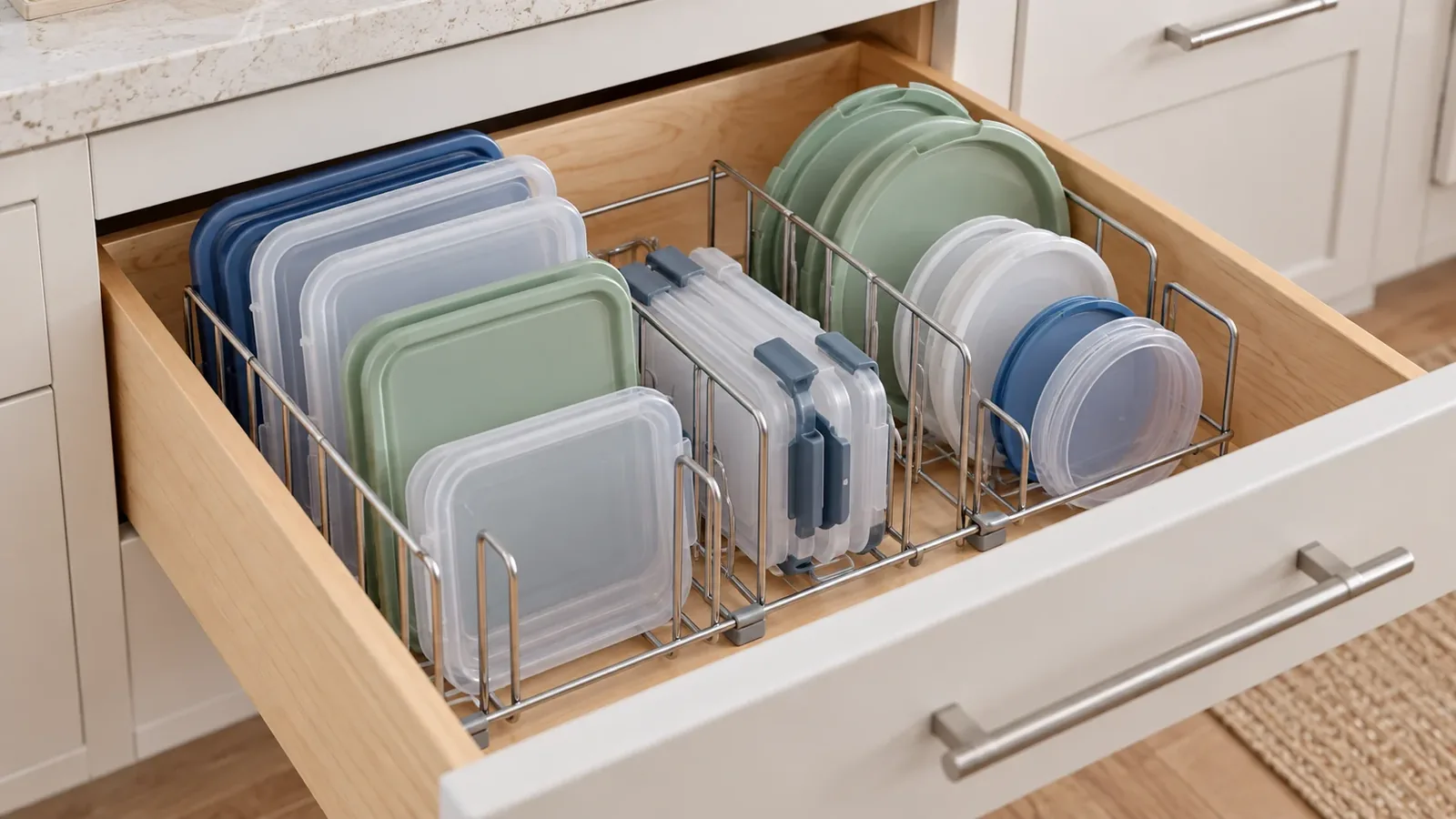
A food container lid organizer for mixed-lid assortments should be specified around the actual lid families, divider positions and storage space it must serve. Importers should test round and rectangular lids, clip or hinge projections, rim thickness, flexibility and intended retrieval—not rely on a single capacity figure or one “typical” lid. The approval record should identify the tested lids, divider configuration, drawer or cabinet envelope and any exclusions. A metal rack may organize lids as a passive storage accessory, but that does not establish food-contact compliance for the lids or organizer.
Why Does One Lid Organizer Fail to Fit a Mixed Assortment?
Lids that look similar from above can have different profiles at the rim. Some are flat; others include snap tabs, clips, handles, hinges, raised seals or flexible edges. Round lids need different lateral space from rectangular lids, while nested profiles may catch on a neighboring part. Thin flexible lids can bow as they are inserted, and a rigid clip can increase the effective width beyond the nominal lid diameter. These details determine whether lids can be grouped, separated, loaded and removed without forcing them.
One user discussion describes a purchased organizer that did not suit three different food-container types, prompting the question of whether separate organizers were needed. That is a directly observed assortment-fit problem, not a defect-rate estimate and not proof that one particular rack design is inadequate. The practical buyer question is which families must fit together and which may need separate sections or products. A one-size organizer can be too broad to provide useful separation, while too many narrow sections can waste space or make retrieval awkward.
Consumer products demonstrate different approaches. YouCopia’s StoraLid page describes an expandable plastic base with eight adjustable dividers for container lids. IKEA’s VARIERA is a stainless-steel pot-lid organizer whose product information also says it can hold food-container lids. Those are distinct, brand-specific designs and intended specifications; neither establishes that a metal rack will fit every lid family or that a particular divider arrangement is suitable for a buyer’s SKU. The buyer should use actual lid samples to define a metal organizer’s own interface and scope.
The first task is to classify the assortment. Separate lids by basic geometry, but do not stop at “round” and “rectangular.” Note the largest perimeter, thickness, edge clips, hinge or handle projection, stiffness and shape of the contact rim. Include lid families that are expected to share a section and those expected to remain separate. If lids are sold with different container bases or as sets, document whether the organizer is designed for standalone lids or for lids kept with their containers. This article concerns lid-only storage and configurable divider fit, not container sealing or cookware-lid knob clearance.
Which Reference Lids Should Buyers Include?
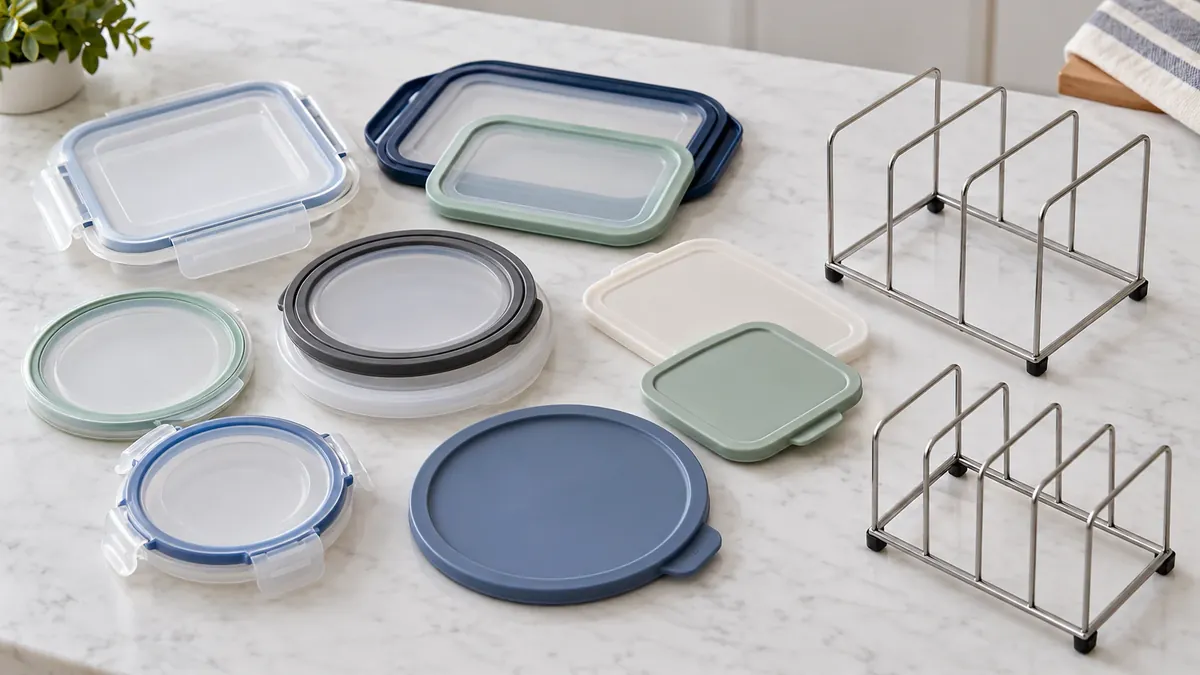
Create a lid-family matrix before selecting divider count or rack width. For each family, record the source or product model, shape, maximum external dimensions, thickness, protrusions, flexibility and the expected quantity. Measure with the projection that actually determines fit—for example, a locking tab that extends past the rim—not only the lid’s main body. For a flexible perimeter, record whether dimensions are measured relaxed or under a defined condition.
Select boundary examples as well as common items. A small, flat rectangular lid may fit easily, while a large round lid or a model with pronounced side clips may control divider spacing. If one family has multiple sizes, choose the smallest and largest relevant examples. If a group includes soft silicone or flexible plastic lids, include a representative piece and observe whether the divider spacing causes it to curl or bend during normal storage. Do not infer material durability from one short sample review.
For each lid, document its likely orientation. Is it stored upright on an edge, slightly tilted, stacked horizontally, or grouped with a matching lid? A rack designed for upright separation needs enough height to support the lid without letting it tip into another group. A horizontal stack organizer may need a different access path. Decide how a user identifies the needed lid and whether they can remove it without pulling neighboring lids out of the organizer.
| Reference detail | What to capture | Buyer decision it informs |
|---|---|---|
| Family identity | Container system, model or anonymized SKU | Which lid types are included in the compatibility claim? |
| Geometry | Round/rectangular outline and edge profile | Which divider layout and orientation are practical? |
| Outer size | Maximum length, width or diameter including tabs | What spacing must a section accommodate? |
| Thickness | Body and rim thickness at the support points | How many lids can share a section without binding? |
| Projections | Clips, hinges, handles, seals and raised features | What clearance is required around each lid? |
| Flexibility | Rigid, semi-flexible or flexible edge behavior | Does placement cause bowing, snagging or difficult retrieval? |
| Planned quantity | Number of lids per family in normal storage | How much organizer space does each family need? |
A representative sample set should match the assortment the retailer expects to sell, not just the supplier’s easiest demonstration pieces. When confidentiality matters, label the lids with anonymized SKU IDs. Keep photos showing the orientation and key measuring points. This gives both supplier and buyer a concrete reference if the lid set or organizer changes later.
How Should Buyers Specify Divider Range and Adjustment?
A divider does more than create compartments. Its spacing sets which lid shapes can fit together; its height influences how the lids are supported; its retention determines whether it remains in position when a lid is removed; and its profile affects whether clips or hinge details catch. Specify the usable adjustment range, the increments or positions available, the divider height and how the divider engages the base or frame. If a metal divider slides in a track, identify the track width and stops. If it clips or uses a bought-in component, show the part and its installation direction.
The buyer should decide whether adjustment is tool-free and intended to be repeated or whether the divider is positioned once during setup. Each choice affects parts, assembly and user experience. A movable divider may make a mixed assortment easier to configure, but a free-sliding piece may shift during retrieval. A detent, notch or retaining piece may hold a position but limit increments or increase assembly complexity. These are trade-offs to compare with a physical sample; no one arrangement is universally best.
Include the base or organizer footprint in the drawing. For drawer use, record the clear width, depth and vertical space after accounting for drawer sides, slides, handles and any internal lip. For cabinet use, consider door opening, shelf depth, nearby products and the path for lifting the organizer out. If the organizer expands or adjusts in length, specify the minimum and maximum usable dimensions and whether stability and divider engagement are maintained across that range. Do not assume that an advertised expansion range for another product carries over to your design.
Use a layout drawing or simple plan view to show the intended lid families, section order, divider positions and retrieval direction. Mark the largest lids and any group with projecting clips. The drawing should also identify clearances near the rack sides and ends. If an adjustable divider can be removed, state whether that is intentional and whether removed parts need to be stored with the organizer. A section that fits a lid at rest may still be too narrow for fingers to grip the lid or pull it out cleanly.
How Can Buyers Approve a Mixed-Lid Sample?
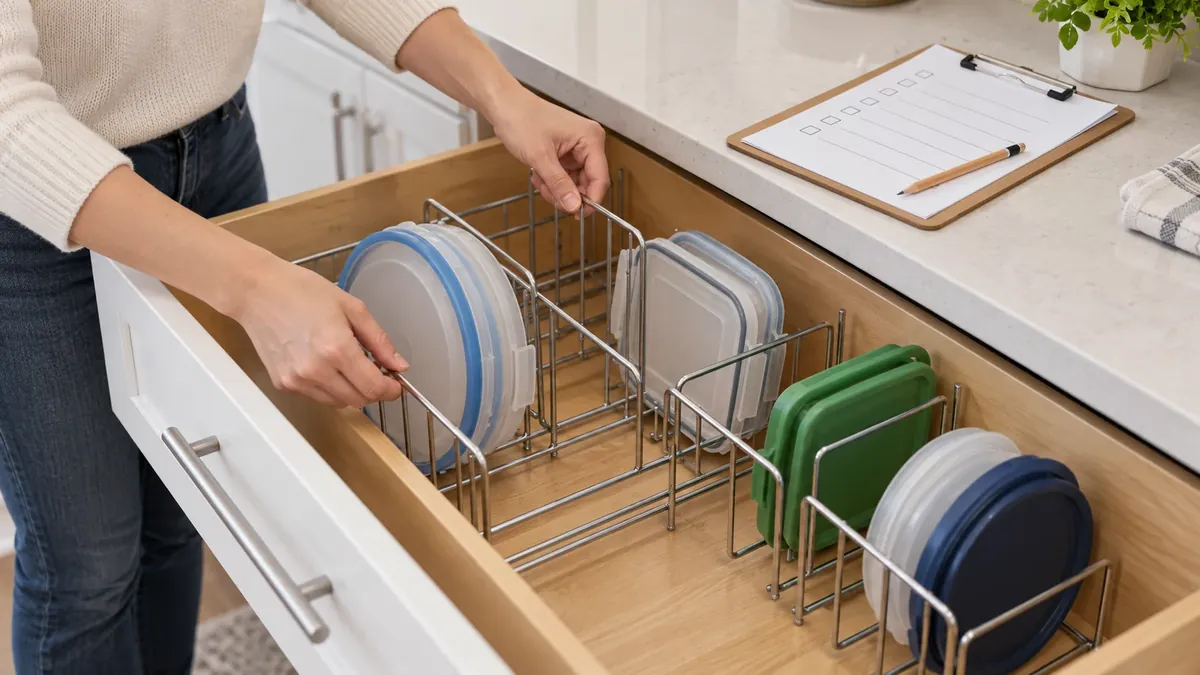
Assemble the production-intent organizer with the specified base, dividers, feet, stops and finish. Put it in the intended drawer or cabinet, not only on a large open table. Install dividers according to the instructions, then load reference lids in the planned orientation and quantities. Include at least one example of every family and the boundary lid that sets the largest or most awkward fit condition.
Test the ordinary interaction:
- Place each lid into its assigned section without forcing it past a divider or catching a clip.
- Remove one lid while neighboring lids remain in place.
- Return it to the section and observe whether the divider shifts or the lid tips into another group.
- Reposition each adjustable divider through the intended range and confirm it can be set and retained as specified.
- Open and close the drawer or cabinet normally and check whether lids move, overlap or interfere with nearby hardware.
- Repeat with the expected range of sizes and shapes, including the largest and most flexible samples.
Define acceptance before reviewing the sample. Criteria can address whether all nominated families fit, whether adjacent lids remain separable, whether a lid can be removed without forcing it, whether a divider moves only as intended, and whether the organizer fits the available storage envelope. These are prompts for buyer-specific criteria, not universal tolerances. If a lid must be prevented from bending or if divider movement is a critical function, define the condition and inspection method in a way the supplier can reproduce.
Do not infer food safety or food-contact compliance from the fact that the organizer stores lids. The metal rack is a storage accessory; any claim involving materials in contact with food, chemical migration or regulatory compliance requires product-specific evidence and a clear determination of which surfaces contact food under intended use. Keep the organizer’s performance statement focused on fit, separation, access and storage unless substantiated evidence supports broader claims.
Capture photographs of the loaded sample from above and from the side. Record which lid IDs occupy which sections, divider positions, drawer dimensions, movement or snagging observations and any approved exclusions. A simple approval log can list the drawing revision, organizer revision, lid sample IDs, component versions and decision. If the organizer is reconfigured after approval, retain the original and revised layout records.
What Manufacturing and Component Details Matter?
A metal rack’s wire or sheet geometry determines divider spacing, contact edges and usable section width. Define the features that affect fit, such as the inside distance between dividers, divider height, base width, end clearance and any stops that retain movable parts. If the product includes multiple frames or welded joints, identify cosmetic faces and assembly requirements. A supplier drawing should clarify how the divider attaches and whether the finished surface changes its engagement.
Finish can affect sliding or clipping interfaces. A coating on a rail or tab may add thickness and change the force needed to reposition a divider. A polished edge may look smooth but still require a clear specification for burrs or exposed ends. Review the actual finished part and functional interface rather than judging a bare prototype. If a retainer, rubber foot or polymer divider is purchased separately, identify its supplier, revision, material and responsibility for replacement. Koitor’s current manufacture of this exact organizer or of plastic dividers is not confirmed.
Packaging matters because dividers and stops can move or become separated from the base. State whether parts are assembled, nested, bagged or packed separately; count each piece in the sample pack-out. Protect finished contact edges from rubbing if appearance matters. Include instructions for adjustment and cleaning if those instructions are part of the retail product. A packaging inspection helps confirm the parts and configuration, but does not prove universal transit performance.
What Common Sourcing Mistakes Should Buyers Avoid?
- Choosing divider spacing from one lid. The widest, thickest or most projecting lid may control the layout. Test a representative range.
- Using nominal diameter or width only. Clips, hinges and raised rims can extend beyond the primary body measurement.
- Confusing capacity with compatibility. A claimed number of lids is product-specific and does not establish a mixed-lid fit range.
- Adjusting the organizer only on a workbench. A drawer’s walls and access path can limit setup and retrieval.
- Approving divider motion without loading lids. A divider that moves easily when empty may shift differently when lids are inserted and removed.
- Making a universal-fit claim. Name the lid families tested and state relevant exclusions instead of implying all brands and lid shapes fit.
- Assuming pot-lid data applies to food-container lids. The rim, clips, flexibility and thickness differ; cookware-lid knob clearance is a separate question.
- Treating a metal accessory as food-contact proof. Storage use does not demonstrate regulatory compliance or material suitability for direct food contact.
- Omitting purchased parts from the revision record. Stops, feet or polymer dividers can alter layout, friction and fit; identify each component.
- Changing finish after approval. A coating can affect clearances or divider movement; recheck functional interfaces on the production finish.
A useful supplier conversation starts with the actual lids, not just a keyword, target price or desired capacity. When a lid does not fit, identify whether the issue is the outline, projection, thickness, divider position, access or drawer envelope. That diagnosis helps the product team decide whether to change section width, divider count, organizer footprint or assortment scope.
How Can an OEM Supplier Support This Project?
A metal hardware supplier can review drawings for wire forming, sheet components, divider interfaces, joints, finishing and pack-out. Koitor Hardware is a family-owned factory focused on bathroom and home storage hardware, with documented metal-product manufacturing experience relevant to discussing a passive storage frame. The current project evidence does not confirm a Koitor food-container lid organizer SKU or plastic divider supply, so exact product scope and component responsibility must be confirmed for the project.
For an adjacent kitchen-storage concept, a buyer can provide lid samples, a family matrix, drawer or cabinet dimensions, desired adjustment range, finish requirements and packaging expectations. The supplier can identify missing measurements or manufacturing questions before a sample is made. If plastic parts or another bought-in component are included, define their supplier, revision, fit checks and replacement responsibility. Confirm MOQ, sample timing, finish and lead time for the actual design and quantity.
Koitor’s OEM home storage hardware manufacturing page gives more context about its broader product-development scope. It does not mean every kitchen organizer is currently in production. The buyer should approve the complete sample configuration against the target lid assortment before making a compatibility claim.
Buyer Checklist and Frequently Asked Questions
Before requesting a quotation or approving a sample, prepare:
- An anonymized lid-family matrix with product IDs, shapes and quantities.
- Maximum dimensions including clips, hinges, handles and raised rims.
- Lid thickness and flexibility notes at relevant support points.
- Expected orientation, section order and retrieval direction.
- Drawer or cabinet clear dimensions and access constraints.
- Divider height, adjustment range, positions, stops and retention expectations.
- Production-intent materials, finish and purchased component revisions.
- A buyer-defined placement, removal and reconfiguration acceptance procedure.
- Packaging, instructions, private-label needs, target market and quantity.
- Any explicit exclusions from the compatibility claim.
Which lid families should a food container lid organizer support?
The buyer should define the named lid families, sizes and projections that the product is intended to organize, then validate them on the production-equivalent sample. A broad fit claim needs evidence across the stated range.
How many different lids should buyers include in a sample test?
Include each intended lid family and boundary examples that represent the widest, thickest, most flexible or most projecting shapes. The exact sample count depends on the assortment. Label the lid IDs and record which sections and divider positions were tested.
Does an expandable organizer fit every food-container lid?
No. Expansion changes the base length or footprint, but lids still differ in outline, thickness, clips and flexibility. Test the intended families in the exact organizer and storage location.
Should every lid type have its own divider section?
Not necessarily. The buyer should define which families can share a section without making retrieval confusing or causing interference. A sample layout can compare grouped and separated arrangements before the bill of materials is finalized.
Can a metal food container lid organizer be claimed as food-contact compliant?
Not from its storage function alone. Any food-contact statement requires applicable product-specific material and regulatory evidence. Do not infer compliance from the organizer’s construction or from the types of lids stored in it.
Is this the same as a pot-lid organizer?
Some organizers may serve both uses, but not all pot lids and food-container lids have the same shape or projections. Test the target lid families rather than assuming cookware-lid fit establishes compatibility.
What happens if the lid assortment changes after approval?
Compare the new lids with the documented range, especially outside dimensions, clips, hinge projections and flexibility. Recheck affected divider positions and storage clearance, and update the compatibility statement if the evidence changes.
Discuss a Custom Kitchen Storage Drawing or Sample
Share your lid-family matrix, reference samples, drawer dimensions and divider concept to discuss the metal product scope. The exact organizer and any plastic components need project-specific confirmation.
OEM / PRIVATE LABEL
Turn this sourcing guide into a product brief
Share your target product, size, finish, order quantity and packaging requirements. Your team receives a practical manufacturability review before quotation.
 English
 Español
 Português
 Français
 Deutsch
 العربية