
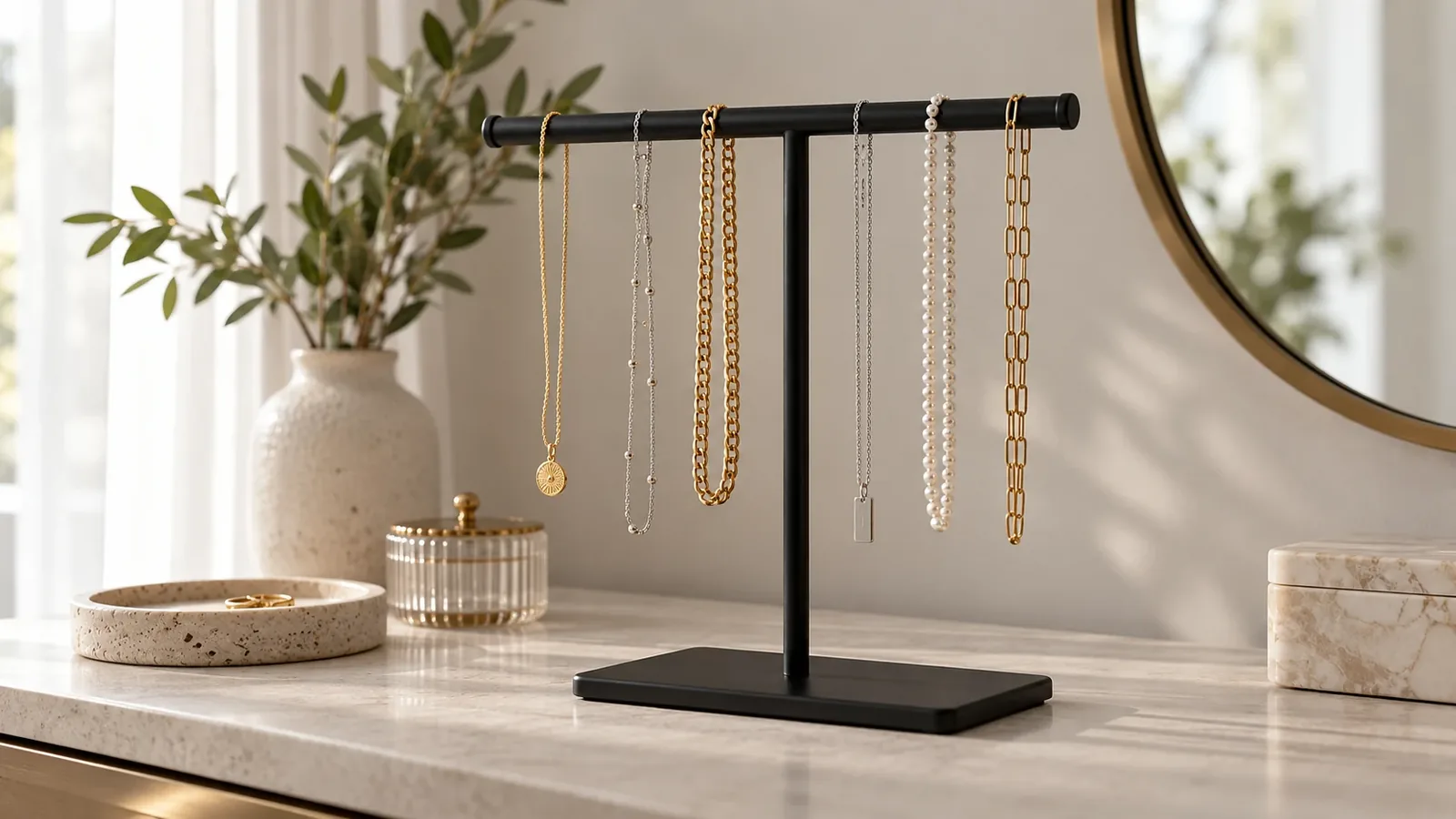
A necklace organizer stand should be checked with the chain lengths, pendant shapes, and storage habits of the buyer’s intended assortment. A stand can have many hooks and still make a long chain difficult to see or a rear necklace difficult to retrieve. For an importer, the useful question is whether representative pieces can be hung with adequate vertical drop, spaced for visibility, and removed individually without unnecessarily disturbing neighboring items. No stand should be described as preventing every tangle or scratch unless a defined test supports that claim.
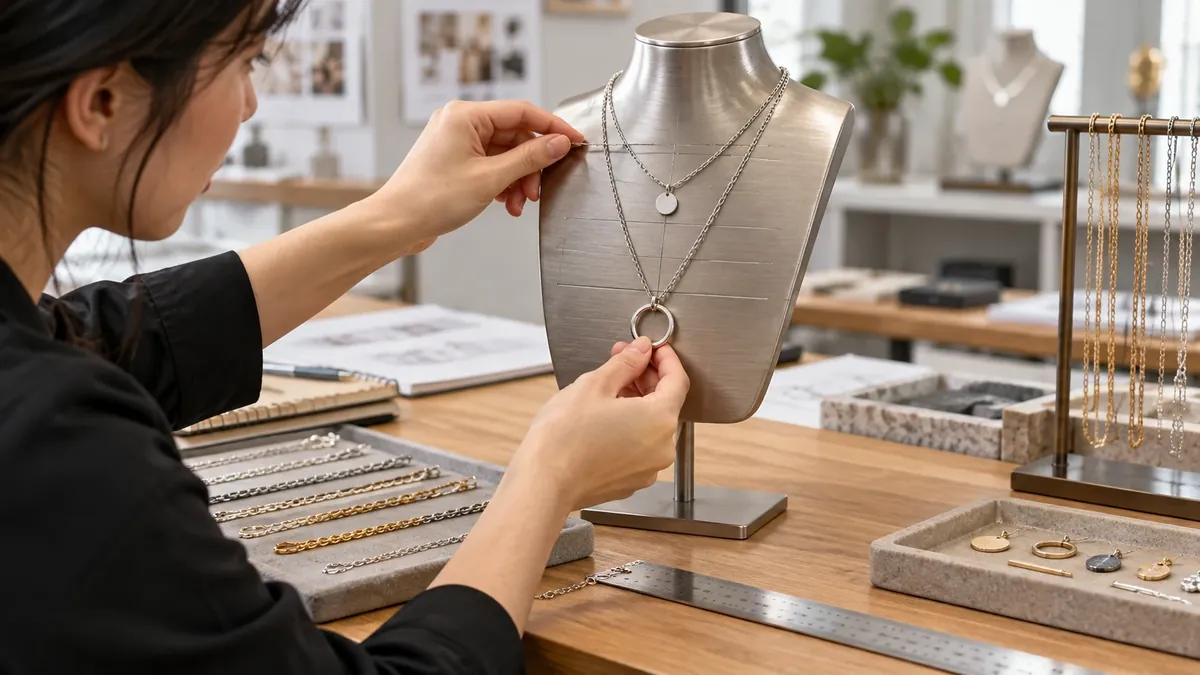
Start with a representative jewelry set
“Necklace” covers a wide range of sizes and shapes. A short chain with a small pendant occupies a different envelope from a long beaded necklace, a chunky chain, a layered piece, or a pendant with a wide loop. Chain length alone does not determine fit. The pendant’s height and width, clasp location, chain flexibility, and whether the user stores two pieces together can all affect how the item hangs.
Collect representative reference items before the design is frozen. The set should reflect the target market and the product’s intended price point. Record chain length, pendant dimensions, approximate hanging drop, clasp size, and any feature likely to contact the stand. Include the longest intended piece and the largest pendant, as well as a narrow or delicate item if the organizer is expected to hold one. If an actual jewelry sample cannot be supplied, provide scaled drawings and clear photographs, while recognizing that a physical sample gives a better view of chain movement and retrieval.
A simple assortment sheet can include:
| Reference item | Dimensions and behavior | Design implication |
|---|---|---|
| Short chain | Chain length, clasp and pendant drop | Check the hook shape and short-item visibility |
| Long necklace | Full hanging drop and chain flexibility | Check clearance from tray and countertop |
| Large pendant | Width, height, and loop size | Confirm it can pass over the hook without forcing |
| Chunky chain | Link size and packed width | Check neighboring hook spacing |
| Layered set | Number of pieces normally stored together | Determine whether one or multiple hooks are needed |
Do not use an arbitrary hook count as a capacity claim. The number of pieces a stand holds depends on jewelry dimensions, the chosen spacing, whether pieces are layered, and the user’s retrieval preference. If the retail package says “holds 20 necklaces,” the buyer should establish the sample set and arrangement behind that number. A display with every hook occupied by small chains may look full, yet it may not represent ordinary use with pendants and long pieces.
Define the stand’s storage promise
Decide whether the product is intended to store jewelry at home, display items in a retail setting, or do both. A display may prioritize front-facing visibility, while a home organizer may prioritize access and footprint. A stand intended for a vanity needs to fit the surface and leave room for other items. A closet version may need a different height or base. These use cases should not be collapsed into a single vague design brief.
Clarify what items are included in the product scope. Some jewelry stands combine metal supports with a wood base, tray, silicone mat, or another purchased part. Such examples can show possible architectures, but they do not establish the components or performance of the buyer’s planned design. List each included component, its material, finish, source responsibility, and packaging position. If the base or protective mat is not included, the product page and sample should not imply that it is.
Also define whether the lower area is a storage tray, a catch surface for small accessories, or simply a base. Its purpose affects dimensions and clearance. A long pendant may touch the tray; a wide pendant may extend over it; a tray rim may obscure a short item. The buyer should state what “clear” means for the intended assortment rather than assume that a visually attractive stand will work with all jewelry types.
Set hook height, spacing, and vertical drop
Hook height should be related to the longest intended hanging drop and the counter or tray below. If a chain hangs too low, a pendant may rest on the base or become obscured by other accessories. If the stand is too tall, it may be unstable or unsuitable for a shelf with limited vertical clearance. Measure the assembled product with representative pieces loaded, not only the top-hook dimension on a drawing.
Hook spacing affects both density and access. Closely spaced hooks can increase nominal capacity but make neighboring chains overlap. A large pendant may swing into another piece. Wide spacing can improve separation while increasing the footprint. The right trade-off depends on the assortment, the display style, and how users expect to select an item. Ask the buyer which criterion matters more when capacity and visibility compete.
If hooks are arranged in tiers, test whether upper pieces hide lower ones and whether a user can reach rear items. A multi-tier design can provide vertical storage, but a chain on an upper hook may drape across a lower hook. Orient hooks to reduce interference where practical, then verify the actual result with the sample set. A drawing can show nominal positions; it cannot fully predict how flexible chains settle under gravity.
The buyer should identify whether hook ends are open, looped, or shaped with a stopper. A closed loop may require threading a clasp or pendant through an opening, which could be inconvenient or impossible for some pieces. An open hook may simplify loading but allow an item to slip off when the stand moves. Test loading and removal with the sample jewelry, and state the expected handling conditions. Avoid implying that one geometry is universally secure.
Check individual retrieval, not just loaded appearance
A useful sample review includes retrieval from the front, rear, upper, and lower positions. Place a representative set on the stand, then ask an unfamiliar user to locate and remove one designated piece and return it. Observe whether adjacent chains move, whether a pendant catches on another hook, and whether the user needs to unload neighboring jewelry first. This is a simple usability check rather than a broad consumer study, and results should be described accordingly.
Test more than one arrangement. Users may put a necklace on an empty hook, share a hook between layered items, or hang a chain in a way the designer did not expect. The buyer can decide which arrangement the product instructions should recommend. If using multiple pieces per hook is not supported, say so in the intended use rather than inflate capacity by counting every item individually.
Chain tangling is influenced by chain length, link construction, movement, neighboring pieces, and storage behavior. A stand’s spacing and hook layout may help organize pieces, but it does not guarantee that chains never tangle. Test under a defined loading and movement sequence if tangle performance is important. Record which pieces were used, how they were hung, how the stand was moved, and what outcome was observed. Do not turn one successful arrangement into a universal product claim.
Inspect contact points and finish
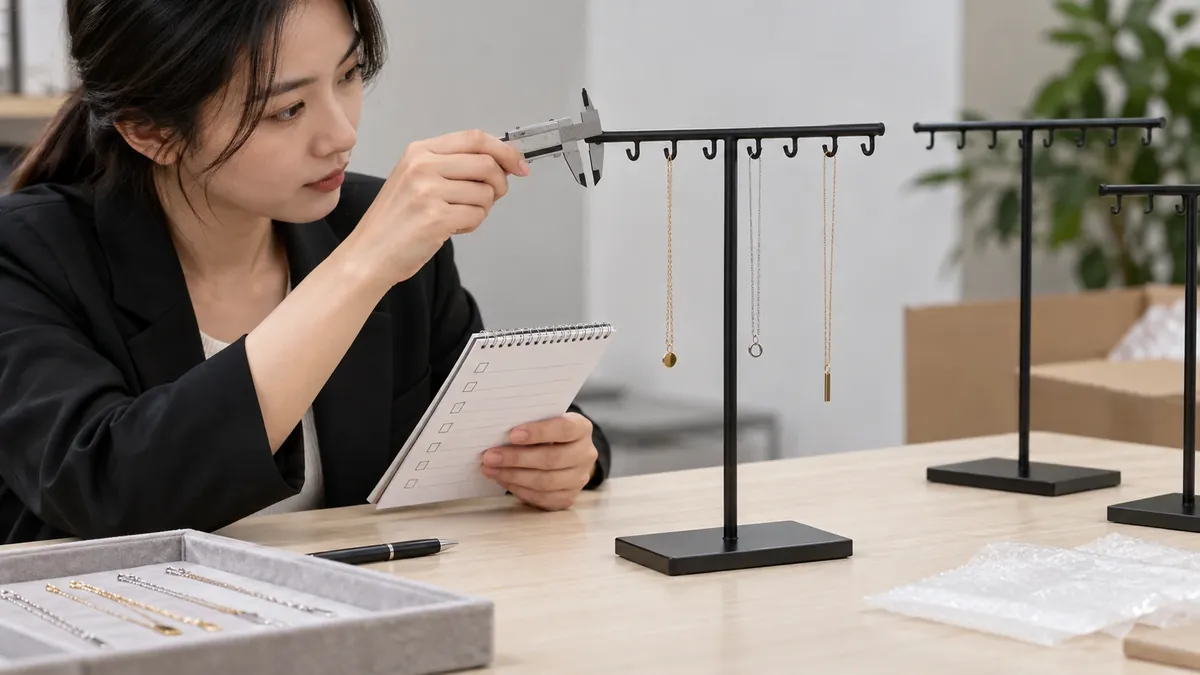
Jewelry contact creates an appearance and handling concern, especially for pieces with delicate surfaces. Inspect hook ends, bends, welds, cut edges, coating transitions, and any separate protective component. Check for visible burrs, sharp edges, rough joints, and areas where a chain might catch. A smooth-looking finish alone does not establish scratch resistance or compatibility with every jewelry material.
Use representative samples for repeated loading and removal. Examine the chain and pendant before and after the agreed check for visible snagging or marking. If the buyer wants a more formal scratch or abrasion assessment, define the surface materials, contact force, movement, duration, inspection method, and acceptance criteria. A visual check with one chain cannot prove that every plating, coating, stone setting, or jewelry finish is protected.
If a silicone mat, sleeve, coating, or other contact layer is proposed, verify its material and position in the bill of materials. Check that it remains in place during use and does not obstruct the hook opening. If a protective accessory is a purchased component, confirm who supplies it and whether it is installed, packed separately, or optional. Koitor’s current jewelry-stand production and any specific jewelry-protection performance are unconfirmed, so the buyer should confirm capability and component responsibilities for the actual design.
For a metal-only product, review the final finish at the points where jewelry is expected to touch. The finish, edge radius, and geometry are linked: a coating does not correct an inconvenient opening or an undersized hook. When a sample shows a snag, report its exact location and the jewelry piece involved. That gives the supplier an actionable issue to review.
Evaluate the loaded base and product footprint
A stand that is empty may behave differently when long pieces hang from one side. Load it according to the planned arrangement and observe whether it rocks, slides, or tips when a user removes a rear necklace. The result depends on the base dimensions, weight distribution, surface, and loading pattern. Do not infer a stability rating from appearance or from an empty product.
Measure the usable footprint on the intended vanity, countertop, or shelf. Include the path needed for a hand to reach a rear hook and the space occupied by pendants and a lower tray. If the organizer is meant to sit below a shelf, check assembled height and loaded height. If it is intended for retail display, evaluate the sight line and access from the customer side. These details can change the preferred tier arrangement or base size.
If a numeric stability or load requirement is necessary, specify the method and configuration. Identify which hooks are loaded, what objects represent the jewelry, the test surface, and what movement or force is applied. A product is not automatically safe from tipping merely because it is intended for lightweight items. Conversely, an arbitrary heavy-load test may not reflect the ordinary use case. Define the condition that matters to the buyer.
Include the full assortment in the sample review
A representative sample set should include the combinations most likely to interfere: long chains beside short ones, a wide pendant near a neighboring hook, and items in front of and behind each other. Check the stand full, partly loaded, and with a single item remaining. A display can look organized at full capacity while the last piece sits far from the user’s natural reach or rests against the base.
Photograph the stand from the front and side at each loading state. Record hook assignments and item identifiers. A photograph is not a substitute for measurements, but it helps link a fit observation to a specific sample. If the design changes hook positions, height, base size, or finish, repeat the affected checks. Keep the approved drawing revision and sample identification together.
If accessories such as earrings, rings, or bracelets are included in the marketing description, verify those use cases separately. A lower tray may hold small accessories, but the presence of a tray does not establish a secure earring display or prevent items from being lost. Avoid broad “all jewelry” claims unless the tested assortment actually covers the promised categories.
Specify how the necklace organizer stand sample will be measured, installed, and approved before production release.
What to put in the RFQ
An importer’s RFQ should specify:
- The intended channel and use: home organization, vanity storage, or retail display.
- Representative jewelry samples or measured reference dimensions.
- The target hook count, tier layout, hook opening, spacing, and height.
- The longest chain drop and largest pendant envelope.
- A required gap from the countertop or lower tray.
- Whether a tray, mat, base, or other purchased part is included.
- Material, finish, color, and cosmetic-face requirements.
- The intended retail footprint and any shelf-height limit.
- Packaging protection for protruding hooks and finished surfaces.
- Sample quantity and the fit, retrieval, contact, and stability checks.
Ask suppliers to state assumptions. Does a quotation include a wood base or silicone mat? Are hooks integral to the metal frame or assembled separately? Which surfaces receive the specified finish? How is the product protected in the retail package? Is the proposed sample representative of the final material and finish? If an alternate design is suggested, request the implications for capacity, retrieval, components, and packing.
Compare quotations using equivalent scope. A lower price that excludes a tray, mat, or packaging insert does not represent the same product. Record any tooling or fixture assumptions, minimum order basis, and whether the sample fee covers changes. Do not treat a photo reference as a complete specification; provide dimensions, samples, and a written acceptance checklist.
Approve against observable criteria
A useful approval record states which jewelry items were tested, where they were placed, whether each could be loaded and removed individually, whether any chain snagged or visibly marked, and whether the loaded stand remained stable during the defined use check. The buyer can add preferences such as front-facing visibility or a particular decorative shape, but those should be separated from must-pass fit and safety requirements.
Write findings so the supplier can repeat them. “The pendant on sample J3 touched the tray when placed on the lowest right hook” is more actionable than “not enough space.” “The rear necklace could not be removed without lifting the chain on the front hook” identifies a specific retrieval interference. If a test is subjective, identify who performed it and what they observed rather than presenting an opinion as a measured result.
Approve the production-representative finish and components. If the final coating, base, or protective mat changes, recheck the contact and retrieval points. Keep any approved sample under the project’s normal reference process and communicate the revision before mass production. A buyer should be able to trace the final design to the sample set and review criteria.
Sourcing takeaway
A necklace organizer stand should be developed around actual jewelry, not just a hook count. Importers should collect a reference assortment, define vertical drop and hook spacing, test retrieval from crowded positions, inspect finished contact points, and evaluate the loaded base in its intended location. This creates a clearer product brief and helps prevent broad promises about universal fit, scratch prevention, or tangle-free storage.
For related metal storage sourcing, see Koitor’s OEM home-storage hardware manufacturing information and confirm the exact construction, finish, accessories, and production scope with the factory.
Discuss Your Metal Necklace Stands Specification
OEM / PRIVATE LABEL
Turn this sourcing guide into a product brief
Share your target product, size, finish, order quantity and packaging requirements. Your team receives a practical manufacturability review before quotation.

 English
 Español
 Português
 Français
 Deutsch
 العربية