
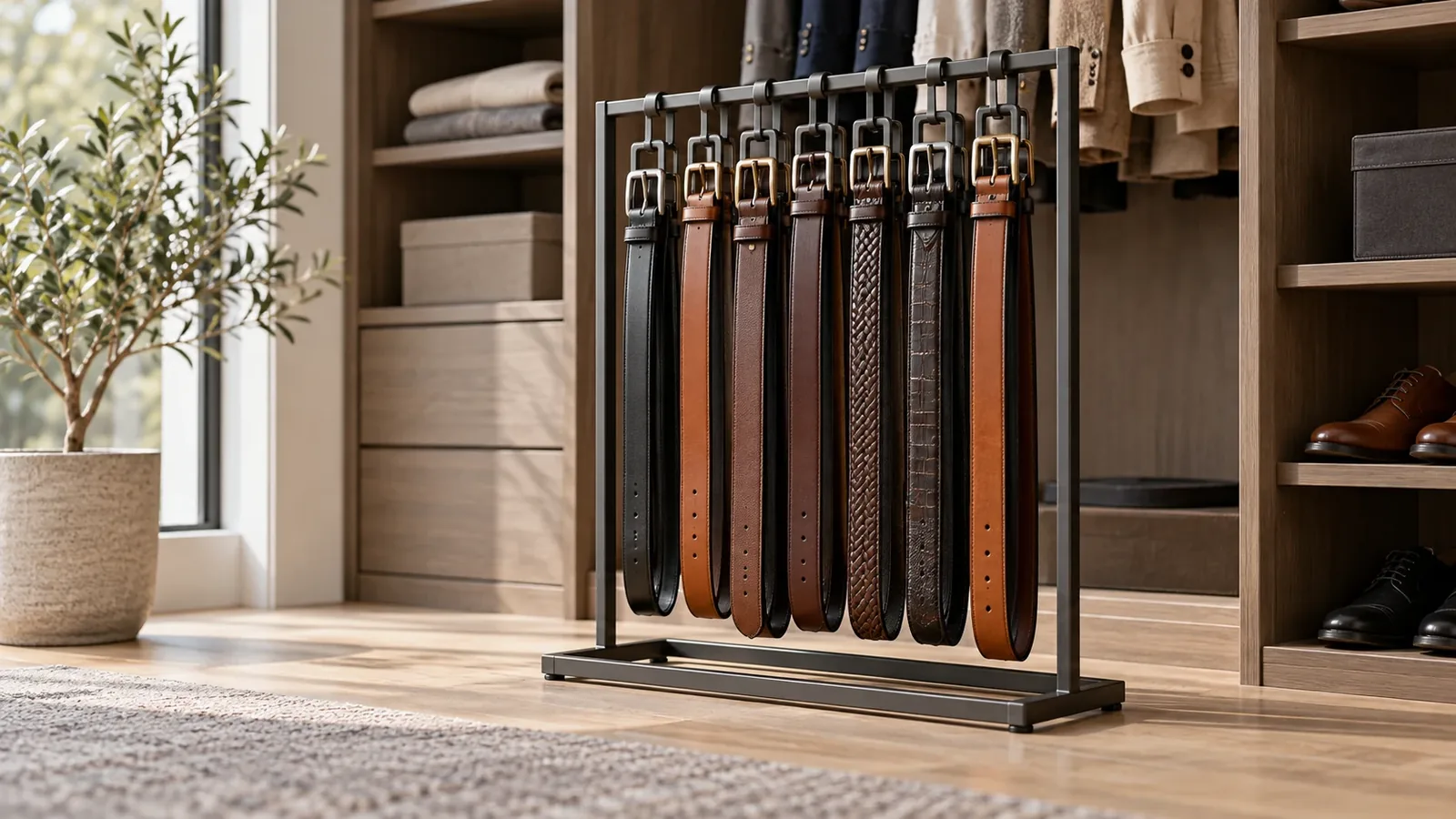
A metal belt rack for a closet should be checked against the buckle shapes, belt widths, and closet layout that the buyer actually plans to serve. A hook that works for a narrow pin buckle may not accept a large flat buckle comfortably. A rack may fit the closet panel yet leave too little space to reach a rear belt or close the door. For an importer, the useful sample question is whether representative belts can be loaded, retained, and retrieved within the intended closet envelope—not simply how many hooks the product has. For an importer, the metal belt rack closet should be evaluated against the target assortment, installation context, and written sample criteria.
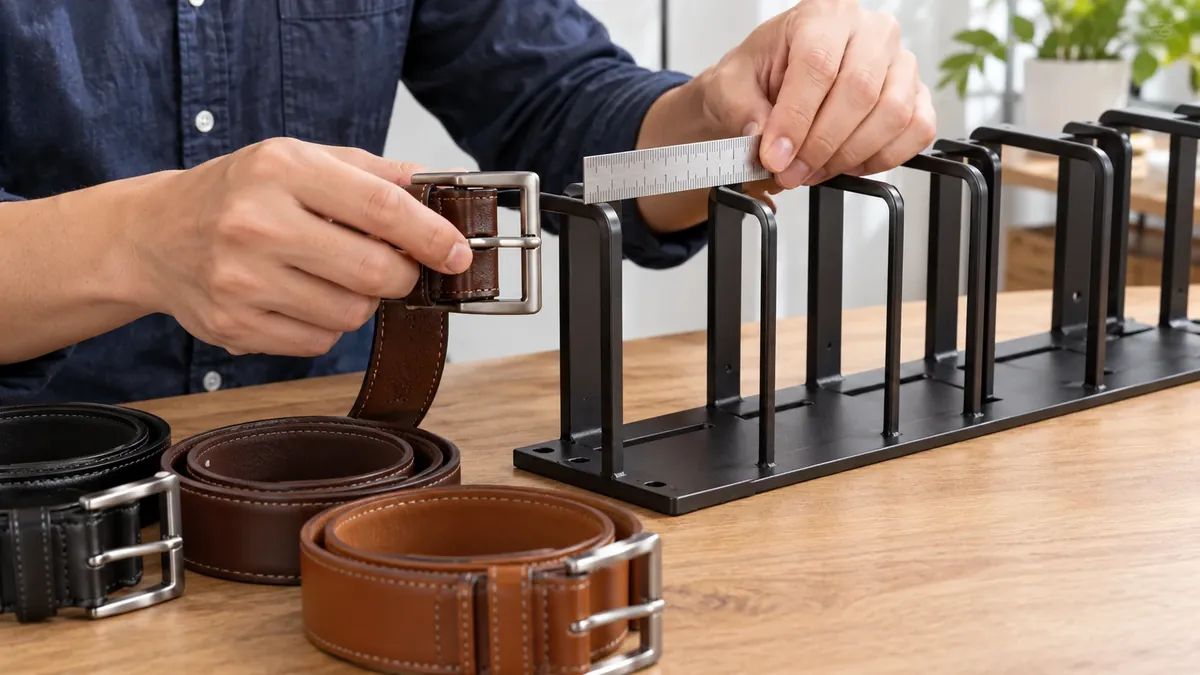
Define the belt assortment
Belts differ in strap width, thickness, flexibility, length, and buckle geometry. Common pin buckles, plates, clasps, and oversized fashion buckles do not hang the same way. Some users hang a belt from the buckle; others fold or loop the strap. The buyer should decide which arrangement the product supports and test that method with representative samples.
Collect a set that includes the narrowest and widest straps, a standard pin buckle, the largest flat buckle, and any unusual closure that matters to the target assortment. Record overall buckle width and height, the space needed to pass it over the hook, belt drop from the support point, and whether the belt tends to rotate. If leather or another stiff material is included, note how it behaves when hung; avoid making claims about long-term material preservation without testing.
A reference matrix helps turn the product idea into a sample plan:
| Belt sample | Dimensions and feature | Fit question |
|---|---|---|
| Narrow strap | Width and thickness | Does it remain captured on the hook? |
| Wide strap | Maximum width and buckle size | Can it hang without contacting adjacent positions? |
| Pin buckle | Pin and frame geometry | Can the buckle be loaded without forcing? |
| Large flat buckle | Overall width and projection | Does it collide with the rack or closet panel? |
| Long belt | Belt length and hanging drop | Does it clear the floor, shelf, or lower storage? |
Avoid treating the word “belt” as a complete dimension specification. If the organizer is meant to hold a particular range, state that range and verify it. If users can load more than one belt per hook, test that arrangement separately and do not count it as one position unless the product’s capacity statement explains the assumption.
Choose the architecture and access method
Belt racks may be fixed, sliding, pivoting, or mounted in another way. A fixed rack has fewer moving parts but may make rear positions hard to reach. A slide-out design can improve access while requiring suitable cabinet depth and a mechanism that is included in the bill of materials. A pivoting architecture changes the sweep area and can conflict with neighboring storage. These are distinct product choices; the buyer should specify the intended one rather than assuming that every closet rack can be adapted.
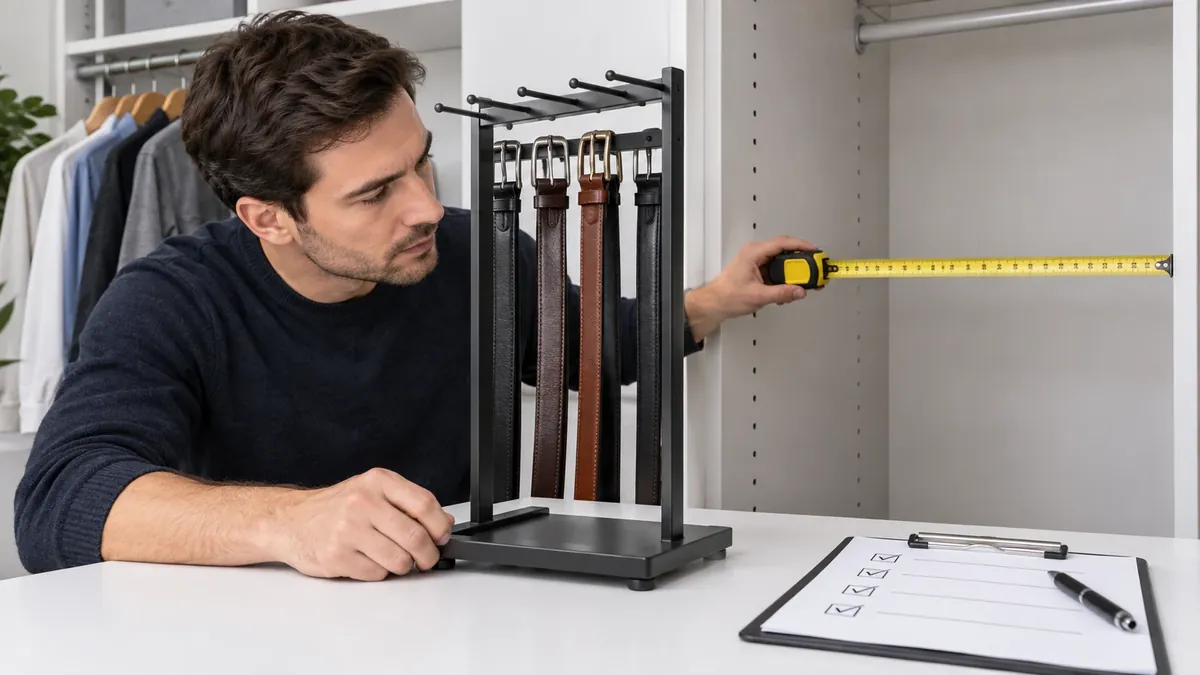
Measure the target closet panel, mounting surface, available width, and clear depth. Include doors, drawer fronts, adjacent garments, shelves, and any closet rod that could interfere. For a sliding model, include the product’s full extended envelope. For a pivoting model, check the entire arc. The rack should be reviewed in the actual closet arrangement or a representative mock-up, not just on a table.
If a competitor product lists a slide type or mounting depth, treat that as a model-specific feature, not a universal performance standard. Do not copy a competitor’s rating or assume the buyer’s planned mechanism will behave the same way. Identify the slide, pivot, fasteners, and spacers as supplied or separately sourced components, and confirm their capacities and installation conditions from the responsible supplier.
Set hook geometry and spacing
Hook shape controls how a belt is loaded and whether it can slip off during movement. An opening that is too narrow can make a large buckle hard to insert. An opening that is too wide can make a narrow strap less secure. A short hook may not retain bulky belt loops; a deep hook may reduce clearance behind the rack. The correct geometry depends on the reference set and the mounting orientation.
Test each representative buckle on more than one position. A frame near the side wall may be harder to load than a center hook. The buyer should define hook pitch, usable opening, height, edge radius, and the distance from the mounting panel. If a hook is formed from wire or sheet, inspect its finished shape and surface at the contact and loading points. The final finish can change the opening and the way a buckle slides.
Spacing should reflect both buckle width and belt drop. Large buckles can overlap neighboring belts even if the hooks themselves are adequately separated. Wide spacing reduces the number of positions in a fixed rack width, while closer spacing may create tangles or obstruct retrieval. Load the rack to the intended assortment density and confirm that each belt can be removed without lifting multiple neighboring items.
A simple access review should include the belt at the front, middle, and rear. Ask a reviewer to remove one selected belt and return it. Note if a buckle catches on the hook, a neighboring strap wraps around it, or the user must move another belt first. The observation should be tied to a specific sample and position, not summarized as a vague “easy access” claim.
Check closet depth and loaded clearance
Measure from the mounting face to the farthest point of the rack, including the largest buckle and hanging strap. Check whether the closet door closes and opens without pressing against the product. Confirm that the belt’s drop does not strike a drawer, shelf, shoe organizer, or floor. If the product is mounted close to a wall or side panel, assess whether a user’s hand can reach the rear hooks.
For a pull-out rack, check clearance at both the closed and fully extended positions. The mechanism’s movement can bring belts closer to neighboring garments or door edges. For a pivoting model, inspect the swept area with belts loaded. If the rack is mounted inside a narrow cabinet, the belt may hang into the path of another product even when the rack itself fits.
A useful sample test can include:
- Install the rack on a representative closet panel using the intended hardware.
- Load the smallest and largest buckle samples on front and rear hooks.
- Close and open the door or drawer several times.
- Extend or pivot the rack through its normal movement.
- Remove and replace a belt from each position.
- Inspect for contact, snagging, unintended movement, or belt overlap.
Record the panel material and thickness, mounting method, and exact configuration. A rack that works on one thick cabinet wall may require a different fastener or clearance on a thinner panel. Do not claim universal closet compatibility when installation conditions have not been defined.
Review contact, finish, and belt handling
The rack’s hooks and edges should be inspected after finishing. Look for burrs, sharp transitions, rough welds, coating buildup, and exposed edges that may catch a strap or buckle. Use the actual belt samples to load and remove items repeatedly. Check for visible marks or snagging, but do not infer that the rack preserves leather or prevents scratches under every material and storage condition.
If the buyer wants a defined contact test, specify the belt material, contact points, loading force, movement cycle, and inspection criteria. A basic sample check may reveal a sharp edge or awkward hook shape; it does not prove long-term leather or coating durability. Product wording should remain within what has been tested.
A metal belt rack may include a separate slide, pivot bracket, stopper, or mounting fastener. Identify which components are bought in and who is responsible for them. Koitor’s current belt-rack SKU, moving mechanism, and belt-contact test are unconfirmed. A buyer should send a drawing or sample and receive explicit confirmation of the proposed construction and component scope before treating the concept as a ready-made offering.
Understand nominal capacity and real assortment density
A six-hook rack does not necessarily store six large belts accessibly. Capacity depends on buckle dimensions, strap width, hanging orientation, and the space available to remove each item. If the product claims a maximum count, test that arrangement with the actual assortment and measure clearance. Consider whether the user may hang a scarf or other accessory; if the product is only intended for belts, avoid broad accessory claims.
Different users may prefer sorting by color, frequency, or belt type. A simple rack does not need to dictate that system, but its visibility and spacing should allow the buyer’s intended assortment to remain distinguishable. If a belt overlaps another buckle, a user may need to move both items to identify the one behind. This can be a product usability issue even when the physical load fits.
The buyer can decide whether to develop one adjustable rack or separate sizes. Adjustability may increase range but add parts or setup steps. A fixed product can be simpler, but may support fewer buckle shapes. Compare using the actual reference set and intended markets rather than using “universal” as a design requirement.
Prepare an RFQ that makes quotations comparable
Include the following in the supplier brief:
- Target customer and closet location.
- Reference belts with strap and buckle measurements.
- Maximum buckle width, height, and projection.
- Desired hook count, pitch, opening, and contact geometry.
- Fixed, slide-out, or pivot architecture.
- Closet panel dimensions, material, and installation conditions.
- Full loaded projection and required door or drawer clearance.
- Finish, color, edge expectations, and cosmetic faces.
- Slides, pivots, fasteners, spacers, and other included components.
- Retail packaging, instructions, and barcode requirements.
- Sample quantity and acceptance checks.
Ask the supplier to state assumptions about the mounting panel, hardware, moving mechanism, finish, and pack-out. Are slides included in the quote? Does the buyer need to source them separately? Are the hook dimensions based on supplied physical belts or a nominal category? What is the intended installation depth? Which tests are included in sample review? Clear assumptions reduce the risk that two quotations describe different products.
Compare quotations on equivalent scope. A lower price that excludes the slide or mounting fasteners may not be cheaper for the finished product. Record any tooling or fixture assumptions and whether the sample includes the production-representative finish. If a supplier proposes a substitute mechanism, review its effect on access, projection, installation, and packing before accepting it.
Specify how the metal belt rack closet sample will be measured, installed, and approved before production release.
Record how the metal belt rack closet will be checked against the approved drawing, reference item, and sample acceptance criteria.
Approve the sample with a belt-by-belt record
A sample approval should name the reference belts and show where each was placed. Confirm that every belt can be loaded and removed according to the intended method, that large buckles clear adjacent hooks, and that the rack fits within the target closet dimensions. For moving designs, inspect the full movement path with the rack loaded. Record any item that does not fit and decide whether to narrow the compatibility statement or revise the product.
Use observable findings. “The flat buckle on sample B4 contacted the side panel when the slide was fully extended” gives a repeatable condition. “The rack is tight” does not tell a supplier which dimension or location to change. Keep photos, drawing revision, mounting details, and acceptance result together.
Repeat affected checks if the hook, spacing, rack depth, slide, finish, or mount changes. A change that appears small can alter the clearance envelope or belt drop. If the project allows, retain an approved reference sample and communicate its revision before production.
Sourcing takeaway
A metal belt rack should be developed around real buckle envelopes and the buyer’s closet layout. Importers should test pin and large flat buckles, check belt drop and hook spacing, review front-to-rear retrieval, and verify the rack’s full movement with the target panel, door, and nearby storage. Keep capacity and material-preservation claims tied to the assortment and conditions actually checked.
For adjacent metal home-storage sourcing, see Koitor’s OEM home-storage hardware manufacturing information and confirm the exact rack construction, moving parts, finish, fasteners, and order scope directly.
Discuss Your Metal Belt Racks Specification
OEM / PRIVATE LABEL
Turn this sourcing guide into a product brief
Share your target product, size, finish, order quantity and packaging requirements. Your team receives a practical manufacturability review before quotation.

 English
 Español
 Português
 Français
 Deutsch
 العربية