
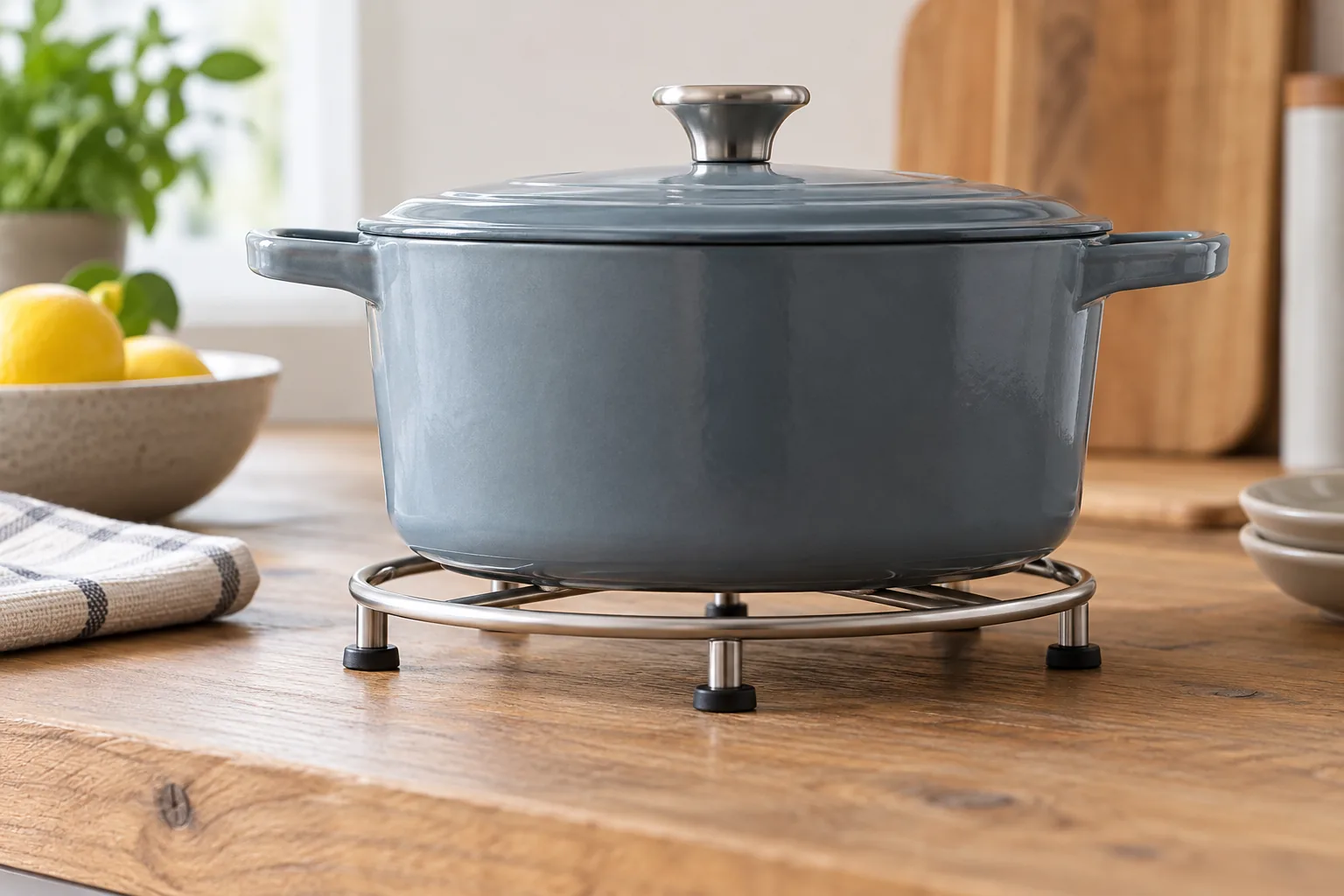
Metal trivet heat resistance cannot be established from the word “metal,” a material grade, or a component temperature rating alone. The importer needs to define the complete finished assembly, the pan or dish footprint, the table surface and the intended use conditions. The supplier’s evidence must match that configuration and the exact claim that will appear on the product or packaging.
A trivet can have a metal frame, raised feet, a silicone mat, a coating, or a combination of contact parts. Those details change what touches the cookware and the tabletop. A number published for one model or one insert is not a universal guarantee that every pan, countertop, exposure time or assembly will be protected. Before approving a claim, match the BOM, sample and wording to the same controlled revision.
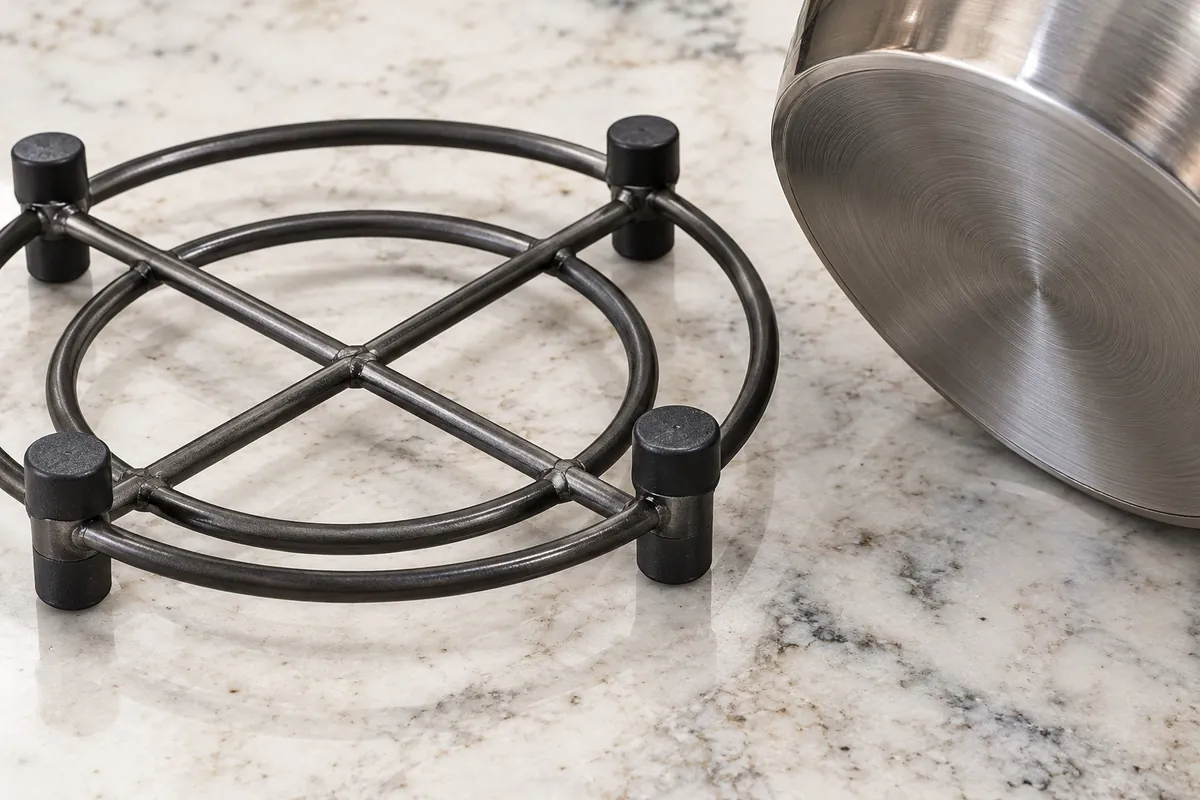
Define the finished trivet, not just its metal frame
Start by listing every component in the saleable assembly. Identify the support frame, contact points, feet, inserts, pads, fasteners, coating or surface finish, and any removable part. Note which component touches the hot cookware and which contacts the tabletop. If an insert or foot is bought in, record its supplier and material specification separately from the metal body.
The word “metal trivet” describes a broad product family, not one thermal design. A raised steel stand with three feet differs from a stainless frame with a removable silicone mat. A one-piece metal platform differs from an expandable composite accessory. The airflow, contact area, spacing, material, geometry and intended use can vary, so a statement that suits one model should not be copied to another.
Manufacturer product pages illustrate this variation. Robert Welch describes its Signature Oval Trivet as polished stainless steel with a removable silicone mat and states a heat-resistance figure for that named model. Joseph Joseph describes its Stretch trivet as a silicone/nylon composite design and lists its own model-specific limit and care guidance. Those listings show that product makers may define ratings for a complete named design, but they do not prove a different OEM assembly or every tabletop condition. Treat each rating as belonging to its published model and ask what exactly the maker’s figure covers.
Create a product map before seeking a quote:
| Part or interface | What the buyer should specify | Evidence to connect to the claim |
|---|---|---|
| Metal structure | Material designation, thickness or section, shape, finish and revision | Controlled drawing and production-intent sample |
| Cookware contact | Support pattern, contact height, area and permitted pan-base envelope | Assembly drawing and representative cookware sample |
| Table contact | Feet, pad or mat material, contact location and replacement status | Supplier material data and finished-product review |
| Removable insert | Material, dimensions, orientation, retention and supplier revision | Part specification plus evidence for its intended use |
| Intended use | Pan or dish type, placement, surface, duration or other claim boundaries | Claim-specific test plan or competent technical evaluation |
| Label and instructions | Approved wording, warnings, care and use limits | Final copy tied to the tested product revision |
Do not assume that a visible metal frame controls every relevant surface. A heat-protection claim may depend on the insert or feet, their attachment, the distance from the pan to the tabletop, and how the assembly performs as a whole. If one component changes, review whether the claim and supporting evidence still apply.
Specify the cookware footprint and the support arrangement
A buyer should provide a representative cookware base, not only the pan’s top diameter or nominal capacity. The base shape and diameter affect where the trivet supports the pan. A small pot on a wide trivet may sit differently from a large skillet that approaches the frame edge. A rounded base may rest on fewer points than a flat-bottomed vessel, and handles can affect how the pan is positioned.
Record the pan-base envelope used for sample evaluation: shape, maximum footprint, flat or rounded area, and any defined placement orientation. Identify whether the trivet is intended for a single pan, multiple pans, serving dishes, or another specific use. If the design is expandable or has multiple configurations, each configuration should be considered as a separate assembly state. Do not create a general “fits all pots” statement from one sample.
Review the support geometry with the cookware in place. Check whether the pan is supported at the intended contact points, whether it rocks under ordinary placement, and whether any feet or rails can be displaced. This is a fit and assembly observation, not a load rating or a thermal result. If stability under a particular load matters, define that separate requirement and have it evaluated by the responsible technical party.
The buyer’s drawing should show the cookware base relative to the trivet. Include the frame’s support span, raised height, foot layout, insert dimensions and intended centering. Where the pan is expected to overhang or where the trivet has a decorative cut-out pattern, document the acceptable placement range. The reviewer should not infer intended support from a lifestyle photograph.
Identify the tabletop and the claim boundary
“Protects the table” is too broad without naming the surface and conditions. Tabletops can use different materials, finishes, coatings, edges and care instructions. The user may place the trivet on a wood finish, stone, laminate, glass, a coated surface or another material, each with its own sensitivity and manufacturer guidance. A buyer cannot assume one support design behaves the same on every surface.
Write down the intended surface categories and any limits the product is supposed to address. If the consumer instructions exclude certain surfaces, identify them clearly. If the marketing claim refers to a tabletop being protected from heat, distinguish that from preventing scratches, stains, moisture marks, discoloration, cracking or other damage. Those are separate outcomes and may need separate evidence.
Also describe the relevant use conditions. What type of pan or dish is expected? Is it placed immediately after cooking, or after another process? Is the claim about short placement or repeated use? Does the trivet need to work with a removable silicone mat installed, or is the frame itself presented as the contact surface? Do not substitute a competitor’s limit or a bare material property for the performance of the finished product in the buyer’s actual use case.
A model-specific temperature number is not automatically a tabletop-protection guarantee. The number may describe heat resistance of the trivet’s own material or assembly under stated conditions, while the tabletop sees a different temperature profile through the actual geometry and contact points. Ask the supplier or qualified evaluator to explain the test setup, what was measured, the sample configuration and what claim the result supports. A document with a unit but no method, sample identity or limit is not enough for a broad claim.

Match supplier evidence to the whole assembly
Build an evidence matrix with one row per product revision and one column for each claim the buyer intends to publish. For example, a supplier material statement, component temperature rating, finished-product evaluation, care instruction and tabletop compatibility claim answer different questions. Identify which party controls each document and whether it covers the same insert, finish, foot, geometry and assembly as the production unit.
When reviewing a supplier-provided rating, request:
- The exact product model and revision covered.
- The tested assembly, including insert, feet, finish and fasteners.
- The cookware or heat source used and the contact location.
- The test method, equipment, sample preparation and any conditioning.
- The measured outcome, units, pass criterion and permitted use wording.
- The tabletop or surface category evaluated, if the claim concerns protection.
- The report or specification owner and any exclusions.
- The revision-control process when any component or supplier changes.
Do not treat a raw-material datasheet as finished-product evidence. It can identify material properties for the defined grade or formulation, but it does not demonstrate how a complete trivet works. Likewise, a component rating may support a component-specific statement without establishing the finished assembly’s effect on a table. A product test may support only the sample and conditions stated in its report.
A buyer should not write its own pass criteria after seeing a favorable result. Agree the test question and acceptance rule before testing. If the proposed claim is broad, ask a competent laboratory, engineer or compliance specialist to determine an appropriate evaluation. This article does not prescribe an at-home hot-pan test or a universal number of minutes, pan weight or temperature. Without a defined and suitable method, a demonstration can create false confidence.
The output should be a claim-release record: claim wording, product revision, evidence reference, surface and use scope, reviewer, approval date and any limitations. Put the approved wording on the drawing, packaging brief or product-data record so a later copy change does not quietly exceed what the evidence supports.
Control inserts, feet, finishes and production changes
A change to a small component can change how the finished product contacts cookware or a table. Track the supplier and revision for silicone mats, pads or feet; note their dimensions and attachment method; and identify the surface finish on the metal body. If a pad is replaced by a new material or a different thickness, review the installed height and contact arrangement. Do not assume that a dimensionally similar component preserves the same use claim.
Examples of changes that should enter a controlled review include:
- Switching metal grade, thickness, frame geometry or finish.
- Changing the number, shape, spacing or height of the feet.
- Changing an insert’s formulation, thickness, hardness, surface texture or supplier.
- Removing, adding or relocating a silicone mat or pad.
- Changing the cookware footprint or intended use described in the product listing.
- Revising package language, care instructions or claim wording.
- Changing a supplier, tool, assembly method or order of installation.
A production-intent sample should be checked against the same BOM and supplier declarations intended for the purchase order. Confirm that all removable parts are included, that the feet or inserts remain attached as specified, and that the sample and packaging describe the same setup. If the test specimen differs from production in a claim-relevant feature, obtain an expert decision about whether the existing evidence remains valid.
Also distinguish quality checks from performance substantiation. A visual check can verify the presence, orientation or apparent condition of a foot or mat. A dimension check can confirm stated geometry. Neither proves a thermal result. A temperature rating on one supplier component does not become the finished trivet’s rating unless a qualified reviewer establishes how the component evidence supports the complete claim.
Koitor’s approved experience supports discussion of metal structure, forming, finish, assembly, drawings and sample development within the documented scope. It does not confirm current trivet production, silicone manufacture, thermal testing or thermal certification. Buyers should assign product performance claims to the responsible supplier and competent evaluator rather than imply those services through a general metal-hardware inquiry. The OEM home-storage hardware information describes the factory’s documented scope; the contact page can be used to discuss a specific drawing or metal assembly question.
Importer checklist before approving a heat-protection claim
Before approving the trivet SKU and its consumer-facing wording, confirm the following:
- Finished assembly: The BOM identifies the metal frame, feet, insert, coating and all contact parts.
- Cookware: The buyer’s representative pan or dish has a defined base footprint and placement.
- Tabletop: The surfaces covered by the intended claim are named; exclusions are recorded.
- Use conditions: The product’s expected use and any duration, temperature or handling boundary are defined by the responsible technical party.
- Component scope: Each supplier document identifies the exact part and revision it covers.
- Assembly scope: Evidence refers to the same complete construction that will be produced and sold.
- Test meaning: The method, sample, measured result, criterion and limitations are clear.
- Claim wording: A reviewer confirms that the marketing phrase does not exceed the evidence.
- Change control: Insert, foot, finish, geometry, supplier and instruction changes trigger review where relevant.
- Pack and listing: The label, care information, online listing and carton language match the approved configuration.
- Other requirements: Any food-contact or other regulatory question is assessed separately where relevant; a heat-protection review does not answer it.
- Release owner: A named importer or brand representative approves the evidence and final wording.
Keep “not evaluated” visible where the project does not have evidence. A buyer may decide to narrow the claim, remove a use case, obtain additional testing or choose a different configuration. The point of the evidence file is to make that decision specific to the product rather than implying universal protection from a generic material label.
Frequently asked questions about metal trivet heat resistance
Does a stainless steel frame prove that a trivet protects every countertop?
No. The frame material alone does not establish heat transfer or the outcome on every surface. The result depends on the complete design, contact points, cookware, tabletop and conditions covered by evidence.
Can the silicone insert’s temperature rating be used for the entire assembly?
Not automatically. A component rating belongs to the specified material or part and its stated conditions. A qualified reviewer should determine whether it supports a claim about the complete trivet and its intended use.
Is a raised metal trivet equivalent to a metal frame with a silicone mat?
No. The designs have different contact materials, geometry and assemblies. The buyer should specify which configuration is sold and review evidence for that exact construction.
Does a trivet rating mean no table damage can occur?
Not unless the manufacturer explicitly supports that precise outcome under defined conditions. Heat, scratches, moisture, finish sensitivity and other damage mechanisms are different questions. Avoid a broad “protects any surface” claim without matching evidence.
If the metal structure stays unchanged, can the buyer change the feet or mat without review?
A feet or mat change can alter the contact interface, height or material in the assembly. Route it through the claim and sample review to determine whether the existing evidence still applies.
Does checking that a pan sits flat establish thermal protection?
No. A fit or visual check confirms a geometric observation. It is not a thermal test and does not show what happens to the tabletop under a defined use condition.
Manufacturer examples and evidence boundaries
- Robert Welch Signature Oval Trivet — The product page describes a polished stainless frame with a removable silicone mat and gives a model-specific heat-resistance statement. It does not establish a rating for another trivet.
- Joseph Joseph Stretch Trivet — The manufacturer describes an expandable silicone/nylon composite model with its own stated limit and care instructions.
- Cricket Forge Steel Trivet — A distinct steel design with raised ball feet and a model-specific material/finish description.
These examples illustrate why the complete assembly and published claim must stay connected. Their ratings and product details are not Koitor specifications, universal trivet limits or proof that one design protects every countertop.
Metal trivet heat resistance should be evaluated only for the complete, controlled assembly and stated use conditions; component appearance or a single material label is not a performance result.
Match the Claim to the Complete Assembly
Share the trivet drawing, BOM revision, contact parts and intended use wording for a bounded metal-structure discussion. Thermal claims and test interpretation must be confirmed by the responsible suppliers and competent technical reviewers.
OEM / PRIVATE LABEL
Turn this sourcing guide into a product brief
Share your target product, size, finish, order quantity and packaging requirements. Your team receives a practical manufacturability review before quotation.

 English
 Español
 Português
 Français
 Deutsch
 العربية