
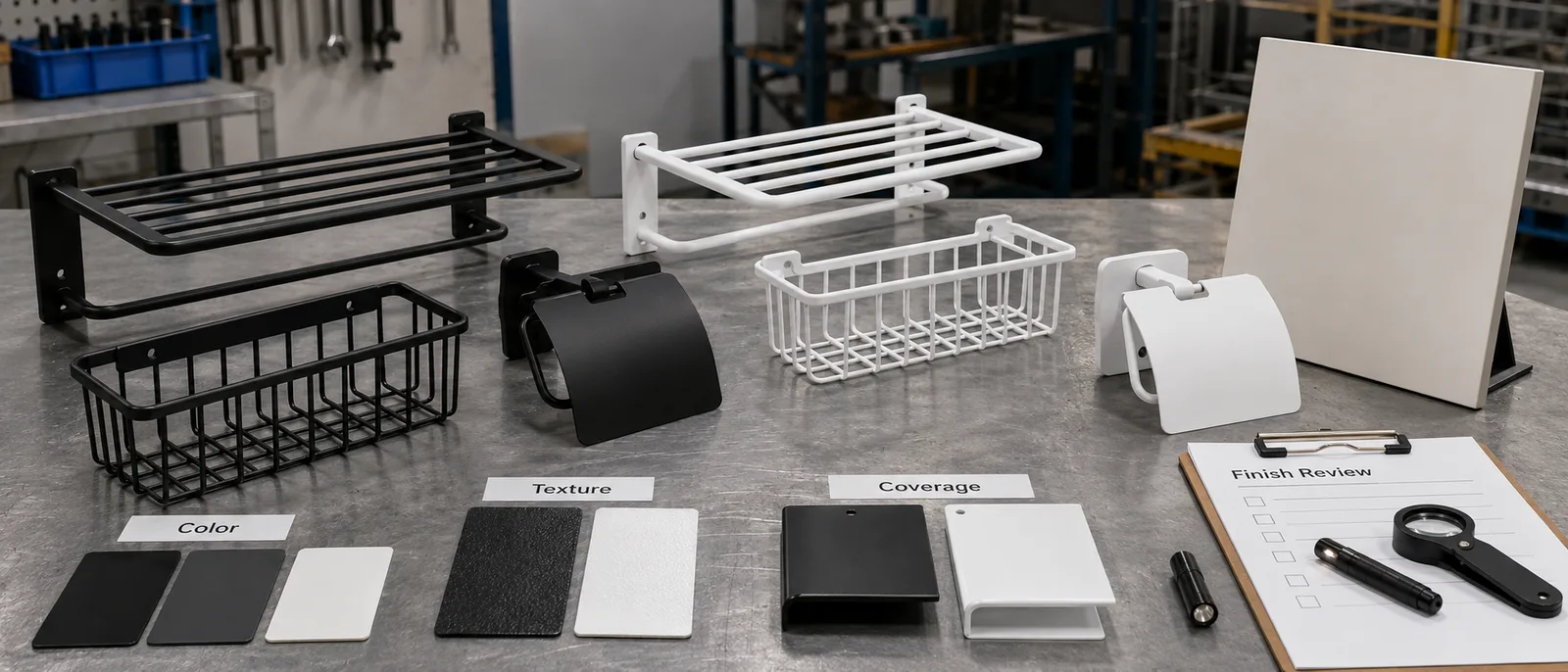
Powder coated bathroom accessories should be checked as complete finished products, not only as flat color samples. B2B buyers need to review color and texture consistency, coating coverage at welds and corners, visible marks, edge condition, assembly fit and packaging protection. The most reliable approval method is to define the finish reference, inspect representative product samples under consistent lighting and record acceptable limits before bulk production.
What Defines Good Powder-Coating Quality on Bathroom Accessories?
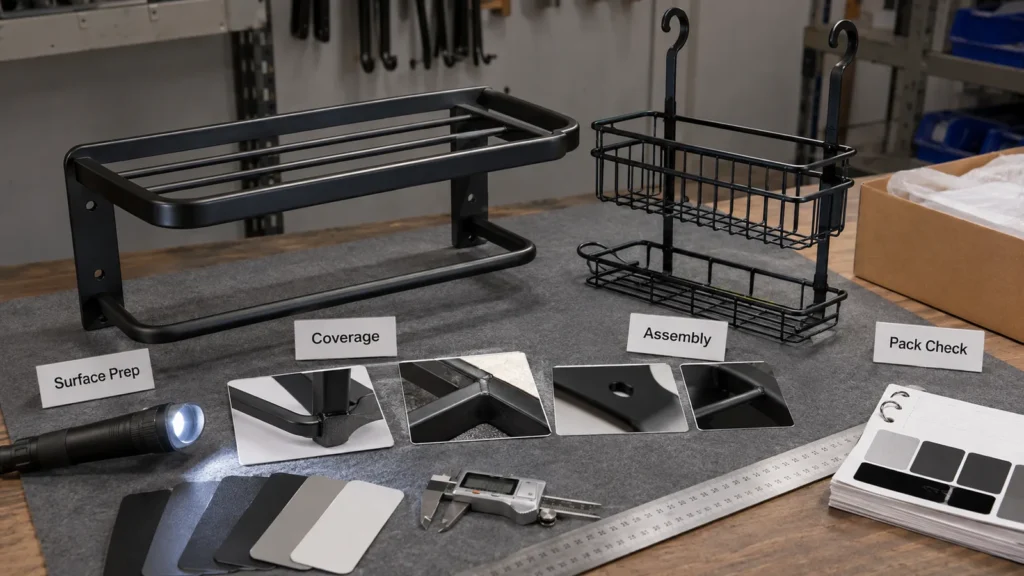
Good powder-coating quality means that the agreed color and texture are applied consistently across the product, including visible faces, edges, corners, weld areas and practical recesses. The finished rack, caddy, basket or tissue holder should also assemble correctly and reach the buyer without avoidable rubbing or impact damage.
Powder coating is a dry finishing process. Powder is electrostatically applied to prepared metal and then cured so it forms a continuous finish. For a buyer, the process name is less important than whether the complete production route can repeatedly achieve the approved appearance and functional requirements.
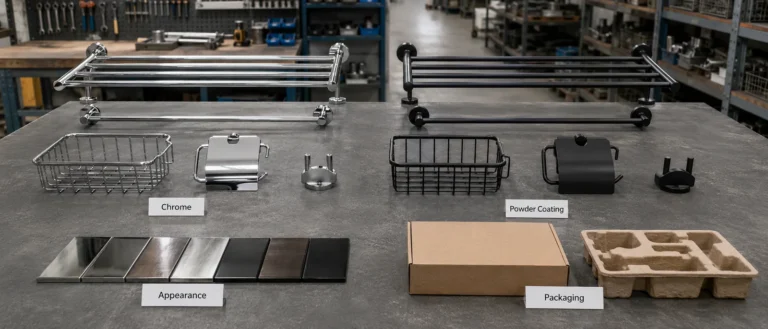
A finish may look acceptable from one angle but show variation under side lighting. A broad flat bracket can reveal texture changes, while welded wire intersections can expose thin coverage or powder build-up. Deep corners and hanging points can also behave differently from open surfaces. This is why a single loose color chip cannot represent every surface on a three-dimensional product.
Buyers should separate four acceptance areas: visual appearance, coverage, dimensional and assembly effect, and delivery condition. A visually attractive coating is not enough if mounting holes are restricted, threaded areas are blocked, mating parts no longer fit or the packaging allows finished pieces to rub together.
For broader product-development context, Koitor’s custom bathroom hardware manufacturer page explains the factory’s work with towel racks, shower caddies, tissue holders and related OEM products.
Which Production Steps Affect the Final Coating?
The final coating is influenced by the product design, incoming metal condition, fabrication, surface preparation, powder application, curing, handling and packaging. A coating defect may originate before the powder is applied, so buyers should review the process as a connected sequence rather than judge the spray stage alone.
Product geometry determines which surfaces are easy or difficult to cover. Tight gaps, overlapping wires, deep corners and closed tube ends can create different coating behavior. Hanging orientation can affect contact marks and how the powder reaches edges. These points should be considered during sample development, especially when a product combines wire, tube, sheet and welded brackets.
Fabrication quality also remains visible after finishing. Welding spatter, rough grinding, oil, scratches or uneven metal transitions can show through the cured layer. Powder coating can change the appearance, but it is not a substitute for suitable welding and surface preparation.
Surface preparation helps remove contamination and create a suitable base for the agreed coating system. The exact preparation route depends on the material, product and supplier process. Buyers do not need to prescribe every production setting, but they should confirm the material, intended use, finish reference and inspection method with the manufacturer.
| Production Stage | Possible Effect on Finish | Buyer Review Point |
|---|---|---|
| Product and joint design | Tight gaps, sharp transitions or hidden recesses can be difficult to coat evenly | Review geometry on the actual finished sample |
| Cutting, bending and welding | Scratches, spatter, distortion and rough repairs can remain visible | Inspect visible surfaces, welds and frame alignment |
| Surface preparation | Residual contamination can contribute to local appearance or adhesion concerns | Confirm the preparation route and keep approved samples |
| Powder application | Coverage, texture and build can vary around edges and complex shapes | Compare multiple areas and multiple samples |
| Curing and cooling | Color, gloss or film performance can vary if the process is inconsistent | Approve production-representative finished parts |
| Assembly and packaging | Tools, fasteners or adjacent parts can scratch or rub the coating | Test assembly and packed-sample handling |
The table is a sourcing framework rather than a universal coating specification. Acceptance points should match the product structure, market positioning, installation method and buyer requirements.
What Finish Defects Should Importers Check on Samples?
Importers should check samples for inconsistent color or texture, thin or missed coverage, excessive build-up, visible particles, pinholes, rough weld areas, scratches, contact marks and packaging damage. When reviewing powder coated bathroom accessories, each observation should be recorded by location and viewing condition so the factory can identify the relevant process stage.
Color consistency should be compared between parts in the same set and between representative samples. Use the agreed reference and similar lighting each time. Warm and cool light can make the same finish appear different, while gloss and texture alter how color is perceived. Photos are useful for communication, but a physical approved sample is usually a stronger production reference.
Coverage checks should include front faces, lower edges, inside corners, weld intersections, hooks, mounting plates and the underside of shelves. Buyers should distinguish a deliberately masked functional area from an unintended bare or thin area. Masking requirements for threads, electrical contact points or tight-fit assembly areas should be shown on the drawing or sample notes.
Excessive coating build can also create problems. It may reduce clearance around holes, interfere with sliding or mating parts, soften sharp design details or make screw assembly difficult. The inspection therefore needs both visual review and a basic assembly check.
Particles, craters, pinholes and bumps should be evaluated by size, quantity, location and visibility. A minor point on a hidden rear face does not have the same commercial impact as a cluster on the front of a retail-visible towel bar. Instead of using vague terms such as “perfect surface,” buyers should define cosmetic zones and practical acceptance examples.
For products that combine coating with welded rack structures, the custom metal storage rack manufacturing page provides related OEM capability information.
How Should Buyers Approve Color, Texture and Coverage?
Buyers should approve color, texture and coverage with a documented physical sample, clear viewing conditions, marked cosmetic zones and a checklist that includes assembly and packaging. The approved reference should identify the powder code or agreed finish description where available, but the finished product sample remains essential because geometry affects appearance.
Start by confirming the base material, target color, gloss or texture direction, visible surfaces and retail positioning. A fine texture, smooth finish and stronger texture can reflect light differently even when their nominal colors are close. The buyer should decide which visual characteristic matters most before requesting repeated adjustments.
Next, review more than one sample. One part can hide normal variation or an isolated defect. Representative samples help the buyer compare the main visible face, complex joints, edges and assembled appearance. If several product sizes belong to one collection, review whether the finish appears coherent across the range.
The buyer and factory should record decisions in a sample approval sheet. Photographs can identify inspection areas, while short written notes define what is accepted. Keep one reference with the buyer and one with the factory when practical. If a later change affects powder, material, geometry or supplier, a new approval may be needed.
Buyer Sample Approval Checklist
- Confirm product number, revision, material and finish reference.
- Compare color and texture under consistent neutral lighting.
- Check front, side, underside, inside corners, edges and hanging points.
- Inspect welded intersections, ground areas and tube-to-bracket joints.
- Mark primary cosmetic surfaces and less-visible secondary surfaces.
- Check holes, threads, brackets and mating parts for excessive build-up.
- Assemble the sample with production-intent hardware and instructions.
- Review multiple samples for repeatability rather than one ideal piece.
- Approve packaging separators, protective sleeves and hardware placement.
- Record approval date, sample revision and any accepted deviations.
A useful checklist turns subjective feedback into specific sourcing decisions. It also gives inspectors a repeatable reference for later production checks.
How Do Packaging and Transport Affect a Metal Rack Surface Finish?
Packaging affects the metal rack surface finish because contact, movement, pressure and loose hardware can damage an otherwise acceptable coating after inspection. Packaging should therefore be tested with the final coated product, mounting components and retail pack configuration rather than designed around an unfinished sample.
Common contact risks include two coated frames rubbing together, a mounting bracket pressing against a visible bar, screws moving inside the box and a product edge touching the carton wall. Protective bags alone may not prevent concentrated impact or movement. Separators, sleeves, formed supports or individual hardware packs may be required depending on the structure.
Freshly finished parts also need controlled handling before packing. Stacking, workbench contact and assembly tools can create marks that resemble coating-process defects. Inspection records should note whether a mark was found after coating, after assembly or after packaging so corrective action addresses the right stage.
Buyers can request a packed sample and perform the transport checks that fit their distribution route and internal standards. After the check, open the package, inspect the main cosmetic surfaces, assemble the product and compare it with the approved finish sample. Do not assume that a stronger carton alone will prevent part-to-part rubbing inside the package.
Retail labeling and instructions should also avoid direct abrasive contact with the product. Adhesive labels should not be placed on coated surfaces unless specifically reviewed, because removal can leave residue or affect presentation.
How Can Koitor Support Powder-Coated OEM Projects?
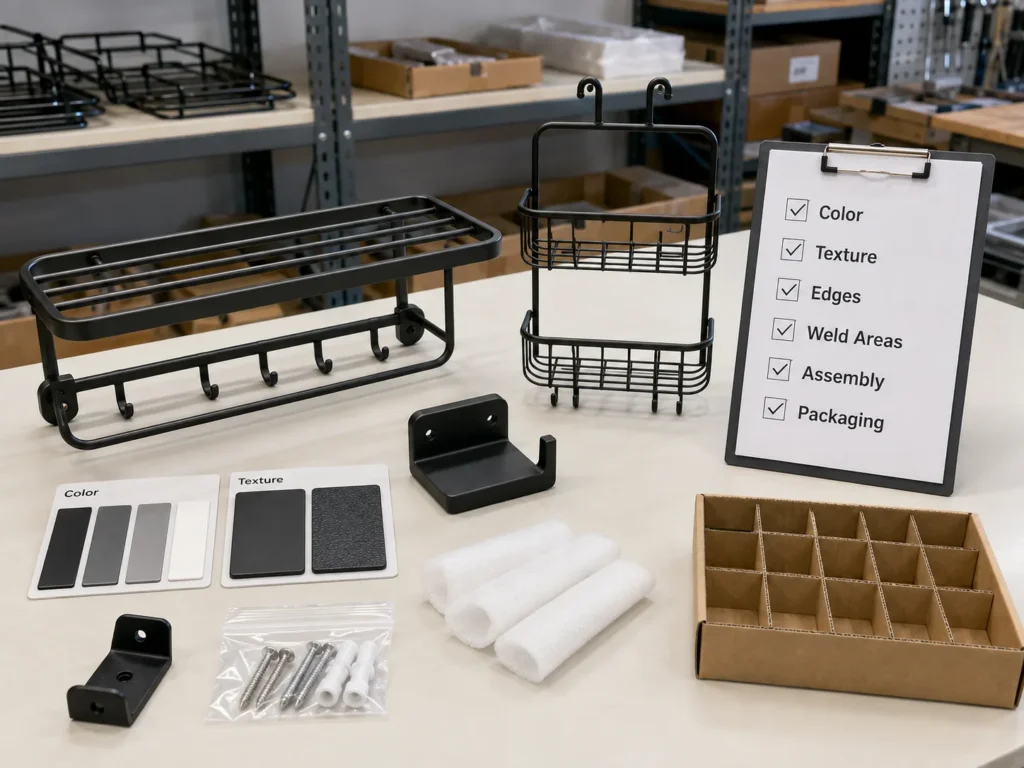
Koitor Hardware can review drawings or physical samples, identify visible surfaces and difficult coating areas, prepare finished samples and discuss packaging protection before small-batch production. As a family-owned custom metal hardware factory, Koitor supports practical development of bathroom racks, towel holders, shower caddies, wire baskets and related home storage hardware.
For powder coated bathroom accessories, buyers can send the product drawing, reference sample, color or texture target, cosmetic-surface priorities, installation hardware, packaging idea and expected quantity. Clear inputs allow the factory to review metal construction, welding, masking, coating access, assembly and packing as one product-development process.
Koitor’s practical review may identify issues such as a tight corner that is difficult to cover, a mating area that needs masking, a welded surface that requires better preparation or a packaging contact point that could mark the coating. The goal is to address these details during sample development instead of discovering them after bulk goods are packed.
MOQ can start from 100 pieces depending on the product structure, material, finish and packaging. Samples usually take 5-7 working days after the main details are confirmed. Bulk production usually takes 4-6 weeks depending on quantity, complexity, material availability, finishing and packaging. These ranges should be confirmed for each project.
During production, the approved sample and checklist can guide checks for appearance, coverage, dimensions, assembly and packaging. If a concern appears, photographs should show the product number, defect location, viewing angle and quantity observed. This gives the buyer and factory a clearer basis for deciding whether the issue is isolated or process-related.
More sourcing and quality-control guidance is available through Koitor resources.
Frequently Asked Questions
Is a powder color chip enough for sample approval?
No. A color chip is useful as a reference, but product geometry, texture, gloss, metal preparation and lighting affect the final appearance. Approve a finished production-representative product sample as well.
Which areas of a bathroom rack coating need the closest inspection?
Check primary visible faces, edges, inside corners, welds, hooks, mounting plates, undersides and hanging points. Also inspect holes, threads and mating areas where coating build-up can affect assembly.
How should buyers describe an acceptable cosmetic finish?
Define viewing conditions, cosmetic zones, color and texture references, and examples of acceptable and unacceptable observations. Avoid relying only on terms such as “perfect” or “high quality.”
Can powder coating hide welding or grinding marks?
Powder coating may change the visual appearance, but rough welds, spatter, scratches and uneven repairs can remain visible. Fabrication and surface preparation should be reviewed before finishing.
Why should packaging be approved with the coated sample?
The final coating can be scratched or rubbed by adjacent parts, hardware and carton movement. A packed-sample review confirms whether the protection method suits the actual finished product.
Work With Koitor Hardware
Need Help Approving a Powder-Coated Bathroom Hardware Finish?
Send Koitor your drawing, physical sample, color or texture reference, cosmetic-surface notes, packaging idea and expected quantity. Our team can review coating access, sample approval points, assembly and small-batch production options before quotation.
OEM / PRIVATE LABEL
Turn this sourcing guide into a product brief
Share your target product, size, finish, order quantity and packaging requirements. Your team receives a practical manufacturability review before quotation.
 English
  Español
  Português
  Français
  Deutsch
  العربية