
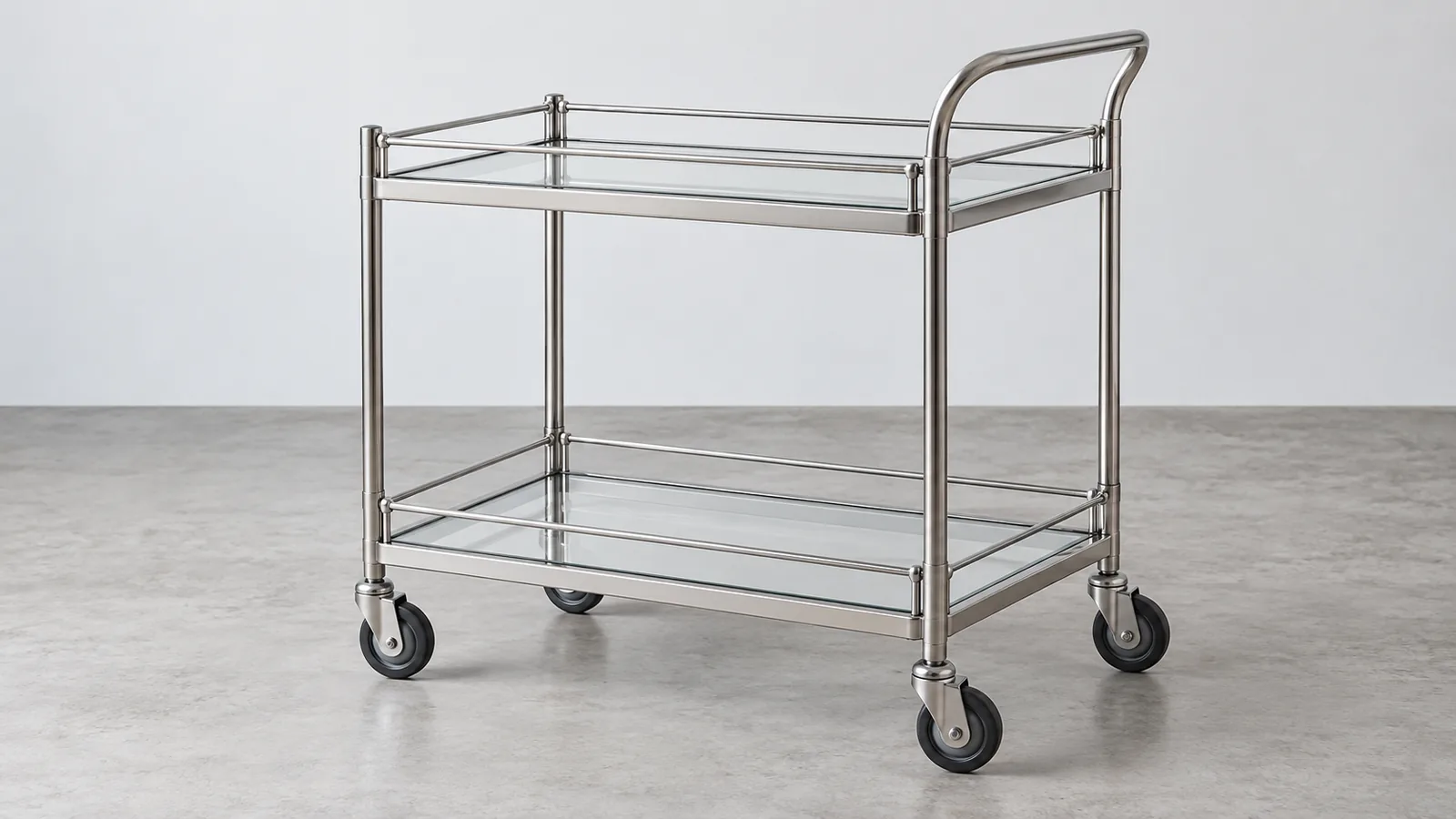
A serving cart can be a compact bar trolley, a hospitality service cart, or a decorative storage piece with a metal frame and glass or wood shelves. These products may share a silhouette while solving different buyer problems. One cart may be judged by bottle organization; another by moving between service areas; another by how it looks in a home assortment. A buyer who sends only a reference photo leaves the intended product and acceptance criteria unclear.
A useful metal serving cart OEM specification starts with the intended use and the items the cart must hold. It then defines shelf layout, component interfaces, movement, assembly, finish, packaging, and the evidence needed to approve the sample. This guide helps an importer turn those decisions into a comparable RFQ and review record. It does not imply that Koitor currently manufactures serving carts or that one design has a universal load capacity.
Define the cart’s job before choosing its shape
Start with the buyer’s assortment and actual use. Is the cart intended for beverage service, home bar storage, dining-room display, hotel amenity presentation, or another purpose? List the products that will sit on each level, including their approximate footprint, height, shape, and handling pattern. A wine bottle, glass set, ice bucket, and tray may all fit within the outside dimensions but compete for the same usable space.
Record which product configuration is in scope: shelf count, shelf material, rail or edge treatment, bottle supports, baskets, handle, caster type, brakes if specified, and any accessory. If a product page offers different finishes, colors, shelf materials, or logo options, identify the exact version being quoted. Each version may change appearance, interfaces, or packing requirements.
Use a short use-case statement to anchor the RFQ: “The cart moves between a defined room and service area while holding this named set of products,” or “The cart is primarily a stationary display unit.” Avoid asking for a generalized “commercial-grade” cart without explaining what the buyer expects. If the destination is hospitality, clarify whether the cart is used by staff, guests, or both, and whether cleaning and repeated handling are part of the intended use.
The statement should also distinguish appearance from function. A styled image may show bottles and glasses arranged attractively, but it does not establish shelf capacity, suitability for rolling over a threshold, ease of cleaning, or assembly performance. Use the image as a visual reference, then write down the conditions that need to be verified.
Specify the shelf, frame and accessory interfaces
Outside width, depth, and height do not describe usable capacity. Dimension the clear shelf area, height between levels, shelf-edge clearance, handle position, and the space occupied by wheels or corner posts. Confirm that the named bottles, glasses, trays, or room products can be arranged without hitting a rail or preventing removal. Use representative items during sample review rather than relying only on a CAD layout.
The frame-to-shelf connection is another important interface. Identify how each shelf is supported or retained, whether it is removable, and which surfaces are cosmetic. For glass or wood shelves, clarify edge treatment and the interface material; for a wire shelf, define wire spacing and perimeter geometry. Avoid specifying a material by appearance alone. If the product must have a particular material, thickness, finish, or edge standard, state it in the drawing or bill of materials and obtain the supplier’s written confirmation.
Accessories should be described by function and location. Bottle holders, stemware rails, removable baskets, hooks, or handles can change the cart’s clearances and assembly sequence. Mark their positions and note which components are included in each SKU. If an accessory is optional, give it a separate part number and indicate whether the retail carton contains it.
| Specification area | Buyer should define | Sample review evidence |
|---|---|---|
| Intended use | Service, display, home bar, or another defined job | Written scenario and representative items |
| Shelf layout | Count, clear area, level spacing, edge and surface | Items fit and can be removed in the stated arrangement |
| Frame interfaces | Joint location, shelf support and cosmetic faces | Visual and dimensional observations tied to drawing |
| Movement | Caster arrangement, handle, brakes if required, surfaces | Recorded movement observation under agreed setup |
| Included components | Bottle holders, rails, basket, fasteners and tools | Bill of materials and carton contents |
| Finish | Color, texture, sheen and reference sample | Comparison under agreed viewing conditions |
| Pack-out | Assembly state, protection, instructions, carton labels | Packed sample and SKU-level record |
A metal serving cart OEM specification should identify which dimensions are critical to fit and which are cosmetic preferences. If every measurement is marked “critical,” the supplier may not know where variation matters most. Identify buyer-controlled acceptance limits and the method used to inspect them.
Review movement with the cart’s intended load and route
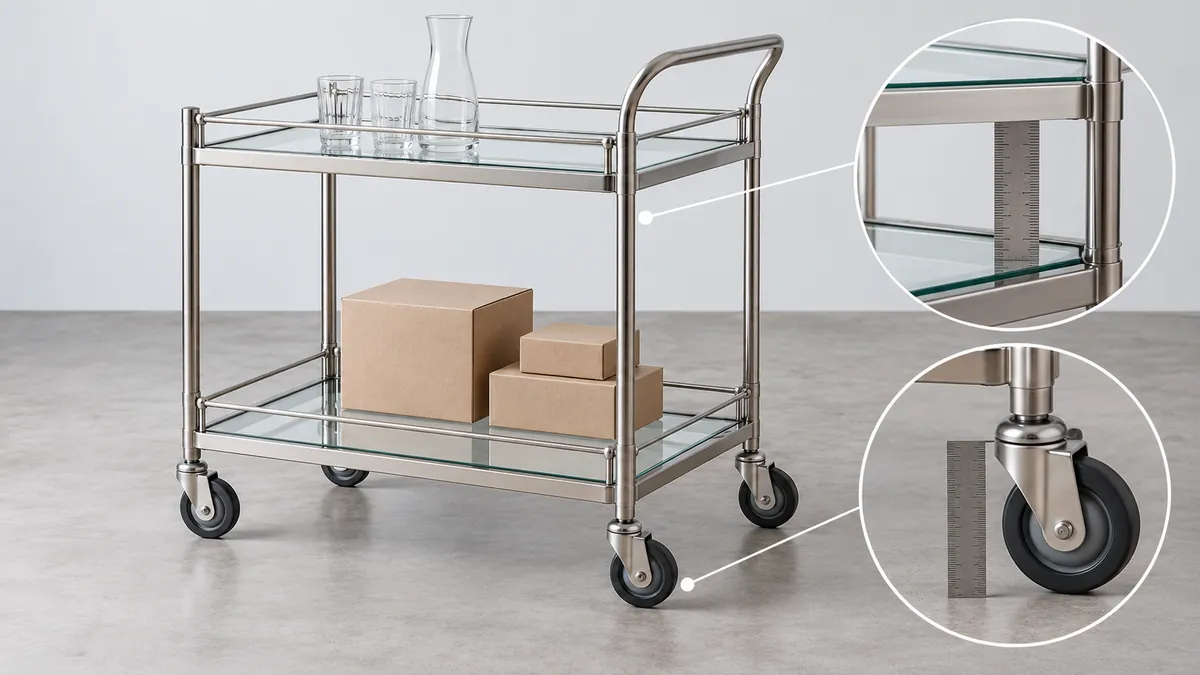
A cart that looks balanced while empty may behave differently with the products the buyer plans to display. Use the representative items and arrangement from the use-case brief. Record where weight is placed, which route or surface is used, and what movement the buyer expects. If the cart will remain stationary, do not assume that a rolling test is a relevant acceptance criterion; if it will be moved in service, do not approve only from a static photograph.
Inspect the caster-to-frame interface, hardware, orientation, and any specified brake. Ask whether wheels are fixed, swivel, or mixed and verify that the sample matches the drawing. Note whether the handle can be gripped without contacting the shelves or stored items. Observe how the cart starts, turns, and stops in the agreed sample scenario, then write down the result. Do not turn a brief sample observation into an untested load rating, stability guarantee, or universal floor-compatibility claim.
If the supplier provides a numerical load statement, request the basis, model identity, loading arrangement, test method, and report or record behind it. A number without its method and product revision is not enough for comparison. A buyer who requires a defined load or movement test should create acceptance conditions with a qualified product reviewer or laboratory and identify the responsible party before approving the product claim.
A practical test brief might identify the exact configuration, shelf positions, representative load, load distribution, route, floor surface, threshold or turn conditions, observation method, and acceptance result. The buyer and supplier should agree which observations are informal fit checks and which require a documented performance test. Do not assume another cart’s published capacity can be transferred to the sample under review.
Approve assembly, finish and change control
If the cart ships knocked down, assemble the sample with the included components and proposed instructions. Record tools needed, part orientation, fastener access, and whether shelf or caster installation is clear. Have a reviewer who did not participate in product development follow the manual. Confusion at this stage can reveal missing labels or a poor sequence, even if the assembled cart looks correct.
Check the appearance of the assembled product under the agreed light. Compare all visible frame components against the approved finish reference. If shelves, handles, rails, and frame parts are sourced or finished separately, confirm that the approved sample reflects those combinations. Mark which surfaces and joints are cosmetic. Request a revision record when the supplier changes a part, finish source, weld location, caster, fastener, or shelf material.
The approval record should name the sample’s SKU, drawing revision, bill of materials, finish code or physical reference, packaging revision, and date. Attach photos from front, side, underside, and the assembled accessory arrangement. The purchase order should refer to that approved revision rather than a vague product name.
Set change-control triggers for any change that can alter fit, function, appearance, assembly, cleaning, movement, or packaging. A caster substitute may appear minor, but its interface and height can change clearances. A shelf material change can affect the visible finish and edge. The buyer should decide which changes require a new sample, a documented comparison, or a test review. Do not rely on a supplier’s phrase “same specification” without checking the changed component.
Plan a pack-out that protects the actual configuration
A cart’s packaging must reflect whether it ships assembled, partially assembled, or knocked down. Start with the approved disassembly sequence and identify each part that can rub, dent, scratch, chip, or compress another component. Include the shelf material and accessory bags in that map. A glossy image of the final carton cannot show whether fasteners can move against the visible finish inside.
Review the packed sample. Check that parts are restrained, surfaces are separated where required, and the instructions and hardware kit correspond to the correct SKU. For a multi-version range, verify that the labels and box contents distinguish variants. An interchangeable carton may be suitable only when the product identification and assembly parts remain unambiguous.
If the buyer needs a package test, define the distribution environment and method with the responsible testing party. A passed drop test for one configuration does not prove another carton, weight, or component arrangement will perform the same way. Packaging material should be proportionate to the product’s protection needs and shipping plan; more layers are not automatically better.
Compare suppliers and approve a repeatable sample
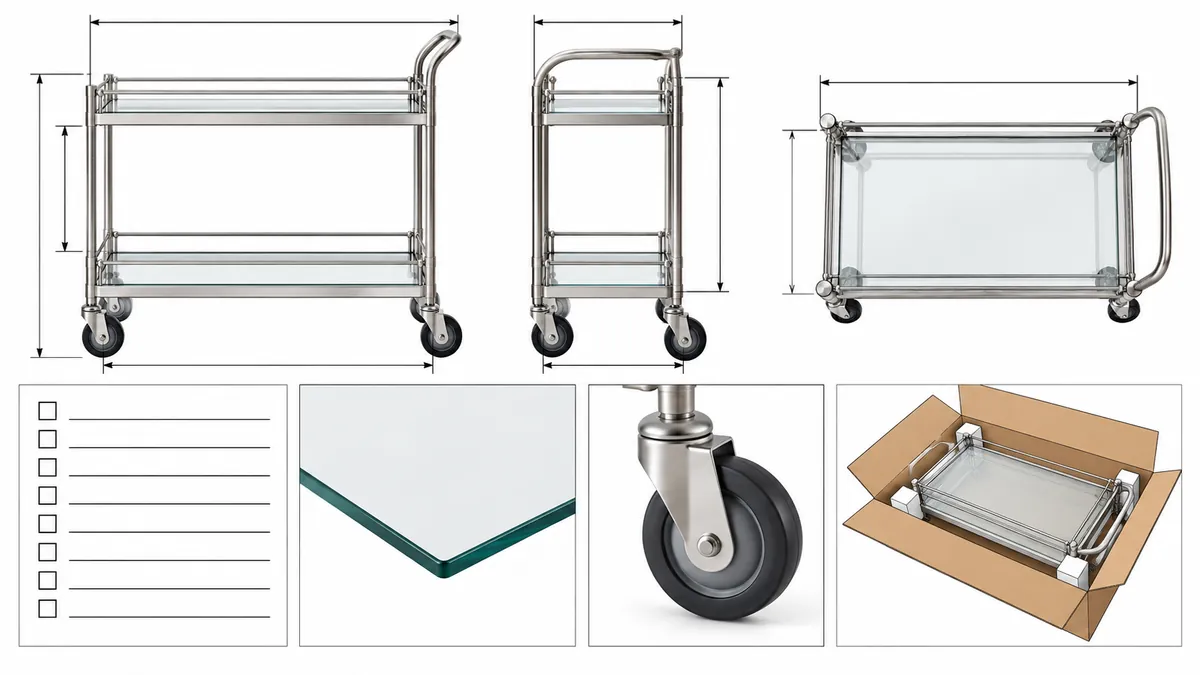
To compare a metal serving cart OEM proposal, send every supplier the same use-case statement, item list, drawing or dimensioned concept, finish reference, accessory schedule, and packaging expectation. Ask the supplier to mark deviations and quote them separately. A quotation that omits casters, hardware, assembly instructions, shelf protection, or final packaging is not comparable to one that includes those items.
Use a sample checklist with three outcomes: pass, fail, and not assessed. For each requirement, record the evidence source and owner. The record could include a drawing check, a physical fit observation, a report, an artwork review, or a packaging inspection. If the only evidence is a supplier statement, label it as such rather than giving it the same status as an observed measurement or verified report.
Common purchase-stage questions deserve explicit answers:
Does a larger shelf automatically mean a better cart? No. The buyer needs to consider the products that will sit on it, usable clear area, access, overall footprint, and pack-out. A larger surface may not meet the room or assortment requirement.
Should a cart be tested with empty shelves? Only if empty movement is the intended use being evaluated. If products will be loaded, define representative items and arrangement. Do not make a capacity claim without a stated method and evidence for the exact model.
Do all serving carts need brakes? The requirement depends on the design and use brief. State whether a brake is required, which wheels have it, and how it will be reviewed. Do not infer a braking feature from a photograph.
Can one sample approve multiple finishes? A sample in one finish does not automatically establish the appearance of another. Approve each finish that matters to the assortment with its own reference and record.
What should the buyer do when the supplier changes a wheel or shelf? Compare the new part and interface against the approved drawing, use case, assembly and packaging. Ask the responsible reviewer whether a new sample or test is needed, and update the revision record.
A metal serving cart OEM specification is complete when a different buyer or inspector can identify the model, build the approved arrangement, repeat the stated observations, and tell what changed from the approved sample. This reduces ambiguity without pretending that one checklist proves every performance claim.
Link the sourcing brief to documented supplier capability
Koitor’s approved public positioning is as a bathroom and home-storage metal hardware manufacturer with OEM and sample-development experience. This guide offers an adjacent-category buying framework; it does not claim that Koitor makes serving carts, casters, glass shelves, or hospitality equipment. A buyer considering an adjacent product should share drawings and the intended configuration so capability can be confirmed rather than inferred.
Review Koitor’s OEM home-storage hardware information for documented sourcing context. For a project-specific question, use the contact page and include the product drawing, item list, intended movement, finish, target quantity, destination, and evidence needed.
Sources and product examples
- MAGI serving carts and OEM/ODM product context
- Sintop metal-and-glass bar-cart example
- Wholesale custom rolling bar-cart listing
Supplier descriptions and individual product features apply to those listings only. They do not establish Koitor capability, category-wide load limits, or verified performance.
Discuss a metal home-storage product brief
Share the drawing, intended use, representative items, movement expectations, finish reference, and packaging plan. A project-specific review can identify which facts are documented and which require confirmation before sampling.
OEM / PRIVATE LABEL
Turn this sourcing guide into a product brief
Share your target product, size, finish, order quantity and packaging requirements. Your team receives a practical manufacturability review before quotation.


 English
 Español
 Português
 Français
 Deutsch
 العربية