
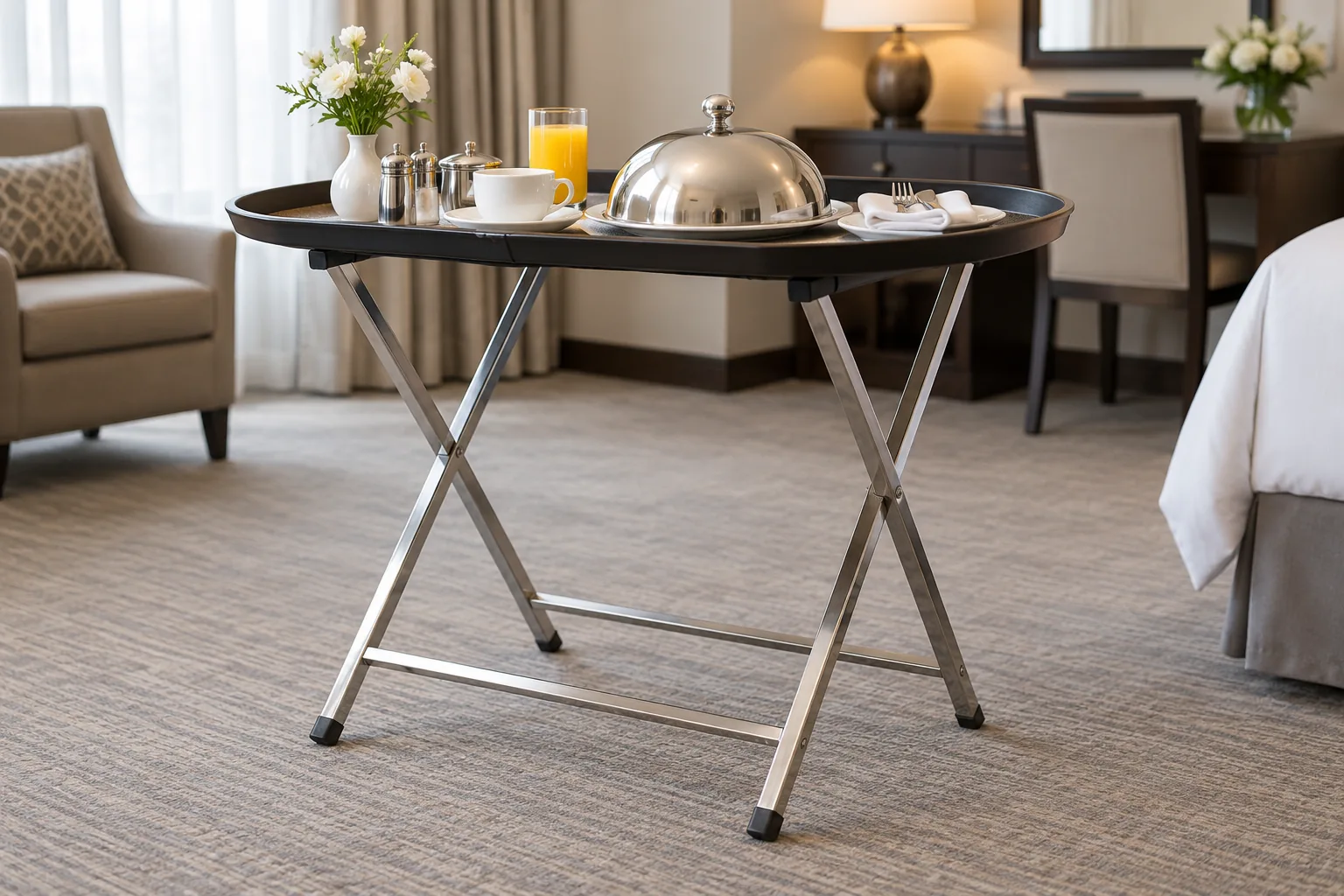
For procurement, the metal service tray stand specification starts with the exact reference parts and intended arrangement. A metal service tray stand specification should identify the actual tray, the stand’s contact points and the way a server sets down and lifts off the tray in the intended station. A stand that appears suitable in a catalog photo may contact a different part of a buyer’s tray rim or underside. Approve the tray and stand together with a representative service arrangement rather than assuming that similar outside dimensions guarantee a useful fit.
This article covers a floor-standing metal support for a tray during hospitality service. It is different from a rack used to store trays vertically and from an elevated buffet display frame that holds a fixed top. It does not establish safe load, ergonomic suitability, slip resistance, injury reduction, food-contact status or a current Koitor tray-stand product.
Is the product for service set-down or tray storage?
Clarify the job before selecting a frame. A service stand is positioned so that a tray can be placed on it during a task and removed again. A storage rack organizes trays when they are not in service. A buffet riser supports a dish or display top for presentation. Each use creates a different contact geometry, approach path and acceptance review.
The stand should be shown in its intended open configuration, with the actual tray resting on the support members. If the stand folds for storage, that feature can be recorded, but it does not replace review of the open service arrangement. Ask the buyer which team will open, position, load, clean and fold the stand. Document whether it is moved between locations or remains at one station.
Tablecraft’s Double Bar Tray Stand, item 24, is one catalog example. Its published listing identifies a chrome-plated iron construction and rubber top rings. Tablecraft’s tray-stand category shows more than one support format, including single and double-bar stands and wood alternatives. Those are facts about the supplier’s listed options, not universal designs. Tablecraft’s own “slip-proof” wording is a supplier claim; this guide does not adopt it as demonstrated performance. Buyers should verify contact materials, care and any handling requirement for the exact item.
Do not use one model’s measurements or configuration as a generic standard. If a buyer is evaluating another stand, request its current controlled drawing and sample. Dimensions in a catalog describe that particular listing at the time it is published. They do not prove fit with an independently sourced tray.
What should be measured on the tray and support?
Start with the tray’s underside rather than its top outline alone. Record the outer shape and dimensions, but also note any rim return, molded foot, underside rib, stacking feature, recessed base or handle that changes where the tray can contact a support. Identify the surface that will touch the stand and whether that surface is continuous or interrupted.
On the stand drawing, identify each horizontal bar, ring, strap or pad that is expected to contact the tray. Show its spacing, height, orientation and relationship to the stand’s frame. The buyer should be able to see whether the tray rests on the intended support points and whether the supported parts line up with the tray’s underside structure. If a rubber ring or pad is fitted, identify its supplier and replacement reference. Do not treat the presence of a soft component as proof of slip performance or protection in every condition.
The support interface can be reviewed with a simple matrix:
| Interface | Buyer records | Sample review |
|---|---|---|
| Tray identity | Supplier, item and revision | Does the sample match the intended tray? |
| Underside | Rim, feet, ribs, recesses and handles | Which surfaces make contact? |
| Stand contact | Bar or ring position, height and material | Does the tray rest on the planned points? |
| Placement | Approach direction and orientation | Can the tray be positioned without catching? |
| Removal | Grip and lift path | Can the tray be lifted without hitting the frame? |
| Pads | Supplier, model, condition and care source | Are they correctly located and replaceable? |
| Station | Floor, furniture and nearby objects | Does the complete arrangement fit the work area? |
Fill the dimensions from controlled drawings or actual samples. Numeric tolerances and acceptance values must be agreed by the buyer and supplier for the exact project. This checklist does not create a universal rail gap, tray size or permissible movement.

How should set-down and lift-off be evaluated?
The operator’s movement matters because the tray is placed and removed repeatedly. Mock up the intended service sequence with the actual tray and stand. Mark where the operator approaches, where hands hold the tray and whether the tray should be set down from one direction. If the tray is large, handled with two hands or carries tableware during the demonstration, reproduce that configuration without claiming a load rating.
Watch the leading edge as the tray comes down. Does it land on the planned support members or catch against a side frame? Does the tray need to be rotated or slid to reach its final position? Can the operator remove it in one planned motion, or does the frame block a grip? Repeat from the actual side of approach, since access around a dining chair, service cart or table can limit the movement.
A sample review should include:
- Confirm the tray and stand identifiers, drawings and revisions.
- Assemble the stand in the approved service configuration.
- Place it on the intended floor or mock-up surface.
- Align the real tray over the stand using the normal approach.
- Observe the contact points after set-down.
- Lift the tray off using the intended hand positions.
- Repeat with representative service items arranged as the buyer expects.
- Check nearby chairs, tables, carts, walls and service paths.
- Record movement, contact, rocking or interference as observations, not conclusions.
- Sign off the exact tray, stand, pads and layout that were reviewed.
If the buyer requires a defined stability or load evaluation, write a separate protocol. The method should name the stand revision, tray, surface, contents, placement, handling and acceptance threshold. A casual demonstration cannot establish a universal load or stability rating. Do not infer performance from metal gauge, stand weight or the fact that a tray stayed in place during one observation.
Some supplier pages use terms such as “slip-proof” or “ergonomic.” Treat those as claims to verify against the manufacturer’s documentation and the buyer’s requirements. A rubber contact ring does not, by itself, demonstrate a measured friction value, safe handling or injury prevention. Keep the claim out of private-label copy unless appropriate evidence is available for the exact product and test conditions.
What are the frame, finish and pad checks?
Inspect the structural members, connections, pivot points, feet and fasteners for alignment and visible finish condition. If the stand folds, review the open and closed configurations, hinge clearance, locking or stopping details where applicable, and the order of movement. These observations help the buyer document the product, but they are not a strength or cycle-life test. Any required test needs an agreed method and acceptance rule.
Check that the tray contact points remain accessible for inspection and care. If the stand uses elastomer or rubber pads, ask the responsible supplier for material identification, care guidance and available replacements. Do not assume a pad’s color or softness confirms its formulation or suitability for a cleaning agent. Do not claim dishwasher compatibility, food-contact compliance or chemical resistance without product-specific documentation.
For a metal frame, fabrication may involve tube or wire forming, cutting, joining, finishing, assembly and packaging depending on the design. A drawing review can flag whether a bend, weld or finish boundary affects the contact surface or folding movement. These are general manufacturing considerations. They do not imply that Koitor currently makes this tray stand, supplies a rubber compound or has tested the stand.
If a finish reference matters to a hospitality buyer, specify the visible surfaces and compare a physical sample. Note the areas hidden after assembly and any contact surfaces that might rub against a tray. For a buyer with an appearance standard, agree on the approved sample and the inspection conditions rather than relying on a screenshot. Keep any exception—such as an accepted mark on a hidden face—in the approval record.
How do service-station constraints change the fit?
A tray can fit the stand on a clear floor and still be awkward in a real dining or service area. Place the assembled combination in a representative layout. Map the footprint of the open legs and the tray while supported. Include chair movement, a table edge, server route, cart position and any nearby equipment. If the stand is used in a narrow aisle, the buyer should evaluate the actual occupied envelope and local requirements with the responsible operator.
Consider where the stand is stored between service events. A folding design may reduce storage space, but confirm the folded dimensions and the storage location. Check whether staff can carry or move the stand using the intended handling method. Avoid describing the product as compact or easy to handle without dimensions and an agreed criterion.
If the tray is shared across several uses, create a separate sample combination for each materially different tray underside or size. A stand may accept a broad range visually, but only the tested tray configurations should be listed as approved. Keep tray variants linked to the stand in the item master.
What should appear in the RFQ and approval record?
Send the supplier the tray drawing or physical sample, underside photos, intended service layout, stand configuration, finish reference, pad requirement and packing scope. State whether the stand must fold, how it is stored and which parts the supplier must provide. If the buyer already has a tray, clearly identify that it is buyer-supplied and include the actual item in sample approval.
Request the stand’s controlled drawing, current quotation, component list, assembly instructions and packaging details. Ask which parts are included and whether pads, caps or fasteners can be replaced. If the supplier provides a rated capacity or performance statement, ask for its exact scope and evidence rather than transferring it to a different tray or stand.
A useful SKU record includes:
- Stand item number and drawing revision.
- Tray supplier, item and underside geometry.
- Support member and pad details.
- Open and folded dimensions from the controlled drawing.
- Finish reference and visible-face requirements.
- Set-down and removal orientation.
- Intended station footprint and nearby constraints.
- Supplied hardware and replacement parts.
- Carton contents and unpacking inspection.
- Sample outcome, acceptance criteria and owner.
- Any tray configuration excluded from approval.
When a buyer changes the tray model, support bars, pad, finish or fold mechanism, identify which sample checks need repeating. The approved sample and its associated documents should travel together through the quote, production, final inspection and reorder. A replacement tray that looks similar should be treated as a new interface until confirmed.
For general company context, buyers can review Koitor’s custom metal storage rack manufacturing and OEM home storage hardware pages. These do not represent a current service-tray-stand catalog. A buyer can share the tray, floor layout and frame requirements through the contact page for a bounded discussion of the metal component.

How is this different from a buffet riser or tray rack?
A buffet riser usually supports a display top at a serving station. A tray rack stores trays for retrieval, often in a vertical or slotted arrangement. A service-tray stand supports a tray temporarily as part of an operational handling sequence. The buyer should not merge these page intents because the products share a metal frame and a tray noun.
The review evidence differs too. A buffet display focuses on top-to-frame seating and an occupied presentation footprint. A rack focuses on tray orientation, slot fit and storage or retrieval. A service stand focuses on contact points during set-down and lift-off in a working layout. Specify the product function before requesting a quote and route any unrelated tray-carrier or rack question to its appropriate owner.
The purchase decision is complete when the buyer can identify the tray and stand, see the intended contact, reproduce the operator’s placement and removal path, and confirm the open stand fits the station. If those details are written into the RFQ and approved sample record, the supplier can quote the intended configuration without relying on an unverified product-family assumption.
Source basis: Tablecraft Double Bar Tray Stand, item 24 and Tablecraft Tray Stands category. Manufacturer claims and dimensions are tied only to named listings; this article does not establish load, slip, ergonomic or safety performance.
Keep the metal service tray stand specification tied to the named sample, drawing revision and included components.
Reviewing a Metal Service Tray Stand?
Share the actual tray, underside drawing, stand layout, contact-pad reference, service-station footprint and sample criteria for a bounded metal-component feasibility discussion.
OEM / PRIVATE LABEL
Turn this sourcing guide into a product brief
Share your target product, size, finish, order quantity and packaging requirements. Your team receives a practical manufacturability review before quotation.

 English
 Español
 Português
 Français
 Deutsch
 العربية