
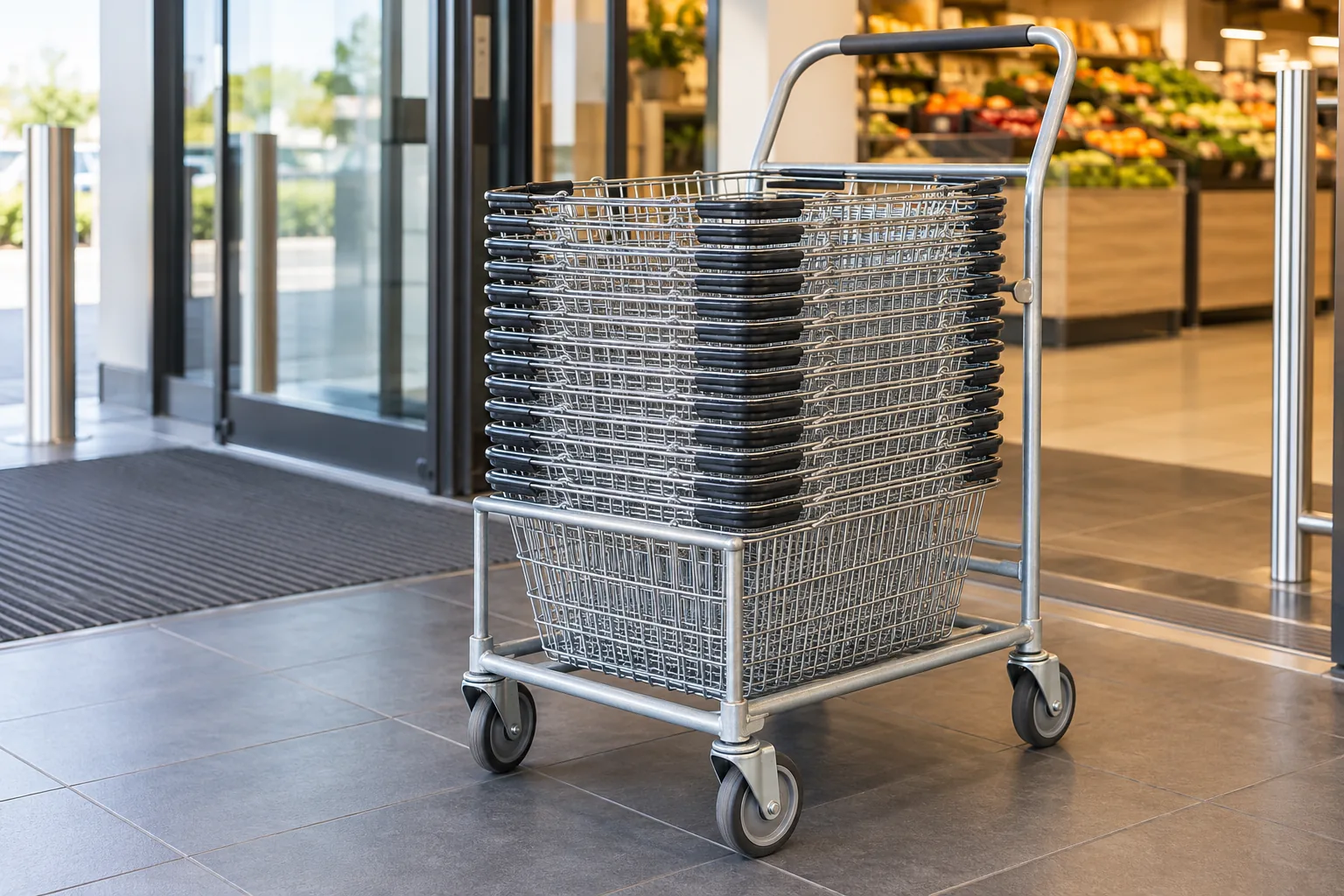
For procurement, the shopping basket collection trolley compatibility starts with the exact reference parts and intended arrangement. A shopping basket collection trolley compatibility review should match the fixture to the actual empty basket family and the way the retailer collects, stores and relocates baskets. Basket-to-basket nesting alone does not establish that the bottom basket locates on a trolley, that handles clear its frame, or that staff can retrieve the top basket in the intended return-station arrangement.
This guide focuses on a separate metal trolley or stand used with a stack of empty retail baskets. It does not cover the design or manufacture of the baskets themselves, shipment nesting inside a carton, or movement of loaded merchandise. It does not establish capacity, stability, braking performance, aisle compliance or operational safety. Those claims require product and site-specific evidence from the responsible suppliers and project owner.
Why are the basket and trolley separate purchasing decisions?
Retail manufacturers sell baskets and basket stackers as related but distinct products. Wanzl’s basket-stacker listings include variants described with and without handles, different caster configurations and named compatible basket families. Its HW-series basket page describes wire baskets with folding handles and separately refers to stackers. These catalog examples show that handle arrangement and basket family can be part of the supplier’s pairing. They do not establish cross-brand compatibility or universal fit.
The importer should therefore identify both sides of the interface. Record the basket supplier, model, revision, base shape, outside dimensions, handle type and intended empty-stack arrangement. Then identify the collection trolley model and its locator, support or retaining features. If the trolley is sourced separately, do not rely only on product-family names or a photograph showing a similar basket.
Clarify the actual retail task. Is the trolley a stationary return point with occasional repositioning, or is it routinely moved between collection areas? Are baskets nested while empty, and does the retailer remove a single top basket or move a stack? These operational differences change what the sample review should observe. They do not justify assuming a load rating or safe movement method.
How should the empty stack be defined?
Select the exact basket SKU that will sit at the bottom of the stack and identify the intended handle position. Some baskets have folding handles that rest outside or inside the basket body; the arrangement may affect the width and height of the stack. Measure or record the stack in the actual nested configuration, including any handle or label holder that projects from the outline.
The buyer should identify the minimum and maximum configurations within the product assortment. If basket models vary in depth or base, test each relevant model against the trolley. Record how many are in the reference stack only as the test setup, not as an advertised capacity unless capacity is supported by appropriate supplier evidence. A stack of empty baskets is not equivalent to loaded baskets, and this article makes no loaded-transport recommendation.
A sample checklist can capture:
| Pairing detail | What to identify | What to record |
|---|---|---|
| Basket model | Supplier, item number and revision | Controlled SKU reference |
| Bottom basket | Base outline and support surfaces | Locator and contact observation |
| Handle variant | Fixed, folding, internal or external position | Position during nesting |
| Stack profile | Actual empty nested stack and quantity tested | Sample configuration |
| Trolley interface | Rails, platform, stops or guides | Drawing and engagement points |
| Top access | Removal and return approach | Observed sequence |
| Movement | Stationary or planned relocation arrangement | Responsible project requirements |
| Inclusions | Trolley, baskets, straps, parts and labels | BOM and carton list |
The table is a buyer record, not a performance standard. Define numerical measurements from controlled drawings or the approved samples.
What should be checked at the lower basket interface?
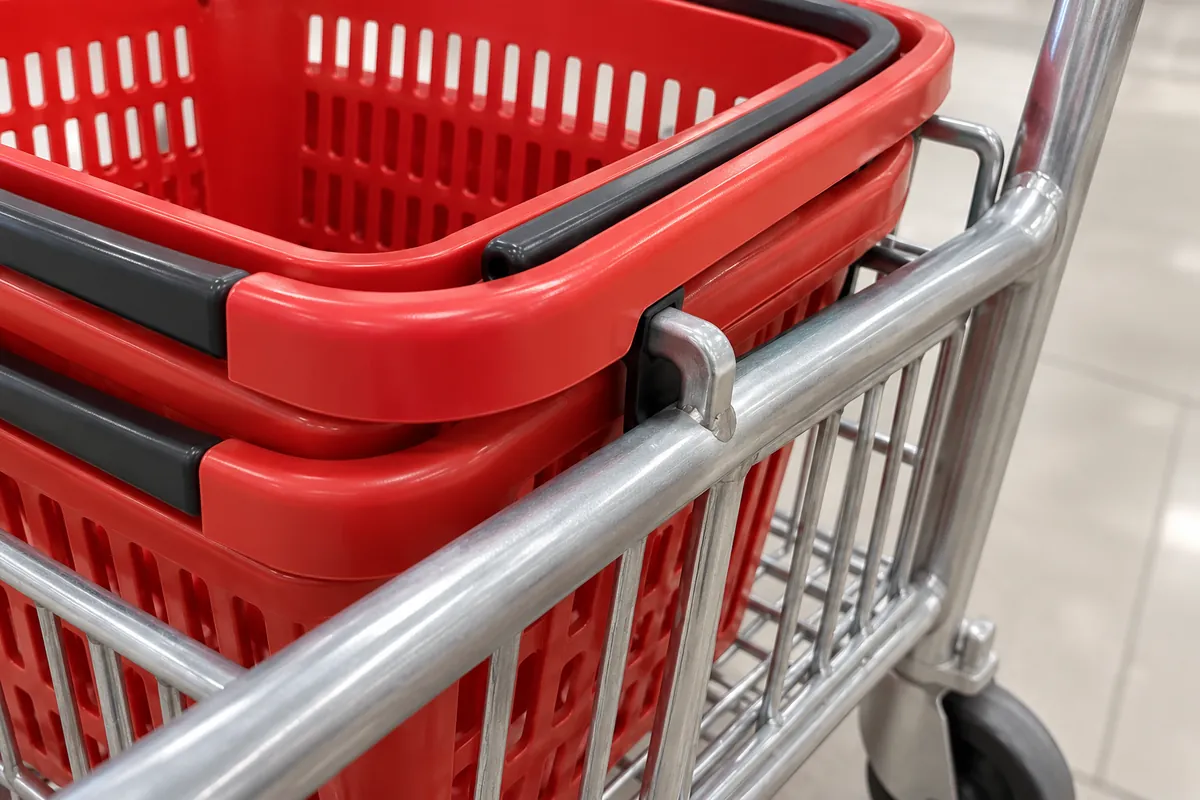
Compare the bottom basket’s base, feet or lower frame with the trolley’s support surface. Identify whether the trolley uses a platform, locating rails, guides or a restraint. Observe the actual contact and whether the basket sits in the intended orientation. If a locator is meant to engage a feature on the basket, verify that feature on the current basket revision. Do not assume a small shift is harmless; record whether it changes the intended access or fit and ask the supplier to review it.
Check the path for returning the basket stack to its station. The trolley frame may be positioned around an approach direction, but the actual operator path and store layout belong to the retailer. Review the sample in a representative fixture arrangement if available. A catalog image does not provide aisle clearance or prove that the chosen station suits a particular site.
How do handles and nesting affect retrieval?
A basket can nest properly yet snag when removed from a stack if its handles overlap or shift. With the actual basket type, inspect how the handle moves when nested and whether it needs to be repositioned before the top basket is removed. Confirm that the trolley’s side frames or crossbars do not block the movement. If customers or staff retrieve a single basket, check that action without moving the entire stack in the unapproved way.
Define whether the collection fixture returns one basket at a time or receives pre-nested stacks. The workflow may determine whether a top basket needs open access or whether the trolley accommodates a known stack from the collection area. These are distinct product uses and should be reflected in the product description and instructions.
Retail assortments may include baskets with different handle colors, label holders or dividers. Those accessories can affect nesting or the outer envelope. List any required accessory and test the assembled basket configuration. Do not imply that a basket with a similar exterior is compatible if its handle or base geometry differs.
What does the sample approval need to cover?
Build the sample from the production-intent trolley and exact basket model. If casters are part of the fixture, list their supplier and model, but do not transfer a catalog’s load or maneuverability statement to the proposed combination. Confirm whether brakes, handles, fasteners and any retaining parts are included. Keep mobility, capacity and site safety as separate checks with defined requirements.
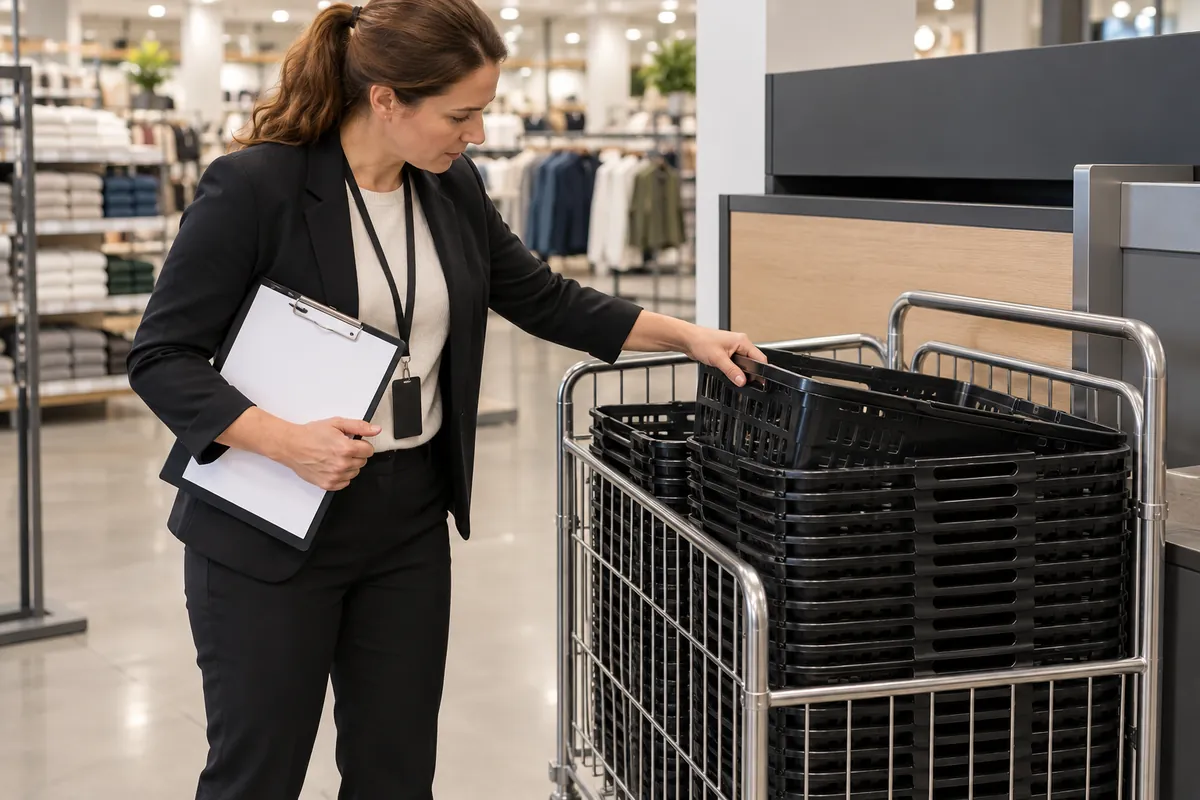
During review, record the trolley revision, basket revision, handle position, stack setup, assembly condition and observed contacts. Try placing and removing baskets as the intended retail workflow requires. Note catching, blocked access, frame interference or visible damage as specific observations. A short sample review cannot establish durability, safe load or performance over repeated store use.
If assembly is required, inspect whether the process changes frame alignment or the locating opening. Keep the current instructions and hardware pack with the sample record. If the fixture is shipped assembled, specify how the trolley and loose components are protected and identified in the carton. Packaging checks should be based on the agreed pack, not generic claims that more packaging guarantees transit performance.
How should the return station be specified?
Provide the fixture supplier with the intended basket family, return pattern, station layout, desired stack configuration and planned movement, if any. Ask the supplier to mark the interface in a drawing and state all supplied parts. The retail buyer should separately confirm site conditions and operational requirements.
Wanzl’s product family is useful as an example of a supplier pairing different basket and stacker variants. It is not a license to copy a proprietary geometry or assume another system fits. Avoid replacing a branded basket or trolley with a generic equivalent without a written fit review. If a new basket is introduced, verify the lower interface, nesting profile, handle position and station access again.
For broader context on metal storage components, buyers can review Koitor’s custom metal storage rack manufacturing and OEM home storage hardware pages. They do not confirm a current retail collection-trolley or caster product. Buyers can share a fixture drawing and basket sample through the contact page for a bounded metal-component feasibility discussion.
How should the manager define a return workflow?
Write down what reaches the station: a single empty basket, a pre-nested stack, or baskets sorted by type. Identify who positions the basket, whether handles are folded, and how the top basket is retrieved. If several basket models share the return point, specify whether they arrive mixed or separated. This information helps the fixture supplier create a useful location and helps the buyer decide which pairings need sample review.
Do not describe a collection trolley as a cart for transporting loaded customer purchases unless the design and intended use have been assessed for that purpose. The research and this guide concern empty-basket collection. A different payload or route changes the product requirements and would require its own review. Keep the product description consistent with the intended empty-return function.
The facility operator should also confirm where the return point will be placed and how often it is repositioned. These operating details are project inputs, not universal product capabilities. Document the intended floor and surrounding fixture context only to the extent needed for the sample check. Leave regulatory aisle, egress and accessibility decisions to the project’s responsible professionals.
What if the basket model changes after approval?
A new basket may have a different base, nesting depth, handle shape or side projection. Review the bottom-basket contact, handle position and top-basket access again. If the return point accepts several basket families, use samples from each and record whether they arrive mixed or separated. Do not assume similar color or outside length means the bases and handles share an interface.
The retailer should tell the fixture supplier whether the intended task is empty-basket return, short-term collection, stationary storage or planned relocation. This article addresses empty-basket return only. A new task involving loaded merchandise or long-distance transport introduces requirements outside this fit checklist. Route those requirements to the project owner rather than changing the product claim informally. If a supplier changes wheels, handles or locators, update the drawings and BOM and check the revised sample. Keep the product description limited to the configuration actually documented.
What should a retail buyer inspect at handover?
Receiving checks should compare the delivered fixture with the approved configuration. Confirm the model and finish, count the supplied parts, inspect the assembled frame for visible transit damage, and verify that instructions and hardware correspond to the current revision. If baskets are supplied with the trolley, match their item identifiers and handle variants to the purchase documents. If sold separately, the receiving team should know that the fixture alone does not constitute a validated basket system.
Handover review is not a substitute for the supplier’s manufacturing controls or a structural assessment. Record a discrepancy with the carton, part and drawing identifiers so the supplier can investigate. Do not make a performance conclusion from a cosmetic observation alone. For example, a visible gap can be a fit issue if it affects the locating interface, or a cosmetic concern if it does not; use the product specification and acceptance criteria to classify it.
For retailers planning several return stations, repeat the location and access review at each relevant configuration. A floor plan or sample station can help identify where the trolley will stand, but site dimensions and traffic conditions remain the retailer’s responsibility. Avoid describing a trolley as suitable for every aisle or store layout without that review.
What belongs in the RFQ and reorder record?
A usable approval file should include the exact basket and trolley SKUs, drawings, reference photos, handle orientation, empty-stack setup, lower support contact, access observations, caster/source data, assembly instructions and packing scope. The quote should identify included baskets or clearly state that the trolley is sold separately. Product photos and labels should represent the approved configuration.
At reorder, compare both basket and trolley revisions. Changes to handle shape, base, frame opening, guide, wheel, bracket or packaging can affect the pair. Ask suppliers to disclose substitutions and route affected parts through sample review. If the configuration changes, update the product copy so distributors know what was evaluated.
The product is ready for an assortment when the buyer can identify the exact basket family, verify its stack and lower interface on the trolley, understand how a basket is retrieved or returned, and see what components the SKU includes. That is a concrete purchasing decision. It is narrower and more defensible than an unsupported promise of universal compatibility or a capacity inferred from a photograph.
Source basis: Wanzl basket stackers and Wanzl HW-series shopping baskets. Their described variants and pairings are supplier-specific examples and are not generalized to another system.
Keep the shopping basket collection trolley compatibility tied to the named sample, drawing revision and included components.
Developing a Metal Retail Fixture?
Share the reference basket, fixture drawing, contact points, return workflow and packing scope for a bounded feasibility discussion.
OEM / PRIVATE LABEL
Turn this sourcing guide into a product brief
Share your target product, size, finish, order quantity and packaging requirements. Your team receives a practical manufacturability review before quotation.



 English
 Español
 Português
 Français
 Deutsch
 العربية