

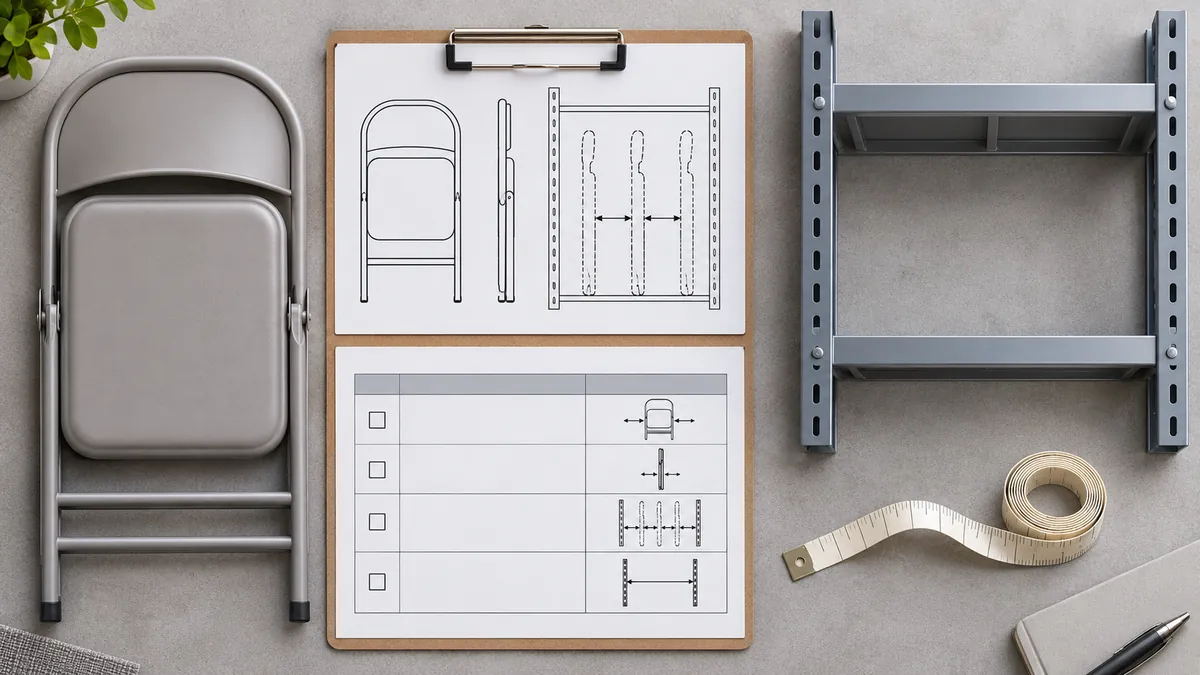
A folding chair storage rack specification should name the chair models it is intended to hold, show their actual folded condition and define how the chairs accumulate and can be removed. A rack’s arm spacing or advertised capacity alone does not establish compatibility with every folding chair. Feet, hinges, armrests, straps and folded thickness can change the occupied envelope. Approve a reference set and count claim together, while treating structural load and wall anchorage as separate questions requiring product-specific evidence.
Why Does Chair Count Depend on the Reference Set?
Folded chairs do not all present the same shape to a rack. One model may fold nearly flat; another leaves a thicker stack because of hinges, feet, armrests or a locking mechanism. Fabric seats, straps or protruding leg caps may change where two chairs touch. Even units from the same product family can differ when the buyer selects different frame or seat options. A count statement should therefore describe a verified configuration, not an abstract rack length divided by one nominal chair thickness.
Retail product pages show that wall-mounted chair racks are sold with stated chair counts, while commercial chair-storage systems describe particular hanger-set arrangements. Those are useful signs that buyers need to evaluate both rack geometry and chair construction. They are not independent performance tests. One current product page reviewed for this topic presented conflicting load information across its narrative and specification elements, so this guide does not repeat or resolve those advertised values. Buyers should request the current model-specific drawing, instructions and approved evidence for the exact product they are considering.
The core sourcing question has three parts: does the chair engage the intended support, do multiple folded chairs fit in the proposed sequence, and can the user place and remove them without an unapproved maneuver? Passing one does not prove the others. A chair may hang successfully on the first arm but interfere with the adjacent chair at the intended count. A row may hold the quantity geometrically but make the last chair difficult to retrieve. A successful fit check does not establish safe load or wall strength.
| Approval question | What to check | What it does not prove |
|---|---|---|
| Does one chair fit? | Named model/revision, folded state and actual contact features | Fit for another chair or variant |
| Does the set accumulate? | Full intended quantity, sequence and occupied neighboring positions | Structural rating or anchorage strength |
| Can each chair be retrieved? | Insertion and removal path with the adjacent positions filled | Ease of use for all people or all placements |
| Is the mounting approved? | Supplier’s product-specific instructions and qualified substrate review | That a visual fit mock-up validates the wall or fasteners |
| Is the count claim supportable? | Exact configuration and evidence for that claim | Universal compatibility or load capacity |
For broader platform and track interfaces, see the separate home storage hardware guidance and review the actual target product page for its intended substrate. This article stays with the folded chair as the stored object.
Which Folded-Chair Details Should the Buyer Measure or Photograph?
Choose representative chairs from the intended assortment before finalizing the rack. Record model, revision and any option that affects the folded outline. Photograph each chair folded exactly as it will be stored, including straps, latches or removable parts in their normal position. A photo from the front and side can reveal projections that a single flat view hides. Include a scale reference or agreed dimensions when needed, but do not use a photograph as a substitute for a controlled drawing.
Inspect the likely support points. The rack may contact a frame rail, seat frame, back support or another defined area. The buyer should note the contact feature and any nearby hinge, foot, armrest or fabric that could interfere. A soft pad, cap or coating may matter to appearance, but an image cannot prove non-marking performance. Agree the actual contact and cosmetic acceptance requirements for the intended product.
Measure the folded envelope that affects storage: overall height, width and thickness at the points most likely to touch. A single average thickness may be misleading if the chair is wedge-shaped or has a localized hinge bulge. If multiple models are intended, list each separately. The largest envelope may govern the overall arrangement, but one “worst case” is not necessarily representative for every interference or engagement question.
Do not assume the advertised chair count from a rack seller applies to your chair models. The rack supplier may have used a specific reference set, alternating direction or order of placement. Ask for the basis of any published count. If the supplier does not provide the reference configuration, create a buyer-defined intended set and have the proposed rack evaluated against it. Keep competitor dimensions, proprietary forms and instructions within lawful use; a market example is not permission to copy a protected design.
How Should the Buyer Check Rack Engagement and Accumulation?
Start with one chair and confirm that the support engages the intended part of its frame. Note whether the chair hangs by a rail, rests over an arm, sits on a shelf or uses a different support. Do not assume all wall racks use the same architecture. Then add chairs one at a time in the proposed orientation. Record which features collide, whether the chairs lean or rotate, and how far the final unit projects from the wall. These are observations about fit, not load or safety conclusions. Keep the folding chair storage rack specification tied to that reference-chair set and rack revision.
Test the sequence the user is expected to follow. If the last chair can only be inserted before the rack is mounted or before adjacent units are added, that constraint should be visible in the instructions and product claim. If chairs alternate direction, identify the starting side and the direction in which the rack is loaded. If the product is intended for multiple chair types, trial each material variation separately; a tubular frame, molded shell or upholstered design may have a different contact surface.
Consider wall projection and surrounding space. A chair can fit within the rack while extending into a doorway, storage aisle or neighboring product zone. The buyer should provide the intended installation location and have the appropriate project party assess the actual mounting surface and route. This guide does not prescribe anchor size, wall construction or safe load. Those depend on the rack design, attachment method, substrate and qualified evaluation.
The rack and chair should also be reviewed as a retrieval system. Can one chair be removed without lifting or shifting every other one? Does a protruding foot catch on the adjacent chair? Does the user need access to a locking lever? These questions help a buyer decide whether the product arrangement matches a specific storage use. They do not create a universal ergonomic standard or guarantee performance in every room.

How Can Buyers Make a Storage-Count Claim More Precise?
Tie the count to a defined chair set and storage arrangement. An accurate product claim might state that the rack was configured for a named family of folded chairs in a stated orientation, subject to the approved model and installation information. The actual wording must be supported by the product owner and applicable requirements. Avoid phrases such as “fits all folding chairs” unless that broad claim has been substantiated across the relevant range.
Separate the count from load capacity. A rack that geometrically accommodates several chairs does not thereby have a verified safe working load. The chair count may be a fit demonstration, while structural testing and installation approval are distinct evidence. Similarly, a rack’s mounting hardware or manufacturer instructions should not be generalized to a different wall, anchor or building surface. Have the responsible supplier and qualified installer identify the basis and scope of each claim.
When the count depends on orientation, state that orientation in the product instructions or image. If chair sizes vary, note the limiting dimensions or approved models. If the fixture is designed for one specific chair, use a model-specific fit statement. Keep visual marketing aligned with the actual sample and stock SKU; do not photograph a special chair arrangement and imply that every version stores identically.
For a private-label program, record claim approval with the sample revision and supporting evidence. The product manager should know whether a count claim comes from a physical fit trial, a supplier specification, a qualified structural test or another source. Do not represent a visual demonstration as test data. If the buyer changes chair models, rack spacing or mounting method, review whether the prior claim still applies.
What Should the Sample Approval Record Include?
Use a buyer worksheet that captures the chair, rack and use configuration on one page. The record should be specific enough that another reviewer can reproduce the same fit discussion later.
| Record field | Suggested buyer entry | Review purpose |
|---|---|---|
| Chair identity | Model, revision, frame and seat options | Defines the product tested for fit |
| Folded state | Photo, latch/strap position and removable parts | Reproduces the stored configuration |
| Rack reference | Drawing, sample ID, finish and revision | Connects the observation to the offered rack |
| Support contact | Frame area, support spacing and depth | Shows how the chair engages |
| Interference points | Feet, hinges, arms, fabric or neighboring units | Captures local conflicts |
| Quantity arrangement | Count, orientation and loading order | Defines the basis of a count statement |
| Retrieval sequence | Which unit can be removed and how | Clarifies everyday access assumptions |
| Mounting evidence | Supplier instructions and qualified review reference | Keeps installation separate from fit approval |
| Claim and limits | Approved models, exclusions and reviewer/date | Prevents overbroad compatibility wording |
Keep the reference chair available for the next sample round if possible. If it must be returned or is unavailable, use dated photographs and controlled dimensions, while noting what cannot be rechecked physically. A design change to the chair or rack should be assessed for affected contact, spacing, count and retrieval items. Do not automatically repeat every check, but do not assume a previous fit decision remains valid after an interface change.
What Must Stay Outside a Fit Check?
A fit check does not prove a rack’s strength, anchor performance, allowable wall type, long-term deformation, finish durability or safe user behavior. Those require the appropriate supplier evidence or qualified project-specific review. Do not convert the number of chairs placed on a sample into a load rating. Do not borrow a competitor’s published limits or installation instructions for a different design.
For a product that will be installed above people, near a doorway or in a shared environment, the buyer should identify the intended use and qualified reviewer. The rack supplier should state its own approved installation scope and any exclusions. A buyer’s installer or project professional evaluates the actual substrate and site. The distribution team should not write installation assurances based only on a product photograph.
Product images can also mislead if the chair count is staged with unusually thin references or a nonstandard orientation. Show the intended folded state, and keep image captions consistent with the approved product model. If the model in a marketing picture is illustrative, say so. Do not label the rack as tested, certified, universal or safe unless the responsible party has the necessary evidence.
Buyer Checklist Before Ordering a Folding-Chair Rack
- Name the chair models and revisions the rack must fit.
- Provide folded-state photos and relevant dimensions for each reference.
- Identify the rack’s contact features, support spacing and revision.
- Demonstrate the full intended quantity, not only the first chair.
- Record orientation, insertion order and individual retrieval path.
- Review the rack’s wall projection against the intended site information.
- Obtain current product-specific mounting instructions and qualified review.
- Separate fit, count, load and installation claims in the approval record.
- Tie any private-label compatibility statement to named chair references.
- Recheck affected items after a chair, rack or mounting change.
Koitor Hardware is a family-owned custom metal hardware manufacturer with experience discussing buyer drawings, physical samples, metal forming, joining, finishing, assembly and packaging for bathroom and home-storage hardware. A buyer considering a new storage adjacency can share a lawful reference-chair set, product drawing and intended fit brief for a feasibility discussion. This does not confirm that Koitor currently manufactures folding-chair racks or provide structural engineering, anchor selection, installation approval or certified load testing. Exact capability and project scope must be confirmed before a product commitment. See the OEM home-storage hardware manufacturing page for the confirmed commercial scope and keep the folding chair storage rack specification aligned with the reviewed reference set.
Frequently Asked Questions
Can a rack’s advertised chair count be used for every folded chair?
No. The count depends on chair geometry, orientation, support contact and the specified arrangement. Confirm the reference models before using a compatibility claim.
Does fitting the chairs prove the rack is safe to mount?
No. Fit and accumulation are separate from structural capacity, attachment design and the actual wall substrate. Use the supplier’s current evidence and qualified site review.
Is folded chair thickness enough to calculate capacity?
Not by itself. Hinges, feet, armrests, straps and tapered shapes can change how chairs stack, engage and are removed.
Should buyers approve a count claim using a sample?
A sample can demonstrate a defined configuration, but the record should identify the chair models, rack revision, arrangement and limits. Structural claims need separate support.
What if the buyer changes the chair model after approval?
Recheck the affected contact points, total envelope, orientation, retrieval sequence and any count statement before carrying the old approval forward.
Review a Metal Storage Product Brief
Share your own reference samples, drawing and intended use to discuss metal-product feasibility within Koitor’s confirmed manufacturing scope.
OEM / PRIVATE LABEL
Turn this sourcing guide into a product brief
Share your target product, size, finish, order quantity and packaging requirements. Your team receives a practical manufacturability review before quotation.


 English
 Español
 Português
 Français
 Deutsch
 العربية