
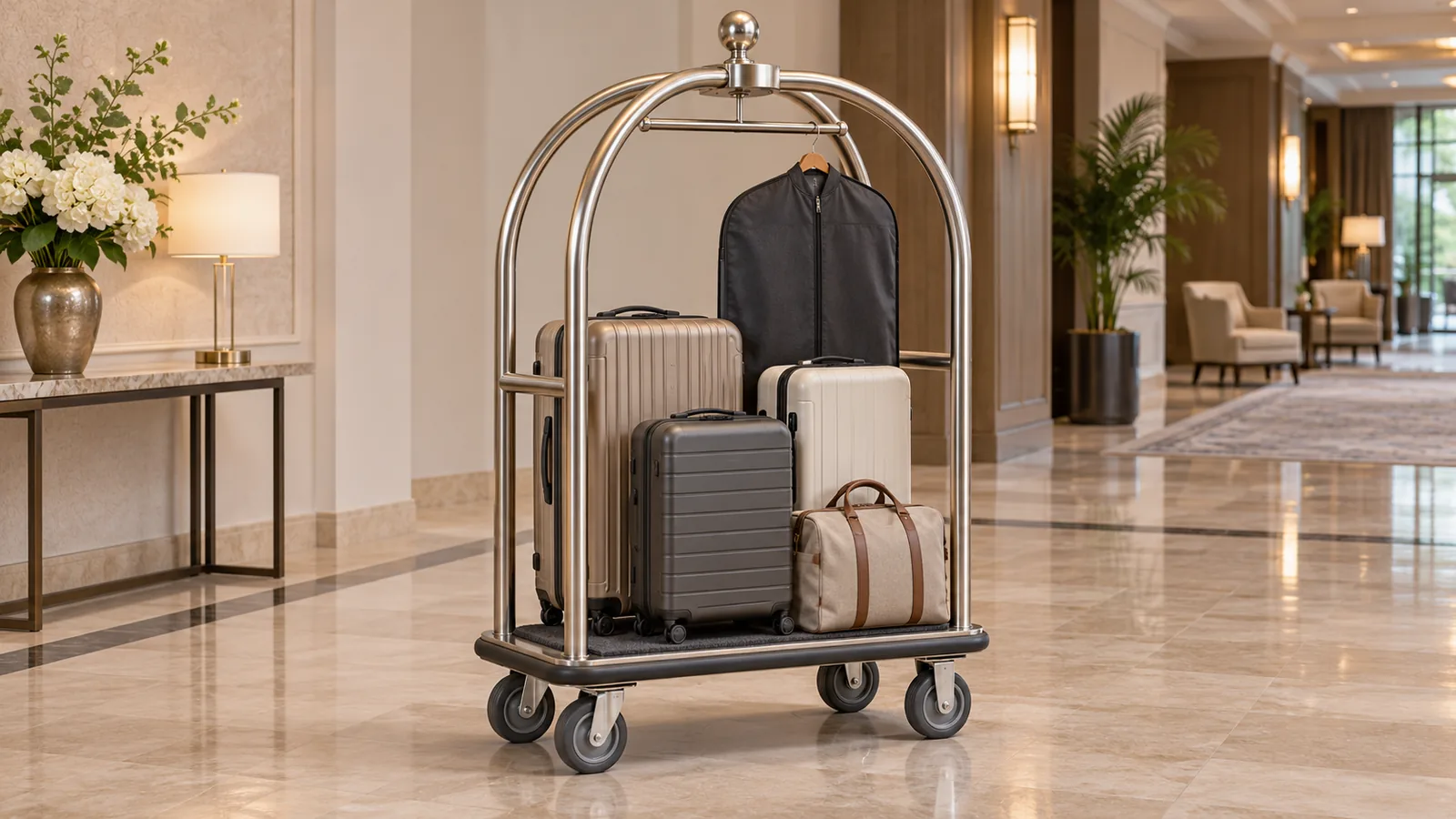
A hotel luggage cart buyer specification should define the actual luggage and garment arrangement, complete loaded envelope, intended route and selected options before sample approval. Empty outside dimensions do not show whether suitcases overhang the platform, garments conflict with bags or the loaded trolley fits a named doorway, turn or lift entrance. Buyers should connect the sample to a route brief and option list. Operational safety, structural capacity and site approval remain separate decisions for the responsible qualified parties. Use the exact hotel luggage cart buyer specification phrase in the RFQ index to connect this checklist to the selected configuration.
Why Does the Loaded Arrangement Matter?
Hotel luggage carts can combine a deck, frame, garment rail, handles, bumpers and casters in different configurations. A manufacturer’s product page may show choices for finish, deck or wheels, and some options may be quoted separately. A picture of an empty frame cannot show how the buyer’s suitcase references sit on the deck, whether a garment drops onto luggage or whether the handle projects into a route. Approve a stated configuration with the actual representative items rather than assuming every trolley in a product family is identical.
Hospitality equipment makers publish materially different cart heights, deck lengths, rail structures and caster arrangements. One manufacturer listing identifies a metal superstructure, deck and bumper and distinguishes options from included features. Another European hospitality channel groups luggage carts with guest-room stands and housekeeping products. These sources establish a real hospitality procurement adjacency, not that Koitor makes hotel carts, that any one configuration is safer, or that all buyers purchase these products together.
Cart dimensions also need definitions. The outer frame may extend beyond the usable deck; a bumper, handle or rail may create the widest or highest point. Loaded bags add another envelope, and garments hanging from a rail can extend below it. The route envelope includes doors, turns, elevator entrances and a storage point. A straight width comparison is not proof that a loaded trolley can turn or be operated safely.
| Review layer | Define | This does not prove |
|---|---|---|
| Cart configuration | Frame, deck, rail, wheels, bumper and options | That options are included in the quote |
| Loaded arrangement | Reference luggage and garments | Structural capacity or approved load |
| Complete envelope | Cart parts, baggage and overhang | Maneuvering or turning performance |
| Site route | Named doors, turns, lift entrance and storage point | Safe operation or building approval |
| Sample approval | Offered revision and observed fit | Long-term durability or performance claims |
This article focuses on lobby baggage service. The serving-cart sample guide addresses a different product interface, while the hotel housekeeping cart assortment guide concerns cleaning-service SKUs rather than guest luggage.
Which Luggage and Garment References Should the Buyer Provide?
Select items from the hotel’s real operating use rather than generic dimensions copied from a marketplace listing. Include the common suitcase sizes, soft bags or carry-on formats staff expect to move, plus a garment bag or hanger arrangement if the cart has a rail. State whether luggage is stacked, stood upright, placed side by side or positioned another way. If two or more configurations are used in service, list them separately so the sample review has a defined basis.
Record each reference’s outside dimensions, handles, wheels and protrusions that affect contact. Take a side photo and a view from the cart’s approach direction. Include bags with different shells or handle positions if those details can change the result. If the deck has a raised edge or retaining feature, observe where the bag contacts it and whether the feature blocks loading or unloading. Such observations do not establish that baggage will remain in place during movement.
For garments, identify hanger type, garment length and whether items are covered. Available drop from the rail may be limited by luggage beneath it. A short garment may fit when the cart is empty but overlap a taller suitcase when loaded. Ask whether the rail is fixed, removable or optional, and verify the quoted sample contains the selected configuration. A product photograph showing one jacket cannot represent every garment or user’s arrangement.
Keep buyer reference dimensions separate from supplier product dimensions. Ask whether a catalog height is measured to the frame, top rail, hanger, handle or another point. Ask whether the listed width includes the bumper, casters or handle. Then add the actual bag projection and selected option to the loaded-envelope record. Do not calculate a universal route clearance from a product listing.
How Should Buyers Define the Complete Loaded Envelope?
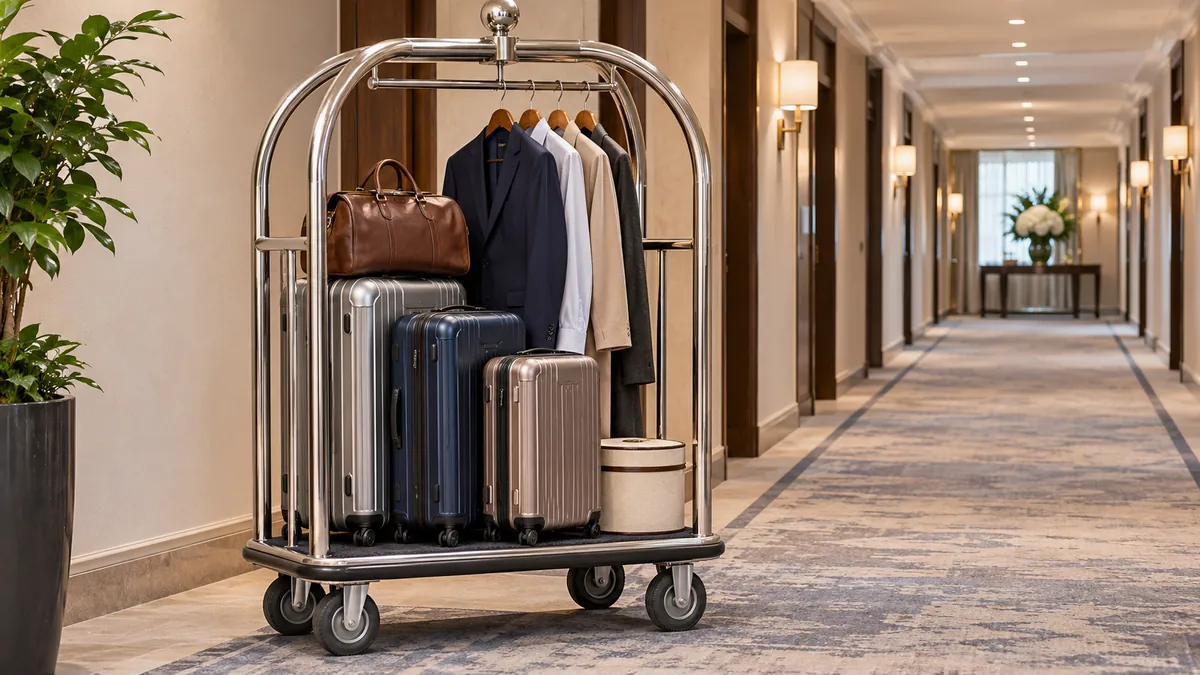
Start with the configured cart drawing or sample. Identify its widest, highest and longest points, including the selected rail, bumper, casters and handle. Then arrange the actual luggage and garments in the approved pattern. Record overhang beyond usable deck area, handle projection and the garment drop below the rail. The relevant point depends on the route: a suitcase wheel or handle can be the outermost part even if the cart frame itself is narrower.
Use a plan or side view to show the arrangement. Distinguish cart components from reference baggage. If the supplier drawing does not show the selected option, ask for a matching configuration reference rather than treating a generic photo as the exact sample. Keep the product revision, option list and buyer reference set together.
Review loading and unloading as well as the parked arrangement. Can the representative bags be placed without contacting the rail? Can a garment be removed while the luggage stays on the deck? Does a tall stack block access to the handle or prevent access to a lower bag? These are operating questions for the hotel’s team and qualified reviewers. A fit trial alone does not establish ergonomic or safety approval.
If the trolley must be stored in a closet or service area, include that location. Note whether rails or parts are removed and how the cart is oriented while parked. Do not assume that a trolley will fit an elevator or doorway because its static width is less than the clear opening. Turning, approach angle, thresholds, slope and maneuvering conditions need a site-specific review.
How Should the Buyer Review a Hotel Route?
Name the locations that control the trip: storage, lobby, guest-room corridor, doorway, turn, elevator entrance and cabin, where relevant. The hotel’s facilities or operations team should provide current site information and identify constraints. The supplier can provide the configured cart envelope and state which features project beyond the deck. A qualified site reviewer decides whether the route and operating procedure are appropriate.
Do not treat a straight-on door measurement as maneuvering approval. A trolley can be narrower than a doorway and still be difficult to angle through when loaded. A turn needs space beyond a static footprint, and elevator-door opening differs from cabin dimensions. A route sketch can help locate pinch points, but does not prove that the cart can safely navigate them.
If a representative route trial is necessary, agree who conducts it, which baggage arrangement is used, what flooring and thresholds are present, and how observations are recorded. Do not invent a universal turning radius, slope limit, push force, brake requirement or doorway dimension. The buyer’s hotel and qualified project parties must identify the applicable criteria. Ask the supplier which product-specific evidence it has for the selected configuration.
Confirm brake and caster options instead of assuming they are standard. Some product listings distinguish optional braking from the base cart. Select the exact option in the RFQ and verify the sample matches it. This guide does not assess braking performance or state which configuration is suitable for a specific floor, load or route.
Which Configuration Should the Quote Freeze?
List frame, finish, deck, bumper, garment rail, casters, brake option, handles and accessories. For each item, state whether it is included, excluded or optional. If the trolley has multiple variants, select one before sample review and production. The sample should match the quote. A picture may help identify a feature but cannot replace the parts list or controlled drawing.
Ask the supplier how each published dimension is measured. Is height to the frame, rail, handle or garment hanger? Does width include the bumper and caster offset? What usable deck area remains after rails or edges? These definitions make suppliers easier to compare. Two offers listing “cart width” may be measuring different boundaries.
Coordinate finish and maintenance expectations with the hotel’s team. A visual sample shows appearance, but does not prove coating life, corrosion resistance, no-mark behavior or compatibility with cleaning products. Request specific evidence if the project requires it and tie that evidence to the offered material and finish. Avoid copying absolute marketing wording without support.
| Quote field | Buyer confirmation | Sample cross-check |
|---|---|---|
| Frame and finish | Material/finish reference and cosmetic face | Sample matches the approved reference |
| Deck | Material, usable surface and accessories | Actual luggage contact and loading pattern |
| Rail | Included, optional, removable and height reference | Garment drop with baggage loaded |
| Caster and brake | Selected option and supplied component IDs | Sample and quote show the same option |
| Bumper and handle | Included parts and outer envelope | Route brief uses the same configuration |
| Packaging | Assembly state, protection and carton scope | Parts remain identifiable and protected |
What Should the Sample Approval Record Contain?
Join the cart to its intended baggage arrangement and route in one approval record. Include the product drawing and revision, sample ID, finish reference, options selected, luggage and garment references, loading diagram, complete envelope and unresolved site questions. Identify the source of each measurement: supplier drawing, hotel site measurement or sample observation.
| Record field | Example entry |
|---|---|
| Intended service | Lobby delivery, room transport, storage or other described use |
| Reference baggage | Model/type, dimensions, handles and arrangement |
| Garment setup | Hanger, cover, approximate drop and rail option |
| Cart configuration | Drawing revision, finish, deck, bumper, rail and caster option |
| Loaded envelope | Cart dimensions plus observed bag/garment overhang |
| Route | Named door, turn, lift entrance and storage location |
| Responsible reviewer | Hotel/site contact and supplier sample approver |
| Evidence and exclusions | Product documents and unchecked claims |
| Decision | Approved, conditional, revise or unresolved with date |
Do not write only “sample approved.” State what was reviewed and what remains open. If the sample omitted a rail or used a different caster, record that difference. If site measurements were unavailable, leave the route decision unresolved. If the hotel expects a specific load pattern, preserve it in the drawing and photos. A later change to baggage references, rail, handle, bumper or wheel option may affect the envelope and should trigger a focused review.
Which Claims Must Stay Separate from Fit Approval?
A fit review can establish that stated bags and garments were placed on a sample in a documented arrangement. It does not prove safe load, long-term durability, wheel or brake performance, no-mark results, turning capability or compliance with building requirements. Those claims need product-specific evidence and a qualified reviewer for the actual configuration and use.
A soft bumper does not prove that walls or furniture will not be marked. A quiet-looking caster does not prove noise behavior on every floor. A metal frame does not establish corrosion resistance or a service life by itself. Separate visual observations from supplier tests and independent reviews. Do not assign a numeric capacity or route limit based on a competitor listing or on how many bags appear in a photo.
Koitor Hardware has approved experience in metal forming, joining, finishing, assembly, packaging and drawing/sample coordination for bathroom and home-storage hardware. Hotel luggage carts are an adjacent category; Koitor’s current cart SKU, high-capacity frame engineering, caster/bumper supply, structural testing and hotel project history are unconfirmed. Do not present the pictured cart as Koitor-made. A buyer can share a lawful reference brief for feasibility discussion, and exact capability must be confirmed before a project is promised.
Buyer Checklist Before Sample Approval
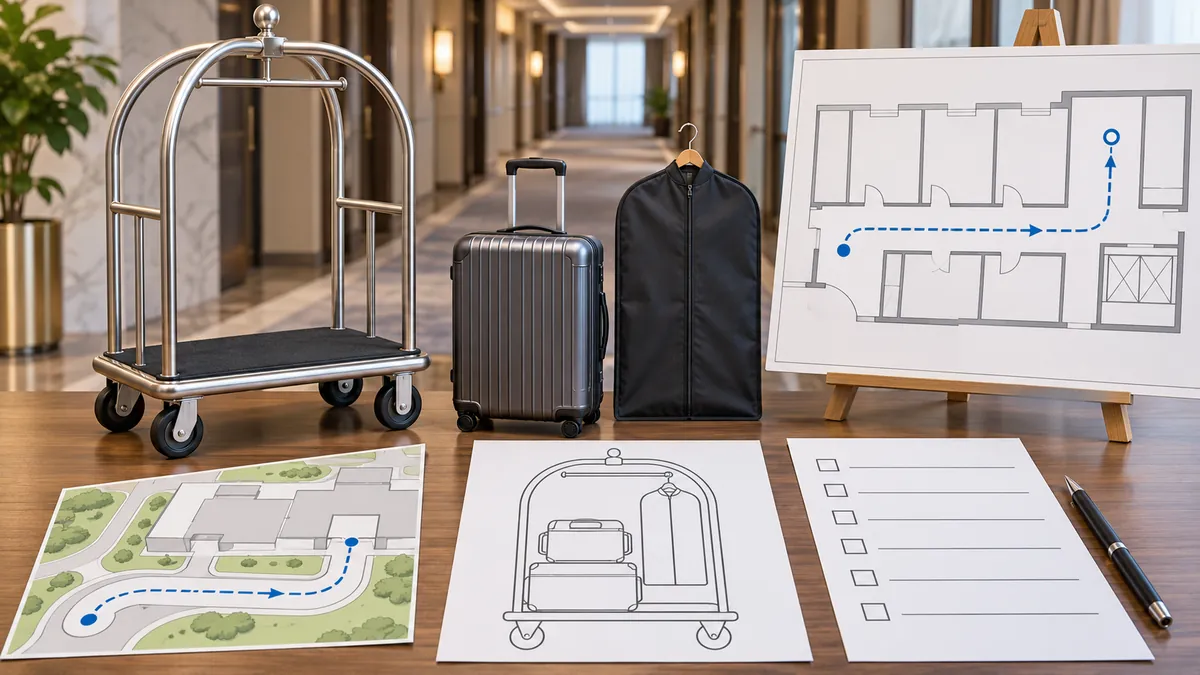
Use hotel luggage cart buyer specification as the review record name, then attach the named luggage, garment, route and option references.
- Define the intended hotel service and storage location.
- Choose actual suitcase and garment references.
- Show the approved loading pattern and item orientation.
- Distinguish usable deck area from outside frame dimensions.
- Record bag overhang, handle projection and garment drop.
- Name doors, turns, elevator entrance and storage point for review.
- Confirm caster, brake, rail, bumper and deck options in the quote.
- Ask how the supplier measures listed dimensions.
- Separate sample fit from structural, route, brake and safety approval.
- Record the drawing revision, sample ID, site reviewer and open items.
- Recheck changes that affect the loaded envelope.
Frequently Asked Questions
Are outside dimensions enough to approve a hotel luggage cart?
No. Review the loaded arrangement, rail and handle options, overhang and route as well. Outside dimensions do not establish maneuvering.
Should the sample include a garment rail?
If the quoted product is expected to carry garments, include the selected rail in the sample or controlled configuration record and check it with representative baggage.
Does fitting through a doorway prove the trolley fits the route?
No. Turns, approach angle, thresholds, elevator access and loaded projections may matter. The site team should assess the actual route.
Are brakes included on every hotel cart?
Do not assume so. Confirm the caster/brake selection in the quotation and verify the sample matches it.
Can sample approval confirm a safe cart capacity?
Not by itself. Capacity and structural claims need product-specific evidence and qualified review separate from fit observation.
Discuss a Hospitality Hardware Brief
Share your lawful reference, drawings, material/finish direction and packaging needs to discuss metal-product feasibility within confirmed scope.
OEM / PRIVATE LABEL
Turn this sourcing guide into a product brief
Share your target product, size, finish, order quantity and packaging requirements. Your team receives a practical manufacturability review before quotation.
 English
 Español
 Português
 Français
 Deutsch
 العربية