November 2026 · Hardware Sourcing Knowledge · Quality Control
Scope. This shower caddy AQL buyer note explains how importers, distributors, and private-label teams can classify Critical versus Major defects on wire shower caddies during lot inspection, and how to attach photo evidence so factory and buyer teams judge the same way. It is written as a generic inspection aid for bathroom storage OEM programs—hanging, corner, adhesive, tension-pole, and wall-mounted wire caddies used in wet bathrooms. The goal is a shared language for RFQ, golden-sample approval, IQC / IPQC / FQC / OQC gates, and third-party or buyer-side lot disposition.
Disclaimer. Examples below are Generic photo-spec / inspection aids. They do not claim that Koitor already ships every SKU shown, do not prove any specific lot outcome, and do not replace your approved drawing, golden sample, CTQ list, or supplier quality agreement. Photos used for training or illustration are generic and do not claim Koitor ships every shower-caddy variant in every finish. Do not assume a defect class from marketing photos alone; classify against your written acceptance criteria and the sample you approved. This article does not reproduce proprietary ISO sampling tables and does not certify any shipment.
Table of contents
- Why shower caddy AQL Critical vs Major classification decides lot risk
- What Critical vs Major means—and the CTQs
- Photo-spec library
- Shower caddy AQL sampling-plan decisions
- RFQ, photo labeling, and sampling language
- Buyer checklist and worked scenario
- FAQ
- Turn this into a product brief
Why shower caddy AQL Critical vs Major classification decides lot risk
Shower caddy AQL programs look simple from a catalog page: a few shelves, hooks, and a mounting kit. In production and after-sales, the same SKU family concentrates risk in a small set of CTQs—cut-wire ends, load-path welds, finish coverage in Faraday-cage intersections, warp that blocks flat install, mounting kit completeness, and carton abrasion that scrapes finish after FQC has already passed. Importers who leave Critical versus Major undefined until a container dispute discover that “quality” meant different things to merchandising, QC, and the factory sales desk. Align defect classes with how your AQL indices are interpreted, and name the standard you mean when you write “AQL” into an RFQ.
Terminology note for RFQs: ISO 2859-1 uses the phrase “Acceptance Quality Limit,” while the NIST engineering statistics handbook often says “Acceptable Quality Level.” Buyers should name the standard and edition (or the handbook context) whenever they write AQL indices into a purchase order, so factory QC and third-party inspectors do not argue about labels that look interchangeable but come from different documents.
Shower caddy AQL only works when defect classes are defined before sampling starts. Without that mapping, inspectors still fill forms, but disposition becomes negotiation: the buyer upgrades every visible scratch to Major; the supplier downgrades every incomplete weld to Minor; neither side can show a photo boundary that was frozen with the golden sample. For private-label and e-commerce programs, that ambiguity shows up as return rates, chargebacks, and rework invoices that were never priced into the RFQ.
This note is therefore a classification and evidence playbook, not a catalog claim. Use it to train buyer QA and supplier IQC teams on the same shower-caddy defect language, then lock the same language into the quality agreement. If a CTQ or photo boundary is missing from your PPS, treat this article as a checklist to close that gap—not as proof that a generic example already applies to your SKU. Topics such as AQL sampling-plan QC checklists, wire-basket RFQ templates, custom manufacturing process maps, and from-sketch-to-shelf manufacturing guides are useful companion reading in plain text on your sourcing wiki; this article keeps body hyperlinks limited to the highest-signal references.
What Critical vs Major means—and the CTQs that should drive mapping
Defect classes for shower caddy AQL
For shower caddy AQL programs, buyers usually keep three classes. Names can vary by retailer handbook, but the decision logic should stay stable across hanging, corner, adhesive, and screw-mounted formats:
- Critical — safety, injury, or regulatory risk; structural failure under a defined use load; sharp edges likely to cut skin; mounting failure that can drop a loaded unit onto a user; any finding your channel treats as stop-ship for injury exposure.
- Major — function, fit, durability, or high-likelihood return: missing load-path weld, coating chip with bare metal on a visible or wet-zone face, warp that blocks install, carton abrasion that scrapes finish in transit, missing mounting hardware, wrong language insert for the destination market.
- Minor — cosmetic issues unlikely to drive returns when viewed at the agreed distance and light (small dust nib in a hidden zone, slight orange peel within appearance standard, faint fixture mark outside the primary sightline).
Do not treat “Critical / Major / Minor” as universal labels copied from an unrelated product family. A sharp tip on a hanging hook is not the same risk profile as a dust inclusion under a powder film on the rear rail. Your RFQ should name shower-caddy CTQs (dimensions, weld map, edge safety, finish DFT, mounting kit completeness, packaging) and map each CTQ to a class. Generic lists help training; they do not override the PPS / golden sample you signed.
Channel weighting also matters. E-commerce private-label programs often need tighter Major cosmetic and packaging rules than value wholesale cartons, because return logistics amplify small finish defects. Hotel or project buyers may weight mounting reliability and load path more heavily than shelf-face orange peel. Do not copy another brand’s AQL indices without checking channel risk; Generic defaults are starting points for RFQ negotiation, not proof of the right plan for your SKU mix.
CTQ families to freeze before first mass PO
Shower caddy AQL classification without CTQs produces arguments about photos. Classification with CTQs produces auditable lot decisions. For wire shower caddies—including programs scoped with a custom shower caddy manufacturer—most buyer programs should at least freeze the following CTQ families before first mass PO:
- Geometry and fit — overall height / width / depth, shelf pitch, hook opening, wall standoff, flatness / twist limits that affect install rock.
- Wire and joint integrity — wire diameter tolerance, weld map for primary and secondary nodes, nugget size or visual class where specified, crack / incomplete fusion rules on load path.
- Edge and tip safety — cut ends, grind quality, burr height, sharp weld spatter, plastic tip / end-cap presence when the design requires them.
- Finish performance — powder or plating type, DFT or plating thickness method and locations, Faraday-cage coverage at intersections, adhesion / pretreatment evidence, wet-zone appearance map.
- Mounting system — adhesive pad or suction claim limited to named substrates and loads; screw kit completeness; instruction language; rated load definition for shelves and hooks.
- Packaging and arrival condition — carton BOM, corner protection, bag / wrap against abrasion, label accuracy, spare-part bag, and kit count for retail readiness.
Map each CTQ to defect class, method, gage ID, frequency, and reaction plan. Example: “primary load-path weld crack = Critical; glove-detectable sharp tip on user-facing hook = Critical; bare metal chip on front wet-zone rail above X mm = Major; dust nib on rear non-sightline wire within appearance board = Minor.” Without that sentence-level mapping, photo libraries become decorative. Quality-control pages and product-family overviews on the site can help merchandising align vocabulary, but the enforceable document remains the CTQ table tied to your drawing revision.
Photo-spec library: Critical and Major defect examples for wire shower caddies
How to build a shared photo-spec library
Shower caddy AQL photo specs reduce the most common dispute: buyer says Major, supplier says Minor. A usable library is not a gallery of random phone shots. For each defect type, store at least:
- One full-unit context shot (where on the caddy).
- One close-up with a scale (ruler or coin) when size matters.
- One accepted-borderline example and one reject example when the boundary is subjective (coating texture, color shade).
- A short caption: defect name, class, CTQ, viewing distance, lighting note, and “Generic — training aid” unless the photo is locked to the golden sample.
- Revision, date, SKU family, finish code, and drawing revision in the file metadata or cover sheet.
Keep photo packs under revision control next to the drawing revision. When finish, wire diameter, or mounting method changes, update the photo pack; old photos do not prove the new SKU is acceptable. Separate “Generic training” packs from “golden-sample–linked” packs so factories cannot treat a stock training image as a commercial acceptance boundary for a private-label finish.
For shower caddies, prioritize photos at wet-zone rails, wire intersections, hooks, cut ends, and mounting interfaces. Those zones drive both safety complaints and humidity returns. A beautiful front-face photo alone does not prove edge safety or weld integrity. Likewise, a single DFT reading on a flat outer wire does not prove Faraday-cage coverage at intersections; map the worst-case locations named in your CTQ list.
Critical defect examples (Generic starting point)
Use the table as a Generic starting point. Confirm class and test method in your quality agreement before mass production—buyers can copy clauses from the supplier quality agreement checklist for hardware buyers. Do not escalate every cosmetic weld mark to Critical; escalate when the written load path or injury rule is triggered.
| Example (Generic) | Why it is often Critical | Photo-spec cue | Typical check |
|---|---|---|---|
| Sharp burr / sharp cut-wire end on hook or rail | Cut / puncture risk in wet bathroom handling | Macro of tip + glove-swipe result | Glove test + visual; treat as Critical when sharp to touch |
| Structural weld break or crack on primary load path | Shelf can collapse under rated bottle load | Joint close-up + full-unit under load fixture | Weld map visual + defined load / movement test |
| Mounting failure at rated load (adhesive/suction/screw interface as specified) | Falling unit risk; safety complaint path | Install setup + failure mode photo | Only against named substrate and load in the brief — do not assume all walls |
| Exposed sharp weld spatter that can cut skin | Injury risk after install | Macro of spatter before/after grind | Tactile + visual; Critical if sharp remains |
| Missing end-cap / tip on a design that requires user-facing tip protection | Exposed cut end injury path | Open tip vs capped tip comparison | Completeness against BOM; Critical when tip is safety CTQ |
Limits: a “broken weld” photo does not prove every incomplete nugget is Critical. Classify from your weld map and load path. A cosmetic weld mark on a non-load secondary wire is usually Major or Minor unless your spec says otherwise. Mounting claims must stay inside the named substrate list; a photo of a failed adhesive pad on an unapproved textured wall does not by itself prove a Critical process defect if the brief never allowed that substrate.
Major defect examples (and how photos should document them)
Major defects drive most shower-caddy returns without always creating an immediate injury case. Photo packs should show size, location, and whether base metal or function is affected. For retail and marketplace channels, Major often includes packaging-induced finish damage discovered only at OQC or destination inbound.
| Example (Generic) | Why it is often Major | Photo-spec cue | Notes for inspectors |
|---|---|---|---|
| Coating chip with bare metal on visible / wet-zone face | Corrosion and appearance returns | Close-up + zone label (front rail / intersection) | Hidden face may be Major or Minor per your appearance map |
| Missing weld on defined structural node | Stiffness / long-term reliability loss | Weld-map overlay + joint detail | May escalate to Critical if node is primary load path |
| Frame twist / warp that prevents flat wall fit | Install fail; rocking shelves | Flat-surface rock test + gap measurement | Record gap with gauge ID |
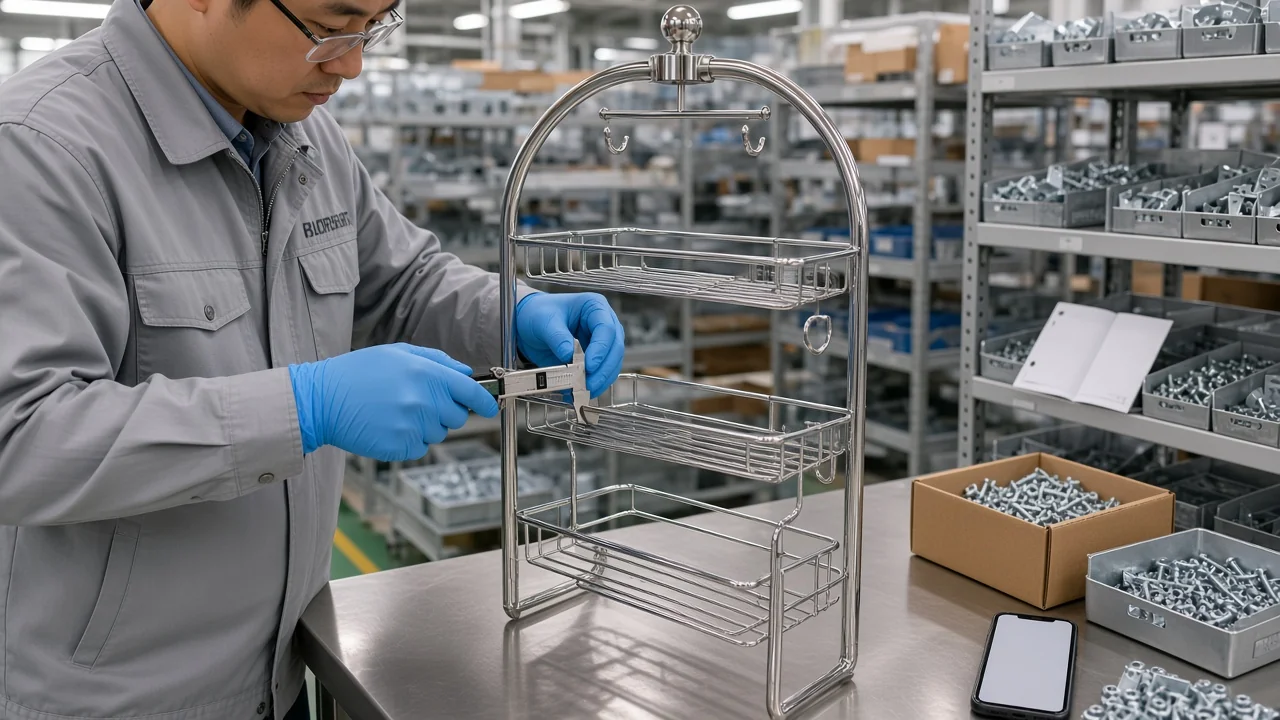
| Wire diameter or key dimension out of tolerance | Fit, stiffness, private-label consistency | Caliper reading in frame of photo | IQC + FQC; do not assume mill cert alone |
| Packaging abrasion creating finish scrape in carton | Arrival fail after FQC pass | Unit-in-carton + scratch close-up | OQC packaging CTQ — not optional for e-commerce |
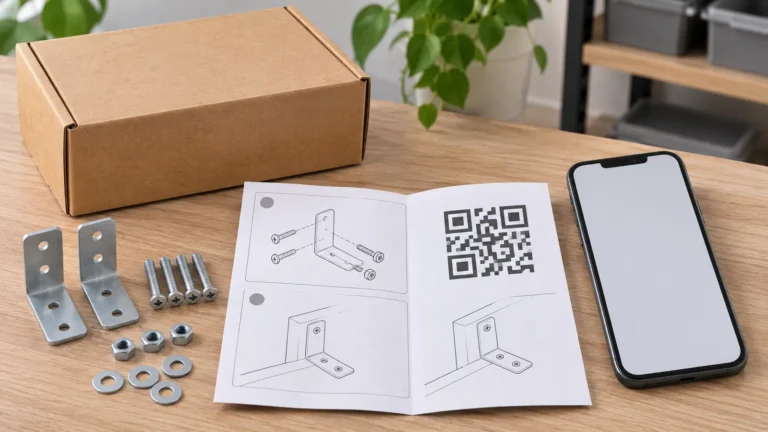
| Missing mounting kit / wrong instruction sheet | Incomplete saleable unit | Open-box completeness shot | Major for most retail channels |
| Color / gloss shade outside approved board on primary sightline | Assortment mismatch and returns | Side-by-side with master under agreed light | Do not judge under mixed warehouse lighting alone |
Generic reminder: a scratch on a plastic tray insert is often Minor if it does not affect function and is within your cosmetic distance rule. Do not auto-upgrade every cosmetic mark to Major without the written standard. Conversely, do not auto-downgrade bare metal on a wet-zone rail to Minor because “it still holds bottles.” Humidity returns are a Major commercial risk for bathroom storage even when structure remains intact.

Shower caddy AQL sampling-plan decisions and IQC / IPQC / FQC / OQC gates
Once Critical and Major boundaries are frozen, shower caddy AQL sampling only works if the same class map is used at IQC, IPQC, FQC, and OQC—otherwise a lot can pass FQC and still fail buyer disposition.
Running Critical vs Major inside a shower caddy AQL sampling plan
Keep the decision sequence short and auditable. Long narratives after the fact rarely survive a chargeback review; a six-step record does. For how accept/reject risk shifts with lot quality, see the site overview of the AQL, LTPD, and operating-characteristic sampling curve before you freeze indices on the PO.
- Define the lot — same SKU, finish, material grade, production window, powder/plating batch window, and packaging BOM revision. Mixing lots voids the sample’s meaning.
- Pull the sample — random cartons across the stack; record carton IDs. Do not let the line “choose” units. Note if cartons were already opened for other audits.
- Inspect CTQs — edge safety, weld map, key dimensions, finish coverage at Faraday-cage zones, mounting completeness, packaging protection.
- Classify each finding — Critical / Major / Minor against the photo-spec and CTQ list; attach labeled photos with sample ID and zone.
- Apply acceptance numbers — many buyers treat Critical as effectively c=0 for the sample; Major and Minor follow the agreed AQL indices (often General Level II). This article does not reproduce proprietary sampling tables.
- Dispose — Accept / Reject / Hold / Rework only when rework restores CTQs without new risk; record who authorizes release.
AQL is a lot decision tool. It does not prove the unsampled remainder is defect-free, and it does not replace process control at IQC → IPQC → FQC → OQC. Stage definitions, DFT / pretreatment CTQs, and wire-bathroom hardware QC checklists belong in your internal SOP set; the lot plan only works when those earlier gates feed consistent class language into the final sample.
When a lot fails on Major counts, resist the urge to “spot-check a few more cartons” without a written switching rule. Unplanned extra sampling can be used to shop for an Accept outcome. Prefer pre-agreed tightened inspection after a reject or after a process change (new powder lot, new welding fixture, new carton supplier). Document the switch in the same revision tree as the drawing and photo pack.
Where Critical vs Major should be caught by stage
Lot AQL at the end of the line is expensive insurance if earlier gates are empty. Wire shower-caddy programs should place Critical and Major controls at each stage with clear ownership, then choose a named lot-acceptance plan type—single, double, or multiple—using guidance such as NIST’s overview of kinds of lot acceptance sampling plans (LASPs):
- IQC (incoming) — wire diameter / grade evidence, plating or powder inputs as applicable, mounting kit components, carton materials, and any purchased trays or plastic tips. Rejecting bad wire diameter at IQC is cheaper than discovering stiffness drift after welding and coating.
- IPQC (in-process) — weld map audits after welding / grinding, edge safety after cut and grind, fixture checks for twist, first-article after a setup change, and Faraday-cage coverage checks after coating trials. IPQC is where Critical weld and tip issues should be stopped before volume builds.
- FQC (final) — full CTQ sample on finished goods before packing density hides defects: dimensions, appearance map, kit completeness if packed later, load / rock checks as specified.
- OQC (outgoing / packing) — packaging abrasion rules, carton drop or vibration rules if in the plan, label and barcode accuracy, destination-language inserts, and random open-box checks that prove arrival condition is still a CTQ after FQC pass.
A common failure mode for bathroom wire goods is “FQC green, OQC or destination red” because powder or chrome scrapes against a hard tray edge inside the carton. If packaging is not a CTQ with photo boundaries, Critical vs Major debates restart at the DC. Treat packaging abrasion examples as Major for most retail channels unless your agreement says otherwise.
Stage photos should use the same labeling grammar as lot photos. An IPQC weld crack photo that is not tied to the weld map node ID is weak evidence later. An OQC carton scrape photo without the packaging BOM revision is weak when the factory claims “old carton stock.” Link evidence to revision, not only to a date stamp.
RFQ and sample-approval language, photo labeling, and sampling language to freeze
Turning defect examples into RFQ and sample-approval language
Photo examples only help if they appear in the commercial document set. Before tooling or mass PO, ask for a shower-caddy RFQ package that a second factory could quote against without chat archaeology:
- CTQ table with method, frequency, defect class, gage ID, and reaction plan.
- Weld map for the shower-caddy SKU family, marking primary load-path joints.
- Photo-spec pack marked Generic or golden-sample–linked, with revision and date.
- AQL indices by class and switching rules (tightened after reject or process change).
- OQC packaging BOM and abrasion rules for chrome / powder finishes.
- Mounting claim sheet: substrates, loads, cure times, and what is out of scope.
- Disposition: who pays for 100% sort, rework limits, re-inspection under tightened plan, and scrap authority.
- Sample-approval form that freezes the physical unit, the photo boundary set, and the drawing rev together.
Sample approval should freeze the reference unit and the photo boundary examples together. Approving a pretty unit without defect photos leaves Critical vs Major open to negotiation after the container is packed. From-sketch-to-shelf manufacturing guides and wire-basket RFQ templates are useful companion documents on your sourcing drive; keep them linked from your internal brief rather than stuffing every related URL into this article’s body.
Practical RFQ sentence templates importers can adapt (Generic — edit for your legal terms): “Critical defects: c=0 in the inspection sample; any Critical finding holds the lot pending buyer disposition.” “Major coating defects on wet-zone Zone A: as per photo pack Rev X; bare metal visible at 500 mm under D65 / agreed light = Major.” “Mounting performance claims apply only to substrates listed in Annex B; other walls are out of scope for Critical classification unless separately tested.” These sentences are not legal advice; they illustrate how photo packs become enforceable only when the PO points to a revision.
How photo evidence should be labeled so disputes stay short
When a Critical or Major finding is recorded, the photo pack should answer five questions without a follow-up call: which sample ID, which CTQ, which defect class, where on the unit, and what rule was used. A practical file label looks like LOT2401_S07_Major_CoatingChip_FrontRail. Put the same string on the inspection sheet line. If two inspectors disagree, they should be arguing about the written boundary example—not about memory of “what we usually accept.”
Recommended minimum metadata on every inspection photo for shower-caddy lots:
- Lot / PO / SKU / finish code.
- Sample ID and carton ID.
- Defect class and CTQ name.
- Zone label matching the appearance map (front rail, hook tip, intersection, rear hidden wire).
- Scale object when size is part of the rule.
- Lighting note (warehouse LED vs agreed booth) when shade or gloss is judged.
- Inspector ID, date/time in the factory local zone, and drawing / photo-pack revision.
- Clear “Generic training” or “Lot evidence” flag so packs are not mixed.
Keep a “borderline library” separate from reject examples. Borderline photos train new inspectors faster than reject-only packs, and they reduce over-rejection that burns supplier trust without improving field risk. Still: borderline does not mean Accept. Accept only when the finding sits inside the agreed class limits and the lot’s AQL counts remain within acceptance numbers.
Sampling language buyers should freeze before the first mass PO
Importers often paste “AQL 2.5 Major / 4.0 Minor, Level II” into an RFQ and assume the factory will interpret Critical the same way. For the statistical definition of lot acceptance sampling, see NIST’s handbook section on what acceptance sampling is. For shower caddies, write sampling language that answers operational questions:
- What constitutes one lot when finishes or packaging BOMs change mid-week?
- Are spare parts and mounting kits sampled with the metal unit or as a separate lot?
- Is Critical inspected on 100% of the sample with c=0, or under a named index?
- Who selects cartons, and how are top / middle / bottom stack positions represented?
- What happens if the factory offers rework: sort scope, re-sample rule, and who pays?
- When does inspection switch to tightened, and who resets to normal?
Do not invent shower caddy AQL sampling table numbers in marketing copy. Point to the agreed standard edition in the quality agreement and keep the operational answers above in an annex. That annex is what third-party inspectors can follow without calling merchandising. Pair it with the CTQ and photo-spec revisions so the inspector is not forced to invent Critical vs Major on the floor.

Buyer checklist and worked scenario for Critical vs Major photo-spec readiness
Buyer checklist for shower caddy AQL readiness
- Lot definition written (SKU + finish + material + batch windows + packaging revision).
- CTQ list mapped to Critical / Major / Minor with methods and gage IDs.
- Weld map identifies primary load-path joints for the caddy configuration.
- Photo-spec pack includes Critical and Major examples with scale and zone labels.
- Edge-safety rule stated (glove test / sharp tip reject).
- Coating / plating acceptance includes wet-zone and Faraday-cage locations.
- Mounting claims limited to named substrates and loads — do not assume universal wall types.
- Random sampling method and carton ID recording are mandatory in the SOP.
- OQC packaging abrasion and kit-completeness checks are in the same plan as FQC.
- IQC / IPQC / FQC / OQC owners and frequencies are named, not only “QC will check.”
- Disposition and switching rules are in the PO / quality agreement, not only in chat.
- Revision control links drawing, golden sample, and photo pack to the same rev number.
- Borderline library exists separately from reject examples for inspector training.
- Disclaimer remains clear: Generic photos do not claim Koitor ships every SKU or prove a lot outcome.
Worked scenario: classifying findings without rewriting the RFQ mid-audit
Consider a Generic hanging wire shower caddy AQL lot under Level II sampling with Critical treated as c=0 in the sample, Major AQL as agreed in the PO, and a photo pack Rev B locked to the golden sample. Inspector finds: (1) a glove-detectable sharp cut end on a front hook tip; (2) a 3 mm bare-metal chip on the front wet-zone rail; (3) a dust nib on a rear wire outside Zone A; (4) one carton with tray-edge abrasion scraping powder on two units.
Under a typical buyer map: finding (1) is Critical if the edge-safety CTQ says sharp-to-touch on user-facing tips is Critical—lot disposition becomes Hold / Reject for the sample rule, regardless of how good the finish looks. Finding (2) is Major if Zone A bare metal above the size limit is Major—count it toward Major acceptance numbers and photograph with scale and zone label. Finding (3) is Minor if the appearance map allows it at the agreed distance—count Minor, do not silently ignore. Finding (4) is Major packaging / finish if OQC rules treat arrival scrapes as Major; open more cartons only under the written switching or expanded-sample rule, not by informal request.
The point of the scenario is discipline: the inspector should not invent a new class because the factory “always ships like this,” and the buyer should not invent a new Critical because a marketplace review mentioned rust last quarter. Change the map in a controlled revision, then apply it to the next lot. Mid-audit reclassification without revision control is how both sides lose trust.
FAQ
1. Does finding one Critical defect always reject the lot?
No / limit. Many shower caddy AQL buyer plans treat Critical as c=0 for the sample, which effectively rejects when any Critical is found in that sample. That is a contractual choice, not a universal AQL law. Write the rule into the quality agreement; do not assume the factory uses the same Critical list you use in retail QA.
2. Can a Major coating chip be reworked to Accept?
No / not always. Spot touch-up may hide a chip without restoring pretreatment, adhesion, or corrosion performance. Rework is acceptable only when it restores CTQs and is verified under the agreed method. Do not assume cosmetic paint-over proves humidity performance.
3. Do these Generic photos prove Koitor’s current production quality?
No. Photos in this article are Generic inspection aids. They do not prove lot status for any SKU, and they do not claim every shower-caddy variant is already in Koitor’s catalog. Use your approved sample and inspection records for commercial decisions.
4. Is packaging damage a Major if the metal part still works?
Often yes for retail / e-commerce — confirm in your plan. Abrasion that creates bare metal or customer-visible scrapes commonly drives returns even when structure is intact. Treat packaging as a CTQ in OQC; a factory FQC pass does not prove arrival condition.
5. Should Minor defects be ignored?
No. Minor counts still feed AQL acceptance numbers and brand consistency. Ignoring Minor trends can mask process drift that later becomes Major (for example, dust inclusions rising until visible faces fail).
6. Can IQC mill certificates replace dimensional CTQs on wire?
No. Certificates support incoming review; they do not replace caliper checks against your drawing tolerance for stiffness-critical diameters. Record gage ID and sample IDs the same way you would for FQC.
7. Should adhesive mounting failures always be Critical?
Only against the named substrate and load. If the brief lists tile type, cure time, and rated shelf load, failure under that protocol is often Critical for falling-unit risk. Failures on unapproved painted drywall or wet silicone residue are out-of-scope evidence unless your claim sheet included them. Do not assume universal wall types.
Turn this into a product brief
If you are building or refreshing a wire shower-caddy program, convert this shower caddy AQL note into a one-page brief: SKU family, finish, CTQ table, Critical vs Major photo pack revision, AQL indices, packaging BOM, IQC / IPQC / FQC / OQC owners, and sample-approval sign-off. Send drawings or target references via the contact page or email simon@koitorhardware.com. Factory base: Jiangmen, China (as listed on site).
Generic / Do not assume / does not prove: This draft is an educational inspection aid for importers and private-label buyers. It does not certify any shipment, does not claim Koitor ships every SKU illustrated in training photos, and does not replace third-party inspection or your own acceptance testing. Keep status discussions with your supplier tied to approved samples and written CTQs—not to marketing imagery.
OEM / PRIVATE LABEL
Turn this sourcing guide into a product brief
Share your target product, size, finish, order quantity and packaging requirements. Your team receives a practical manufacturability review before quotation.

 English
 Español
 Português
 Français
 Deutsch
 العربية