
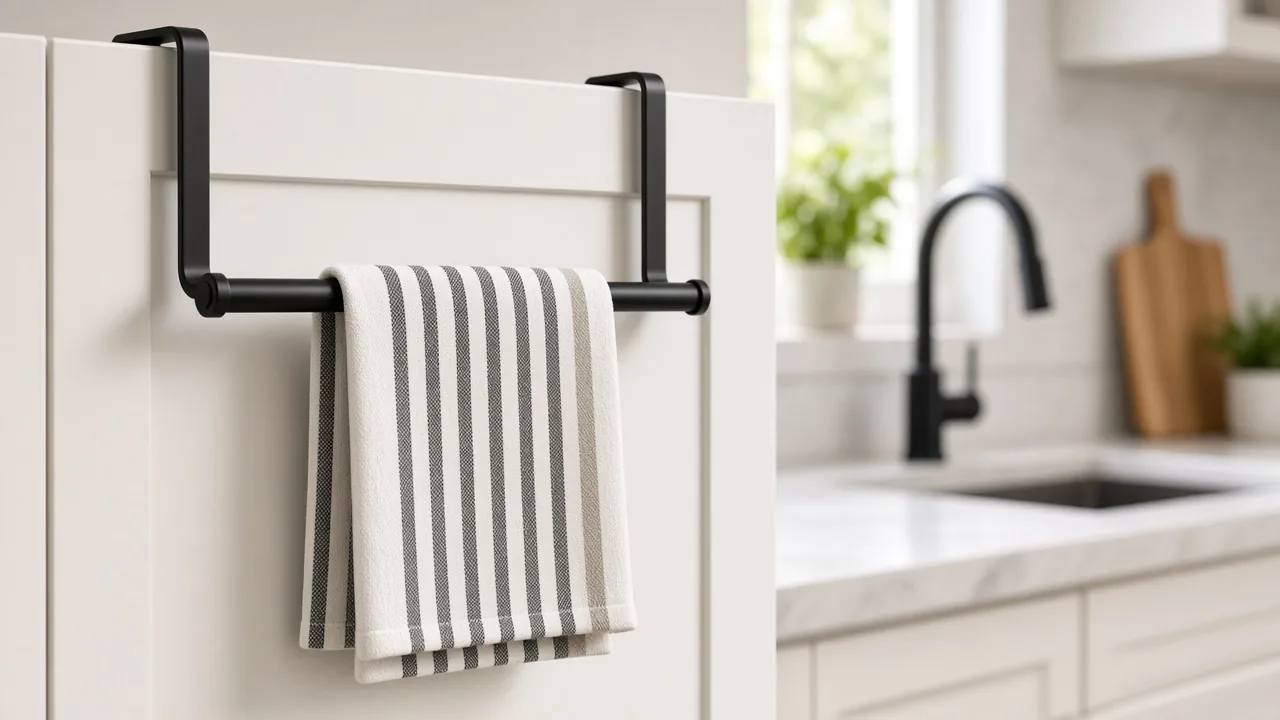
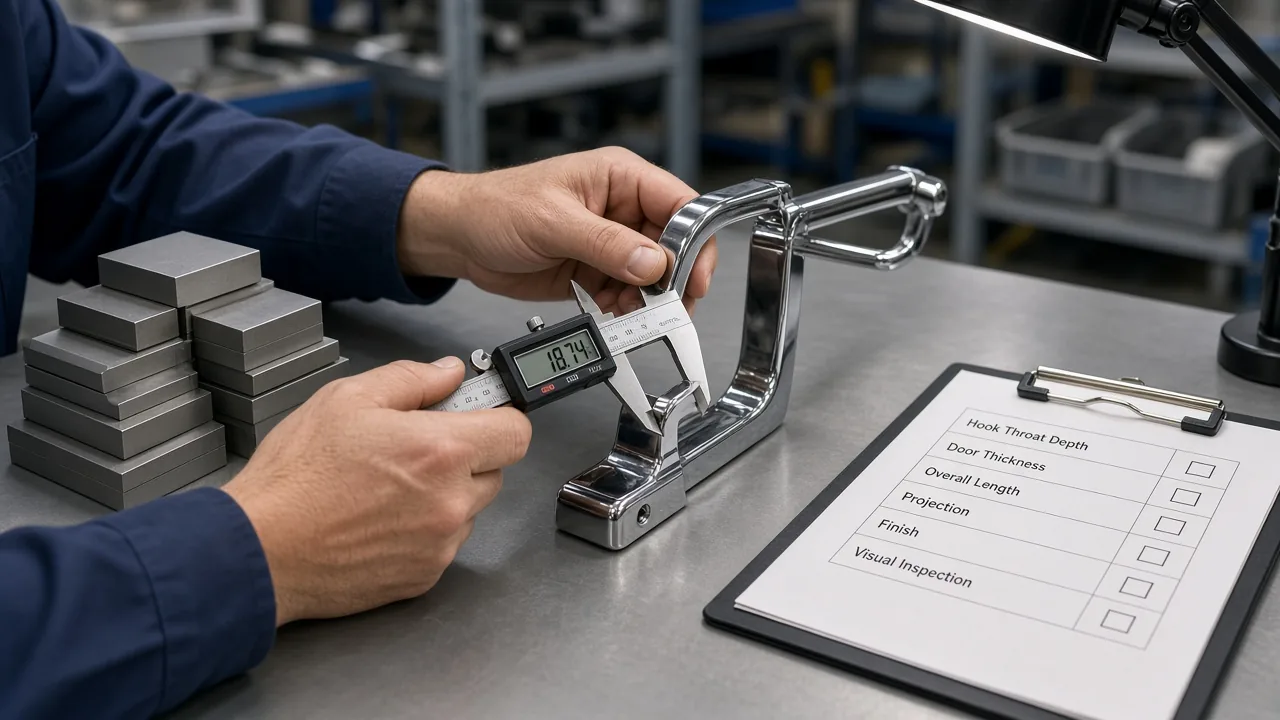
Kitchen importers who buy an over cabinet towel bar often inherit returns that sound like “doesn’t fit my door,” “scratched the paint,” “tips when wet,” or “arrived bent.” Those complaints are rarely solved by a lower FOB quote. They are solved by RFQ and IQC language that freezes cabinet thickness range, hook geometry, tip-over limits, finish rub on doors, packaging anti-bend rules, and wet-towel load methods before the PO is released.
This article is written for OEM buyers, private-label teams, and inbound QC. It is over-cabinet and over-door specific acceptance language—not a rewrite of wall-mounted bathroom towel rack specs. Wall screw mounts and concealed brackets belong in a different verification pack. Here the product lives on a moving cabinet door, so fit, leverage, and paint contact become CTQs equal to weld and finish.
Photos in this guide are generic visual aids for RFQ and IQC discussion. They do not claim that every SKU ships from one plant. Koitor Hardware supports kitchen and bath wire programs from Jiangmen, China, with practical specification wording for importers.
In this guide
- Why Over-Cabinet Mount Specs Differ from Wall Towel Racks
- How to Spec an Over Cabinet Towel Bar for RFQ and IQC
- 11 RFQ Checks for Over Cabinet Towel Bar Acceptance
- Accept, Rework, or Reject: IQC Decision Rules
- RFQ Checklist Language for Thickness, Hooks, Tip-Over, and Packaging
- FAQ: Over Cabinet Towel Bar RFQ and IQC
- Send Your Over Cabinet Towel Bar Spec for Review
Why Over-Cabinet Mount Specs Differ from Wall Towel Racks
A wall-mounted bathroom towel rack is anchored into a substrate you choose and control. An over cabinet towel bar hangs on whatever door thickness, edge radius, and paint system the end customer already owns. That single difference changes every CTQ: throat depth must match a thickness window, contact pads must protect paint, and wet-towel mass creates a tipping moment around the door top edge instead of a shear load into wall anchors.
If your team copies a bathroom towel-rack RFQ into a kitchen over-door program, you will over-specify screws and under-specify door fit. You will also miss finish rub, which is one of the highest chargeback drivers when rental kitchens and white painted doors are in the channel mix.
Boundary with wall towel rack specification pages
Use the wall-program guide when you are freezing material grades, DFT plans, and screw-mount CTQs for bath rails. That work lives here: OEM bathroom towel rack specification. Keep this page for over-cabinet acceptance language—thickness range, hook geometry, tip-over, door-face rub, packaging bend, and wet load. Capability and catalog context for mounting families lives on the towel racks product page. Do not treat that listing as your PO annex.
Commercial stories that start as “fit issues”
Most over-cabinet returns cluster into six commercial stories: hooks too narrow for thick doors, hooks too deep so the bar rattles on thin doors, tip-over when a wet towel hangs forward, paint scuffs after two weeks of open–close cycles, bent bars after parcel transit, and instructions that never state the supported thickness range. Each story maps to one or more of the eleven checks below. If claim codes only say “defective,” you cannot trend factories or dual-source honestly.
Marketplace reviewers also punish silent exclusions. A bar that works on a flat 18 mm panel but fails on a thick European door with a soft-close overlay becomes a one-star fit complaint. Your insert and packaging must name the window. IQC must verify the window on the sample door set you freeze at first article.
Why kitchen doors amplify leverage and paint risk
Kitchen towels are often heavier when wet than bath hand towels used for short hangs. The mass sits outward from the door face, so the moment arm fights the hook return and any soft bumper. Soft-close doors add cyclic contact. High-gloss or soft-touch paint shows rub marks faster than textured laminate. Spec language must therefore cover both geometry and contact finish protection—not only chrome shine or powder color.
Importer cost of an unfrozen over-door stack
Unfrozen thickness and tip-over rules on an over cabinet towel bar program create silent margin leaks. Replacement shipments, paint-damage claims on rental units, and influencer reseeding after “tips when wet” videos all hit after the PO closed at the low quote. Freezing CHK IDs before award is cheaper than three CAPA rounds across two factories.
Category managers should also budget a simple door-panel fixture for first article. An over cabinet towel bar that never sees a wet-towel hang on a 16 mm and a 22 mm panel will still face those doors in the field. One controlled fixture costs less than a season of chargebacks.
For related kitchen wire process CTQs—bending, welding, finish, and carton protection—align language with your broader kitchen program so defect classes stay consistent across racks and bars. A practical manufacturing CTQ companion is the kitchen storage program overview, used here only as family context, not as a substitute for the eleven over-cabinet checks.
How to Spec an Over Cabinet Towel Bar for RFQ and IQC
Write every over-door requirement as a closed loop: check name, inspection location, measurement or photo method, severity class, and disposition. Ambiguous words such as “fits most cabinets,” “stable,” or “won’t scratch” fail under dispute. For an over cabinet towel bar program, treat door interface CTQs as equal to weld integrity and cosmetic finish.
Photo-spec labeling that survives email and WhatsApp
Golden-sample photos work only when each image carries a label block: SKU, finish lot, door thickness used, towel wet mass, viewing distance, and check ID (for example, CHK-03 Tip-Over Under Wet Load). Mark accept / borderline / reject on the same frame or an annotated crop. Store the labeled set with first-article records so production IQC is not comparing against a faded chat screenshot.
Official references for packaging, coating adhesion, and storage-unit context
For distribution hazards that bend bars and crush contact pads, buyers commonly reference ASTM D4169 performance testing of shipping containers and systems. Use it to agree a distribution cycle and open-inspect rule for bar straightness and finish scuffs—not as a vague “export packing OK” line.
For coated frames where door rub and transit scuffs interact with adhesion risk, reference ASTM D3359 tape adhesion methods as a process gate on the metal finish itself. Adhesion on the bar does not replace a door-face rub test; it prevents shipping a coating that already lifts under light tape pull.
Cabinet storage units have their own strength, durability, and stability methods in ISO 7170:2021. That standard is about furniture storage units, not a consumer towel bar product mark. Cite it only as context when you explain why tip-over and door-mounted accessories need explicit buyer-defined pass criteria—ISO 7170 itself does not hand you a wet-towel accept number for an over cabinet towel bar.
CTQ table starters for over-cabinet programs
Minimum CTQs for most over cabinet towel bar RFQs include: named door thickness min/max; hook throat depth and tip clearance; dual-hook span and coplanarity; soft bumper pad material, diameter, and compression set; tip-over angle or lift criteria under stated wet mass; door-face rub cycles on an agreed paint coupon; bar straightness after agreed packaging sequence; wet-towel static load and hold time; install/remove cycle spring-back; wire or tube diameter and weld class; and instruction content that restates the thickness window and exclusions. Add humidity or coastal corrosion only when your channel truly needs it.
Documentation that survives staff turnover
Buyer teams change; factories change inspectors. An over cabinet towel bar program that lives only in chat threads will drift. Keep the check catalog, photo masters, and CTQ table in a controlled folder with revision dates. Require suppliers to echo the same CHK IDs on IQC sheets. When a new merchandiser asks why a lot was rejected, the photo-spec should answer in one page.
Also freeze the sample door set. Record panel thickness, edge radius, paint system, and soft-close presence. Without that, “passed tip-over” means nothing when the next auditor hangs the bar on a lighter door.
11 RFQ Checks for Over Cabinet Towel Bar Acceptance
Use the eleven checks as numbered acceptance language in RFQ annexes, first-article reports, and inbound IQC. Severity classes below are starters—tune them to your channel risk. Critical usually means safety, tip-over with injury risk, or door damage that triggers chargebacks. Major means fit or function failure that drives returns. Minor means cosmetic issues that do not change fit or stability.
1. Cabinet thickness range not frozen (CHK-01)
Definition: RFQ or insert fails to state a measurable door or panel thickness window (for example, 16–22 mm), or production hooks are built to an unstated “typical” size. Causes include copying a competitor sample without measuring throat, mixing thin Asian flat panels with thick European doors in one SKU story, or letting sales write “fits most cabinets.” Spec tip: require min thickness, max thickness, and measurement method on the hook throat with the bar seated. Disposition: reject lots that fall outside the frozen window on the golden door set; do not “sort in the warehouse.”
IQC action: measure throat with calipers on both hooks; hang on min and max gauge panels; photograph seating. An over cabinet towel bar that only passes the mid thickness is not acceptable for a published range.
2. Hook throat depth and tip clearance wrong (CHK-02)
Definition: throat too shallow (won’t seat on max thickness) or too deep (rattles, hangs crooked, or leaves excessive play on min thickness); tip return too short so the bar walks off when the door slams. Spec tip: call out throat depth, tip return length, and max gap at the door top when seated on the min thickness panel. Disposition: major—rework only if geometry can be corrected without cracking finish; otherwise reject.
Buyers should also freeze edge-radius assumptions. A sharp panel edge needs different tip geometry than a heavily radiused door. State the edge condition used at first article.
3. Tip-over under wet-towel load (CHK-03)
Definition: with the bar seated on the agreed door fixture, a wet towel or equivalent mass causes rearward tip, lift of the lower contact pads, or door instability beyond the buyer limit. Causes include shallow tip return, high center of mass, missing or hard bumpers, and wet mass higher than the dry marketing claim.
Spec tip: freeze dry mass, wet mass (or water add method), hang time, and pass criteria (no tip past X degrees, pads remain in contact, door remains closed or fixture remains stable as defined). Disposition: critical or major depending on injury and property-damage risk in your market—do not ship “almost stable.”
Record whether the test door is free-standing, latched, or fixture-clamped. An over cabinet towel bar that only “passes” on a clamped lab panel may tip on a light pantry door in the field.
4. Finish rub on painted door faces (CHK-04)
Definition: after agreed open–close cycles or reciprocating rub against a paint coupon, the bar leaves visible scuffs, black marks, or coating transfer on the door face; or the bar’s own finish abrades at contact points. Spec tip: name cycle count, door paint type (or coupon), force or door slam energy if used, and lighting/viewing distance for rub marks. Disposition: major for visible door damage; rework bumpers if pad change fixes it without geometry change; reject if hard metal contacts paint.
Finish rub is not the same as plating adhesion. You can pass tape adhesion on the bar and still destroy soft-touch cabinet paint. Keep both checks.
5. Soft bumper pads missing, hard, or compression-set (CHK-05)
Definition: contact pads absent, wrong durometer, wrong diameter, adhesive failure, or permanent compression set after load so metal contacts the door. Spec tip: freeze pad material class, hardness window, diameter, protrusion, and adhesive or mechanical retention. After wet-load hold, pads must still isolate metal from paint. Disposition: major; replace pads only under controlled rework with lot traceability.
6. Dual-hook coplanarity and span misalignment (CHK-06)
Definition: left and right hooks are not coplanar, span does not match drawing, or bar sits visibly skewed on a flat door. Causes include bent hooks after welding, packaging crush, or fixture error. Spec tip: measure span, height difference between hooks, and bar level on a flat panel. Disposition: major for functional skew; minor only for tiny cosmetic lean inside your frozen tolerance.
Skewed hooks also concentrate rub on one bumper and accelerate tip-over. Treat coplanarity as a stability CTQ, not only a beauty check.
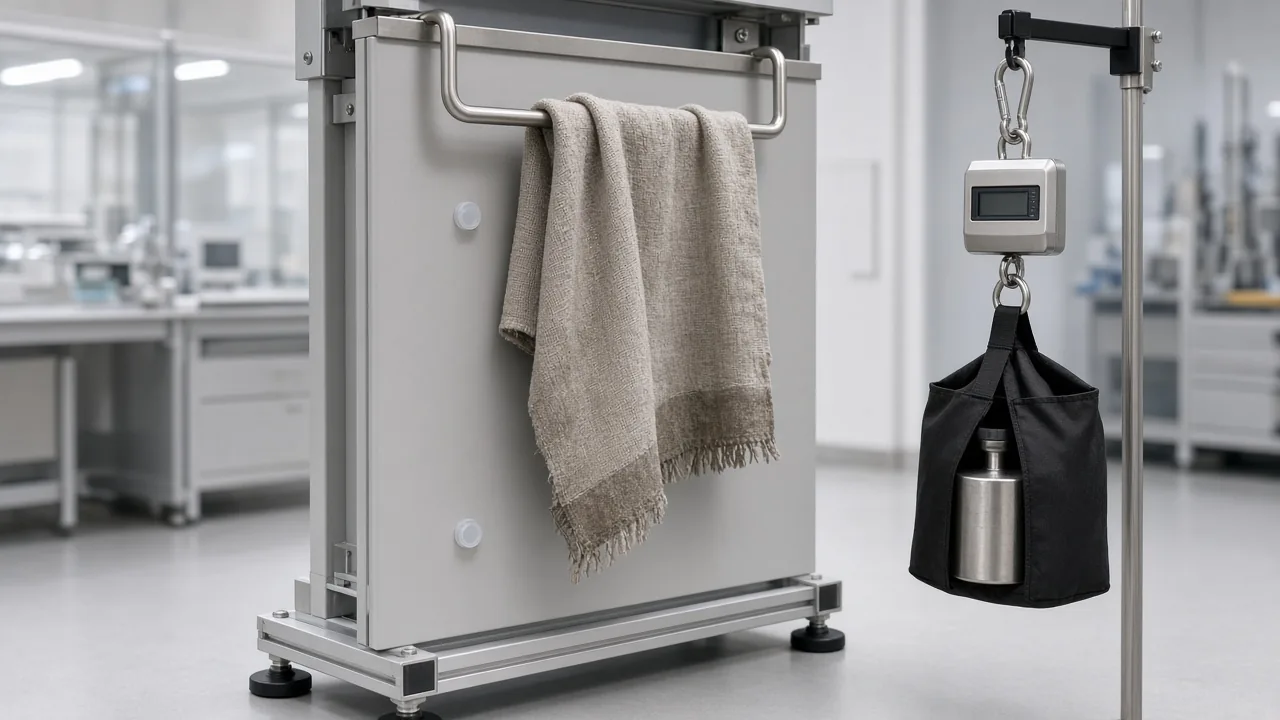
Finally, train supplier IQC and your inbound auditors on the same accept examples once per season. A short review of CHK-01 thickness seating and CHK-03 tip-over photos prevents most “why did you reject this” emails. Keep the over cabinet towel bar check catalog beside finish and weld sheets so door-interface CTQs are never treated as an afterthought when the line is late.
FAQ: Over Cabinet Towel Bar RFQ and IQC
Can one SKU cover every cabinet thickness?
Usually no. A single throat that truly spans very thin and very thick doors often rattles on the thin end or tips on the thick end. Prefer a published window with honest exclusions, or two SKUs with clear merchandising, rather than one “universal” claim that trains one-star reviews.
Is dry load enough for kitchen channels?
No. Kitchen towels pick up water. If your channel is kitchens, freeze a wet method. Dry hang is a useful in-line screen; it is not a substitute for CHK-08 and CHK-03.
Do I need ASTM D4169 on every lot?
Not necessarily every lot. Use a full distribution sequence at pilot and after packaging changes; use lighter drop or compression screens in routine IQC if you have correlation data. The RFQ must still name the sequence and the post-test straightness limit.
How is this different from a bathroom towel rack RFQ?
Bathroom wall racks emphasize anchors, wall substrates, and corrosion in wet rooms. An over cabinet towel bar emphasizes door thickness, hook geometry, tip-over, paint rub, and packaging bend. Keep both playbooks; do not merge them into one vague “towel bar” annex.
What belongs in Critical vs Major?
Tip-over with foreseeable injury or property damage, cracked tips with sharp edges, and hard metal painting doors often sit in Critical for many retailers. Thickness misses, missing bumpers, bent bars, and missing insert warnings commonly sit in Major. Tune with your QA and legal teams; publish the table so factories are not guessing.
Should bumper pads be replaceable?
Replaceable pads help CAPA and spare-parts programs, but only if retention and adhesive are frozen. Loose pads that fall in the carton become a new defect mode. Spec retention as tightly as Shore hardness.
Send Your Over Cabinet Towel Bar Spec for Review
If you are preparing an RFQ or first-article pack for an over cabinet towel bar, send the drawing or sample photos, target thickness window, finish, wet-load expectation, packing channel (parcel vs container), and any door exclusions. Koitor Hardware can review geometry, bumper strategy, and IQC wording before you lock the PO.
Start on the contact page or email simon@koitorhardware.com. Factory: Jiangmen, China.
Bring CHK-01 through CHK-11 to the first call. Clear thickness, tip-over, rub, and packaging language is how over-door programs scale without teaching the market that “cheap towel bars scratch cabinets.”
OEM / PRIVATE LABEL
Turn this sourcing guide into a product brief
Share your target product, size, finish, order quantity and packaging requirements. Your team receives a practical manufacturability review before quotation.

 English
 Español
 Português
 Français
 Deutsch
 العربية