
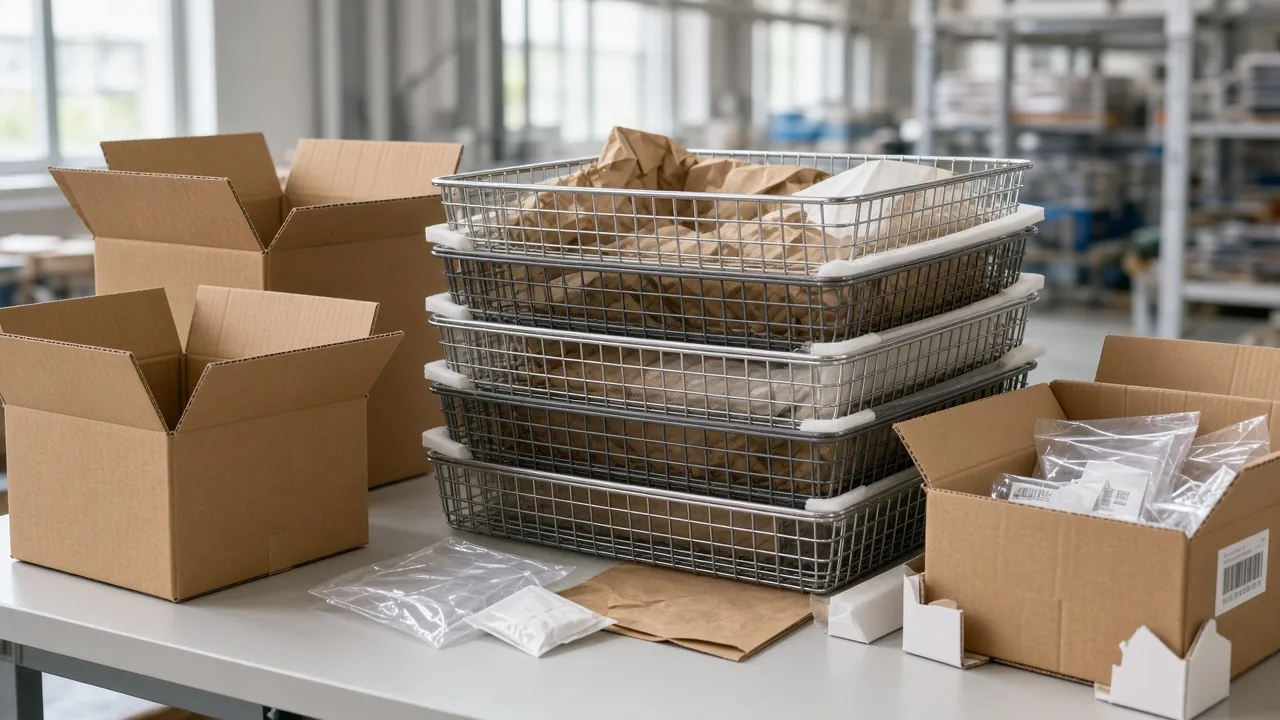
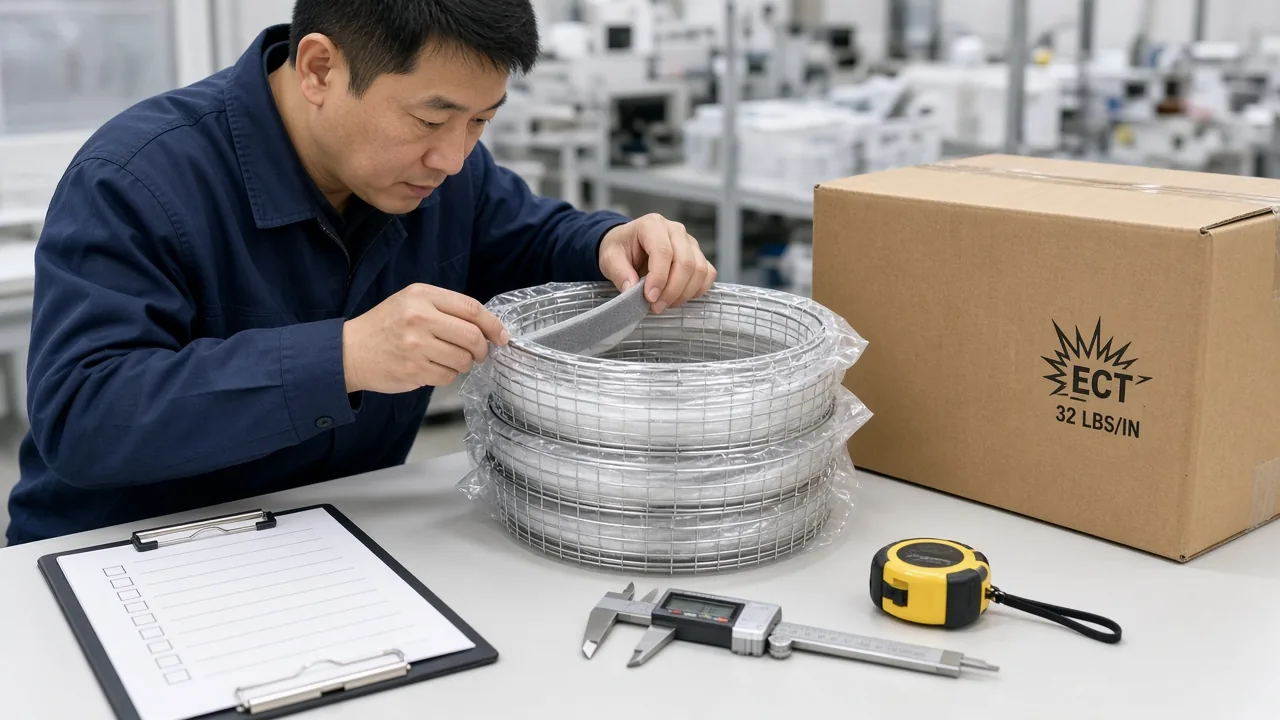
Buyers who treat wire basket packaging as a last-line factory note inherit the returns that look like “coating failed” or “bent in transit.” In reality, nesting abrasion, metal-to-metal rub, underspec cartons, missing desiccant, vague drop language, and label/kitting mix-ups create most export defects after the product already passed weld and finish IQC. This article is a buyer and OEM catalog of packaging CTQs and defect names for wire baskets and related bathroom/kitchen wire goods—written as RFQ and receiving acceptance language, not as a brief packing paragraph inside a manufacturing overview.
It deliberately differs from manufacturing playbooks that only touch pack-out after forming, welding, and finishing. Those pages explain how baskets are made and why packaging matters at a high level. This page names ten export packaging defects, the CTQs that catch them, and the disposition language your IQC team can use on the dock. Photos here are generic visual aids. They do not claim that every SKU ships from one plant. Koitor Hardware supports wire bathroom and kitchen storage programs from Jiangmen, China, with practical packaging specification language for importers and private-label teams.
In this guide
- Why Export Packaging Defects Beat Vague “Factory Pack” Language
- How to Freeze Wire Basket Packaging CTQs for RFQ and IQC
- 10 Export Defects Buyers Must Spec
- Accept, Rework, or Reject: Pack-Out Disposition Rules
- RFQ Checklist Language for Nesting, Carton ECT, Desiccant, Drop, and Labels
- FAQ: Wire Basket Packaging Export Specs
- Send Your Wire Basket Packaging Spec for Review
Why Export Packaging Defects Beat Vague “Factory Pack” Language
Retail and e-commerce returns rarely say “ECT underspec” or “metal-to-metal contact at rim node 3.” They say “scratched out of box,” “rust freckles,” “bent corner,” “missing screws,” or “wrong item in carton.” Your RFQ must translate those complaints into named packaging defects with measurable CTQs. That is the job of this catalog.
Wire goods amplify packaging risk because finishes are thin, contact points multiply when units nest, and hard wire ends punch cartons. A powder coat or chrome stack that passed salt-spray on a hanging rack can still fail in the field if vibration rubs nested rims bare during ocean transit. Packaging is finish protection and freight economics at the same time.
Manufacturing playbooks correctly note that pack-out sits after cure and cool-down. They often stop at “use sleeves and stronger cartons.” Buyers need more: units per carton, barrier material at each contact class, carton board grade, desiccant rules by lane, drop protocol by channel, and label fields that prevent kitting mix. Without that freeze, every supplier quotes a different “standard pack.”
For forming, welding, finishing, and the high-level packaging CTQ frame that sits upstream of this defect list, keep the wire basket manufacturing playbook open during line audits. Use this article when you write the packaging acceptance sheet that manufacturing overviews only summarize.
Cube and nesting economics for wire basket packaging belong in a separate engineering conversation. If you need units per carton, CBM math, and container loading levers, pair this defect catalog with the wire basket packaging engineering playbook. Engineering optimizes freight. This page names what fails when freight optimization skips protection.
How to Freeze Wire Basket Packaging CTQs for RFQ and IQC
A usable wire basket packaging freeze has five layers: contact map, immobilization, carton strength, climate controls, and identity/kitting. Write each layer so a third-party inspector can pass or fail without calling the buyer.
Contact map before nesting ratio
List every predictable metal-to-metal touch when units nest or stack: rim-on-rim, hook tip on mesh, base ring on weld cluster, handle on side wire. For each class, name the barrier: PE sleeve, tissue, EPE strip, corner block, or molded cap. Nesting ratio only counts after the contact map is approved. A higher nest that creates new rub zones is not a cost win—it is a latent return.
Immobilization and void control
Define maximum free play inside the master carton. A practical IQC cue is “no audible rattle when the sealed carton is tilted through three axes,” plus a measured gap limit at the longest free edge. Void fill that migrates away from hard points during vibration is not immobilization. Prefer fixed separators at contact nodes over loose kraft that settles to the carton floor.
Carton construction and stack language
Name board flute, minimum edge crush (ECT) or box compression target, max units and gross weight per carton, and max stack height in cartons or meters. Compression resistance of shipping containers is commonly evaluated with methods such as ASTM D642. Buyers do not need to run every lab method themselves, but they do need a named carton grade and a stack rule that matches the lane.
Climate and moisture controls
For ocean or humid-destination lanes, freeze “dry-before-pack,” desiccant type and grams per carton volume, optional PE liner, and whether a humidity indicator card is required. Packing warm, uncured, or damp product is a packaging defect even when the carton looks strong. Bathroom wire SKUs that will live in steam deserve the same moisture discipline as the coating stack.
Identity, labels, and kitting
Freeze SKU barcode, PO and lot fields, “this side up” and fragile marks if used, hardware bag contents and bag count, instruction insert revision, and spare-part bags if promised. Kitting errors are packaging defects. They fail the carton as a system even when every basket is undamaged.
Channel-matched transit language
Parcel retail packs and LCL/FCL master cartons need different shock stories. For individual packaged-products in parcel networks, many programs reference ISTA Procedure 3A as a general-simulation framework. For broader distribution-cycle sequences on shipping units, buyers often cite ASTM D4169. Lock the protocol name, assurance level or cycle, pass criteria, and who pays for the first validation—not a vague “pass drop test.”
When you turn these CTQs into copy-paste RFQ clauses beside weld and finish gates, use the structure in our wire basket RFQ template so packaging is comparable across suppliers, not a free-text afterthought.
10 Export Defects Buyers Must Spec for Wire Basket Packaging
Name each defect with an ID, a one-line failure, freeze language, and a default disposition class. Adjust Critical/Major/Minor to your channel, but do not leave the names undefined. Inspectors need shared vocabulary on the first nonconformance report.
DEF-01 — Nesting abrasion / rub marks at defined contact points
Failure: nested units vibrate in transit; coating or plating wears through at rim nodes, hook tips, or weld clusters. Arrival photos show dull rub tracks that become rust freckles after humid storage or bathroom use.
Freeze: approved contact map; barrier material and thickness at each node; units per nest; photo masters of pass vs fail rub marks under agreed lighting. IQC opens a sample carton and inspects every defined contact zone before accepting the lot. Disposition: finish breach exposing metal at a mapped node = Major (Critical on humid-bathroom SKUs with warranty exposure).
DEF-02 — Metal-to-metal contact without barrier
Failure: packers skip sleeves or EPE strips under line pressure. Baskets touch bare. The carton still looks neat from outside. Vibration does the rest.
Freeze: “no direct metal-to-metal contact” as a hard rule for coated and plated wire; barrier BOM line items with change control; packing WI photos at PPS. Spot-check packing stations mid-run, not only finished goods. Disposition: missing barrier on a controlled contact class = Major; systemic skip across cartons = lot hold.
DEF-03 — Hard-point carton puncture or corner crush
Failure: hooks, bracket ends, or welded corners punch the master carton or crush adjacent units. Cartons arrive torn; next stack collapses; DC marks freight damage that started as pack design.
Freeze: corner pads or caps on named hard points; minimum clearance from hard point to carton wall; max gross weight; “no sharp protrusion through board” visual standard. Disposition: puncture exposing product = Major; crush that bends geometry out of tolerance = Major.
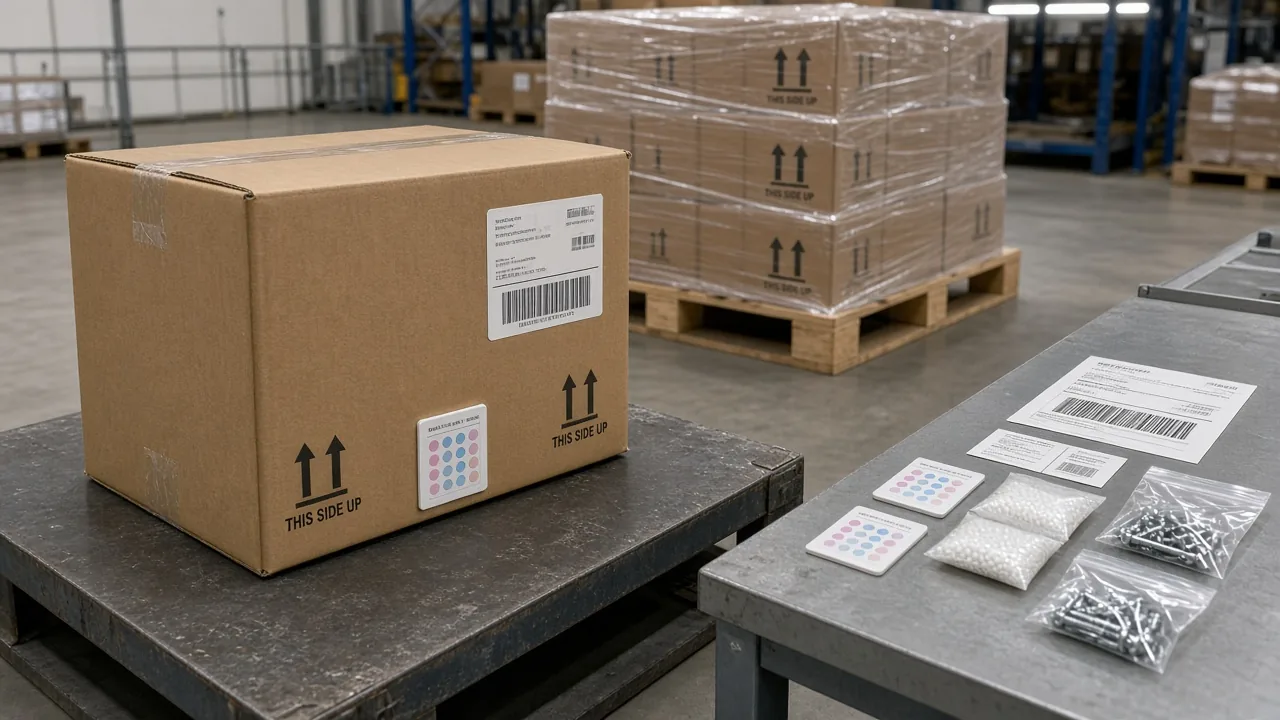
First-article packaging package
A useful first-article pack set for wire basket packaging includes: contact map drawing; pack-out photos from four angles plus open nest; barrier BOM with thicknesses; carton drawing with ECT/BCT callouts; desiccant and liner photos; label and barcode scan proof; kit laydown photo; drop/compression report summary; and signed DEF ID checklist. Missing pieces become negotiations after the first DC chargeback—when leverage is gone.
What not to copy from capability pages
Do not paste “export standard packing” or “anti-scratch packing included” into a wire basket packaging PO without the contact map, carton grade, and protocol name. Capability pages optimize trust. RFQs optimize dispute survival. Keep marketing soft claims aligned to the frozen annex, or force marketing to soften until evidence exists.
Channel differences: retail parcel vs master carton export
Retail parcel packs for a single wire organizer face corner drops, conveyor impacts, and compression under other parcels. Master cartons for B2B wire basket packaging face fork handling, container stack, and long humidity cycles. Do not reuse one drop height for both. Name the channel on the RFQ line and attach the matching protocol annex.
E-commerce returns often start with a “scratched” photo of a rim that nested without a sleeve. Retail intake failures often start with a barcode that will not scan. Both are packaging defects. Train merchandising and QA to open NCRs with DEF IDs so engineering does not chase plating baths for a kitting error.
How this catalog sits beside manufacturing CTQs
Wire diameter, weld maps, DFT, and edge safety remain mandatory. Wire basket packaging does not replace them. It sits after cure and cool-down as its own subsystem with its own owners on the packing line. A complete inspection flow runs geometry and welds, finish, then packaging CTQs before the carton is sealed and labeled.
When CAPA starts, ask whether the failure is barrier skip, carton crush, damp pack, unit-load strap damage, or true finish under-spec. Wrong root-cause coding wastes months. DEF-01 through DEF-10 exist so the first nonconformance report already points at the packaging subsystem.
Sample gates that prove pack-out before mass production
At concept sample, show a proposed nest and barriers even if the carton is temporary. At engineering sample, freeze the contact map and run a short vibration or truck proxy if full lab time is not booked yet. At PPS, lock the production carton, labels, kits, desiccant, and the named transit sequence. Mass production without a PPS pack freeze is how “factory standard” quietly returns.
Photograph every gate with the same lighting and node callouts. Compare PPS photos to the first three production lots. Drift in sleeve count or board stamp is a packaging change even when the basket drawing is untouched. Treat that drift as change control, not as a packing-line preference.
Cost myths that create export defects
Myth one: thicker powder fixes rub marks. It does not if metal still grinds metal for three weeks at sea. Myth two: any ECT stamp is “export grade.” Stack height and humidity decide whether that stamp is enough. Myth three: desiccant is optional if the coating passed salt spray. Salt spray on a hanging panel is not a wet carton microclimate.
Myth four: labels are “operations,” not quality. Wrong SKU intake is a quality event with chargebacks. Myth five: nesting always lowers landed cost. Nesting without barriers raises returns enough to erase CBM savings. Good wire basket packaging accounting includes damage, DC rework, and reverse logistics—not only FOB and ocean freight.
Inspector cues that do not need a full lab
On the dock, inspectors can still catch most DEF classes without ASTM equipment. Open the carton. Check barriers at mapped nodes. Rattle-test immobilization. Read the board stamp against the PO. Confirm desiccant presence and dry feel. Scan the barcode. Count hardware bags. Photograph anything borderline. Escalate to lab compression or a full distribution sequence when the pack revision is new or when crush patterns repeat.
Keep a golden carton from PPS sealed in the QC cage. When a production carton “looks the same,” open both side by side. Visual memory fails under schedule pressure. Side-by-side packs make missing EPE obvious in seconds.
Private-label and multi-factory programs
If two factories quote the same basket drawing, they will not invent the same wire basket packaging unless you freeze it. Dual source without a shared pack annex creates two abrasion behaviors and two label layouts. Require both plants to ship against the same contact map, carton grade, kit BOM, and protocol name. First-article each plant’s pack, not only each plant’s weld coupon.
When a second plant proposes a cheaper nest, run the cost through returns risk. Approve only after barriers and transit validation match the frozen pass criteria. Price is not a packaging specification.
Writing the NCR so suppliers cannot redefine the defect
Lead with the DEF ID, the frozen CTQ clause, the photo of the node or label, the sample size, and the disposition. Avoid adjectives alone—“poor packing” invites a polite disagreement. “DEF-02: metal-to-metal at rim node R2; barrier BOM line EPE-3 missing in 4/5 cartons; Major; rework not allowed after ocean transit” ends the argument shape.
Attach the PPS photo that showed the barrier present. Suppliers sometimes claim the buyer never required sleeves. The annex and the photo close that loop. Keep the same ID language in Chinese and English work instructions on the packing line so the team that bags the basket uses the same names as the team that writes the NCR.
FAQ: Wire Basket Packaging Export Specs
Is packaging really separate from coating quality?
Yes in inspection ownership, no in field physics. Rub marks from nesting are packaging defects that become coating failures later. Score the root cause correctly so CAPA hits separators and immobilization, not only pretreatment baths.
How many times should the phrase wire basket packaging appear in our internal SOP?
Enough that every form—RFQ, PPS, IQC, NCR—uses the same subsystem name. Teams that only write “packing” in one cell of a manufacturing checklist lose the CTQs that belong uniquely to wire basket packaging: contact maps, ECT, desiccant grams, and kit identity.
Do we need full ISTA certification for every SKU?
Not always. Many importers require a named protocol and a passing report on the golden pack, then control change. Certification vs. internal validation is a commercial choice. What you must not do is ship on undefined “drop OK” emails.
Can nesting ratio increase after PPS?
Only with change control, new barriers if contact classes change, and a fresh transit validation. Cube gains that recreate DEF-01 are not savings.
Where do bathroom vs kitchen wire goods differ in pack?
Bathroom SKUs usually need stricter abrasion-to-rust and moisture rules. Kitchen chrome may prioritize scratch visibility and hard-point puncture. The ten DEF IDs still apply; severity and desiccant defaults shift with environment and channel.
Who owns label artwork errors?
Treat them as packaging system defects on the finished carton. Root cause may be buyer artwork, factory print, or scan process—but disposition on the dock follows DEF-08 so intake does not guess.
Send Your Wire Basket Packaging Spec for Review
If you are freezing pack-out for a new wire basket, shower caddy, dish rack, or under-sink organizer program, bring the contact map, carton grade, lane moisture rules, drop protocol name, and label/kit BOM—not only a product drawing. Clear wire basket packaging CTQs shorten sample cycles and cut “scratched out of box” arguments before the first container sails.
Share drawings, pack-out photos, and labeled defect masters via our contact page or email simon@koitorhardware.com. We can help you turn the ten export defects above into a supplier-ready acceptance sheet before the next production release.
Koitor Hardware — Jiangmen, China. Wire bathroom and kitchen storage programs for importers and OEM buyers who want inspectable packaging language, not vague “factory pack” promises.
OEM / PRIVATE LABEL
Turn this sourcing guide into a product brief
Share your target product, size, finish, order quantity and packaging requirements. Your team receives a practical manufacturability review before quotation.



 English
 Español
 Português
 Français
 Deutsch
 العربية