
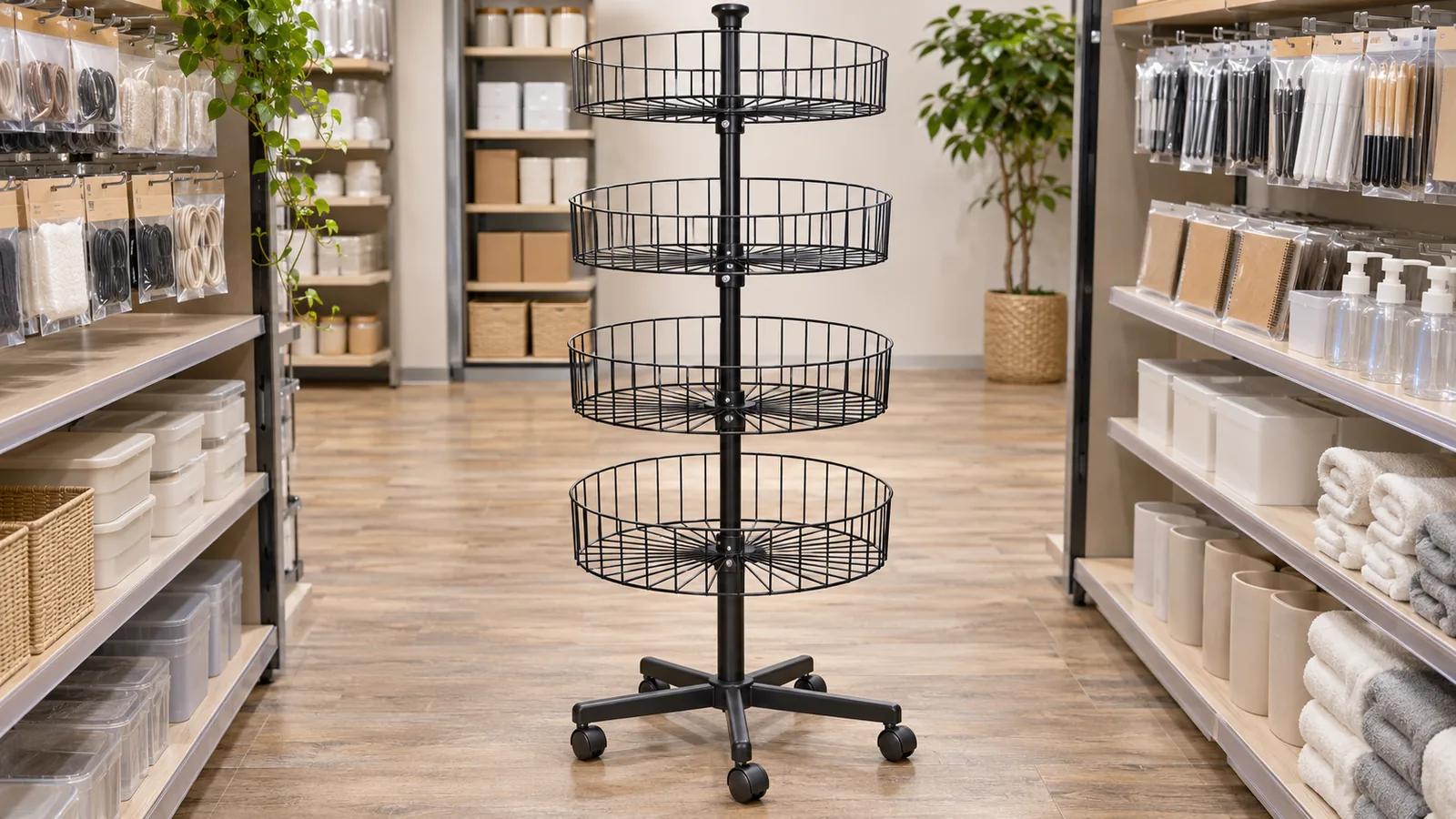
A buyer comparing a wire spinner display rack should identify what actually rotates before comparing hook counts or overall footprint. Some fixtures have independently moving tiers; some may move as one assembly; and catalogs can use broad rotation language that does not settle which subassemblies move. The buyer should request a model-specific drawing or demonstration, name the retention hardware and review the rack with the intended packages installed.
This guide is for housewares importers, retail merchandising buyers, brand owners, and fixture distributors sourcing a passive wire display for hanging packaged goods. It is a procurement and sample-approval framework, not a design specification for a bearing or a stability test. The article does not claim that Koitor currently manufactures spinner fixtures. Any spring, bushing, bearing, pin, clamp or other purchased moving part remains within the responsible supplier’s scope unless a verified agreement states otherwise. For buyers assessing wire spinner display rack, the controlling record is the approved configuration, supporting evidence, and named approval owner.
Define the Motion Before Counting Hooks
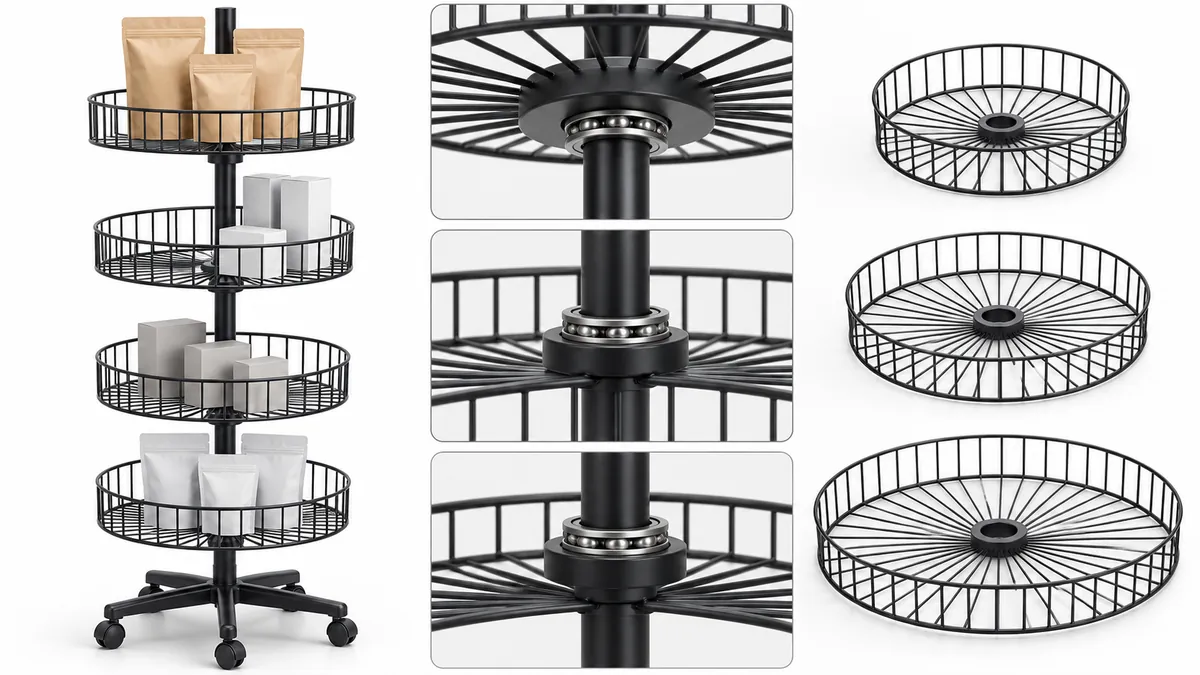
Ask the supplier to show which parts remain stationary and which parts move. The base, center post, tiers, hooks, retaining pins and merchandise may have different relationships. A buyer should describe whether each tier is expected to rotate independently, whether a set of tiers is linked, or whether the whole fixture turns on another interface. If the product page does not make this clear, request a drawing, video or sample demonstration for the exact model.
Manufacturer product descriptions document multiple actual configuration choices. Marvolus describes wire peg displays with independently rotating tiers and identifies tier positioning retained by a cotter pin or clamp in certain configurations. Estella describes a floor spinner with independently rotating, height-adjustable tiers and a different set of product-specific details. These sources establish that motion and retention can be explicit assortment choices; they do not mean that every rack combines all features or uses the same mechanism. Review the makers’ wire peg hook spinner range and floor spinner stand example only for their named products and current information.
A sourcing brief can make the motion requirement concrete:
- Identify the supplier model and revision under quotation.
- Label the base, post and each tier in a reference drawing.
- State which tier or group of tiers should move.
- State whether tiers are intended to be positioned at different heights.
- Ask the supplier to identify the retention part for each adjustable position.
- Describe the intended loaded and partly replenished states.
- Name the reference packages and how they hang from the hooks.
- Record whether the buyer needs to rotate a tier, the whole rack, or both.
- Identify which details remain subject to the supplier’s technical confirmation.
Avoid replacing these specifics with “360-degree rotation” or “spins smoothly” unless the supplier defines the reference and scope. The phrase can describe an overall product impression without explaining which part rotates, whether tiers move independently, or how they remain at a selected height. A retail buyer needs an arrangement that can be replenished and merchandised as intended, and the distributor needs a product description that corresponds to the supplied fixture.
Name the Height-Retention Method and Its Owner
If tiers can be repositioned vertically, ask how the selected position is retained on the quoted model. A cotter pin, clamp, collar or other mechanism may be shown in a supplier’s particular product line. The buyer should use the actual supplied part and supplier terminology, not assume one retention architecture applies across all models.
The retaining part is relevant to the BOM, assembly instructions, replacement inventory and sample review. Ask whether it is captive, loose, purchased separately, included in every unit, or fitted by the supplier. Ask for its model or component reference and confirm whether the instructions show how the buyer or store operator interacts with it. If the tier height is fixed at production, record that instead of suggesting store adjustment.
A sample review can document:
- The selected tier heights and the model-specific references.
- Which part retains each tier position.
- Whether the retention hardware is present in the sample kit.
- Who installs or adjusts it, according to current instructions.
- Whether adjacent tiers can be configured differently, if the supplier claims they can.
- Whether repositioning is a supplier setup or a buyer/store operation.
- Which model or revision would require a different part.
Do not set a universal clamp force, pin size, play allowance or adjustment-cycle count. The research pack contains no such standard, and product mechanisms differ. If the buyer needs a quantitative acceptance limit, the responsible fixture supplier should define a justified criterion and the method. The buyer’s record should make the supplier’s evidence findable and prevent an observed sample from becoming a claim about all configurations.
Retaining hardware also creates a change-control question. A revised clamp or pin may alter tier positioning, installation steps or replacement needs. When a supplier substitutes a component, ask whether the existing drawings and sample approval still apply. Preserve the changed component reference and the supplier’s response. If the buyer sells spare parts, ensure the replacement component maps to the exact fixture family and revision.
Use the Actual Merchandise to Review the Occupied Sweep
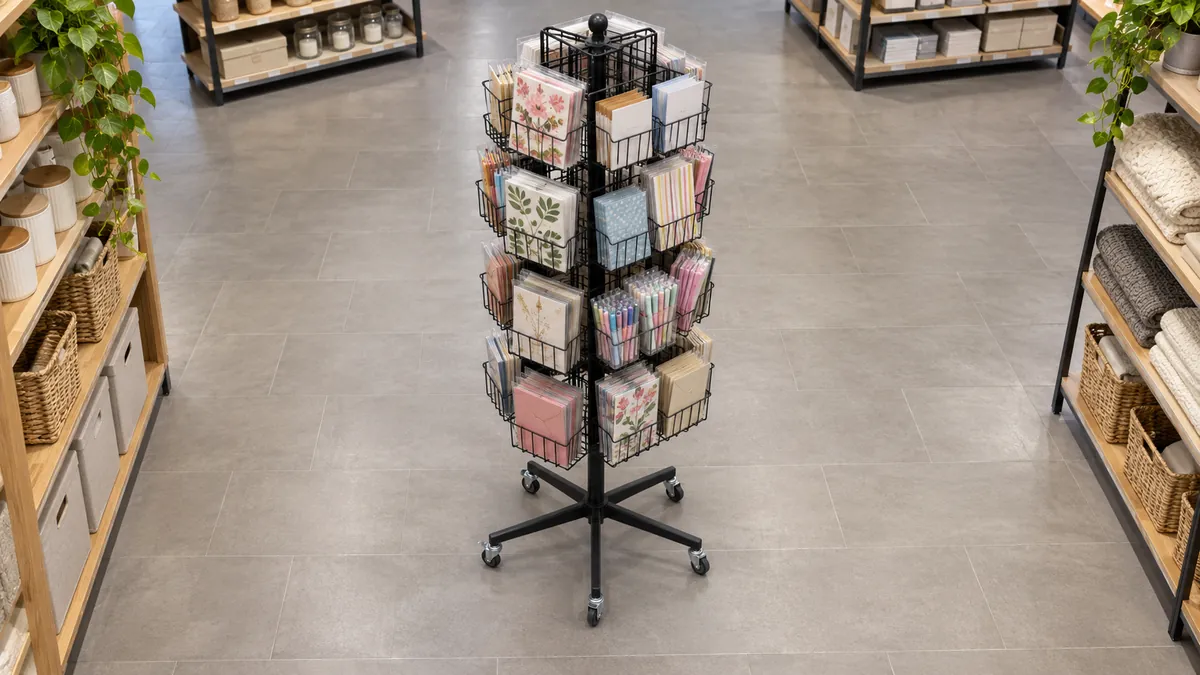
An empty fixture shows the base and static footprint, but not how a tier behaves when packages project from hooks. Product width, thickness, hanging-hole position and orientation affect the space occupied around the post. The buyer should therefore nominate the merchandise that represents the intended assortment and review it in the intended hook arrangement.
The reference package record can include:
- Brand or buyer SKU, sample identifier and revision.
- Package width and thickness from controlled product data.
- Hanging-hole type and position.
- Which face will point toward the aisle.
- Whether a hook passes through one pack or a group of packs.
- The number and orientation of items placed on each selected hook.
- Any display variation, such as a larger package mixed with smaller ones.
- Whether the rack is being reviewed full, partly replenished or with one item removed.
This is not a packaging-drop or retail safety test. It is an interface review. The package sample helps the supplier and buyer understand how merchandise projects, where adjacent items may approach, and how a shopper or staff member is expected to access it. The buyer should not interpret a photograph of sample goods as evidence that every package will clear every tier.
When tiers rotate independently, adjacent tiers may be at different heights. That may create new overlaps or clearances compared with a uniform arrangement. The buyer can agree on a representative range of heights and package combinations with the supplier, then record which states were actually reviewed. Do not assume all possible height combinations were covered by a single sample.
A sweep review should include the space occupied during the supplier-demonstrated motion, not only the rest position. Place the rack in the proposed aisle or fixture area if the project provides that context. Include nearby shelves or displays only when they are represented accurately. If the complete store layout is not available, mark the review as a component-level exercise and leave final floor-plan clearance to the retailer’s responsible party.
Separate Empty Rotation From Loaded Observations
A tier turning when empty is only one observation. It does not establish that the tier moves in the same way with the nominated merchandise, that the package arrangement is acceptable, or that the entire fixture is stable. Keep the observations distinct and ask the supplier to define any performance assessment it offers.
The buyer and supplier can describe the sample review without inventing thresholds:
- Identify the fixture, revision and assembled state.
- Verify the intended tier movement against the current drawing or instructions.
- Confirm the retention parts and selected positions shown on the sample.
- Install only the nominated packages in the agreed orientation.
- Ask the supplier to demonstrate the intended tier motion using its approved method.
- Record visible contact, interference, unintended movement or access questions for supplier resolution.
- Identify whether the sample was empty, partly loaded or in another supplier-defined state.
- List what the review did not examine, such as load limits, tip resistance, bearing life or safety compliance.
This is a documentation sequence, not an operational instruction for an unqualified user to load or manipulate a fixture. The supplier should define a safe procedure and own any mechanical performance claims. If a sample moves unexpectedly or seems incomplete, stop the review and request the supplier’s direction. Do not force a tier, remove a pin, or add weight to see what happens.
A merchandising buyer may want proof of a particular retail outcome, but a catalog statement about rotation cannot establish sales lift, shopper behavior or loss prevention. Avoid describing a fixture as “boosting sales” or “preventing products from falling” unless the claim has specific evidence and the responsible supplier approves its scope. The research pack explicitly excludes load, no-falling and sales-benefit language from generalization.
| Review state | Configuration to identify | Buyer record |
|---|---|---|
| Empty fixture | Supplier-approved assembled unit | Parts, model, revision and visible motion |
| Selected tier positions | Each tier and its retention part | Height arrangement and supplier instruction |
| Reference merchandise installed | Named package samples and hook positions | Occupied envelope and observed contact |
| Partly replenished display | Agreed representative tier/package state | What changed and what was reviewed |
| Store context | Actual nearby fixture only if represented | Review boundary and remaining retailer checks |
Check Hook Projection, Package Depth, and Tier Spacing
A hook count can be identical across two racks while the usable display geometry differs. Buyers should compare the hook’s usable projection, package depth and adjacent-tier arrangement using the nominated goods. Ask the supplier which measurements define the available display position and whether those measurements correspond to the actual package sample.
A drawing can help buyers compare quotes. It should identify the post, tier position, hook direction, package reference, and any fixed or adjustable geometry that the supplier considers relevant. Keep the drawing revision with the sample. A rendered image or a generic product photo may not show all relevant projections or clearances. Do not derive a precise dimension from perspective.
Useful questions include:
- Does the nominated package hang through its intended hole without forced deformation?
- Does the supplier define a maximum package thickness for this configuration?
- Does package orientation change the expected tier sweep?
- Do adjacent hooks or packages overlap in the reviewed arrangement?
- Does a different tier height change access to or contact with the merchandise?
- Which tier positions are fixed and which are buyer-adjustable?
- Are the hooks supplied as part of the rack or as separate purchased parts?
- Does the supplier offer replacement hooks, pins or clamps for the exact model?
If a package family has multiple sizes, do not approve the entire family based on the smallest sample. Nominate a representative assortment that covers the relevant extremes or ask the supplier to state what it has reviewed. The supplier should explain any limitations. The buyer should not invent a universal “maximum package” rule absent from the product specification.
Packaging change control is also relevant. A new blister, header card, bag or folded package can alter the hang-hole location or thickness. A product that fit the previous package might present differently after a packaging revision. Define which changes require a new fixture review and link that decision to the buyer SKU.
Coordinate Components and Supplier Responsibilities
Wire tiers, central posts, bases, hooks, retention hardware and purchased rotational parts may come from different sources. A buyer should identify who provides each part and who approves the assembled fixture. Koitor’s confirmed metalworking knowledge includes wire and sheet forming, bending, welding, finishing, assembly and drawing/sample review. It does not verify a current spinner-fixture product, bearing or bushing manufacture, retail-fixture stability engineering, or test certification.
A responsibility record can separate:
| Component or claim | Supplier to identify | Buyer evidence |
|---|---|---|
| Wire tier, hook and post | Metal fabricator or fixture supplier | Drawing, material and finish references as documented |
| Rotation interface | Specialist mechanism supplier or fixture maker | Exact part identity and supplier-supported operation |
| Height retention | Supplier of pin, clamp or other part | BOM, instructions and replacement reference |
| Base and complete assembled fixture | Fixture designer/manufacturer | Assembly drawing and any applicable system evidence |
| Merchandise fit | Buyer and fixture supplier | Nominated packages and observed configuration |
| Retail layout | Retailer/project owner | Site context and aisle review boundary |
| Product claims | Brand owner and responsible suppliers | Claim-to-evidence record and exact model mapping |
This matrix does not transfer responsibility automatically; project parties must agree the owner. It keeps an importer from attributing a specialist mechanism to a metal fabricator simply because that supplier ships the complete carton. If a buyer asks Koitor to quote an adjacent fixture, provide a drawing, reference merchandise and purchased-part scope. Koitor should first assess whether the request fits its verified capabilities rather than promising a complete spinner system.
Keep purchased parts traceable. If a bearing, bush, clamp or pin is not made by the fixture fabricator, record the source and substitution rules. Ask whether replacement components can be identified by part reference and whether they remain compatible with the assembled revision. The buyer should not assume that two parts with the same general description are interchangeable.
Build the Assortment Record and Reapproval Triggers
A controlled SKU file should let purchasing, merchandising, warehouse and support teams identify the same fixture configuration. Record the model and revision; number the tiers; identify stationary and moving parts; map each retention component; state the approved merchandise references; and link the sample photos and drawings. If the fixture ships flat-packed or requires assembly, record the supplier’s current instructions and included hardware.
The file can also note what has not been approved. For example, a sample may have demonstrated tier motion with no packages but not with the planned goods. A set of packages may have been reviewed on one tier only. A retailer’s final aisle layout may not yet exist. These are useful limits, not reasons to invent an approval. The buyer can then hold the relevant claim or order decision until the right evidence is available.
Common reapproval triggers include a changed tier count, hook projection, retention part, post, base, rotational interface, finish, package dimension, hang-hole position or intended loaded arrangement. Ask the supplier which changes require new review. Capture the supplier’s answer and update images, product copy, BOM and replacement-parts records together.
For a multi-SKU assortment, build a matrix rather than a single general description. A different tier number or height arrangement can create a distinct configuration. If two models share a component, the supplier must confirm that interchangeability. A shared profile or color is not evidence that the moving parts are the same.
The buyer can use the matrix to compare quotations that advertise the same number of hooks. A quote may differ in independent movement, height retention, supplied components, base style, package compatibility or included assembly. The decision should account for those differences. A lower price does not establish equal scope, and a larger hook count does not establish suitability for the nominated goods.
Preserve the approved sample as a configuration reference
A single sample can help align the buyer, fabricator and mechanism supplier, but it should be labeled with the model, revision and assembled components. Store the sample photos with a drawing that identifies each tier and retention part. If the fixture is dismantled after review, keep the loose pins, clamps or bought-in rotation parts associated with that same sample record. A photograph without the model reference may later be mistaken for a different variant that shares the same wire finish or general shape.
If the buyer compares two suppliers, write down the setup used for each sample. One supplier may demonstrate independent movement on every tier while another may rotate the complete post assembly. Both could be described informally as a spinner, yet they present different replenishment and configuration questions. The comparison should show what moved, what stayed fixed, which sample packages were installed and which review conditions were omitted. This does not rank one architecture as universally superior; it gives the category manager a fair basis for choosing the one that fits the planned assortment.
Before approving product photography or a digital listing, compare the pictured tier arrangement with the selected SKU. Remove any mockup that shows an unquoted hook, different base, or unsupported package configuration. The sales team can then describe the actual fixture consistently across the carton, catalog and replacement-part record.
Buyer Questions Before Ordering
Does “rotates” mean that every tier rotates independently? Not necessarily. Ask the supplier to identify moving subassemblies for the exact model.
Does an adjustable tier use the same retention part on every rack? No. The manufacturer examples show model-specific choices. Confirm the actual supplied pin, clamp or other part.
Does empty rotation prove the fixture will work with merchandise installed? No. Empty and occupied states are different observations; any performance criteria must come from the responsible supplier.
Can a hook count alone compare two quotations? No. Motion, retention, package geometry, component scope and the loaded sweep can differ even at the same count.
Does a retail spinner guarantee increased sales or prevent falling merchandise? No. Those are outcome and performance claims requiring evidence beyond the existence of a rotating display.
Can a Koitor metalworking capability statement be treated as proof of spinner production? No. Current spinner-fixture and rotation-mechanism capabilities are unconfirmed. Assess the drawing and purchased-part scope before any commitment.
A Motion-and-Merchandise Approval Sheet
Before ordering, label every tier and state which one moves, ask how positions are retained, nominate the actual packages and review the occupied sweep with the supplier’s approved method. Capture empty and loaded observations separately, document the fixture model and revision, and state what the review did not assess. Keep the base, post, wire, hooks, rotation parts and retail layout in their proper responsibility scopes. Reopen the review when merchandise or fixture components change.
This wire spinner display rack worksheet helps a distributor make a like-for-like purchasing decision and keep product listings tied to the configuration reviewed. It does not promise stability, load capacity, bearing life or sales results. Buyers sourcing related wire baskets and storage hardware can compare the distinct containment questions in Koitor’s wire display basket specification guide. For a broader metal-storage sourcing discussion, see Koitor’s OEM home-storage hardware information, or share a controlled drawing and merchandise sample through the contact page to determine whether the request fits confirmed production scope.
Work With Koitor Hardware
Discuss an Adjacent Metal Hardware Scope
Koitor’s confirmed focus is bathroom and home-storage metal hardware. For an adjacent product, share a controlled drawing, representative sample and any bought-in component scope so the team can assess whether the request fits its confirmed capabilities. This review does not imply that the complete product is currently manufactured.
OEM / PRIVATE LABEL
Turn this sourcing guide into a product brief
Share your target product, size, finish, order quantity and packaging requirements. Your team receives a practical manufacturability review before quotation.
 English
 Español
 Português
 Français
 Deutsch
 العربية