

Buyer Decision and Project Scope The buyer should document hotel luggage rack replacement straps as a named requirement.
Buyer Decision and Project Scope
Short answer: approve the replacement strap program with the rack, not as a loose spare
For hotel luggage rack replacement straps, hospitality buyers should decide at the original rack RFQ whether the support straps are fixed or intentionally replaceable, then record the exact rack model, frame revision, strap construction, attachment method, and spare-part identity. A replacement strap should be evaluated on the approved metal frame and matched to the intended installation method. A strap that looks similar may not fit the same frame or attachment, and a fit check does not establish a load rating or long-term durability. This guide covers buyer specification and service-part planning; it does not claim that replaceable straps always lower cost, extend product life, or meet a legal repair obligation.
Hotel supply listings illustrate why the distinction matters. One hospitality supplier offers strap sets for selected stand models while excluding a fixed-strap model, and another tells buyers to confirm the webbing attachment and replacement arrangement with the supplier. Those are product-specific examples, not evidence that every hotel rack uses interchangeable straps or that Koitor manufactures luggage racks or textile parts. The buyer’s task is to decide which architecture suits the program and capture the evidence before ordering.
What decision should the buyer make before the first RFQ?
The first decision is not “how many spare straps should we buy?” It is “what does replaceable mean for this rack, and who owns compatibility?” A rack may use permanently fixed straps, straps that loop around a frame member, stitched sleeves, detachable fasteners, or another attachment. The construction determines whether a strap can be changed without disassembling the frame, which tools or instructions are needed, and whether the buyer can identify a replacement part later.
A fixed construction can be appropriate when the buyer wants a single finished rack and no service-part program. It may also be simpler for the supplier to assemble. A releasable construction may support a planned replacement kit or allow the buyer to specify a strap variant, but it adds interfaces, parts, identification, assembly steps, and documentation. Neither choice is automatically superior. The decision depends on the intended hospitality assortment, maintenance expectations, purchasing model, supplier responsibilities, and the evidence the buyer is prepared to manage.
Make the choice before the frame drawing, packaging artwork, and spare-part catalog are frozen. A buyer who asks for replaceability only after production may discover that the frame has no accessible attachment, that a strap must be cut to remove it, or that a substitute strap changes the way it contacts the frame. Conversely, adding a detachable fastener to a product without a clear service requirement may add cost and complexity without helping the hotel or distributor.
Define the intended service boundary. Is the buyer replacing only a textile strap, or is the “strap set” a kit that includes loops, screws, buttons, end fittings, or other purchased components? Does the buyer expect hotel staff to replace it, a maintenance contractor, a distributor, or the original supplier? Who will provide instructions and confirm the replacement is suitable for a specific rack revision? These are program decisions, not assumptions that should be left to a retail photograph.
A practical RFQ line could say: “Quote rack model LR-01, drawing revision B, with removable strap assembly S-01. Identify the strap supplier and all attachment components. Confirm the frame contact geometry and provide one replacement set for paired sample review. Do not claim compatibility with other rack models unless separately listed.” The language is deliberately specific; it does not invent a universal interface or performance level.
How do fixed and replaceable strap architectures differ?
In a fixed design, the strap is attached during assembly in a way that is not intended for routine removal. The ends may be sewn, wrapped, riveted, trapped, or otherwise captured by a construction the buyer must understand. If the strap wears or is damaged, the rack may require a repair route, return to the supplier, replacement of a larger assembly, or retirement. The buyer should not assume a fixed strap can be safely cut off and replaced locally.
In a replaceable design, the strap has a defined release and reattachment method. That method may use a loop over a crossbar, a slot, a button, a screw, a pin, a buckle, or a kit-specific feature. Identify the exact interface and the parts required to operate it. A product that can be removed during assembly is not necessarily intended as a field-replaceable spare; those are separate requirements.
A replaceable attachment must also be protected against the types of unintended movement relevant to the design. A buyer can ask how the end is retained, what prevents the strap from slipping along the frame, and whether the attachment can be inspected after assembly. The question should be answered by the design owner with drawings and sample evidence. Do not invent a retention strength, failure mode, or cycling result. A visual examination alone cannot prove how the strap behaves over time.
The metal frame and textile component have different suppliers and process controls. Koitor’s approved manufacturing facts cover metal forming, joining, finish, basic assembly, and sample development, but they do not confirm textile or leather production, luggage rack production, webbing fasteners, or a spare-parts service. If an importer sources webbing or leather from another supplier, name that party and define the supplied condition: material, color, width, thickness where relevant, stitching, edge treatment, and any buyer-required documents. Do not suggest that the metal frame manufacturer controls a purchased textile characteristic unless the project assigns that responsibility.
A design can combine a metal frame with bought-in straps, end fittings, protective sleeves, and fasteners. Each mating boundary should be visible in the drawing and bill of materials. If the strap is threaded through a narrow opening, the frame opening, strap thickness, finished edge, stitch bulk, and installation route all matter. If the strap wraps a tube, the tube diameter, wrap length, fastener position, and usable surface can matter. These are examples of questions for the actual design; they are not a recommendation to copy another supplier’s proprietary button or attachment layout.
Which model and frame information should the replacement set identify?
Give the rack a stable model identifier and revision. Record whether a new drawing revision changes the frame member, strap spacing, attachment location, end shape, finish, or assembly sequence. If rack variants share a base frame but differ in width or strap count, define whether one replacement set can serve all variants or whether separate SKUs are required. Never rely only on a product family name if the physical interface changes between sizes.
For the metal frame, identify the member contacted by the strap: its location, shape, section, and relevant dimensions on the controlled drawing. For the strap, identify its own SKU or set number, length and width as specified by the buyer, material or material family as agreed, color reference, end construction, stitch or termination details, and any accessory hardware. The details should be proportionate to the product. A catalog description such as “black strap” cannot uniquely identify a future replacement.
The compatible-model list is a controlled statement. If the buyer has two rack models, list both and state whether they use the same set. If the rack is revised, make a compatibility decision rather than automatically carrying the old spare number forward. A replacement part should not be sold as interchangeable merely because it has the same color or nominal width. End-loop dimensions, fastener placement, frame contact, and installation route may differ.
A buyer can maintain an identification table:
| Record field | What to identify | Why the buyer needs it |
|---|---|---|
| Rack identity | Model, size, frame revision, market or program code | Prevents a generic spare from being assigned to the wrong rack |
| Strap identity | Set SKU, color reference, material source, end construction | Defines what is being replenished |
| Interface | Frame member, attachment method, contact region, required hardware | Describes how the replacement fits |
| Kit scope | Strap count and any fasteners or tools included | Prevents missing components at service time |
| Compatibility | Rack models and revisions reviewed with the sample | Limits claims to evaluated configurations |
| Change trigger | Frame, strap, supplier, material, or attachment change | Prompts an impact review before reorder |
| Evidence | Drawing, sample number, reviewer, date, disposition | Links the commercial SKU to the approved configuration |
The table is an organizing tool, not a test standard. The buyer should tailor it to the rack program and store the controlling records in a way distributors and service teams can retrieve.
| Buyer input | Record before approval |
|---|---|
| Named product or component | Exact model, code, and revision |
| Interface or project condition | Reference sample, drawing, or site input |
| Evidence and owner | Source, reviewer, and unresolved questions |
| Release status | Approved scope and excluded claims |
Product Fit and Specification
How should the buyer approve the frame-to-strap interface?
Start with a production-intent rack or an explicitly controlled sample. Record the frame revision, strap set revision, component source, and assembly condition. If the first sample uses a temporary strap or a hand-made prototype, document which dimensions and processes are not representative. A prototype can help discuss layout; it does not prove a production-ready assembly.
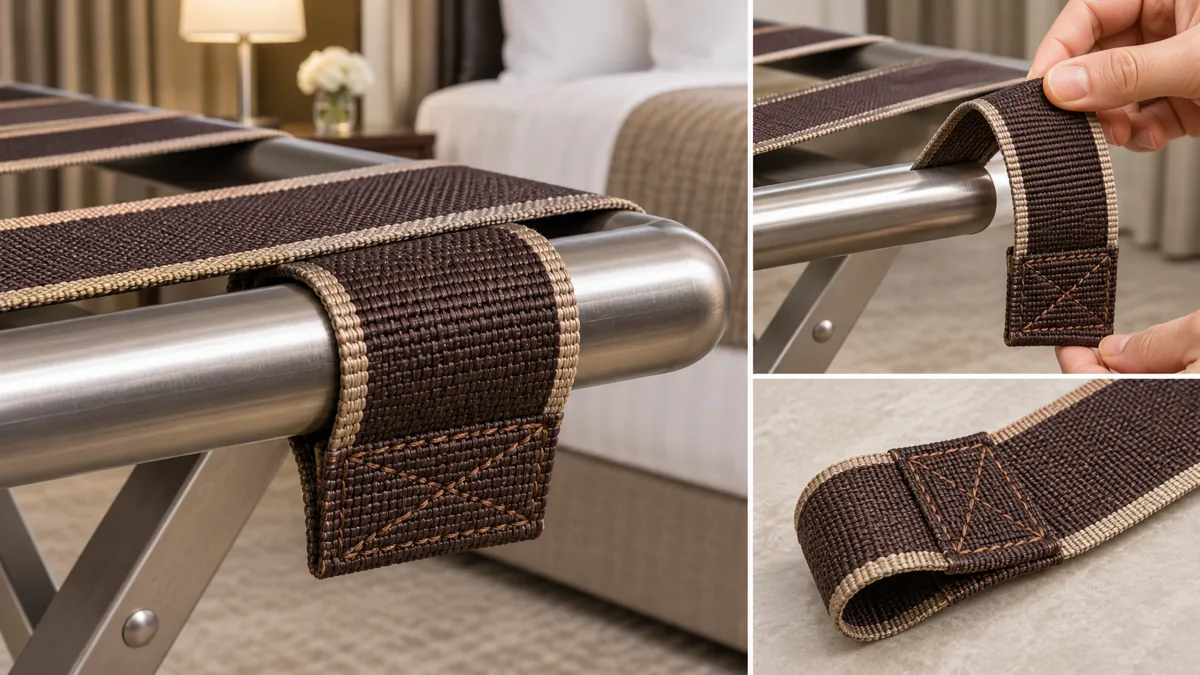
Inspect the interface as a paired system. Confirm that the strap can be installed and removed by the stated method without cutting or damaging a component that is meant to be reused. Verify that the installed strap lies in the intended location and does not twist or bunch in a way that changes contact or appearance. Check whether a seam, fastener, or folded end bears against a metal edge. Review all intended attachment points rather than only the easiest one to access.
If the rack folds, inspect the strap in the relevant folded and open positions, because the surrounding frame geometry may change. Coordinate this with the rack’s actual use instructions. Do not assume that the approved strap arrangement remains clear of a hinge, latch, or cross-member through movement. The buyer should check those interfaces with the final frame and record any restriction.
After removing and reinstalling the replacement set, document what changed. Did the strap return to the same location? Were any fasteners lost or deformed? Was a special tool required? Did the attachment method need to be clarified? A service test should follow the actual intended instructions and should not be improvised into a claim about durability. If repeat replacement is expected, define a repeatability or cycle evaluation with the responsible product engineer and a written acceptance method.
The approval record should include photographs of the attachment before and after installation, the drawing reference, exact rack and strap identifiers, installation steps, any tools used, observable fit issues, and a decision by the buyer. If the strap’s material supplier is separate, record the batch or source information needed for the buyer’s traceability and incoming inspection process. If the buyer accepts a deviation, write down which rack revisions and replacement lots it covers.
Do not treat a fit check as a load test. A strap can attach to the frame and still require evaluation for intended support, movement, wear, or misuse. A sample review cannot establish a maximum load unless an appropriate method, representative assembly, acceptance criteria, and evidence have been defined. The buyer should refer to the separate load-rating evidence for luggage racks where a rating claim is part of the product program.
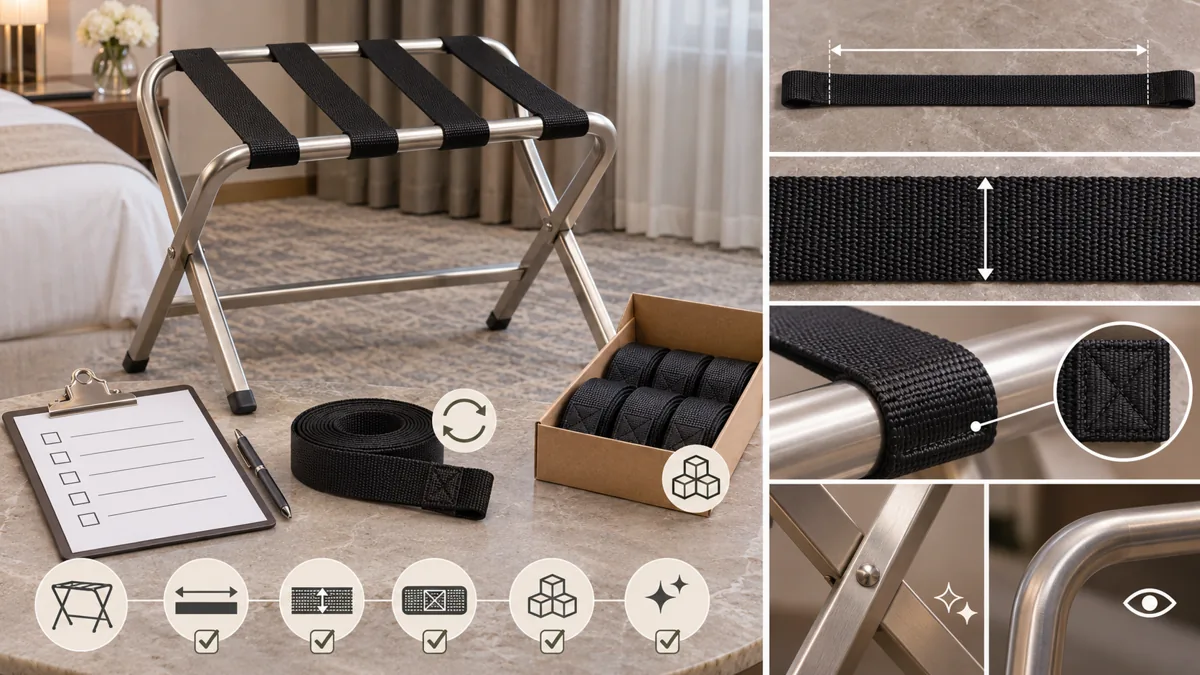
Buyer checks for hotel luggage rack replacement straps
How should a buyer build a spare-part program?
First decide whether a spare strap set will be sold, supplied under warranty, stored as hotel maintenance stock, or made available only through a distributor or service channel. These routes have different packaging and record needs. Avoid promising availability or future service unless the responsible supplier has agreed to support it.
Set a kit bill of materials. State the number of straps per rack, whether left and right components differ, whether any fastener is single-use, whether tools are included, and what the buyer expects the kit to contain. Use a drawing or parts list that links each component to the rack model and revision. If the attachment is directional, label orientation in both the instructions and packaging.
Plan the SKU data alongside the first rack. A spare-part record could include the replacement SKU, compatible rack models and revisions, component source, pack quantity, label text, barcode identifier assigned by the buyer, and a last-reviewed date. A buyer can decide whether packaging should show a diagram, installation steps, or a contact route. Do not print a broad “fits all” claim where only specific models are approved.
Think through spare inventory and discontinuation. If a textile supplier changes its construction or stops supplying a color, the buyer may need a new sample and revised compatibility statement. If the rack frame changes while old stock remains, define whether both frame revisions use the same strap set. If a variant is discontinued, retain enough product data to distinguish its spare needs from current models. These are inventory-control choices; the article does not claim that replacement straps necessarily reduce total cost.
Ask how the replacement kit will be protected in storage and transit. A strap can arrive damaged, creased, contaminated, or mixed with another SKU. Specify individual protection or bundling where the material and presentation require it, identify the part on the package, and check that labels remain legible. Do not claim any packaging method prevents all damage; choose a method based on the parts and the buyer’s distribution conditions.
The customer-facing instruction should explain how to identify the rack, what components are in the kit, how to remove the old strap if the buyer has authorized that procedure, and how to install the replacement. If the method involves fasteners or a tool, the buyer should specify it. Any safety instruction or use limitation belongs to the product owner and should be reviewed for the intended market.
What should the RFQ and purchase order control?
The RFQ should distinguish the rack from the strap and list each deliverable. Attach the current frame drawing, target strap specification, reference sample photographs, intended finish, quantity range, packaging concept, and any approved textile source. Mark critical-to-fit dimensions and state who is authorized to approve a deviation. Identify whether the supplier must quote fixed and replaceable alternatives or only one defined construction.
Ask the supplier to identify assumptions. Is the strap included in the metal frame quote or purchased separately? Are fasteners included? Is the sample made from production-intent material? Does the quotation include a replacement kit, an installation sheet, a sample review, or only the complete rack? Clear scope helps buyers compare quotes without assuming that a supplier has included an unlisted textile or service component.
The purchase order should reference the approved drawing and sample revision, not just a product name. State the accepted strap model, color, attachment, kit scope, and packaging identifier. Define what happens when a material, sub-supplier, seam, fastener, or frame revision changes. A supplier should notify the buyer and obtain a disposition for changes affecting a critical interface.
For repeat orders, compare the incoming rack and spare kit to the approved baseline. The inspection plan may check SKU identification, strap count, visible attachment construction, color against reference, and selected interface dimensions. The exact sample size and acceptance criteria belong to the buyer’s quality plan. Avoid saying that one visual check proves a hidden material property or guarantees future fit.
If the buyer is working with a metal hardware factory on a custom frame, share the textile interface early. Koitor can discuss confirmed metal manufacturing and drawing/sample coordination within its approved scope, but the buyer must verify whether the full luggage rack, strap, and spare program are currently supported. Textiles and any specialist fastening components should be assigned to a confirmed source. A preliminary feasibility exchange is not a production commitment or a load certification.
What common mistakes cause replacement-part confusion?
One common mistake is asking for a “replacement luggage rack strap” without identifying the rack. Spare listings can be model-specific. The buyer needs the rack model, frame revision, attachment style, strap set identifier, and kit contents. A generic phrase on an invoice may be insufficient for a hotel maintenance team to select the right part later.
Another mistake is assuming that a strap with similar width and color will fit. The end construction, total usable length, attachment point, seam location, and frame path may differ. If a strap loops around a tube, the completed loop and seam can affect installation. If a strap uses a button or fastener, the mating feature matters. Confirm the interface rather than matching the product photograph.
A third mistake is deciding on replaceability without deciding who performs replacement and how. A design that requires tools, disassembly, or a difficult sequence may not suit the service route the buyer has in mind. That is not necessarily a reason to reject the design; it is a reason to clarify the maintenance method, kit scope, and training or instructions.
Buyers also sometimes treat sample fit as proof of load or durability. It is not. A replacement sample can demonstrate whether a specific part can be installed on a specific frame. It cannot, on its own, confirm long-term wear, load rating, or behavior under every use condition. Keep those review paths separate.
Finally, a spare-part SKU may be created after the product is launched, when the relevant drawing has changed or the original sample is no longer available. Define the spare identifier and retain the approved reference at the initial program stage. If the original design uses fixed straps, do not imply that the rack can accept a replacement kit unless a compatible repair method has been designed and reviewed.
Sample Review and Change Control
What should hospitality buyers put on the approval checklist?
- Rack model, size, frame drawing revision, and intended market.
- Fixed or replaceable strap architecture and reason for the chosen design.
- Strap material source, color reference, width/length specification, end construction, and seam details as required.
- Frame contact location, attachment method, orientation, and any fasteners or tools.
- Number of straps per rack and complete replacement-kit contents.
- Exact rack models/revisions covered by the compatibility record.
- Production-intent paired sample and installation/removal instructions.
- Replacement demonstration and observations, separate from load/durability evidence.
- Owner for textile, metal frame, fasteners, labels, packaging, and service instructions.
- Buyer-assigned spare SKU, barcode, pack quantity, and model-fit wording.
- Packaging protection and incoming identification requirements.
- Change triggers for frame, strap supplier, material, seam, attachment, or instructions.
- Records that must be retained for reorders and service requests.
Frequently asked questions
Are replaceable straps always better than fixed straps?
No. Replaceability can support a defined spare-part route, but it adds an interface, sourcing responsibility, instructions, SKU control, and sample review. Fixed and replaceable designs can both suit different programs. The buyer should compare the service need and lifecycle plan for the actual rack.
Can a replacement strap fit more than one luggage rack model?
It can if the buyer or manufacturer has established compatibility for the relevant frame revisions and strap interfaces. Similar appearance is not enough. Record each approved model and revision, and avoid extending compatibility to unreviewed designs.
Does a paired sample prove the luggage rack’s load rating?
No. It shows the observed fit and installation behavior under the conditions reviewed. Any load rating or durability claim needs separate evidence from a defined method using a representative final assembly.
Purchasing Questions and Practical Decisions
Should the spare set include fasteners?
The buyer should specify the kit contents based on the attachment method and service procedure. If a fastener, button, or tool is required to replace a strap, list it explicitly and confirm its compatibility with the rack revision.
Can Koitor supply a hotel luggage rack strap program?
Koitor’s approved company facts establish metal hardware manufacturing and drawing/sample discussion, not current production of a specific hotel rack, textile straps, or a spare-parts service. Confirm the complete product and component scope with Koitor before treating it as a supported product program.
Work with Koitor Hardware
If you are developing a metal-frame hospitality product, share a controlled frame drawing, strap-interface details, target finish, sample needs, and the proposed spare-part brief. Koitor can discuss metal-part feasibility within its confirmed manufacturing scope; textile sourcing, rack availability, compatibility, and load evidence require separate confirmation. Contact Koitor Hardware or review the home-storage OEM manufacturing scope.
Sources
- B-TRAY, “Luggage Rack Straps, Nylon or Leather, Colour Options”: https://hospitality-products.co.uk/product/luggage-rack-straps-nylon-or-leather-colour-options/
- Giret International, “Hotel Luggage Rack Specifications”: https://giretintl.com/hotel-luggage-rack-specifications/
Plan the Rack and Replacement Strap as One Program
Share a controlled frame drawing, strap interface, intended service route, and replacement-kit brief. Koitor can discuss metal-part feasibility; textile supply and performance claims need separate confirmation.
OEM / PRIVATE LABEL
Turn this sourcing guide into a product brief
Share your target product, size, finish, order quantity and packaging requirements. Your team receives a practical manufacturability review before quotation.



 English
 Español
 Português
 Français
 Deutsch
 العربية