

Buyer Decision and Project Scope The buyer should document owner furnished contractor installed accessories as a named requirement. The buyer should record the exact "owner furnished contractor installed accessories" requirement in the sourcing file.
Buyer Decision and Project Scope
Direct answer: assign every accessory line item before the purchase order
For a commercial bathroom project, “owner-furnished, contractor-installed” identifies a supply and installation split, but it does not answer every product-side and site-side question. Buyers should assign who selects and orders the accessory, provides its product drawing and supplied components, receives and stages the goods, prepares any required site interface, installs the item, and resolves a missing or changed part. Confirm the actual contract documents and named parties; project conventions differ.
A Missouri public project plan issued in November 2025 explicitly assigns contractor installation for owner-furnished toilet accessories and defines the OFCI abbreviation. SRP’s June 2025 specialty specification separately discusses accessory coordination, product data, mounting or cutout information, and room schedules. These are examples of documented project approaches, not universal rules for every building or country. See the Missouri project plans and SRP specialty specification.
This guide is a procurement coordination aid, not legal or installation advice. Koitor can define the supplied metal product scope and the product information it provides within confirmed capabilities; the project’s authorized team owns site conditions, backing, anchors, code, accessibility, and installation approvals.
Why the supply and installation split needs detail
A project may allocate product procurement to an owner or distributor and installation to a general contractor or subcontractor. That allocation still leaves interface questions. Does the purchase include only the metal accessory, or also screws, plates, inserts, templates, and instructions? Who receives a direct shipment? Who checks quantities? Who stores parts until installation? Who supplies the site-specific anchor or backing design? Who confirms that the latest drawing reached the installer?
If those questions remain open, a product can be purchased without a complete installation package, or two packages can include the same item. A product submittal may be approved while nobody has accepted delivery or installation responsibility. These are plausible coordination gaps, not a claim about their frequency in Koitor projects.
Use the project’s schedule, specification, procurement documents, and written clarifications as the authority. Do not assume that the terms FF&E, OFCI, contractor-furnished, or installer-provided mean the same scope on every contract. The buyer should ask the authorized project manager or contract administrator to resolve ambiguous assignments.
Separate the decisions in each bathroom accessory line
The same party does not always own every step. For each towel bar, robe hook, shelf, basket, or other accessory, distinguish:
- Selected by: who chooses the model and approves its appearance or function.
- Purchased by: who issues the purchase order and holds the commercial relationship.
- Furnished by: which supplier delivers the product and the listed components.
- Product information from: who provides the drawing, dimensions, revisions, and product-side instructions.
- Site interface approved by: who confirms the substrate, backing, and installation details.
- Received by: who counts, inspects for visible shipment issues, and records custody.
- Staged or stored by: who protects and locates the goods before installation.
- Installed by: who performs the work under the project’s authorized method.
- Accepted by: who records completion and any open deviations.
These labels are a buyer’s coordination tool, not contract language. The actual project can combine roles or assign them differently. The point is to make each responsibility visible before the item is ordered.
Use a line-item responsibility matrix
Create a matrix tied to the room schedule or accessory schedule. Each row should identify a product and each column should identify a role, deliverable, or dependency.
| Line-item field | Project record |
|---|---|
| Schedule reference | Room, type, accessory tag, quantity |
| Product identity | Manufacturer/model or controlled custom description |
| Product purchaser | Owner, contractor, distributor, or other named party |
| Furnished scope | Metal part, included components, packaging, documents |
| Product information | Drawing, revision, sample, product-side instructions |
| Site interface | Substrate/backing/anchor questions and authorized owner |
| Receiving and custody | Delivery address, contact, counting and storage owner |
| Installation | Named trade or contractor and required timing |
| Acceptance | Authorized reviewer and documented criteria |
| Open gap | Missing or overlapping responsibility, decision owner, due date |
The matrix should connect to the actual contract or approved project clarification. It is not a replacement for drawings, specifications, purchase orders, or professional review. Do not create technical values or assign structural obligations by filling in a template.
Example: owner-purchased towel bar, contractor-installed
Consider a hypothetical project where the owner buys a metal towel bar and a contractor installs it. The project record should identify the exact towel-bar line and quantity, the approved product drawing, finish, supplied parts, packaging and delivery point. It should then identify the contractor installation scope and route site-specific fixing questions to the authorized project team.
The product supplier can state what the quoted package includes, provide the controlled product drawing, and identify product-side mounting features within its confirmed scope. The supplier should not assume the wall substrate, behind-wall reinforcement, anchor suitability, location, or code requirements. Those are project and site decisions for qualified parties.
If screws are excluded, the documents should say so. If screws are included, that still does not by itself establish that they suit every wall. If backing is required, identify who designs and installs it and by what project milestone. The responsible professionals should settle the actual requirement.
If the towel bar arrives directly at a warehouse, name who receives it, checks the cartons against the packing list, records visible damage, and controls storage. If it arrives at the construction site, identify the delivery window, contact, staging space, and escalation path for a missed shipment. The supplier cannot infer these arrangements from “contractor-installed.”
Product-side inputs versus site-side decisions
A metal accessory supplier can provide product-side information such as part identity, drawing revision, dimensions, finish, component list, and stated manufacturing scope. A project team can use that information to coordinate the wall and installation design. The product supplier should clearly label assumptions and exclusions rather than offering site-specific conclusions without evidence.
Site-side decisions may include substrate, concealed backing, fixing selection, wall condition, installation location, and applicable project standards. Those decisions should be assigned to the architect, engineer, contractor, installer, or other project professional named by the contract. This article does not provide anchors, loads, heights, or installation instructions.
The product drawing should not be treated as a site design. A hole pattern can show the bracket geometry, but does not prove a wall can support the item. A sample approval can confirm visual or product-interface observations, but does not establish that the site preparation or installation is correct.
| Buyer input | Record before approval |
|---|---|
| Named product or component | Exact model, code, and revision |
| Interface or project condition | Reference sample, drawing, or site input |
| Evidence and owner | Source, reviewer, and unresolved questions |
| Release status | Approved scope and excluded claims |
Product Fit and Specification
Buyer checks for owner furnished contractor installed accessories
Resolve gaps and overlaps before ordering
A gap exists when no party is clearly assigned a necessary task. An overlap exists when more than one package assumes the other will supply or perform the same task. Both should be written down with a decision owner and due date.
Common questions include:
- Does the product order include only the accessory or also any named mounting components?
- Who confirms whether the product’s mounting interface matches the project detail?
- Who provides project-specific fixing or backing requirements?
- Who receives and stores goods delivered before installation?
- Who checks a proposed model substitution against the approved product information?
- Who raises a clarification if the schedule and specification differ?
- Who documents shortage, damage, or a late delivery?
- Who authorizes a deviation or revised product?
Do not treat silence as approval. A line item can remain in procurement planning while the project team resolves the open point, but do not assume a missing critical requirement is covered by the supplier. Follow the actual project’s change and clarification process.
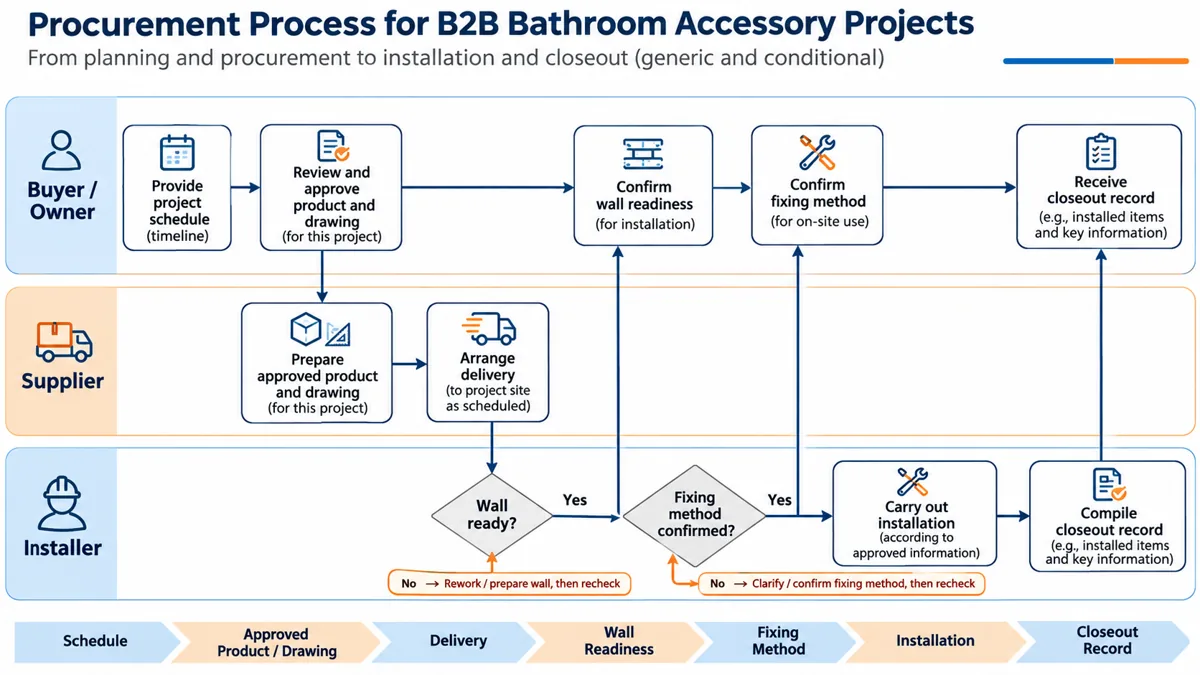
Align drawings, submittals, and purchase orders
The product model or custom description in the purchase order should match the approved schedule and submittal. Include the drawing revision, finish reference, quantities, supplied components, packaging, and required delivery location. If the supplier’s quote contains exclusions or assumptions, carry them into the project record.
When a drawing changes, identify who reviews the product-side change and who confirms project impact. A product supplier may notify the buyer of a changed hole pattern or component. The project’s authorized reviewer determines whether that change is acceptable for the site and contract. Avoid sending an old drawing to the installer after a new revision has been approved.
A purchase order should not leave the delivery and receiving owner implicit. State whether the supplier ships to the owner’s warehouse, distributor, contractor, or site and who is responsible for order tracking and receipt. If the goods are staged before installation, identify custody and storage arrangements under the project’s own procedures.
Manage schedule dependencies
Supply and installation depend on information arriving in the right order. A supplier may need a product schedule, finish selection, sample approval, or drawing signoff before releasing production. The project may need site interface details before walls are closed or before a trade can install. The buyer should map these dependencies to actual project dates rather than assume standard lead times.
For each dependency, record the input, owner, due date, and affected milestone. A metal accessory sample approval and a wall backing decision are different tasks. The supplier can provide product-side information; the project team coordinates when that information is needed by other trades.
If the project changes after a purchase order, route the change through the authorized process. Determine whether the product needs a revised drawing, whether the supplier has started production, and whether the new requirement affects delivery. Do not assume a project revision can be absorbed without commercial or schedule impact.
Handle receipt, storage, and installation handoff
The receiving party should know the order reference, expected quantity, packaging count, delivery contact, and procedure for recording visible discrepancies. Receipt confirmation should be distinguished from technical acceptance. A carton count does not mean the item was installed or that the site conditions were approved.
If goods are stored before installation, the project should assign where they are kept, who controls access, and how room or line-item identity is preserved. These are project logistics decisions. The product supplier can provide packing labels and identifiers within the order scope but cannot assume custody after the agreed delivery point.
Before installation, the contractor or installer should receive the approved product identity, current revision, and project-approved site information through the designated channel. If the goods or drawing do not match, the installer should have a named route to stop, ask, and obtain a decision rather than improvise a substitute.
After installation, the project’s authorized party determines inspection and acceptance. A completed installation record should link back to the product and room schedule as required by the project. This article does not define workmanship acceptance criteria.
Coordinate substitutions and late changes
A substitution can affect appearance, mounting geometry, packaging, documentation, or the commercial order. The supplier should identify the proposed change and provide updated product information. The project’s assigned reviewer then determines whether it can be accepted and what other parties must be informed.
Do not assume that a visually similar accessory is equivalent. Compare the specific product identity and project requirements. A substitute may require new samples, updated schedule entries, a revised purchase order, or site review depending on the project. The authorized project team sets the required evidence.
A buyer should record the disposition: accepted for a named line, rejected, or awaiting information. Include who approved it and the applicable revision. Ensure the installer and receiving contact get the same approved information.
What suppliers should state in their quotations
A clear accessory quotation should identify the product or drawing, finish, quantity, supplied parts, packaging, product documents, delivery assumptions, exclusions, and any information the supplier needs from the buyer. If site-specific mounting components are excluded, state that clearly. Do not imply that the supplier has accepted an installation obligation because it quoted a mounting product.
For a custom metal item, the buyer should provide a controlled drawing or sample and state which details are critical. The supplier can review manufacturability within its verified capability and ask for clarification. A feasibility discussion is not automatically a project approval or installation design.
The quote should identify how changes will be handled and which party must approve revisions. It should distinguish the supplier’s production scope from the construction package. This clarity lets procurement compare suppliers without assuming that a quote includes site coordination or installation.
Sample Review and Change Control
Common scope mistakes
- Assuming OFCI or another abbreviation resolves every product and site responsibility.
- Treating “contractor-installed” as proof the contractor supplies every fixing.
- Leaving the receiving or storage owner unnamed.
- Assuming product approval also approves the wall or installation.
- Sending an obsolete product drawing to the installer.
- Allowing a substitute without recording who approved it.
- Comparing quotations with different included components or delivery points.
- Treating a packing-list count as technical acceptance.
- Assuming the OEM supplier coordinates the entire construction package.
- Making a universal assumption from one project’s contract language.
Frequently asked questions
Does owner-furnished, contractor-installed mean the owner supplies anchors?
Not automatically. The project documents must define included product components and site-specific fixing responsibilities. Ask the authorized project team to clarify.
Does contractor-installed mean the contractor receives the goods?
Not necessarily. Receiving, storage, and installation can be assigned to different parties. Record each role and delivery point.

Can a hardware supplier approve the wall backing?
The supplier can provide product-side information within its scope. Site backing and structural decisions belong to the authorized project professionals.
Who approves a product substitution?
The project documents and change process should name the authorized reviewer. The supplier provides information, but should not assume the project accepts a substitute.
Does the bathroom accessory schedule override the specification?
That depends on the contract and project clarification process. Do not resolve a conflict by assumption; request an authorized written decision.
Purchasing Questions and Practical Decisions
Is the supplier responsible after delivery?
Responsibility depends on the actual commercial terms, delivery point, and contract. The project should clarify receipt, storage, damage reporting, and installation handoff.
Convert the matrix into a purchase-order release check
A responsibility matrix is useful only if it changes the procurement decision. Before releasing the purchase order, compare every open row against the actual project documents. For each item, check that a named party owns purchase, product information, delivery, receiving, storage, installation, and acceptance. Then confirm that included and excluded components match the quotation and the schedule.
The release check should identify unresolved questions without pretending that the buyer can answer them alone. For example, the product supplier may state that a mounting plate is included, while the project team still needs to confirm the site interface. Record the product-side fact and route the site question to its authorized owner. Do not convert the included plate into approval of wall construction or fixing suitability.
Use a clear disposition for each unresolved point: clarified in writing, assigned to a named party for a due date, or held for authorized project decision. The project’s actual procurement rules determine whether an order may proceed with a particular open item. This guide does not impose a universal stop-work rule. It helps buyers identify the gap early enough for the project team to decide.
When clarification changes the commercial scope, update the purchase order or related document through the proper process. Do not rely on an informal email if the project requires an approved change or contract clarification. Share the final scope with the supplier, receiving contact, and installer through the designated channel.
Record delivery exceptions and missing components
A direct shipment may arrive before the installer or project coordinator expects it. The purchase documents should name the delivery address, receiving contact, order reference, and process for reporting a discrepancy. If the goods go to a distributor or warehouse first, identify who controls subsequent delivery and which labels preserve the room or schedule reference.
At receipt, the assigned party can compare carton counts and product identifiers with the packing list and note visible damage under the project’s procedure. This records receipt; it does not mean that the product is technically accepted or that installation is complete. The buyer should state who owns an exception and how photographs, lot references, and supplier notices are retained.
If an accessory arrives without an expected screw, plate, insert, template, or instruction, compare the shipment to the quotation and approved list. Determine whether the component was excluded, omitted, or expected from another package. Avoid asking the installer to improvise a substitute before the authorized project owner resolves the scope.
For a shortage or damaged item, define who contacts the seller and who updates the construction schedule. Product replacement, site labor, and delivery recovery may belong to different commercial agreements. Keep the incident record factual and avoid assigning cause until the relevant parties review the evidence.
Prepare the installer handoff without assuming installation design
The person performing installation needs the right product identity and current product-side information in time for the scheduled work. The project coordinator should identify how the installer receives the approved model, drawing revision, and included parts. If a product substitution occurs, the handoff should include the authorized disposition rather than an obsolete schedule entry.
The installer or project professional may need site-specific information beyond the metal product drawing. The buyer should identify who supplies that information, when it is due, and how a question is escalated. The OEM supplier can describe the product-side mounting geometry within its scope; it should not be asked to approve concealed backing or site conditions that it has not reviewed.
If the project uses mockups or a room sample, clarify who supplies the accessory, who installs it, and who records the review. A mockup may help the project assess appearance or interface, but it does not automatically approve all rooms or later revisions. The contract and project quality process define how observations become decisions.
After handoff, record any mismatch between the scheduled product and delivered part. Capture the product code, revision, room or area reference, and current drawing. Ask the authorized reviewer to determine whether it is a clerical issue, a valid substitution, or a scope change. The installer should not be left to resolve a commercial conflict in the field.
Separate approval ownership from supply ownership
The party buying an accessory may not be the person authorized to approve its product data. Similarly, the party installing it may not be the party that selected the model. Write those roles separately. A simple responsibility chart can show who prepares information, who reviews, who authorizes, and who is informed, while the line-item matrix shows who furnishes and installs.
This distinction matters when a schedule, specification, and supplier quotation use different model names. The buyer can identify the conflict and request clarification, but the responsible design or project authority decides which reference governs. Do not let the manufacturer resolve the contract on the buyer’s behalf.
For custom metal products, identify who signs off the drawing and sample, which revision becomes the production reference, and how deviations are approved. Those product approvals are distinct from site installation approval. The project can then coordinate each decision with the proper owner and milestone.
Questions for the project kickoff meeting
- Which document controls the product identity and quantity for each room or area?
- Who purchases and furnishes the accessory, and what parts are included?
- Who provides the current product drawing, finish information, and revision history?
- Who owns site-specific backing, substrate, fixing, and installation decisions?
- Where will goods be delivered, who receives them, and who records shortages or damage?
- Who stores and distributes the parts by room or schedule reference?
- How are substitutions, drawing changes, or exclusions formally approved?
- Which milestone requires product information or goods to be available?
- Who can close a scope gap or authorize a deviation?
- What information must reach the installer before the work begins?
The meeting record should name people or project roles and due dates. A generic note that “contractor to coordinate” may not identify the actual owner or deliverable. If the project uses a formal responsibility schedule, update that source rather than maintaining conflicting informal copies.
Practical takeaway
For every bathroom accessory, map who selects, buys, furnishes, provides product information, receives, stores, installs, and accepts it. Tie each responsibility to the project schedule and written contract, and route site-specific decisions to the authorized team. Resolve gaps and overlaps before the purchase order, without turning one project’s terminology into a universal rule.
For a metal bathroom hardware RFQ, share the accessory schedule line, drawing or sample, quantity, finish, included components, delivery assumptions, and known exclusions. Koitor can define product-side manufacturing scope and supplied components within confirmed capabilities; the project team retains site, fixing, code, and installation decisions. See the custom bathroom hardware manufacturer page or contact Koitor. For model approval after package scope is assigned, see the separate commercial washroom hardware submittal checklist.
Clarify an Accessory Supply Scope Before Ordering
Share the schedule line, product drawing or sample, quantities, finish, included and excluded parts, and delivery assumptions. Koitor can define the metal product scope; site and installation responsibilities stay with the project team.
OEM / PRIVATE LABEL
Turn this sourcing guide into a product brief
Share your target product, size, finish, order quantity and packaging requirements. Your team receives a practical manufacturability review before quotation.



 English
 Español
 Português
 Français
 Deutsch
 العربية