

— The buyer should preserve the scope of shelf capacity vs total unit capacity in the drawing and approval record.
When a metal storage rack shows a load limit, the buyer needs to know what the number applies to. Shelf capacity vs total unit capacity is a scope question: a stated limit may refer to one level, a complete assembled unit, a particular support configuration, or another clearly defined condition. A buyer should not add shelf figures, divide a total across levels, or transfer a number from a similar rack unless the responsible manufacturer has supplied evidence for that exact configuration.
This guide helps importers and private-label teams preserve the meaning of load information from supplier documents through packaging and product listings. It does not calculate a rack rating, prescribe a test, or assign a capacity to any Koitor product. Koitor’s exact product scope and any project-specific technical evidence must be confirmed directly for the design concerned.
Why a shelf limit and a whole-unit limit answer different questions
A shelf-level limit concerns an identified level under stated conditions. A whole-unit limit concerns the complete rack configuration under its own stated conditions. Those statements are related, but they are not interchangeable. One does not automatically establish the other. A system can have more than one relevant constraint, and the buyer needs the manufacturer’s definition of each one rather than an inferred value.
Published maker materials illustrate why scope matters. Metro’s guide presents level and unit limits for named shelving families with model-specific qualifications. TRINITY’s product page distinguishes shelf or basket figures and total configuration information, including fixed-foot and wheel configurations for the named product. Those are examples of how specific product documents express limits. Their values and conditions apply only to the named products and must not be copied to another rack.
The buyer’s task is not to combine numbers mathematically. It is to preserve every applicable statement with its conditions and ask the responsible manufacturer what configuration was evaluated. If a document supplies only one scope, do not invent the missing one. Leave the field unresolved until the manufacturer provides the required information or until the buyer chooses to omit the unsupported claim.
Define the exact rack configuration first
Before comparing load information, identify the physical configuration the document describes. Record the model or buyer SKU, drawing revision, number and type of levels, frame and support arrangement, installed accessories and whether the rack is configured as shown in the instruction or product image. A product-family name alone may not distinguish variants. The buyer’s internal file should connect the evidence to the item that will actually be ordered and sold.
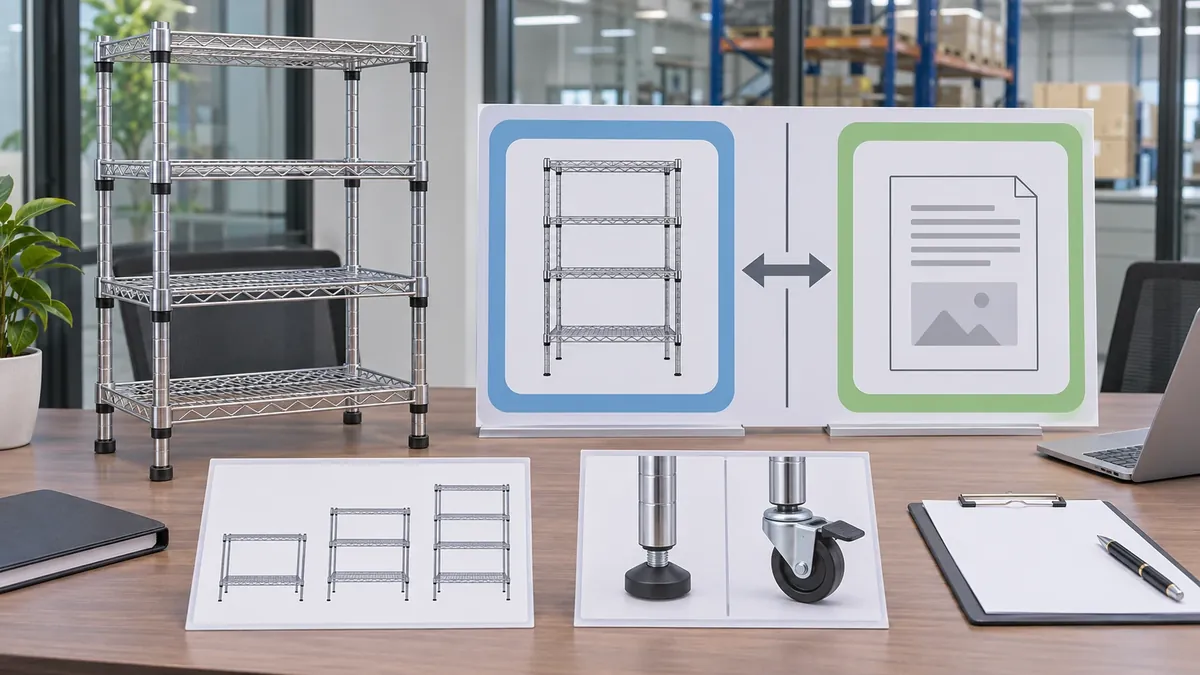
Support mode can matter. A rack supported by fixed feet and one fitted with casters may be different configurations. If a manufacturer publishes separate information for those conditions, retain the distinction. Do not assume that a caster’s own rating can be added to a frame rating or that a stationary figure remains valid while a rack is being moved. Ask the maker to state which conditions the relevant number covers.
The number and type of levels matter too. Wire shelves, baskets, removable shelves and accessories may have different construction or support. If a level is replaced, omitted, repositioned, or fitted with another component, the documented whole-unit statement may no longer apply. A change in configuration should trigger a question to the evidence owner; it is not a basis for deriving a new limit independently.
Record the loading conditions that accompany the maker’s statement. These may describe how the load is placed, whether the limit applies per level or to the assembled unit, and any stated configuration or use qualifications. Do not add assumptions about uniform distribution, point loading, movement, floor condition or duration. Use the manufacturer’s own wording and request clarification where it is incomplete.
Keep the load-limit record explicit
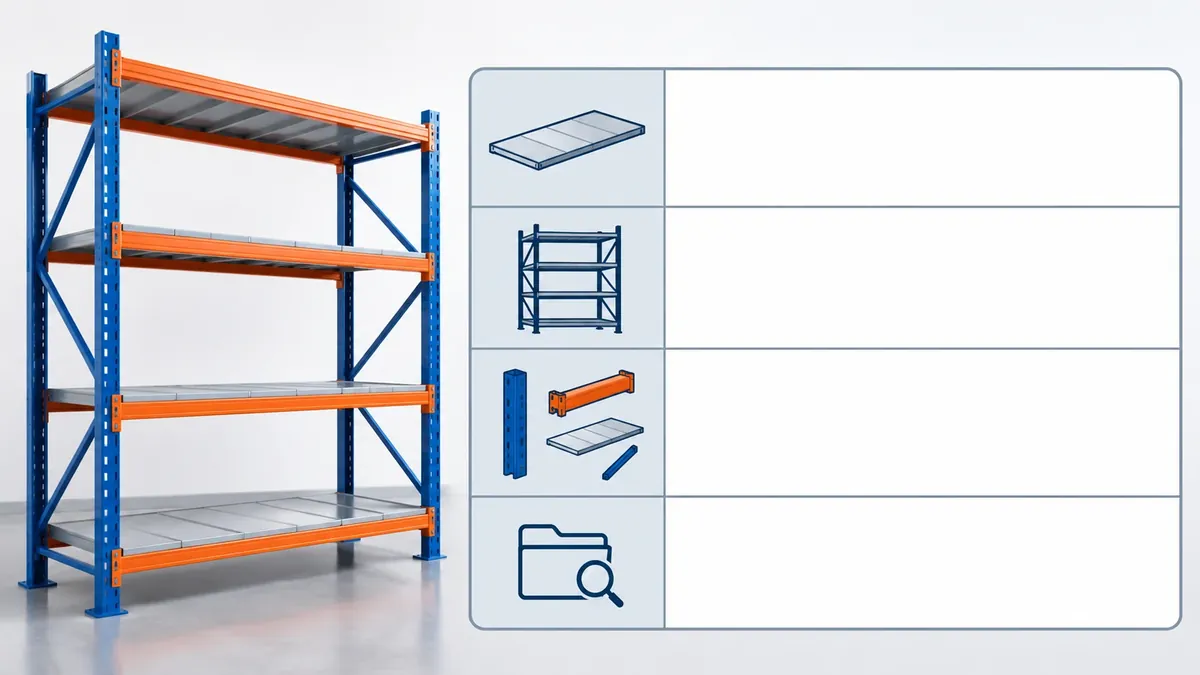
| Specification field | Buyer should record | What not to infer |
|---|---|---|
| Product identity | SKU/model and controlled drawing revision | That every item in a family is identical |
| Level identity | Shelf, basket or other named component | That unlike levels share one value |
| Level limit | Manufacturer-stated value and conditions, if supplied | A value derived by dividing the complete-unit number |
| Whole-unit limit | Manufacturer-stated value and conditions, if supplied | A value derived by adding the levels |
| Support mode | Fixed feet, casters or other stated configuration | That one mode inherits another mode’s limit |
| Configuration | Number, type and location of levels/accessories | That a modified rack retains the original statement |
| Evidence source | Controlled document, revision and responsible issuer | That a retailer summary replaces the source record |
| Approved wording | Exact claim and required qualifications | That a short headline can omit material conditions |
The table is a recordkeeping framework, not a test protocol. Where the manufacturer provides both per-level and whole-unit statements, preserve both. Where a required statement is missing, mark it “not supplied” or “pending clarification.” Do not use blanks as an invitation to calculate. A buyer may decide not to publish a particular claim if its meaning cannot be confirmed.
An example can be explained without inserting a made-up number: a proposed loading plan must be checked against each applicable manufacturer-stated constraint. A plan that appears to respect one limit does not show that another limit is satisfied. This observation does not provide permission to load a particular product, and it is not an engineering calculation. The responsible product manufacturer must define the applicable constraints and their evidence.
Ask what the manufacturer’s document actually proves
When a supplier provides a technical sheet or test summary, check the title, product identity, revision, configuration, scope and author. Is the statement for a component, one shelf, a complete assembled unit, or a family of models? Does the document identify the fixed-foot or caster setup? Does it specify loading conditions and applicable limitations? Is the referenced test or evaluation described, and is the result connected to the product revision being quoted?
A document’s presence is not the same as a buyer understanding its scope. A marketing page may summarize a maker’s claim; a technical document may provide more detail. The buyer should retain the controlling source and ask the manufacturer to resolve any mismatch. Do not describe a manufacturer statement as independently verified unless an appropriate independent review has actually occurred.
Also separate a load limit from other product qualities. A load statement by itself does not establish stability, tip resistance, fatigue life, corrosion resistance, installation suitability, safe use in every environment, or compliance with a standard. Those properties require separate definitions and evidence. Keep each product claim tied to the specific basis that supports it and avoid implying that one number proves a broader performance outcome.
OSHA’s materials for warehousing include the general instruction that storage structures should not be loaded beyond their rated capacity and that load limits should be posted where applicable. That workplace guidance is context, not a rack design calculation, not an assignment of any particular rating, and not a substitute for the manufacturer’s product-specific information. Buyers must assess applicable workplace and jurisdiction requirements with qualified personnel.
Check feet, casters and movement as separate conditions
A stationary rack and a rack on wheels may present different use and support conditions. Review the exact product documentation for each offered setup. If the supplier’s table gives separate figures or conditions, maintain them separately in the buyer’s specification and product listing. Do not combine them or assume the more favorable number applies in every situation.
Ask whether the manufacturer’s information covers the rack while stationary, while being moved, or both, and how a caster option changes the documented configuration. Do not derive a whole-rack statement from individual caster labels. A component rating and an assembled-product rating answer different questions and may have different assumptions. Where the supplier has not provided an answer, treat the condition as unresolved.
The same care applies to floor surface, leveling and positioning. A rack that is not assembled or installed as documented may differ from the evaluated configuration. This article does not provide a setup procedure or a surface-suitability claim. Follow the product manufacturer’s instructions and seek clarification where the intended use differs from them.
If wheels or adjustable supports are optional, identify the exact option code and installation state in the product record. Packaging, listing text and instructions should not make it appear that two configurations share one approved rating when the evidence distinguishes them. This is especially important when the option changes after initial product approval or when marketplace content is copied between variants.
Treat removable or changed shelves as a configuration question
Removable shelf designs can let a buyer change storage layout, but a physical ability to remove a level does not establish that every altered arrangement retains the same documented limit. Ask the manufacturer which configuration the evidence covers and whether a modified setup has a separate statement. Keep the approved assembly and any permitted alternatives in the product record.
If the rack has baskets, shelves or attachments with different roles, identify each by its correct name. A “level” may not be one uniform part across the complete unit. A tray, basket and solid shelf can differ in construction, support geometry and intended use. Do not copy one part’s documented limit to another because they occupy a similar position.
A change to a level count can also change how a customer perceives a total capacity statement. That perception should not be addressed through unsupported arithmetic. If the buyer wants to market a configuration with a removed or repositioned component, request manufacturer confirmation for the exact item, revision and assembly. If no confirmation is available, do not describe the changed arrangement as rated to the original limit.
For buyers evaluating removable-level architecture, a separate design review should address configuration changes. This article focuses on preserving the scope of load statements and should not duplicate a design or structural analysis.
Separate capacity, stability and intended application
Buyers sometimes compress several concerns into the word “capacity.” Clarify whether the question is a documented load limit, the number of levels, the available storage volume, a product’s advertised basket count, or stability in a specified setup. These measures are not interchangeable. A rack may have a stated load value while other product questions still require separate review.
If the intended application includes concentrated, shifting, unusually shaped or potentially hazardous items, provide that context to the supplier and request a project-specific review. Do not assume that a general product page covers an unusual load pattern or operating environment. This guide does not recommend placing people, climbing, or other uses outside the manufacturer’s intended application.
Likewise, an overall rack limit does not by itself tell a buyer how to distribute items across levels. Any placement instructions must come from the product’s approved documentation. Do not create a loading diagram by dividing a total or applying a ratio unless the manufacturer has supplied and approved that method for the exact rack.
The buyer’s marketing team should keep the product description aligned with the manufacturer’s technical wording. Avoid changing “per shelf under specified conditions” into a bare headline that readers could interpret as the total for the entire product. Conversely, do not describe a total-unit statement as a limit for each individual level. Use clear labels and repeat necessary conditions near the claim.
Carry the qualification through packaging and digital listings
The load statement often travels from a supplier document into a product data sheet, carton, instruction leaflet, retailer portal and ecommerce listing. Each handoff can remove the context that made the original statement accurate. Assign an owner to approve the exact wording and ensure that the scope, configuration and conditions remain visible wherever the claim appears.
Use a controlled source document and revision, not a copied fragment from an old listing. If the supplier changes the frame, level, accessory, support mode or assembly, ask whether the prior load information remains applicable before reusing it. Product imagery should depict the configuration described in the text. If a listing shows casters but the stated information applies to fixed feet, the mismatch needs resolution before publication.
For multi-variant listings, connect each value to the correct model. Do not display one number for an entire family if the source differentiates configurations. Retailer systems may have limited fields; the buyer still remains responsible for communicating a clear and supportable claim in the available content. If a platform cannot preserve the necessary qualification, escalate it through the product and compliance review instead of silently dropping it.
Carton or instruction copy should also avoid implying a broader test result. A load figure does not prove that the item will tolerate every transit, assembly or use condition. Keep packaging, installation, stability and performance claims separate unless the evidence supports each one. This discipline protects clarity for the buyer, supplier, retailer and end user.
Questions to send with an RFQ or product review
Ask the manufacturer to identify which limits are established for the exact offered configuration and what source controls them. Request the level-level and full-unit scopes separately where applicable. Ask whether the configuration uses fixed feet, casters or other support, and whether any conditions differ between stationary and movement states. Confirm the number and type of levels, accessories, assembly revision and any stated loading conditions.
If the supplier provides an existing document, ask which SKU, drawing or model it covers and whether the quoted product matches it. Ask whether the document is the current revision and whether a planned change affects its applicability. If the evidence is a test report, request the stated scope and test identity, while avoiding the assumption that a test name alone proves suitability for every use.
The buyer can make the request practical by attaching the intended product drawing, proposed configuration, support option, planned listing wording and any known use conditions. Identify who will approve technical meaning and who will approve consumer-facing copy. The manufacturer can then respond within its actual evidence and capabilities; the buyer should not ask it to create a rating from unspecified conditions.
Frequent errors to prevent
Adding all shelf values to create a total. This assumes that the per-level figures can be combined without another system constraint. Use only a whole-unit statement supplied for the exact configuration.
Dividing a unit value to create a per-level claim. This assumes equal load limits and ignores the level structure and manufacturer’s evidence. Ask for the level-specific information if it is required.
Copying a rating from a similar model. Similar appearance or a shared family name does not establish identical dimensions, materials, supports or evidence. Match the document to the offered item and revision.
Treating feet and casters as equivalent. Keep support-mode-specific conditions visible and ask what the manufacturer’s figure covers.
Assuming removable levels preserve the original statement. The altered arrangement may not match the evaluated configuration. Obtain confirmation before using the same claim.
Using load capacity as proof of safety or durability. A single statement does not establish all structural, installation, stability or lifecycle properties. Keep claims distinct and evidence-based.
Dropping qualifications in the listing headline. Retain the scope and conditions close to the number so readers can tell what it describes.
A buyer approval checklist
Before approving a load-related statement, verify:
- Does the source identify the offered model, SKU or controlled revision?
- Is the statement for a level, the complete unit or another named scope?
- Are different shelf or basket types identified separately where necessary?
- Is the support mode stated, including fixed feet or casters where relevant?
- Are stationary and movement conditions distinguished if the source does so?
- Does the documented configuration match the assembled product being sold?
- Are changes to removable or repositioned parts covered by the source?
- Are loading conditions and qualifications retained in the approved wording?
- Is a named evidence owner responsible for technical questions?
- Does packaging and digital content use the same approved claim?
- Have stability, installation and other separate claims been reviewed independently?
- Are any missing data clearly labeled as unresolved rather than inferred?
This list is deliberately a document-control aid, not a structural rating method. If the product team cannot answer a question from the available source, it should assign the question to the responsible manufacturer or qualified reviewer. A missing value should remain missing until the correct evidence owner supplies an answer.
Frequently asked questions
Is total unit capacity just the sum of all shelf capacities?
Do not assume so. A shelf figure and a whole-unit figure have different scopes. Use the manufacturer’s statement for the exact assembled configuration and do not calculate one from the other unless the manufacturer explicitly supplies an approved method.
Does a shelf limit apply when the rack is on wheels?
Only if the responsible manufacturer’s documentation says it applies to that configuration and condition. Check whether the document distinguishes fixed feet, casters, stationary use or movement. A wheel component statement does not substitute for an assembled-rack statement.
Can I keep the same rating after removing one shelf?
Do not assume that a modified arrangement is covered by the original document. Ask the manufacturer whether the exact changed configuration is addressed. A shelf’s removability does not itself establish an alternate rating.
Does a capacity claim prove the rack is stable?
No. Capacity and stability are distinct product questions. A load statement alone does not establish tip resistance, installation suitability, durability or safe use in every condition.
What if the supplier gives only one number?
Record exactly what the source identifies and request clarification if a second scope is needed. Do not divide, multiply or transfer the value to fill a gap. The buyer can omit an unsupported claim until the evidence owner resolves it.
Can I reuse a number from a similar product in the same range?
Not without confirmation that the source applies to the offered model and configuration. Similar appearance or branding does not prove that the underlying product and evidence are the same.
Sourcing takeaway
Treat every load statement as a scoped claim. Identify the exact rack, level type, assembly, support mode and manufacturer source; preserve shelf and whole-unit limits separately; and keep the accompanying conditions visible in packaging and listings. Never derive a missing value from another number or copy it from a similar product.
For a metal-rack OEM discussion, share the controlled drawing, intended configuration, support option and proposed wording with the supplier and ask which evidence applies. Koitor’s custom metal storage rack manufacturing page is the relevant project contact route; it does not establish a certified capacity for any product. Caster selection and removable-shelf architecture are separate decisions and do not replace the maker’s current load documentation.
Sources and scope notes
- Metro: Commercial Shelving Buying Guide. Shows distinct scopes for specified Metro product families; no figures are transferred to other products.
- TRINITY: 5-Tier Wire Shelving with Baskets and Wheels. Product-specific example of level/basket and configuration distinctions; its claims are not independent test findings for another rack.
- OSHA: Warehousing. General workplace context on rated capacity; not a rack design method or product-specific rating.
For this article, treat shelf capacity vs total unit capacity as the exact buyer question recorded in the approved project brief. Use the phrase only when discussing this defined decision; it does not establish an industry-wide problem or a Koitor product claim.
Work With Koitor Hardware
Discuss Your Project Scope With Koitor
Send Koitor your controlled drawing, reference sample, configuration, finish and packaging requirements. Our team can review the defined metal hardware scope and confirm whether the project fits current capabilities before quotation.
OEM / PRIVATE LABEL
Turn this sourcing guide into a product brief
Share your target product, size, finish, order quantity and packaging requirements. Your team receives a practical manufacturability review before quotation.


 English
 Español
 Português
 Français
 Deutsch
 العربية