
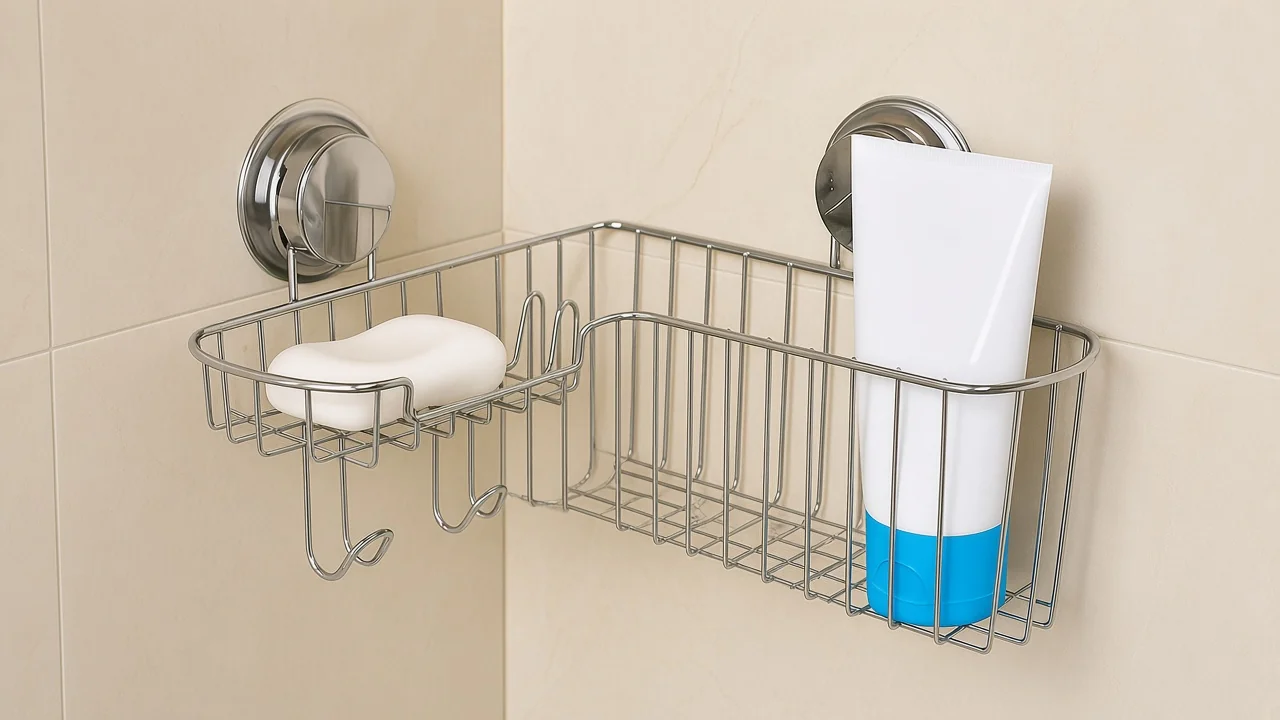
A corner shower caddy 90 degree tile fit claim is a geometry claim: both wall-contact faces of the caddy must sit on the two walls at the same time without being forced. Many listings assume a sharp square corner. Radius tile, a thick corner bead, a wide grout joint, or a protruding glass frame can leave one pad or one cup hanging in air.
Importers should dry-fit the finished sample on a defined corner type before packaging or a product page says the caddy fits shower corners in general. A photograph taken in a showroom with a perfect 90° mock-up does not prove fit on a rounded stall.
This guide covers corner angle, radius, grout, and frame checks, plus honest claim exclusions. It does not replace a load or hold-strength protocol, and it does not invent a universal radius limit for every tile market.
Why so many listings assume a sharp 90-degree corner
A rigid metal corner caddy is usually designed around two flat contact planes that meet at a right angle. That is a convenient factory assumption because it can be checked with a square and a simple tile mock-up. It is not a description of every shower that will appear in product reviews.
Install sheets for adhesive and no-drill corner caddies often warn that the product is for a 90° right-angle corner only. Brand education pages may say the same thing in more detail. Konsilee’s Kora corner-caddy compatibility notes state that the caddy is designed for standard square 90° shower corners, that curved corners vary, and that a hold-in-place check is the practical way to test a curved stall before films are removed.
OEM catalogs sometimes copy “fits corner showers” from a rendering. The rendering usually shows sharp tile and clean grout. Returns and one-star reviews often mention a rounded corner, a bulky aluminum trim, or a corner where the two walls are not truly square.
The buyer’s job is to decide which corner family the SKU will claim, then write the claim no more broadly than the dry-fit evidence. If the program will only support sharp 90° tile, say so on the pack and the page. If the program wants a limited radius band, that band must come from samples, not from a hope that a flexible strap will close every gap.
How radius corners, grout, and frames break flush contact
A radius or bullnose corner moves the two usable flat planes away from the theoretical vertex. The caddy’s inner corner then hits the curve while the outer pads or suction cups have not yet reached the walls, or one cup reaches first and the other sits on grout. The result is a rocking basket or a cup that is only partly seated.
Grout width and depth matter even on a square corner. If the contact pads are designed to sit close to the vertex, a wide recessed grout joint can leave the pad half on tile and half on grout. Some designs intentionally bridge the corner grout line so the adhesive or cup sits on tile only. That intent should be written on the drawing, then checked on a mock-up that includes a representative joint.
Glass frames, metal corner beads, and shampoo niches also steal contact area. A caddy can be square to the tile and still fail if a frame stands proud of the wall. Record those exclusions instead of treating every obstruction as a customer-install error.
Do not transfer fit evidence between mounting systems. A screw-flange corner shelf, a hanging hook-over caddy, and a suction corner basket load the corner in different ways. This article’s sample images show a suction-mounted chrome wire corner caddy, because that is the mounting family used for the visual set. The same geometry questions apply when a buyer is developing an adhesive-pad or screw-flange corner SKU, but the contact parts and the dry-fit method must match that SKU.

What dry-fit protocol supports a corner shower caddy 90 degree tile fit claim?
A dry-fit is a hold-in-place check of the finished caddy on a defined corner, done before adhesive films are removed or holes are drilled. The purpose is to see whether both contact faces can sit flush at the same time without hand pressure that would not exist after installation.
Build or photograph the corner types the retailer will mention. At minimum, include a sharp 90° tile corner with a stated grout width. If the listing might mention rounded corners, add one or more radius samples or site photos with a measurable curve, and treat each result as project-specific evidence, not as a catalog law.
Place the finished caddy in the corner and observe all contact parts: cups, pads, side wires, and any back corner radius in the basket itself. Look for daylight between a cup and the tile, for a cup sitting on grout, and for a basket that has to be twisted to touch both walls.
Record left-right height. A caddy that is high on one side is often tracing a corner that is out of square or a contact part that is not coplanar.
If the SKU is suction-mounted, the dry-fit is about geometry first. Do not treat a temporary suction grab during a one-minute hold as proof of long-term hold on a wet, soapy wall. Hold-strength and surface-prep rules belong in a separate mounting file. Geometry failure will also show up later as a hold failure, but a geometry pass does not finish the mounting file.
| Corner condition | What to observe | Likely listing decision |
|---|---|---|
| Sharp 90° tile, narrow grout | Both contact faces flush, basket level | May support a 90° square-corner claim if the sample is the shipping revision |
| Sharp 90° tile, wide or deep grout | Pads or cups overlapping the joint | Limit the claim, move the contact pads, or exclude wide grout |
| Radius or bullnose corner | Inner frame hits the curve; one face gaps | Exclude, or approve only a stated radius sample that actually sat flush |
| Proud glass frame or corner bead | Contact blocked before the tile plane | Exclude the obstruction in the claim file |
| Out-of-square walls | Basket racks or one side rides high | Do not treat as a universal corner SKU |
Photographs should show the contact faces, not only a styled bottle display. Identify the sample revision and the corner mock-up or site in the same frame or caption file.
How should listing claims and exclusions be written?
Write the claim as a bounded compatibility statement. A defensible line names the corner family that was checked, such as a square 90° tiled corner with contact on finished tile, not on grout. It should not say “fits all shower corners” or “fits rounded and square corners” unless both families were actually dry-fitted and the limits were recorded.
Retail listings that mention a maximum rounded-corner depth are making a vendor-specific claim. That number is not transferable to a different caddy, a different cup spacing, or a different basket back radius. If the buyer wants a similar sentence, it must come from the buyer’s own sample work.
Exclusions are part of the commercial file, not an afterthought for customer service. Typical exclusions include radius corners beyond the approved samples, heavily textured or matte surfaces when the mount needs a smooth face, painted or wallpapered walls, and corners with protruding frames. Surface compatibility for no-drill mounts can be discussed with no-drill bathroom accessories manufacturing, but that page does not freeze corner geometry.
Keep rust, drainage, and load claims on their own evidence. A caddy can drain well and still fail a rounded corner. Drainage design for shower caddies is covered separately in shower caddy drainage design for OEM product development. Load or hold testing, when a program needs it, should stay in its own protocol and should not be used as a substitute for the dry-fit.
What belongs in the RFQ, drawing, and sample brief?
The RFQ should treat corner shower caddy 90 degree tile fit as a geometry characteristic, then name the mounting system, the intended corner family, and the claim sentence the retailer wants to defend. Attach photos of target showers when they exist, including close views of the vertex, grout, and any trim. If the buyer cannot supply site photos, say so and limit the first claim to a laboratory or showroom mock-up.
On the drawing, mark the included angle between the two contact planes, the location and diameter of cups or pads, the back-corner clearance of the basket, and the distance from the vertex to the first contact point. If the back corner of the wire form is radiused to bridge grout, show that radius as a design feature with a purpose, not as an uncontrolled bend.
Koitor Hardware is a family-owned custom metal hardware factory and a China OEM manufacturer of bathroom and home storage hardware, including shower caddies and wire baskets. The factory can review wire forming, welding, cup or pad placement, finishing, and packaging from a drawing or a physical sample. A useful review starts with the corner-geometry notes, not only with an overall width.
OEM context for shower-caddy programs is also described on custom shower caddy manufacturing and custom bathroom hardware manufacturing. Use those pages for capability context; keep this article’s file focused on corner fit and claim limits.
MOQ can start from about 100 pcs depending on the product. Samples usually take 5–7 working days after details are confirmed. Bulk production usually takes 4–6 weeks depending on product, quantity, finish, and packaging. Those ranges depend on the project and should not be treated as a guarantee.
If the first sample fails a radius stall the buyer still wants to serve, the options are to change the back-corner clearance, relocate the contact parts, develop a second SKU, or narrow the claim. Each option has tooling, packaging, and listing consequences. Ask the factory to explain those trade-offs for the actual design rather than assuming a small wire tweak is free.
Describe a radius corner in a way a factory and a retailer can both use. A photo with a scale, a cardboard template, or a measured offset from a true square is more useful than the word “rounded.”
Do not publish a single millimeter value as a Koitor universal limit. If a sample sat flush on one measured curve, record that curve as the evidence for that SKU revision, and keep later stalls that look tighter on hold until they are checked.
Out-of-square walls are common in renovations. A product can be made to a true 90° included angle and still rock in a stall that is 87° or 93°. The listing can say the caddy is intended for a square corner. It should not imply that the hardware will correct a poorly built stall. If a buyer wants a slightly forgiving back radius, that is a design choice to be sampled, not a silent factory tweak after artwork is approved.
Two-material corners deserve their own row. A tile wall meeting a glass panel may be square and still fail if the glass frame stands proud, if the two surfaces have different gloss, or if only one face is a recommended suction or adhesive substrate. Dry-fit across the actual pair of materials when that installation is in the sales story.
If the assortment includes more than one shelf size, dry-fit each size. A shorter basket may clear a frame that a taller unit hits. Do not approve the small SKU and then extend the same claim sentence to a deeper or wider sister SKU.
A dry-fit may be done empty first, then with a representative bottle set if the loaded wires flex toward the vertex. Geometry can change when the basket is filled. Any loaded check is still a geometry observation. It is not a published load rating and should not be written with invented kilogram figures.
Install instructions should repeat the corner family in the same words as the listing. If the pack says “for 90° right-angle tiled corners only,” the page should not quietly add “fits most showers.” Provide a simple instruction to hold the caddy in place and confirm both sides are flush before films come off or holes are marked.
Artwork review should include the corner line, the exclusion list, and the hero image. A hero shot taken in a sharp showroom corner is fine if the caption or the spec table still states the limit. It is not fine if the only visible sentence is a broad corner-storage promise.
Packaging can pre-load a geometry failure. Cups or pads crushed in the carton may no longer sit coplanar when the user opens the box. Include a pack trial that looks at the contact parts after transit simulation the parties agree to use, without treating that trial as a certified laboratory result unless such a report is separately provided and approved.
After-sales photos are more useful when they show the vertex, both contact faces, and any trim, not only the bottles in the basket. Train the retail team to ask for those views so a radius issue is not misclassified as a defective cup.
When the first sample fails the stalls the buyer still wants to serve, compare three paths: a design change to the back-corner clearance or contact spacing, a second SKU for radius stalls, or a narrower claim. A design change can affect welding, packaging size, and bottle capacity. A second SKU adds inventory. A narrower claim is often the cleanest first step while the design is still in development.
Koitor can discuss those paths against the actual wire form and the buyer’s photos. The conversation is more productive when the file already contains the failed corner photo and the claim sentence that caused the problem, rather than a general request to make the caddy “fit more showers.”
Private-label teams selling into rental and hotel-adjacent retail should be especially careful with broad corner claims, because those bathrooms often combine radius trays, glass frames, and uneven renovations. The product can still be a good SKU for square tile stalls if that limit is visible at the point of sale.
If a buyer later adds a second finish color, repeat the dry-fit only if the change can move cup height, pad thickness, or basket spring. A color-only change on the same construction may not need a full geometry redo, but the first carton of the new finish should still be checked for crushed or misaligned contact parts after packing.
Keep a short internal glossary in the project file so merchandising, quality, and the factory use the same words: square 90° corner, radius corner, grout bridge, proud frame, and dry-fit. Mixed vocabulary is how a packing line “fits corners” sentence undoes a careful spec sheet.
A pre-shipment check can repeat the same dry-fit on a retained golden sample and on a production piece from the first lot. The point is not to invent a new laboratory method.
The check confirms that cup spacing, basket back radius, and contact planarity still match the approved revision before a large carton run leaves the factory. If a production piece no longer sits flush on the same 90° mock-up, stop the claim and the shipment discussion until the geometry is restored or the artwork is revised.
Buyer checklist before freezing a corner-caddy listing claim
Use the following checklist to freeze corner shower caddy 90 degree tile fit before artwork is released. Leave the claim narrow wherever a row is still open.
- Mounting system locked (this visual set uses suction; do not mix evidence with hanging or screw-flange SKUs)
- Intended claim sentence drafted in buyer language, not factory adjectives
- Sharp 90° tile mock-up prepared, including a stated grout condition
- Radius or rounded-corner samples included only if the listing might mention them
- Dry-fit performed on the finished sample, both walls, no forced twist
- Daylight gaps, grout seating, and out-of-level placement recorded
- Glass frames, corner beads, and niches listed as inclusions or exclusions
- Surface-prep and hold-strength checks parked in a separate mounting file
- Drainage and rust language kept on their own evidence
- Photos of contact faces saved with the sample revision
- Pack and page copy reviewed so “fits shower corners” is not broader than the file
- Change control: new cup spacing, new back-corner radius, or new basket depth triggers a new dry-fit

Frequently asked questions
Can a caddy designed for square 90° corners also be listed for rounded stalls?
Only after a dry-fit on the rounded samples the retailer will mention. A design that is comfortable on a sharp corner often gaps on a radius. Do not copy another brand’s rounded-corner depth number.
Does a successful dry-fit prove the mount will hold in a wet shower?
No. The dry-fit answers geometry. Hold strength, surface type, and curing or set time belong in a separate mounting review.
Should grout be treated as a usable contact surface?
Usually no, unless the design is expressly intended to bridge a joint and the pads still sit on tile. Check the actual joint on the mock-up.
What if the two shower walls are not square?
Record the condition as a limitation. A caddy cannot honestly be sold as a universal corner product if it only sits well on a true right angle.
Do I need a new dry-fit after a cup or pad relocation?
Yes. Moving the contact parts changes how the basket meets the vertex and the grout line. Repeat the check on the revised finished sample.
Can drainage slots be used as evidence that a corner caddy will fit?
No. Drainage and corner geometry are different decisions. Approve each on its own evidence.
Work With Koitor Hardware
Need a corner shower caddy dry-fit reviewed before listing claims?
Send Koitor the caddy drawing or sample, photos of the target shower corners, and the claim sentence you want to use. Our team can review contact geometry, manufacturability, and small-batch OEM options before quotation.
OEM / PRIVATE LABEL
Turn this sourcing guide into a product brief
Share your target product, size, finish, order quantity and packaging requirements. Your team receives a practical manufacturability review before quotation.


 English
 Español
 Português
 Français
 Deutsch
 العربية