
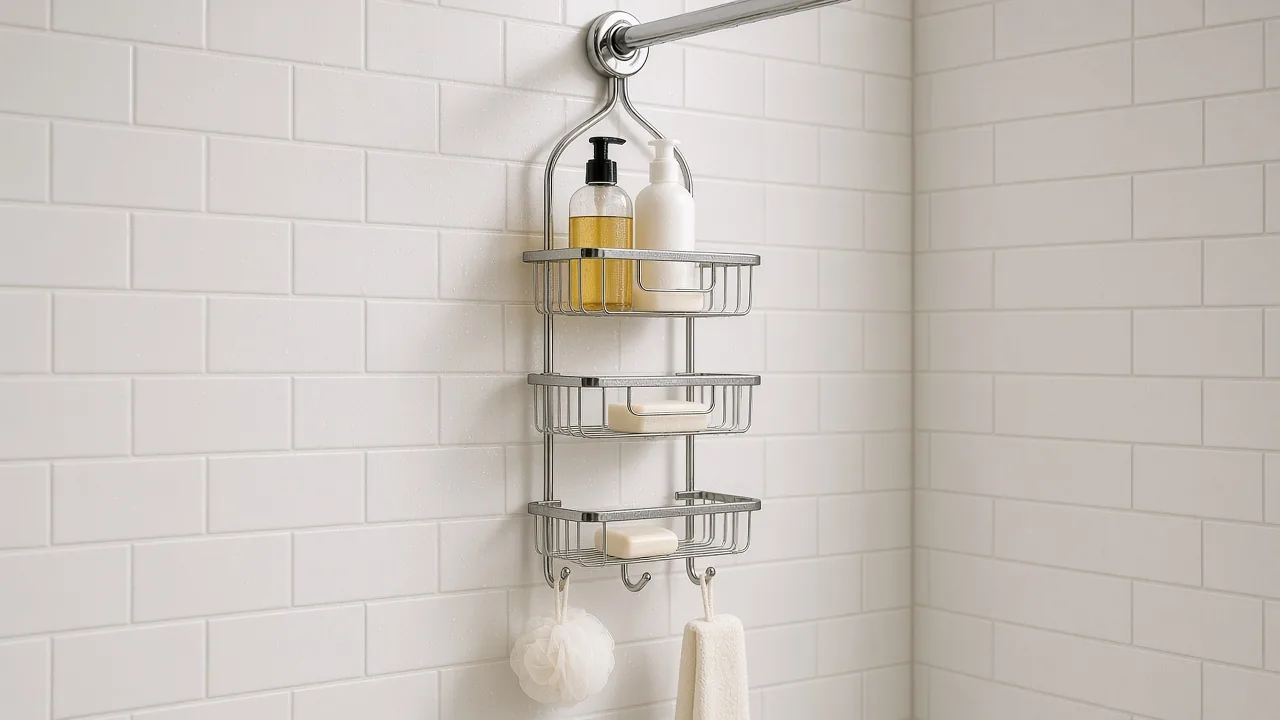
A hook that fits the shower arm can still open under bottles. Shower caddy hook unbending should be frozen as a finished-hook measurement and a named loaded-bottle check, with a permanent-set limit, before a hanging caddy is listed as heavy duty. Arm-diameter fit and hook contour are different files. If the yield check is missing, keep load ratings and heavy-duty hook lines off the artwork.
This guide is for importers and private-label teams buying hanging shower caddies that hang over a shower arm. It is not a suction or adhesive hook page, not an accessory-hook opening file, and not a shower-arm structural warning. Koitor Hardware, a family-owned China OEM manufacturer of bathroom storage hardware, can review a hang-hook brief with a drawing or a sample; this page does not invent a kilogram rating or a Koitor load test number.
Why a hook that fits the arm can still open under bottles
Fit asks whether the hook opening and the arm diameter can be assembled without rocking or scraping the finish in a way you have not accepted. Yield asks whether that same hook stays within an agreed opening after the baskets are loaded. A hook can pass a dry fit on a sample arm and still take a set after a week of full bottles.
Do not use spare-parts shopping for adhesive replacement hooks as this topic’s demand, and do not turn this page into a merchandising list for stick-on hooks. The product here is the hang hook that is part of the caddy.
Custom shower caddy manufacturing can quote a hanging caddy, but a request that only says “fits standard arms” is not a yield file. Shower caddy drainage design is the right neighbor when water path and drip are the question. Drainage does not prove that the hook will hold its shape.
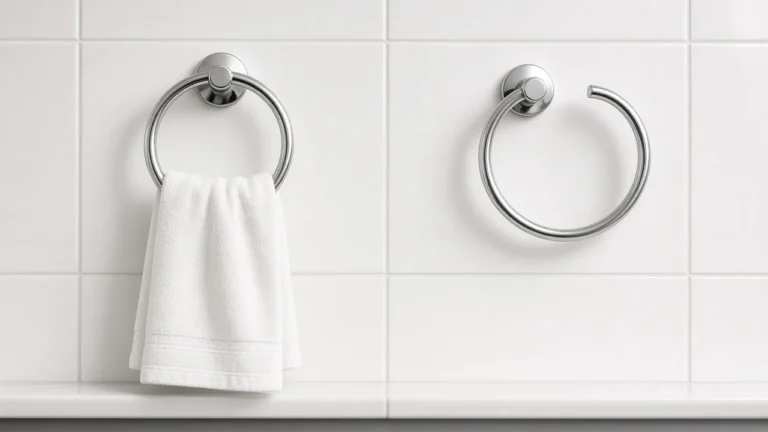
Worked example: a first article sits neatly on a 19 millimetre arm. The listing says “heavy duty.” After a few weeks, the hook opening has grown, the caddy hangs crooked, and bottles lean. The arm fit never changed. The hook took a set.
Worked example: a factory thickens the hook wire and reprints the artwork, but the bend radius is tighter and a crack starts under the coating at the inner bend. The thicker wire is not a method. The named loaded-bottle check, and a look at the bend after the check, were missing.
Accessory hooks at the bottom of a caddy, used for a razor or a loofah, are a different opening question. This file is the hang hook only. A shower-arm load warning, if a program needs one, is also a different decision and should not be used to invent a safe arm load here.
Which finished-hook measurements belong in the file before and after load?
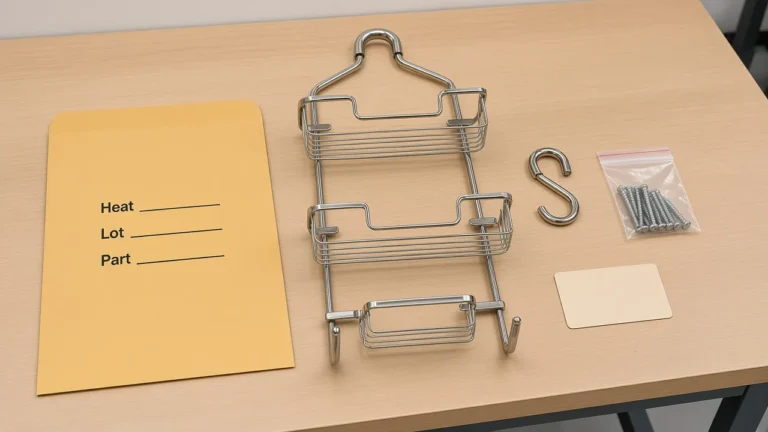
Measure the hang hook on the finished coated caddy, in the attitude it will have on an arm, before the load is applied and again after the agreed check. Typical notes are the opening at a stated datum, the hook depth, and whether the hook is a single wire, a double wire, or a formed plate.
Write the datum: where the caliper sits, and whether the hook is still on a sample arm or is laid on a bench in a defined way.
Keep that measurement method out of any sampling-plan sentence. If you later agree how many caddies in a lot are measured, that scheme can follow ISO 2859-1 or another agreed plan, but the scheme does not define the opening or the set limit.
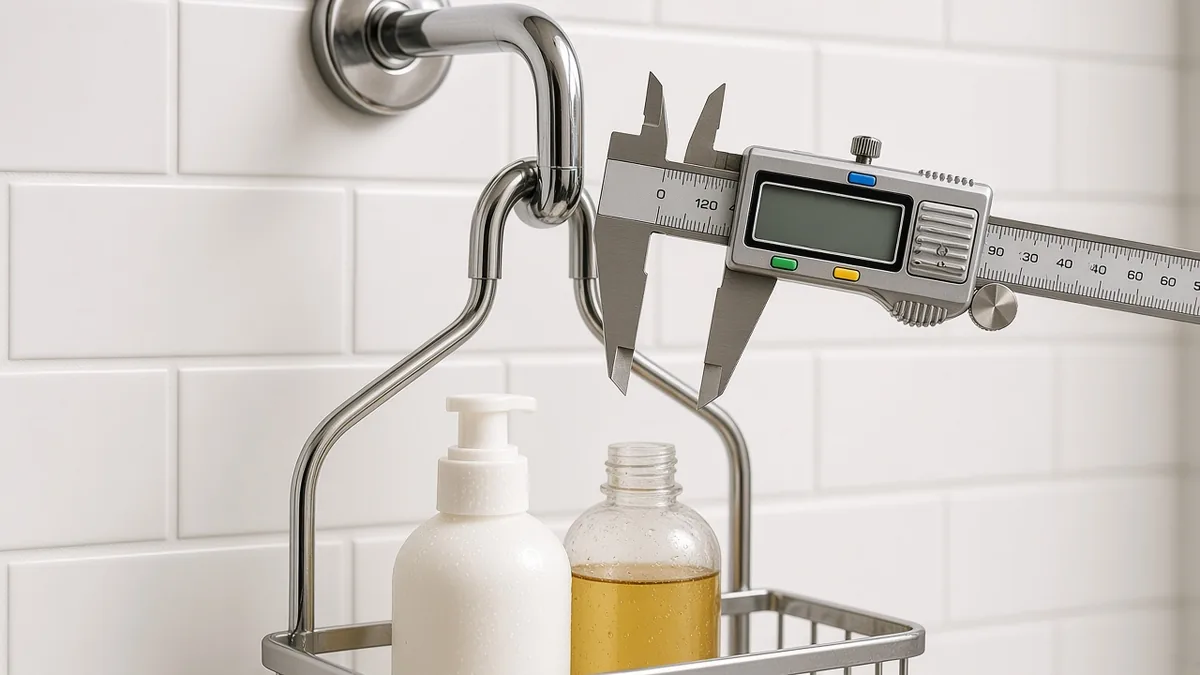
Photograph the hook on the arm before and after, with a ruler or a blank-display caliper in the frame if useful. Do not treat digits in a photo as a published Koitor rating. The photo is evidence that the same datum was used twice.
Look at the inner bend and any weld that joins the hook to the frame. A hook that keeps its opening but cracks at the bend, or that tears a weld, is not an accept, even if the number looks stable. Coating cracks at the bend are an early sign and should be recorded.
If the hook is welded to the frame, name that joint in the file. A hook that is only a press-over loop can behave differently from a welded hook. Do not assume one construction from a catalog silhouette.
Do not invent a default wire diameter or a default allowed set for Koitor. If a project needs a number, agree it on the sample as a project figure, such as a maximum increase in opening, and write the instrument and the datum beside it.
How should a named loaded-bottle condition be written without inventing a rating?
Name the bottles or other items, how many, whether they are full, and which shelves they sit on. A “typical two shampoo bottles and one soap” can be a method if those objects are then described or retained as samples. Do not convert that condition into a printed kilogram capacity on the carton unless a project has separately agreed a rated test and you are prepared to substantiate it.
Run the check on a named arm or a named bar that represents the sales claim, with the caddy hanging as a shopper would hang it. Leave the load for an agreed time, or apply a written on-and-off cycle, then remeasure the opening.
Include a wet or steamy condition if the product will live in a shower. Water and heat can change how a coated hook feels and how a bottle sits, even when they do not change the steel itself.
The point of shower caddy hook unbending is permanent set, not a one-second bounce. A hook that opens under load and does not return is the failure mode shoppers describe as “the hook bent.” Write the wait after unload before the second measurement, so elastic spring-back is not confused with set.
Do not invent a test standard number or a Koitor laboratory load. The U.S. FTC Policy Statement Regarding Advertising Substantiation is a useful reminder that a heavy-duty line needs a reasonable basis. The basis here is the named condition and the set limit, not a badge.
If a program later wants a force value, that is a project discussion with a fixture and an agreed number. It is not required to write a useful first file, and it should not be guessed in a blog or on a carton.
| File item | What to freeze | What a sample should show | What to keep off artwork until then |
|---|---|---|---|
| Finished hook | Opening datum, hook type, and joint to the frame, measured on the coated SKU | Before-and-after measurements use the same datum | A dry-fit photo used as if it were a yield check |
| Named load | Bottles or other items, fill state, shelf placement, and hang attitude | The check uses those objects, not an unnamed “heavy” pile | A kilogram badge invented for the carton |
| Permanent set | A limit you can inspect after an agreed wait | The hook stays within the limit and the bend is free of cracks | “Will not bend” or “unyielding hook” language |
| Arm used in the check | A named sample arm or bar that represents the sales claim | The caddy hangs as a shopper would hang it | A bench clamp that does not represent the arm |
| Neighbor files | Hook contour and arm-diameter fit stay on their own pages when you use them | This file only answers yield under the named load | A fit pass used as a heavy-duty proof |
| Out of scope | Adhesive replacement hooks, accessory loops, and invented arm safe loads | The sample is the hang hook of the caddy | Spare-hook merchandising mixed into this claim |
What heavy-duty language should stay off artwork until the check exists?
Keep “heavy duty,” “holds large bottles,” “will not bend,” and any numeric hook-load line off the listing until the named check and the set limit exist. A hook that merely looks thick in a lifestyle photo is not a basis. If the check is limited to two modest bottles, do not photograph four one-litre bottles as if that were the method.
Arm-fit language can stay if it is only about compatibility: the hook opening and the arm range you actually tried. Do not let a compatibility sentence do the work of a yield sentence. “Fits this arm range” is not the same claim as “stays straight under load.”
Instruction cards should show the intended hang and should not invite overloading with a silent stack of bottles the file never used. If extra shelves can be added, either include the heaviest approved shelf set in the check or state that extras are outside the checked condition.
Buyer checklist for hanging-caddy hook yield
Use this list before a hanging shower caddy is approved for heavy-duty artwork or a large-bottle photograph.
- Confirm the SKU is a hanging-over-arm caddy, not a suction, adhesive, tension-pole, or over-door product.
- Measure the finished hang hook before and after the check, with a stated datum, and keep that method out of any sampling-plan clause.
- Inspect the inner bend and the hook-to-frame joint after the check, not only the opening number.
- Write a named loaded-bottle condition, including fill state and shelf placement, without inventing a carton kilogram rating.
- Hang the sample on a named arm or bar that represents the sales claim, including a wet or steamy look if the product will live in a shower.
- Agree a permanent-set limit and a wait after unload so bounce is not confused with set.
- Keep heavy-duty and will-not-bend language off artwork until that check exists.
- Do not treat hook-contour, arm-diameter fit, accessory-hook, or arm-warning files as a substitute for this yield check.
- Do not merchandize adhesive replacement hooks in this file, and do not invent a safe shower-arm load.
- Rerun the check when hook wire, bend radius, weld, coating, or a heavier shelf set changes.
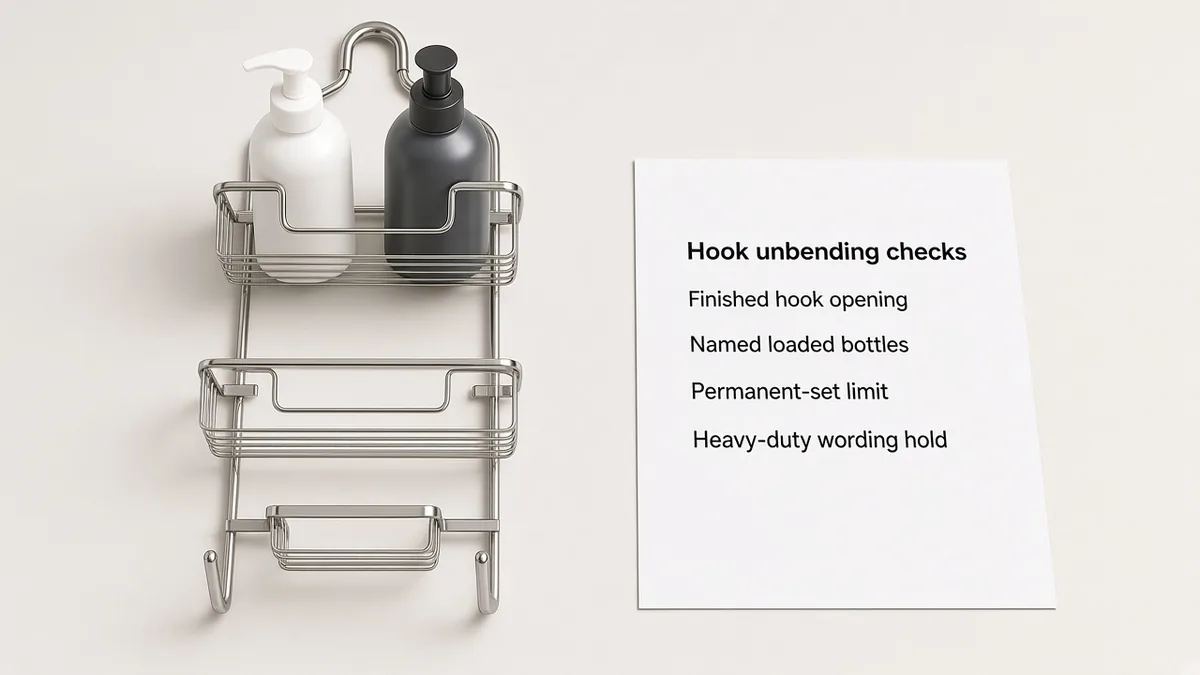
Koitor can review a hang-hook brief as part of custom shower caddy manufacturing. Send the drawing or the sample, the intended heavy-duty or bottle sentence, the hook callout, and the bottle condition you want used.
Small-batch customization is possible depending on the product. MOQ can start from 100 pcs depending on the product, samples usually take 5–7 working days after details are confirmed, and bulk production usually takes 4–6 weeks depending on the project. A heavier hook wire or a new bend can change that discussion under careful approved wording.
A family-owned factory can hold a hook fixture and a retained caddy, but it cannot honestly promise that every later bottle size will stay within an unwritten opening. The buyer still owns the named condition and the artwork.
Incoming lots should include a hook-opening look against the retained sample, not only a count of caddies. A later bend die, a later welder, or a later wire lot can reopen shower caddy hook unbending even when the baskets look unchanged. Tick the hook on incoming photos, on the arm if you can.
If a distributor asks for a deeper basket on the same hook, treat it as a new load condition. A deeper basket moves the center of gravity and can open a hook that passed the first set of bottles.
Retail photography that stacks oversized bottles should be treated as a claim. If the photo is heavier than the named condition, either change the photo or change the check.
Warehouse stacking can pre-bend a hook if caddies are hung on each other in a carton. Inspect hooks after packing trials, not only after a line check on a bare arm.
When the datum, the named load, the set limit, and the bend inspection are written, a heavy-duty hook sentence can be considered. If the file only says “strong hook,” the opening is still an open claim.
A second plant should not inherit the yield claim by a fit photo. Remeasure the opening under the named bottles on the actual hook and finish.
Do not accept a crooked hang as a “tile problem” until the hook opening has been compared with the first article. Many crooked caddies are a set hook, not a bad arm.
Finish at the inner bend can hide a crack. After the check, look under raking light and, if needed, under a slight coat-safe magnification. A hairline in the coat is a reason to hold, not a reason to polish the photo.
If the caddy is sold with a stabilizer bar or a second upper hook, write whether that part is required for the yield claim. A photo that hides a stabilizer while the check used one is a mismatched claim.
Spare caddies shipped as replacements after a bent-hook complaint should be measured before they leave. A replacement that already sits at the limit will fail again and will look like a repeated defect.
Instruction diagrams should show bottles on the shelves you actually checked, not an overloaded artist’s impression. Translating the sheet is fine. Adding bottles in a redraw is a claim change.
Color extensions should rerun the check if the hook is recoated or made from a new wire lot. A black hook is not automatically the same spring as the chrome hook, even when the silhouette matches.
If a marketplace bullet lists both arm compatibility and a bottle count, split those bullets in the file. Compatibility comes from the fit method. The bottle count, if you use one, comes from this yield check. Mixing them in one unsourced bullet is how a fit pass becomes a fake strength claim.
Rain heads and unusual arm shapes can change how the hook sits even when the diameter looks familiar. If the listing shows a wide head or a square bar, include that shape in the hang attitude or exclude it. A check done only on a plain round arm will not automatically cover a flat bar.
Double-wire hooks should be measured as the assembly they are, not as two independent wires that are allowed to splay apart. If the two wires open like a claw, write that as a fail even when a mid-point opening looks acceptable. A claw that spreads will drop the caddy or scar the arm.
Coating build at the inner bend can make a hook feel tight on day one and then flake after set. Inspect the bend after the check, and do not use a thick coat as a substitute for wire or radius. A cosmetic fill at the bend is not a structural fix.
Returns language is often “cheap hook” or “caddy hangs crooked.” Ask for a photo of the hook on the arm, then overlay the opening against the retained sample. Many crooked hangs are a set hook, a missing stabilizer, or a hook that was installed backward, and those should be separated in the file rather than argued as a single quality debate.
If a club pack ships two caddies, check at least one hook from the pack as packed, not only a hand-built sample. Pack compression can pre-open a hook that passed on the bench.
Do not let a sales team add “for large family bottles” to a title after the sample used travel-size bottles. Change the condition, or change the title. The two cannot drift apart and still support the same claim.
Installer blogs sometimes hang a caddy from a shower curtain rod instead of the arm. If that use is not in the file, exclude it on the artwork or run a separate check on a named rod. A curtain rod is a different diameter, a different stiffness, and often a different failure, and it should not borrow the arm-hook yield claim.
When the retained hook, the named bottles, and the packing trial all stay inside the set limit, the heavy-duty line can be discussed. Until then, the honest sentence is that the hook fit the sample arm, not that it will stay closed in every shower.
Keep the retained hook, the last check date, and the bottle list in the same request so a new artwork review starts complete, and so a deeper basket is not approved on memory of the first opening alone.
Frequently asked questions
If the hook fits the sample arm, is a load check still needed?
Yes, if you will talk about bottles, heavy duty, or a hook that will not open. Fit and yield are different questions.
Do I have to print a kilogram rating?
No. You can write a named bottle condition and a set limit without inventing a carton rating. If a project later needs a force value, agree it separately after a sample.
Are the small hooks at the bottom of the caddy included?
No. Those accessory openings are a different file. This page is the hang hook over the arm.
What if the hook returns after I remove the bottles?
Measure after an agreed wait. Temporary opening that springs back is not the same as permanent set. Write both observations, and judge the claim on the set.
Can I use an adhesive replacement hook as a substitute part?
Not in this file. Adhesive hooks are a different product. A hanging caddy must be checked as a hanging caddy.
What should a first sample include?
The finished hanging caddy, a named sample arm, the hook measurements, and the bottles you intend to use in the check. A dry-fit photo without bottles is not a yield sample.
Work With Koitor Hardware
Need a hanging-caddy hook yield brief reviewed?
Send Koitor the drawing or sample, the intended hook or bottle sentence, and the load condition you want used. Our team can review the hang hook, the check, and small-batch OEM options before quotation, without inventing a load rating.
OEM / PRIVATE LABEL
Turn this sourcing guide into a product brief
Share your target product, size, finish, order quantity and packaging requirements. Your team receives a practical manufacturability review before quotation.
 English
 Español
 Português
 Français
 Deutsch
 العربية