
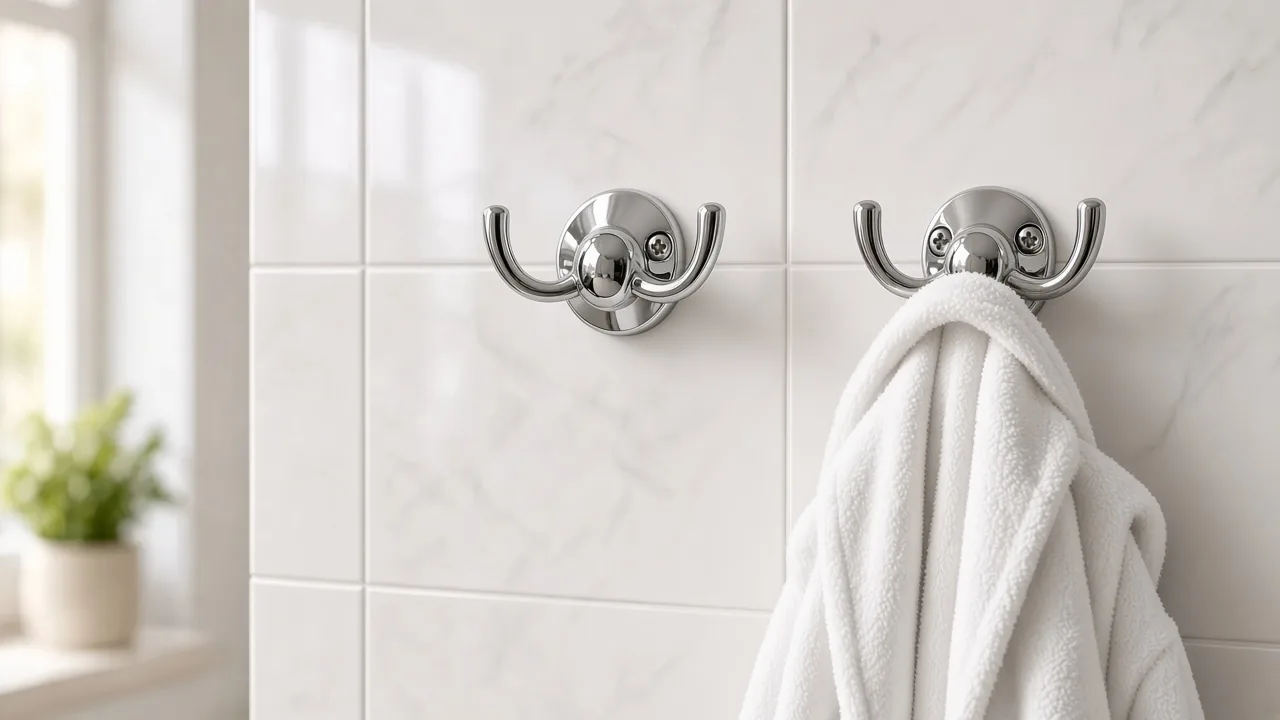
A towel-bar load file is not hook evidence. Robe hook weight capacity should be frozen as a hook-specific method: the mount, the load point, a wet-versus-dry condition, and a duration the sample room will actually run. If those items are not written, a printed weight or a “holds a wet robe” line should stay off the carton. Do not invent a safe-load number in this article, and do not rename a bar test as if it were a hook test.
This guide is for importers and private-label teams writing a screw-mounted robe hook specification. It does not own hook-tip geometry for loop retention, double-hook spacing, or towel-bar load methods. Koitor Hardware, a family-owned China OEM manufacturer of bathroom and home-storage metal hardware, can review a hook-load brief with a drawing or a sample; the buyer still has to name the condition and the claim.
Why a towel-bar checklist cannot be renamed into a robe-hook article
A towel bar spreads a load along a rod and usually into two or more posts. A robe hook concentrates a load at one flange, one or two arms, and a short moment arm from the wall. The failure signs are different: a bar may bow or loosen a post; a hook may bend at the neck, rotate the flange, pull a screw, or let a wet robe slip off the tip.
A weight or wet-robe line is a substantiation problem. Advertising claims need a reasonable basis before they are made; the U.S. FTC Policy Statement Regarding Advertising Substantiation is a useful reminder of that duty, not a Koitor laboratory result. The file should say what was hung, whether it was wet or dry, where it sat on the hook, how the hook was mounted, and how long the condition lasted.
Custom bathroom towel rack manufacturing is the right commercial path when the SKU is a bar or a rack. That product family can have its own load file. This page does not borrow that file, and it does not publish a bar rating under a hook photograph.
Worked example: artwork says the hook “holds a heavy wet robe.” The only report in the folder is a towel-bar load check from a different program, with no hook specimen. The bar may have been acceptable. The hook claim has no evidence.
Worked example: a dry robe is hung on a first article for a photograph. A shopper hangs a soaked bath robe after a shower and the arm takes a set, or the flange loosens. The dry photo was not a wet method. The wet condition was never written.
Tip radius and loop retention belong on a geometry page. A hook can hold a loop and still be the wrong evidence for a weight line. Spacing between two hooks on a plate belongs on a spacing page. Do not write a snag essay here, and do not treat spacing as a load file.
Which wet-versus-dry conditions belong in the RFQ?
Write whether the claim is a dry garment, a wet robe, or both. A wet robe is not “the same robe, slightly heavier.” Water adds weight and can change how the fabric sits on the arm, how long the load stays, and whether the hook is also in a wet room. If the listing shows a bathroom and a damp robe, the wet condition belongs in the file.
Name the garment or a stand-in in project language: a retained house robe, a named bath sheet, or another agreed piece. “A standard robe” is not a condition. If the brand will sell the hook next to a house robe, use that robe. If the brand will not, pick a conservative wet condition and write exclusions for heavier pieces, such as a soaked bath sheet or two garments on one arm, if those uses will be shown or implied.
Do not invent a kilogram, pound, or Newton figure in this article or on the artwork unless the project has actually run that figure and the buyer has agreed it. This page will not supply a Koitor safe-load number. If a number is later printed, it must come from the hook-specific file, not from a bar test and not from a guess.
Say whether one arm or both arms of a double hook are loaded, and whether two garments may share the hook. A double hook photographed with one light garment is not evidence for two wet robes. If the SKU is a single hook, do not use a double-hook report as a substitute.
Duration matters. A one-minute photo hang is not the same as an overnight wet robe, or a repeated daily hang. Write the duration or the number of hangs the sample room will actually run. Do not invent a cycle badge. A qualitative “after a night in the wet condition” is usable only if “night” is then turned into a stated hold time for the lab bench.
Wet-room exposure on the hook itself is a related but separate observation. A hook can carry a dry garment and still stain or loosen because the flange sits in a shower zone. If rust or finish wear is the question, write that as a finish or observation file. If the printed line is about weight or a wet robe, keep the load method in its own clause.
Custom bathroom hardware manufacturing can quote a robe hook, but only if the inquiry lists the intended listing phrase and the wet-versus-dry condition. A request that only says “heavy duty hook” is not yet a claim file.
If the brand will sell both a light powder-coated hook and a solid brass or stainless hook under similar photography, keep two files. The neck, the flange, and the screws may not behave the same. A shared lifestyle photo is not a shared load file.
How should mount, load point, and duration be written without inventing a rating?
Name the mount as it will be sold and installed: screw-through flange into a named backing, a concealed bracket, or another agreed method. A hook held on a bench, or clamped to a test plate that the shopper will never have, is not the same as a hook on the intended wall construction. Write the backing you will actually use in the sample room, and write any wall constructions that are excluded from the claim.
Load point should be written because the arm is a lever. A garment hung at the tip is a harsher moment than a garment seated in the bend. If the photography shows a robe on the tip, the method should use the tip, or the photo should be changed. If the design is meant to seat the loop in the bend, say so, and check that a wet robe still sits there.
Screws, anchors, and backplates are part of the hook system when they are in the box. If the listing includes anchors, those anchors belong in the method. If the listing leaves anchors to the installer, the claim must not imply a wall type you have not named. “Works on any wall” is a claim of its own and should stay off the artwork until a backing list exists.
Record what you will look at after the condition: permanent set in the arm or neck, rotation of the flange, loosened screws, cracked coating at the neck, and whether the garment is still on the hook. Those signs can be written without a numeric rating. If a project later wants a number, add it only after the hook-specific method has been run, and keep the number in the project file, not as a generic factory rating in this article.
Keep the load method separate from any sampling plan. You may later agree how many hooks in a lot are checked, using a scheme such as ISO 2859-1 if both sides want a sampling standard. That scheme does not define a wet-robe condition or a safe-load number.
A person should not be asked to invent a body-weight demonstration, and a photograph should not show an unrealistic hanging stunt. The method should be a garment or an agreed stand-in, in a workshop or a sample room, with no printed number on the hook in the photo.
Substitution is a change-control event. If production later changes the neck section, the zinc or stainless family, the screw length, or the flange thickness, the hook-load file is open again. A first-article pass does not travel with a silent substitute.
Zinc-versus-stainless material choice is a different, occupied decision and must not be republished here. This page may say only that a material change reopens the load file, then return to the wet-versus-dry method.
| Claim element | What to freeze | What a hook sample should show | What to keep off artwork until then |
|---|---|---|---|
| Wet or dry condition | Dry garment, wet robe, or both, with a named piece or stand-in | The named condition is the one in the photograph and the method | A dry photo used to support a wet-robe line |
| Mount and backing | The sold mount method and the backing used in the sample room, plus exclusions | The hook is installed as sold, not only hand-held on a bench | “Works on any wall” with no backing list |
| Load point | Tip, bend, one arm or both arms, and whether two garments are allowed | The garment sits at the written point for the written duration | A tip photo used to imply a milder bend condition, or the reverse |
| Duration or repeats | A hold time or a number of hangs the sample room will actually run | The hook is observed after that time, including set and loosening | A one-minute beauty hang used as an overnight claim |
| Evidence source | A hook-specific file, not a renamed towel-bar report | The specimen is the hook SKU, with photographs and notes | A bar-load report placed behind a hook listing |
| Number on artwork | No printed weight unless the project has run that hook-specific figure | If a number later appears, it matches the hook file exactly | A guessed capacity or a bar number printed on a hook carton |

What artwork should stay off the carton until the file exists?
Once the condition, the mount, the load point, and the duration exist, choose words the file can support. “Designed to hold the named house robe in the written wet condition” is closer to a file than a bold capacity badge. If the file is incomplete, stay silent on the carton, the insert, and the online title.
Do not print a guessed robe hook weight capacity, and do not print a number taken from a towel bar, a competitor card, or a generic “heavy duty” habit. If you do not yet have a hook-specific figure, omit the number. Silence is safer than a figure this article cannot honestly supply.
Do not print an open-ended strength slogan, and do not write a slogan that the hook cannot fail. Those phrases overstate what one sample condition can prove.
Photography should show the named garment at the written load point, or should be captioned so a shopper is not shown a dry hand towel as if it were a soaked bath robe. A hero image that hides the flange can also hide a mount that is not the sold mount. Keep at least one photograph of the installed hook.
Translations must keep the wet-or-dry limit and any number, if one later exists, together. A version that drops “wet” and keeps a weight is a new claim. A version that adds a number the English file does not have is also a new claim.
Channel copy should follow the same file. A marketplace bullet that adds a capacity the carton does not carry is still a claim. Align the bullet with the hook file, or leave the bullet silent.
Instructions should not undo the method. If the sheet tells the shopper to use heavier anchors than the box includes, to avoid wet garments, or to mount only into studs, that limit belongs in the artwork or in an exclusion. An instruction that the listing contradicts is a claim conflict.
What belongs on the geometry or spacing pages instead?
Opening, throat, tip radius, and whether a loop stays on the hook belong on the retention-geometry page. Those URLs are omitted from the official internal-link list and are not used as links here. This page may mention the tip only as a load point, not as a snag or loop essay.
Distance between two hooks on one plate, and whether two robes clear each other, belong on a spacing page. Spacing is not a load method. A correctly spaced double hook still needs a hook-specific wet-versus-dry file if a weight or wet-robe line will be printed.
Towel-bar load methods stay on the bar product. Do not paste a bar checklist into a hook folder and change the title. If a buyer asks for both a bar and a hook in one program, keep two evidence files.
Suction or adhesive hooks are a different mount and a different claim kit. This page stays on a screw-mounted robe hook. Do not copy a suction rating language onto this SKU, and do not use this file to clear a suction hook.
Coat racks, purse hooks, and under-table hooks are different products and, in some cases, different environments. They should not inherit a bathroom wet-robe file by the word “hook” alone.
Sets of hooks sold on one rail or as a matching pair should be described honestly. A rail with several hooks is closer to a hook-rail product than to a single flange hook, and it may need its own mount and spacing file as well as a load condition for each hook or for the rail. Do not copy a single-hook file onto a rail by finish color alone.
Packing and incoming inspection matter because a bent neck from transit is not a load-method failure. Record the incoming arm shape before the wet or dry condition begins. A hook that already has a set from the carton will confuse later notes and can be unfairly blamed on the method.
If the inquiry is still early and no garment has been chosen, you can freeze a written wet-versus-dry rule and a mount method as a holding brief, then add the named garment before artwork is released. Do not print a weight or a wet-robe line while the holding brief is the only thing in the file. Convert it into a hook-specific condition and a run record first.
Private-label buyers sometimes inherit a factory “usual capacity” phrase from a previous hook. That habit is not evidence. Ask for the current hook drawing, the current screws, and a condition you are willing to run, before the first article is signed. A phrase that was used on another flange will not automatically clear this listing.
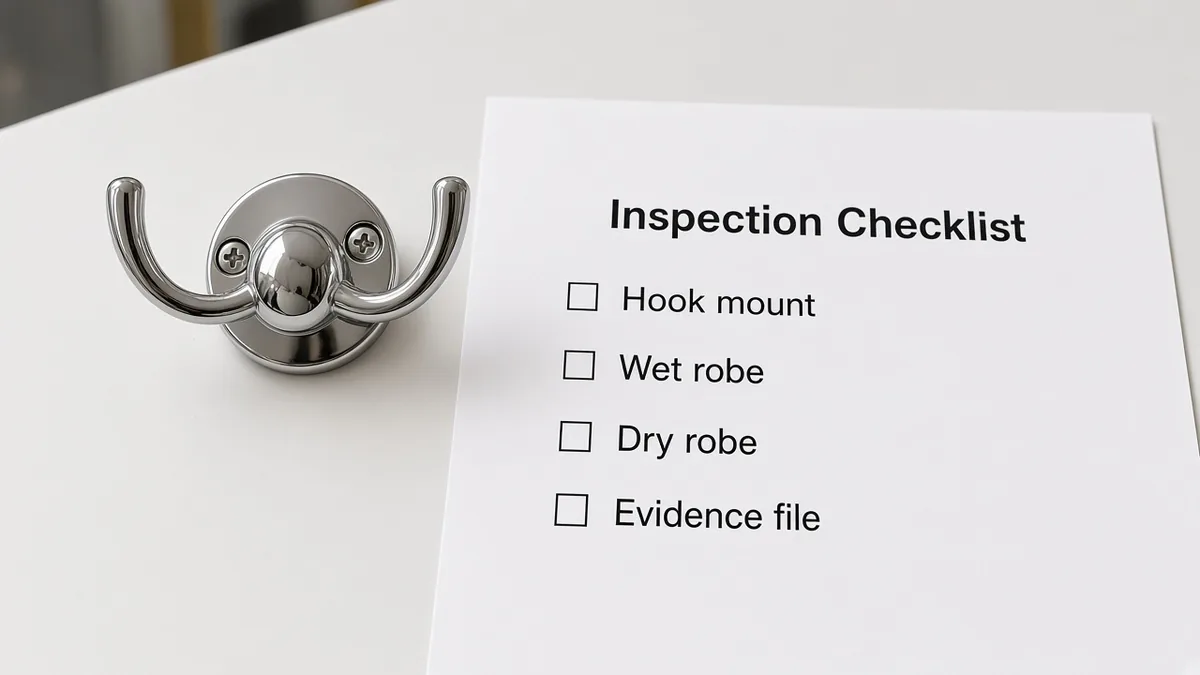
Buyer checklist for robe hook wet-load evidence
Use this list before a weight or wet-robe line is approved for a screw-mounted robe hook.
- Treat robe hook weight capacity as a hook-specific file, and do not rename a towel-bar load report to stand in for the hook.
- Write a wet or dry condition, with a named garment or stand-in, and make the photography follow that condition.
- Name the sold mount method, the backing used in the sample room, and any wall constructions that are excluded.
- Write the load point: tip or bend, one arm or both, and whether two garments are allowed.
- Write a duration or a number of hangs the sample room will actually run, without inventing a cycle badge.
- Record set, loosening, and whether the garment is still on the hook, and keep that method out of any sampling-plan clause.
- Do not print a kilogram, pound, or Newton figure unless the project has run that hook-specific number; this article does not supply one.
- Leave tip-radius geometry, double-hook spacing, and bar-load methods on their own pages.
- Align carton, insert, and marketplace bullets with the hook file; do not print an open-ended strength slogan.
- Send the drawing or sample, the intended listing phrase, and the wet-versus-dry condition with the inquiry.
Frequently asked questions
Can I use our towel-bar load report for the hook?
No. A bar and a hook do not share the same mount, the same moment arm, or the same failure signs. Freeze a hook-specific file, or keep a weight line off the hook artwork.
We need a number for the website. What should we print?
Print a number only if the project has run a hook-specific method and both sides have agreed the figure. This article does not provide a Koitor safe-load number, and a guessed figure should stay off the site.
Is a dry robe in a lifestyle photo enough for a wet-robe bullet?
No. A dry hang is a different condition. If the bullet or the bathroom photo implies a wet robe, write and run a wet condition.
Does a double hook need two methods?
It needs a written rule for one arm versus both arms, and for one garment versus two. A single light garment on one arm is not evidence for two wet robes.
What if we stay silent on capacity?
That is an acceptable outcome. Silence is better than a figure or a wet-robe line the file cannot support. You can still keep an internal hook method for quality even when artwork stays quiet.
What should a first sample include?
The finished screw-mounted hook, the intended mount and backing, a written wet-or-dry condition, the load point and duration, photographs after the condition, and the intended listing phrase or an explicit decision to stay silent and to omit any number.
Work With Koitor Hardware
Need a robe-hook evidence brief reviewed?
Send Koitor your drawing or sample, the intended listing phrase, and the wet-versus-dry condition you want in the file. Our team can review hook-specific evidence setup before quotation, without inventing a load number. MOQ can start from about 100 pcs depending on the product; samples usually take 5–7 working days after details are confirmed; bulk production usually takes 4–6 weeks depending on the project.
OEM / PRIVATE LABEL
Turn this sourcing guide into a product brief
Share your target product, size, finish, order quantity and packaging requirements. Your team receives a practical manufacturability review before quotation.
 English
 Español
 Português
 Français
 Deutsch
 العربية