
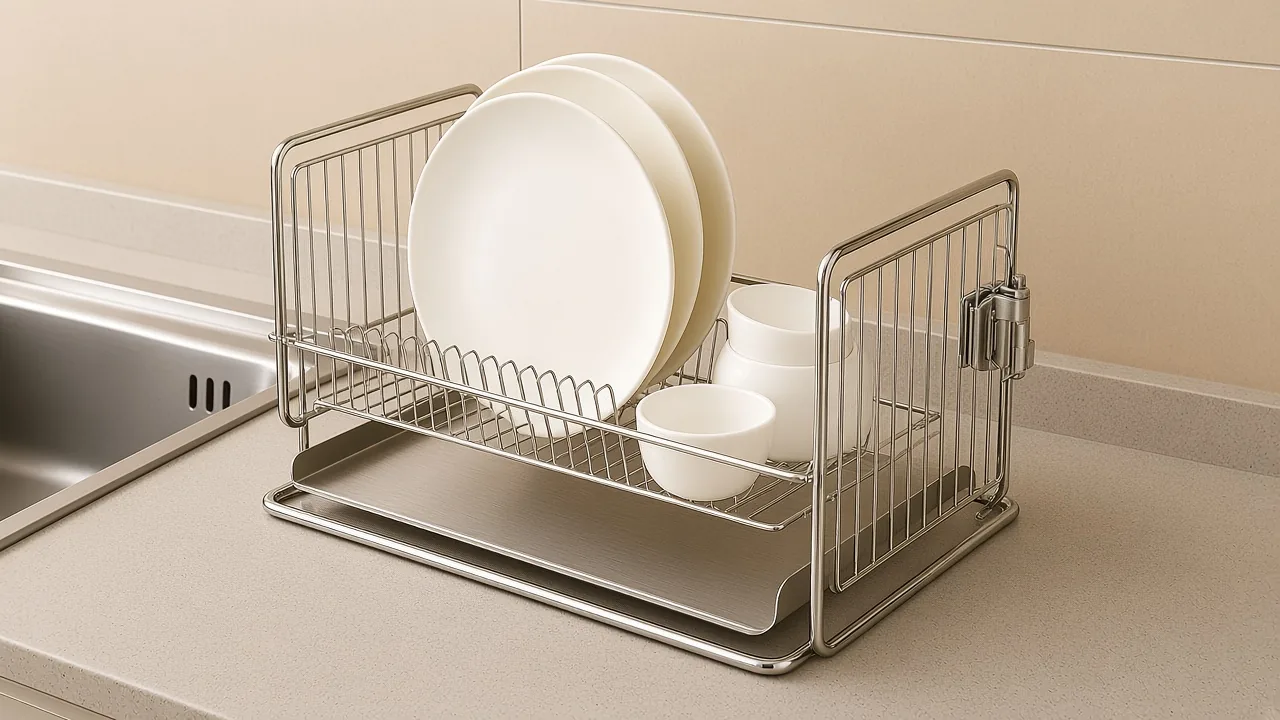
A detent can be geometrically correct and still be the wrong material in rinse water. A folding dish rack latch should be frozen as a named part: the construction, the material family after the sample is agreed, a wet-sink observation, and a fail rule you can inspect. Open-position stability is a different file. Hinge-coating rust is a different file and is not written here.
This guide is for importers and private-label teams writing a folding or collapsible metal dish rack specification. It does not own roll-up ledge fit, plate-count tines, or a stand-alone hinge-rust article. Koitor Hardware, a family-owned China OEM manufacturer of kitchen and home-storage metal hardware, can review a latch brief with a drawing or a sample; the buyer still has to name the part and the wet condition.
Why a stability file does not clear the latch material
A stability file asks whether the rack stays open under plates, and whether it tips or folds when loaded. The latch or detent may appear in that file as a feature that holds the frame. That mention is not a material approval, and it is not a wet-sink observation of the catch itself.
A “stays open” or “locks securely” line is a substantiation problem when the latch is a plastic clip, a mixed-metal catch, or a part that sits in rinse water. Advertising claims need a reasonable basis before they are made; the U.S. FTC Policy Statement Regarding Advertising Substantiation is a useful reminder of that duty, not a Koitor laboratory result. The file should say what the latch is, how it is observed wet, and what a fail looks like.
Worked example: a first article stays open on a dry bench and passes a stability check. After a week beside the sink, the plastic detent creeps, swells, or cracks, and the rack folds when a plate is added. The geometry was not the whole story. The wet material file was missing.
Worked example: the metal catch is the right shape, but it rusts at the pin or stains the frame. Shoppers see brown at the latch even though the rack still stands. Finish at the catch is part of this file, not a reason to rewrite a hinge-coating article.
Custom kitchen storage rack manufacturing can quote a folding dish rack, but only if the inquiry lists the latch construction and the intended listing language. A request that only says “folding rack that stays open” is a stability brief, not a latch-material brief.
Roll-up racks are a different structure. Roll-up sink drying rack ledge fit belongs in the reading path when the SKU rolls rather than folds on a latch. Do not copy a folding-latch file onto a roll-up rack, and do not use a ledge-fit pass to clear a folding catch.
Which latch or detent constructions should the RFQ name?
Name the construction for the SKU that will be sold: a plastic over-center clip, a plastic tab into a wire loop, a metal hinged catch, a sliding sleeve, a pin-and-slot detent, or another agreed part. “It just folds” is not a construction. If the rack uses more than one latch, left and right, name both, and say whether they are identical.
Write the material family after the sample is agreed: a named plastic family, a coated or plated steel catch, a stainless catch, or a mixed assembly with a plastic paddle and a metal pin. Do not invent a Koitor resin grade or a trade-name compound in this article. If the buyer needs a specific grade, that grade is a project input, not a factory default implied here.
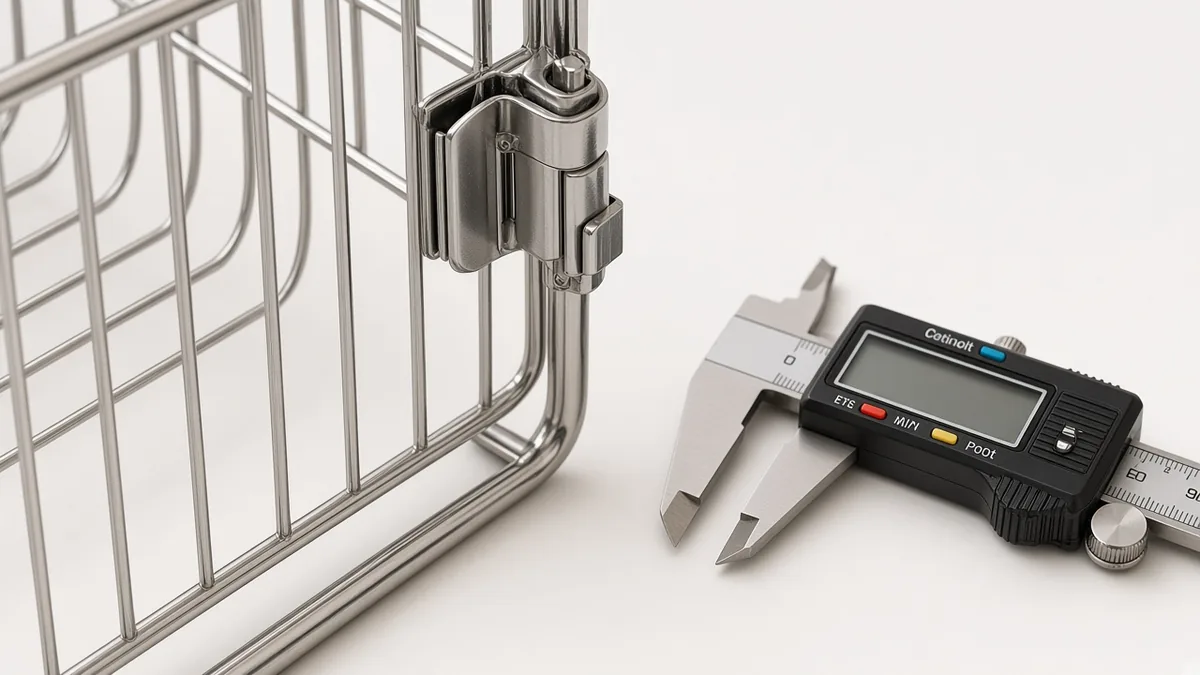
The pin, rivet, or living hinge that the latch turns on is part of the part. A handsome paddle with a rusting pin is still a latch failure. Include the pin, the bushing, and any small screw in the named construction.
Color and finish are not the material. A matching grey clip can be a different compound from a previous grey clip. If production changes supplier or color masterbatch, the wet file is open again. A first-article pass does not travel with a silent substitute.
Service versus integral construction should be written. If the latch can be replaced, say how it comes off, whether a spare is in the box, and how a missing latch is treated in acceptance. If the latch is formed as part of the side frame and cannot be replaced, say so, because a fail may retire the rack rather than a clip.
Location in the wet zone matters. A latch at the lower side, near the drain tray, sees more standing water than a high, open clip. Kitchen sink dish rack drainage design helps when water path and drip trays are the question. This page only asks whether that water sits on the latch, and what the latch is made of.
Do not invent a universal latch design. Wire folding racks, tubular folding racks, and racks that fold flat for packing do not share every catch. The drawing or the retained sample should freeze the part for that program.
If a magnet or a spring assists the catch, name that helper as well. A hidden spring can rust or lose force in a wet sink while the visible paddle still looks correct. Hidden helpers belong on the list.
What wet-environment proof can be agreed without inventing a cycle count?
Write a simple wet-sink method that the sample room can repeat. Name whether the latch is rinsed, left wet, or placed under the drain-tray drip path, the hold time or the number of open-and-close moves you will actually run, and the installed or in-use attitude of the rack. Then look at engagement, cracks, swelling, rust at the pin, and whether the rack still stays open or stays folded as designed.
Do not invent a Koitor cycle count or a dishwasher badge here. If the listing will say the rack is dishwasher-safe, that is a separate claim and needs its own agreed method. A sink-side rinse is not a dishwasher cycle, and a folding motion on a dry bench is not a wet-sink proof.
Keep the observation method separate from any sampling plan. You may later agree how many racks in a lot are checked, using a scheme such as ISO 2859-1 if both sides want a sampling standard. That scheme does not define the latch material or the wet condition.
Plastic creep and stress whitening should be in the fail language if the catch is plastic. A clip can still “fit” and no longer hold after it takes a set. Metal catches should include rust, staining, and a pin that binds. Write the signs in project language you can photograph.
Temperature and cleaner exposure can be named only as project conditions, not as invented ratings. If the brand wants a hot-rinse or a named cleaner in the method, write that after both sides agree. Do not assume a household habit in the sample room unless it is written.
If production later changes the latch supplier, the pin finish, or the detent geometry, the wet file is open again. Record incoming latch condition as well, so a cracked clip from packing is not blamed on the wet method.
Loaded versus empty checks are different. A latch that holds an empty frame may open when plates are added, or may be hard to release when the frame is loaded. If the listing shows a loaded rack, the wet method should include the named load from the stability file or a stated empty-frame limit. Do not let the two files silently disagree.
| Latch decision | What to freeze | What a wet sample should show | What to keep off artwork until then |
|---|---|---|---|
| Construction | Clip, catch, sleeve, pin-and-slot, or another named part, including left and right if both exist | The part on the sample matches the drawing | A “locks securely” line with no part named |
| Material family | Plastic family, coated or stainless metal, or a mixed paddle and pin, after the sample is agreed | The named family is the one in the wet observation | A color match used as if it were a material match |
| Wet-sink method | Rinse or drip path, hold time or moves you will actually run, and attitude | Engagement still works after that method, without invented cycles | A dry-bench fold used as a wet-sink claim |
| Fail signs | Crack, creep, no engagement, rust at the pin, or binding, as the project writes them | Those signs are photographed and used as accept or reject | A vague “feels loose” note with no sign list |
| Service part | Whether the latch can be replaced, and how a missing latch is treated | A spare, if claimed, is in the box and fits | A service-part bullet when the latch is integral and not replaceable |
| Neighbor files | Open-position stability and hinge-coating rust stay in their own documents | A stability pass does not approve the latch material | A stability sentence used as a latch-material line |
When should the latch be a service part?
A service latch is useful when the catch is the part most likely to wear, crack, or rust, and when the frame is otherwise acceptable. Write whether a spare is packed, whether replacements will be offered, and how the shopper or the buyer removes the old part without damaging the side frame.
If the latch is a cheap clip and the frame is the expensive weldment, a service path can reduce returns. If the latch is a formed wire that is the frame, a service story on the carton is misleading. Match the artwork to the construction.
Instructions should show the release direction. A clip that is easy to break during folding will generate complaints that look like “the latch failed in use” when the real issue was a poorly marked release. The instruction is part of the brief, not an afterthought in translation.
Replacement color and material must follow the wet file. A spare in a different compound, or a bare metal spare for a coated catch, reopens the observation. Pack spares dry, and describe them honestly if they can rust in a bag.
Warranty language is out of scope for this article. Do not print a lifetime promise, and do not invent a spare-parts term. If a buyer wants a service policy, that policy is a commercial agreement after the part is named.
What belongs on the stability page or the hinge-rust page instead?
Open-position geometry, foot stance, and whether the rack tips with plates belong on the hinge-stability page. That live neighbor is not used as a link here because it is not in the official internal-link list. This page may mention loaded-versus-empty only as it affects the latch, then return to the part.
Pivot coating cracks and hinge rust belong on the unused hinge-rust topic and must not be written as the core of this article. A rusting hinge barrel is not the same part as a side latch, even when they sit near each other. If both fail, keep two sentences and two files.
Plate-count tines, utensil cups, and drain-tray fit stay on their own pages. A latch can be acceptable and the tines still wrong. Do not merge those checks into one “folding rack quality” paragraph.
Channel copy should follow the latch file. A marketplace bullet that says “heavy duty lock” when the catch is an untested plastic clip is still a claim. Align the bullet with the named part and the wet method, or leave the bullet silent.
If the same latch artwork will be used on a folding laundry rack or another folding product, do not copy this wet-sink file by the word “folding.” A laundry rack and a dish rack do not share the same rinse environment. Freeze the part on the SKU that will actually sit beside a sink.
Child-resistant or “hard to release” language, if someone asks for it, is a different claim and is easy to get wrong. A latch that is hard to open can also be hard to close, or can be forced until it cracks. Do not print that kind of phrase unless the project has a written release method. This page does not supply one.
Finish families can share a frame and not share a latch. A chrome rack with a stainless catch and a powder-coated rack with a plastic clip are two files, even if the fold geometry looks similar in a catalog. If the program will offer more than one finish, name the latch for each SKU.
Incoming inspection of packed racks should include a fold-and-engage check before any wet method, because a latch bent in transit is not a material fail. Record the incoming engagement, then run the wet method, then record the outgoing engagement. That order keeps packing damage and wet-sink damage from being mixed in one note.
Private-label buyers sometimes inherit a factory “usual clip” from a previous folding rack. That habit is not a method. Ask for the current latch drawing, the current compound or metal, and a wet condition you are willing to run, before the first article is signed. A clip that survived another brand’s dry packing rack will not automatically clear a sink-side dish rack.
If the inquiry is still early and the latch is not chosen, you can freeze a written requirement that the catch be named and observed wet before artwork is released. Do not print a lock line while that holding rule is the only thing in the file. Convert it into a named part, a material family, and a wet-method record first.
Translations must keep the part name and the wet limit together. A version that turns “plastic side clip, observed after rinse” into a short “heavy lock” adjective is a new, stronger claim and should be blocked until the file is updated.
Spares packed with the rack should be counted and fitted, not only mentioned in a bullet. A spare that does not match the pin diameter, or that arrives already cracked, is a packing fail, not a later wet-sink fail. Check the spare on the first article the same day you check the installed latch.
If the brand later adds a utensil cup or a drain board that sits against the latch, update the wet method. A new accessory can drip on a catch that used to stay relatively dry, or can block a release path and cause shoppers to force the clip. Re-run the wet method whenever that accessory becomes part of the sold set.
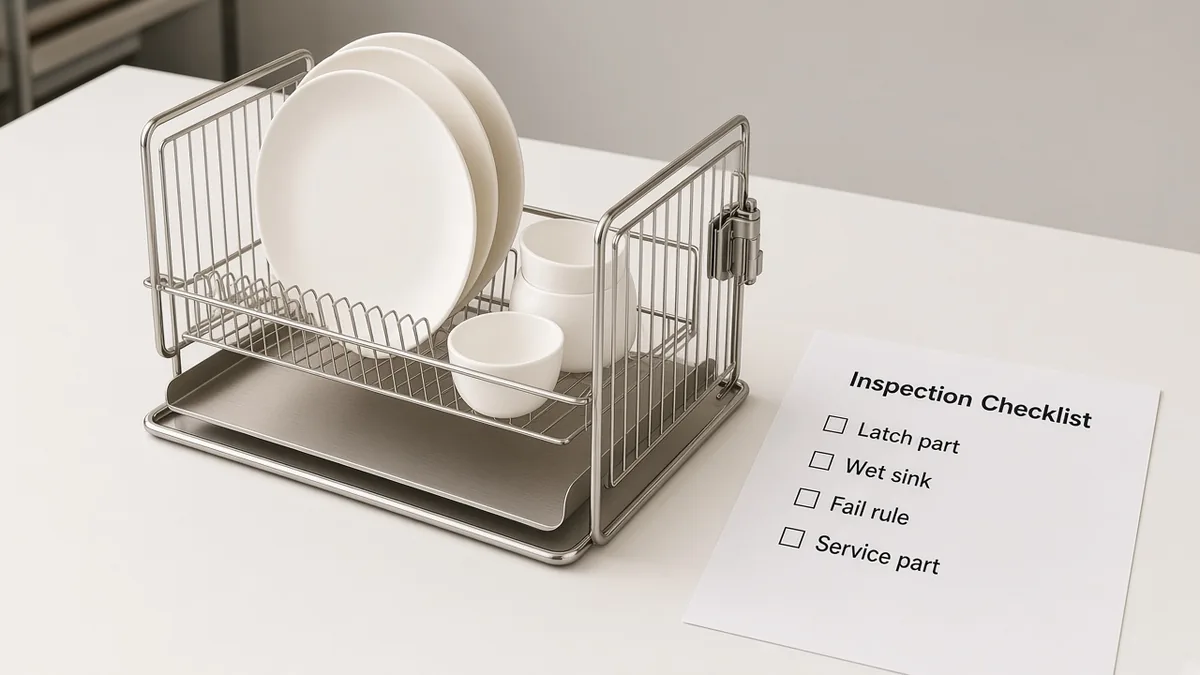
Buyer checklist for a folding dish rack latch
Use this list before a “stays locked” or similar line is approved for a folding metal dish rack.
- Keep open-position stability and the folding dish rack latch in separate files, and do not let a dry stability pass approve the catch material.
- Name the latch construction, including pins, left and right parts, and any hidden spring or magnet.
- Write the material family after the sample is agreed, and treat a supplier or compound change as a new file.
- Write a wet-sink method with a hold time or a number of folds you will actually run, without inventing a cycle badge or a dishwasher rating.
- Record fail signs you can photograph: crack, creep, no engagement, rust at the pin, or binding.
- Say whether the latch is a service part, whether a spare is packed, and how a missing latch is treated.
- Keep the observation method out of any sampling-plan clause.
- Leave hinge-coating rust, roll-up ledge fit, and plate-count tines on their own pages.
- Align carton, insert, and marketplace bullets with the named part; do not print an open-ended lock slogan or a lifetime promise.
- Send the drawing or sample, the latch description, and the intended listing phrase with the inquiry.
Frequently asked questions
The rack stays open on the bench. Why is the latch still an issue?
A dry, empty, or first-day hold is a stability snapshot. The latch can creep, crack, or rust after rinse water. Freeze the part and a wet method separately.
Can I use a cycle number from another folding product?
No. Do not invent or import a cycle count. Write the number of folds or the hold time this sample room will run on this dish-rack latch.
Is hinge rust the same file?
No. Hinge-coating rust is a different decision and is not the subject of this page. A rusty pivot and a failed side catch can happen together, but they still need two records.
Should the latch be replaceable?
Only if the construction allows it and the artwork tells the truth. An integral formed catch should not be sold as a service part. If a spare is claimed, pack it and check that it fits.
Does a drain-tray pass help the latch?
Only in the narrow sense that you then know where water goes. A good drain path can still drip on a lower latch. Put that drip in the wet method if it happens on the SKU.
What should a first sample include?
The finished folding rack, a clear view of each latch, the named construction and material family, a written wet-sink method and result, a fail-sign list, the service-part rule, and the intended listing phrase or an explicit decision to stay silent.
Work With Koitor Hardware
Need a folding-rack latch brief reviewed?
Send Koitor your drawing or sample, the latch construction, and the intended listing phrase. Our team can review the catch as a wet-sink part before quotation, without inventing a cycle count. MOQ can start from about 100 pcs depending on the product; samples usually take 5–7 working days after details are confirmed; bulk production usually takes 4–6 weeks depending on the project.
OEM / PRIVATE LABEL
Turn this sourcing guide into a product brief
Share your target product, size, finish, order quantity and packaging requirements. Your team receives a practical manufacturability review before quotation.
 English
 Español
 Português
 Français
 Deutsch
 العربية