
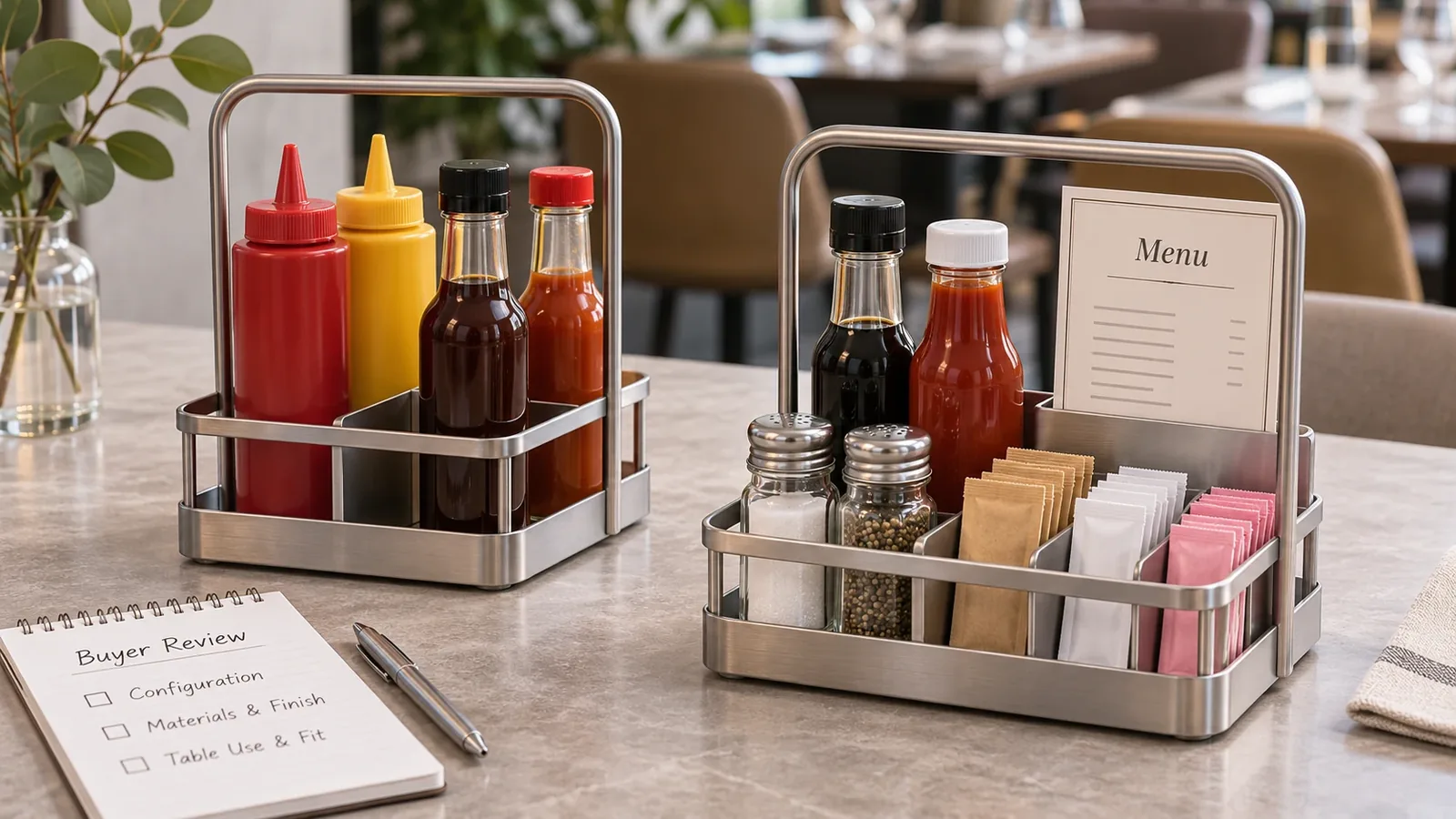
Short answer: Choose a condiment caddy around the table-service set the buyer actually intends to sell or use. A bottle-only carrier, a mixed bottle-and-packet holder, and a configuration with a paper or menu insert are different purchasing scopes. Identify the exact bottles, shakers, packets or paper items, match them to a named caddy model, and record which components are included, excluded or supplied by another party. A product photograph showing several containers does not prove that those containers come with the caddy or that another brand’s containers fit.
This guide is about B2B assortment definition and complete-SKU control. It does not establish food-contact compliance, hygiene, cleaning performance, weather resistance, carrying capacity or stability. Those claims require evidence for the exact product and the responsible manufacturer. The buyer’s task here is narrower: select the carrier architecture, match the documented references and prevent the commercial description from promising an imaginary bundle.
Current manufacturer pages demonstrate several distinct arrangements. Spectrum’s open steel caddy is described as carrying bottles, jars and dispensers, a broad open-caddy concept. Tablecraft’s SBC4 is specified for a particular bottle format and lists bottles as excluded while describing a front graphic-insert feature. Its 591C combination rack identifies selected container and packet positions and names compatible Tablecraft references. Another Tablecraft page for a paper-towel holder describes a different combination that includes a roll position and bottle or shaker provision. These pages show alternative SKU architectures; they are not evidence that the components are interchangeable across brands or that every described item is included. Review the Spectrum caddy page, Tablecraft SBC4, Tablecraft 591C combination rack and Tablecraft black paper-towel holder for the named maker details.
Define the table-service set before selecting a carrier
A condiment caddy should be selected around the intended service set, not chosen by appearance alone.
Begin with the service task, not a catalog photo. Is the buyer preparing a set of squeeze bottles for a counter or table? Does the assortment include salt or pepper containers, sachets, napkins, a paper roll, a menu card or a printed insert? Which of those items must travel together, and which remain at the service station? If the answer is “bottles only,” a mixed holder may create unnecessary compartments or an inaccurate package promise. If the buyer needs several functions together, a simple open carrier may not include the required positions.
List the actual items by reference wherever possible. A container can have a similar silhouette and still differ in a way that affects the selected holder. If the manufacturer names compatible bottles or shakers, retain those references in the product file. If the buyer is sourcing containers separately, make that responsibility explicit and request confirmation from the relevant maker. Do not treat a nominal capacity, material description or product family name as a fit guarantee.
Separate the intended use from a marketing category. “Condiment caddy” can describe open carriers, dedicated bottle organizers, combination racks or foodservice table accessories. Decide whether the buyer needs an item to carry products between locations, to present a stable table-service set, to organize packets, or to combine those functions. These tasks may overlap, but they should not be assumed to be identical.
The buyer should also decide whether the assortment is meant to be modular. A fixed mixed configuration can be easier to explain as a complete SKU if every included part is frozen. A modular offer may give a distributor flexibility, but it requires clear part references and rules for which accessories can be paired. Avoid presenting different products from different manufacturer pages as if they formed one tested system unless the responsible suppliers have confirmed the combination.
Compare bottle-only and mixed configurations
A bottle-specific caddy is defined by the bottle references and the carrier designed around them. The selected Tablecraft SBC4 page, for example, names a bottle format and identifies bottles as not included. That distinction is useful for procurement: the carrier is one line item, and the containers are a separate purchase unless the order expressly bundles them. Do not convert its listed count or dimensions into a generic bottle compatibility rule.
A mixed service rack may combine positions for containers and packets or another table item. The 591C page names its mating container references and describes an arrangement of different positions. That supports a mixed configuration as a distinct buyer choice. It does not justify assuming that any other bottle will occupy the same space, that a ring represents a rated carrying handle, or that an advertised count describes every possible simultaneous arrangement. The exact maker drawing and product instructions govern.
A broader open carrier can be less prescriptive about how the contents are arranged, but the buyer still needs to decide which items are supplied and how the product will be described. “Holds bottles, jars and dispensers” is a manufacturer’s product statement for its named caddy; it does not establish a defined set or performance for a different model. A buyer may use a broad carrier for multiple assortments, but listing images and contents should show the actual option sold.
A paper-roll or menu-card feature introduces another interface. The Tablecraft paper-towel holder page describes a roll position and bottle or shaker provision; that is not the same architecture as a bottle-specific carrier or a packet rack. A graphic insert can be an empty slot supplied with a carrier while the printed artwork is created and inserted by the buyer. State who supplies the insert, who controls its content and which revision is used. Do not imply that a printed card, paper roll or container is included unless the BOM says so.
| Configuration | Buyer’s starting question | Reference to control | Scope that must be explicit |
|---|---|---|---|
| Bottle-only carrier | Which exact bottles or shakers belong in the set? | Carrier model and named container references | Whether containers are excluded or bundled |
| Mixed bottle and packet rack | Which functions are used at the same time? | Rack model plus maker-listed compatible items | Packet positions, containers and simultaneous arrangement |
| Open general carrier | Which assortment will the distributor display? | Exact carrier and sample contents | Which contents are illustrative versus included |
| Paper or menu provision | Is the slot for a roll, card or graphic insert? | Carrier model and insert/holder reference | Who supplies, prints and updates the paper item |
| Modular option | Which pieces can be combined? | Separate part numbers and maker confirmation | Compatibility, quantities, packaging and change owner |
Record included, excluded and purchased parts
The full commercial configuration is more than the metal carrier. A buyer may source bottles, shakers, packet containers, paper rolls, printed cards, grips, feet or packaging inserts from different suppliers. Each part should have an inclusion status and a responsible source. Use “included,” “optional,” “buyer-supplied,” “not included” or “not applicable” instead of allowing a photo to serve as the component schedule.
This is especially important for private-label and hospitality programs. The distributor may sell the caddy empty, with selected bottles, or as a complete service set. Those are different offers with different packaging and product information. If the box contains an empty caddy but the listing photo shows filled containers, the listing should make the distinction clear. If the buyer bundles bought-in parts, each part needs its own reference and a compatibility record.
For every accessory, identify whether it is a separate option or part of the standard configuration. The buyer should confirm quantity per carrier, whether the item is attached at the factory or added later, and how it will be protected in the package. If an accessory is only offered on another product page, do not assume it fits the selected carrier. Ask the maker or supplier to confirm the pairing for the exact model.
A merchandising ring, handle, cutout or grip should be described according to the maker’s documentation. Do not infer from appearance that a ring is intended to carry a loaded caddy or that a grip is made by the caddy supplier. The product may involve a bought-in wood or plastic component; responsibility for that part should be visible in the quotation and BOM. Capability claims about Koitor must remain limited to the verified metal scope.
Review access, refill and presentation on the sample
Once the intended service set is defined, review the actual sample with the selected references. Put only the documented containers and accessories in the caddy. Check whether each item can be placed in its intended position, removed for refill, and returned without changing another item’s location. This is an observation of one configuration, not a general fit guarantee for the container category.
If the carrier moves between a storage area and a table, observe the chosen handling task and record what is carried. Do not add a load claim unless the responsible maker provides an applicable method and evidence. A sample meeting is not an independent stability, safety or carrying test. If a project needs one, define the contents, setup, operator, route and acceptance criteria with the qualified product team.
For a packet or menu insert, review the paper item separately from the holder slot. Confirm the insert dimensions and orientation using the buyer’s actual approved artwork or a neutral sample card. Do not infer exact dimensions from a website photograph. A slot’s presence does not mean that a printed menu, brand card or instruction is supplied. If the insert changes frequently, assign a revision owner and decide how replacement cards will be ordered.
A mixed service set can change over a day. The buyer can map the intended service sequence: initial setup, refill, table or counter presentation, and end-of-service removal. This helps identify whether a packet holder should remain accessible when bottles are present or whether one component is only used for a promotional display. The purpose is to choose a configuration; it is not to make a hygiene or cleaning claim. Food-handling requirements remain with the relevant product and compliance owners.
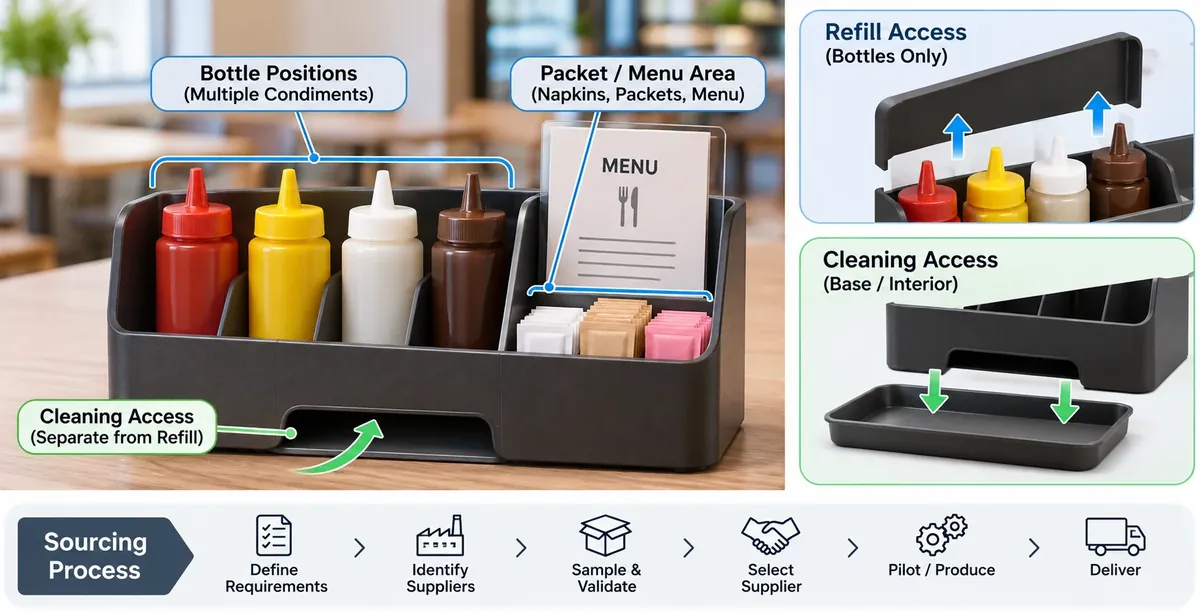
Record what was observed and what remains unknown. If one bottle was checked, do not imply that all bottles with a similar neck or body fit. If a printed insert was not supplied, note that the slot alone was reviewed. If an accessory arrived from a different supplier, keep its reference with the sample record. Clear observations make a later reorder easier to compare without exaggerating the review.
Build a configuration matrix for quotation and listing
A matrix can turn an informal idea into a controlled purchasing record. Use rows for the carrier, each bottle or shaker, packet holder, menu or graphic insert, paper roll, grip or foot, and packaging component. Add columns for its function, exact reference, selected model, maker-confirmed pairing, inclusion status, supplying party, quantity, sample status and listing language. Mark “unknown” explicitly instead of filling a blank with an assumption.
The matrix should show whether the components are used together or are alternatives. A carrier with a card slot might be offered with a printed promotional card for one market and without it for another. A mixed rack might allow different packet or container choices, but the maker’s compatibility references should be followed. If the buyer has not obtained confirmation for a combination, keep it as a proposed arrangement and do not describe it as an approved set.
Use the matrix to compare quotes. One supplier may offer a carrier only, while another may propose a carrier plus bought-in bottles. The lower unit price may not represent the same scope. Compare the included components, packaging, printing, assembly responsibility and sample evidence before choosing. No price or cost advantage should be invented from a product photo or a historical catalog listing.
At order release, the matrix should align with the purchase order, product listing, artwork and carton contents. If the listing says “complete set,” identify what complete means for that SKU. If the carrier is sold empty, show it clearly. If the menu insert is buyer-provided, do not suggest it is printed or supplied by the metal-component manufacturer. If a selected container changes, reopen the pairing review and confirm the revised configuration.
Control revisions, replenishment and buyer claims
Table-service programs can revise their bottles, labels, packets or printed material without changing the carrier. The buyer should decide which changes require a new compatibility check. A new bottle supplier, body shape or cap may change the mating reference. A revised menu card may affect the slot use but not the carrier. A new finish or grip option may change the supplied component scope. Record the owner of each change and the exact question that must be answered before the next purchase order.
For replenishment, save the carrier and accessory model numbers with a photograph of the approved set. A photograph is an aid to identification, not a substitute for the manufacturer’s current reference. If the product has been revised, compare the current item and maker documentation before reordering a component by appearance alone. Keep obsolete and current references separate so that stock records do not merge them.
Product copy should be tied to the released SKU. State whether containers, packets, printed cards or paper rolls are included. Use compatible container names only where the responsible maker has documented them. Avoid translating a maker’s product count into a simultaneous capacity promise if the page does not explicitly support that arrangement. Do not claim food-safe, dishwasher-safe, corrosion-resistant, outdoor-rated, easy-clean or stability performance without current evidence for the exact product.
A sourcing file can include a modest claims table: statement proposed for the listing, source that supports it, exact product reference, any condition or exclusion, approval owner and review date. This helps marketing avoid copying broad claims from a different item in the same supplier’s catalog. It also makes it easier to remove a statement when the product or its component supplier changes.
An assortment review can compare service sets by the job they perform. A bottle-only set may be suitable for a distributor whose customers replenish a known group of bottles. A mixed rack may suit a table-service program that wants several kinds of container and packet in one place. A carrier with a paper or menu feature may be more relevant where presentation material is part of the offer. These are conditional buying distinctions, not product rankings. The buyer should decide which service problem the SKU solves before comparing finishes or promotional photographs.
Procurement can then normalize supplier quotes around the same contents. Ask each supplier to price the same carrier model class, selected container references, packet or card provision, assembly, labels and packaging. If one quote excludes all contents and another includes bought-in bottles, record the difference before comparing. A price comparison that ignores the BOM can make unlike offers appear equivalent. No general cost saving follows from choosing fewer components; actual price, availability and packaging are supplier-specific and must be confirmed in the quote.
Distribution planning may require more than one sellable configuration. A buyer can maintain a core empty carrier and offer a separate bundle for a specific hospitality customer, provided each SKU has its own part list and product information. Keep the bundle identifier distinct from the underlying carrier reference. If a bottle or packet supplier changes, review whether the new component still matches the caddy and update the bundle file. A buyer-supplied insert can also have its own revision and market-language approval without changing the metal carrier.
For returns or customer questions, the product team should be able to tell which configuration was purchased. A carton or product label can identify the complete SKU, while the BOM explains its individual contents. A photo from a retailer may show an optional item; the order record determines whether it belonged to the shipped package. This separation helps customer service distinguish a missing included component from an expectation created by a lifestyle image. It also prevents one customer’s customized bundle from being treated as the standard offer for every distributor.
Finally, decide how a discontinued or revised component will be handled. If a named bottle, shaker or insert becomes unavailable, the buyer should not assume its replacement has the same fit or commercial scope. Ask the relevant supplier to identify the new reference and request a compatibility confirmation for the carrier. Keep the old and revised bundles separate until the change is approved. That small control preserves traceability across reorders without pretending that a product name or appearance guarantees the same assembled set.
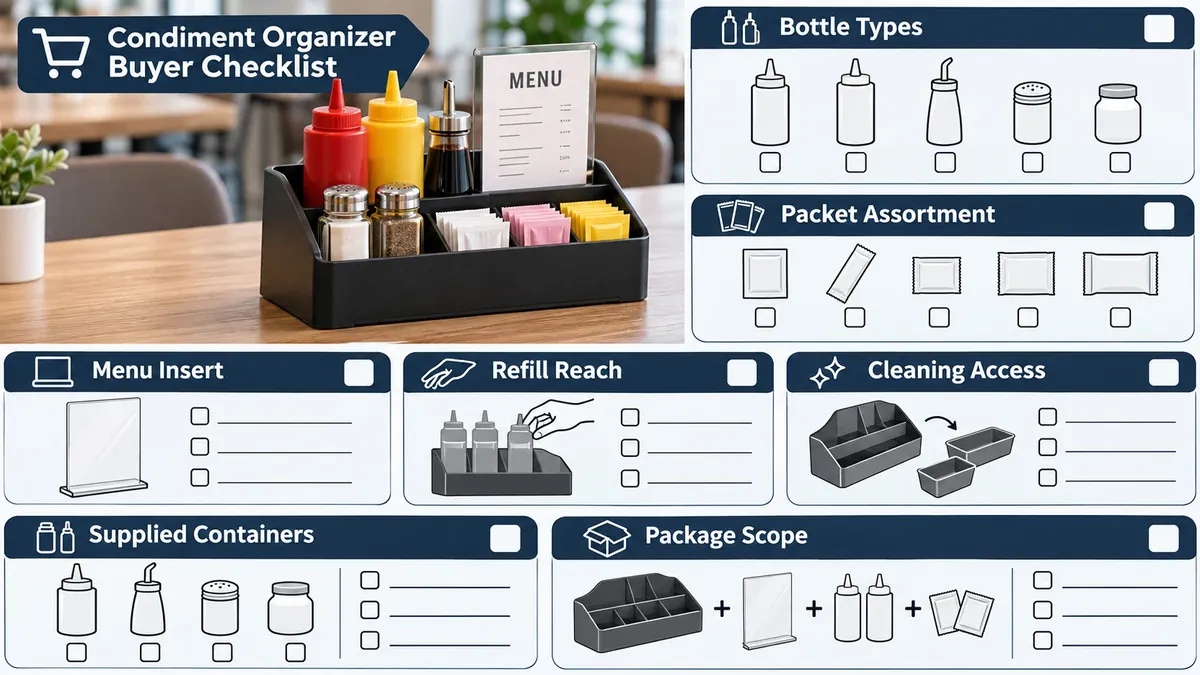
Buyer checklist before order release
- Define the table-service task and the actual items that should travel or sit together.
- Select bottle-only, mixed, open-carrier or paper/menu configuration by model.
- Record each bottle, shaker, packet, paper item and accessory reference.
- Confirm whether every item is included, optional, buyer-supplied or excluded.
- Preserve maker-listed compatibility and do not infer a cross-brand fit.
- Review the exact assembled sample with the selected contents.
- Identify who supplies, prints, assembles and packages bought-in components.
- Tie the BOM, quotation, listing and approved sample to the same configuration.
- State which claims have current evidence for the exact SKU.
- Reopen the review when a container, carrier or insert reference changes.
Does a photo of bottles mean the bottles are included?
No. A photo can show the intended use or illustrative contents. The quotation, BOM and current product page should state whether each bottle is supplied.
Can a bottle with a similar size be substituted?
Do not infer compatibility from appearance or a nominal capacity. Use the carrier maker’s listed reference or obtain confirmation for the exact selected container.
Does a mixed rack accept any packet or shaker?
No universal compatibility follows from a mixed layout. Confirm the exact carrier and mating references with its maker.
Does a ring on the caddy prove it is a carrying handle?
Not by appearance alone. Follow the manufacturer’s description and do not infer a loaded-carrying rating without applicable evidence.
Does this article claim Koitor manufactures condiment caddies?
No. It discusses buyer configuration decisions and does not establish a current Koitor condiment-caddy product. Any project discussion must first define the metal scope and confirm actual capability.
For broader metal project context, see Koitor’s OEM home-storage hardware scope. Buyers can share a selected configuration and component schedule for a defined-scope discussion.
Review a Defined Metal Hardware Scope
Share the selected carrier and component references, the included versus purchased parts, finish and packaging needs. Koitor can first confirm whether the defined metal scope fits its current capabilities before quotation.
OEM / PRIVATE LABEL
Turn this sourcing guide into a product brief
Share your target product, size, finish, order quantity and packaging requirements. Your team receives a practical manufacturability review before quotation.


 English
 Español
 Português
 Français
 Deutsch
 العربية