
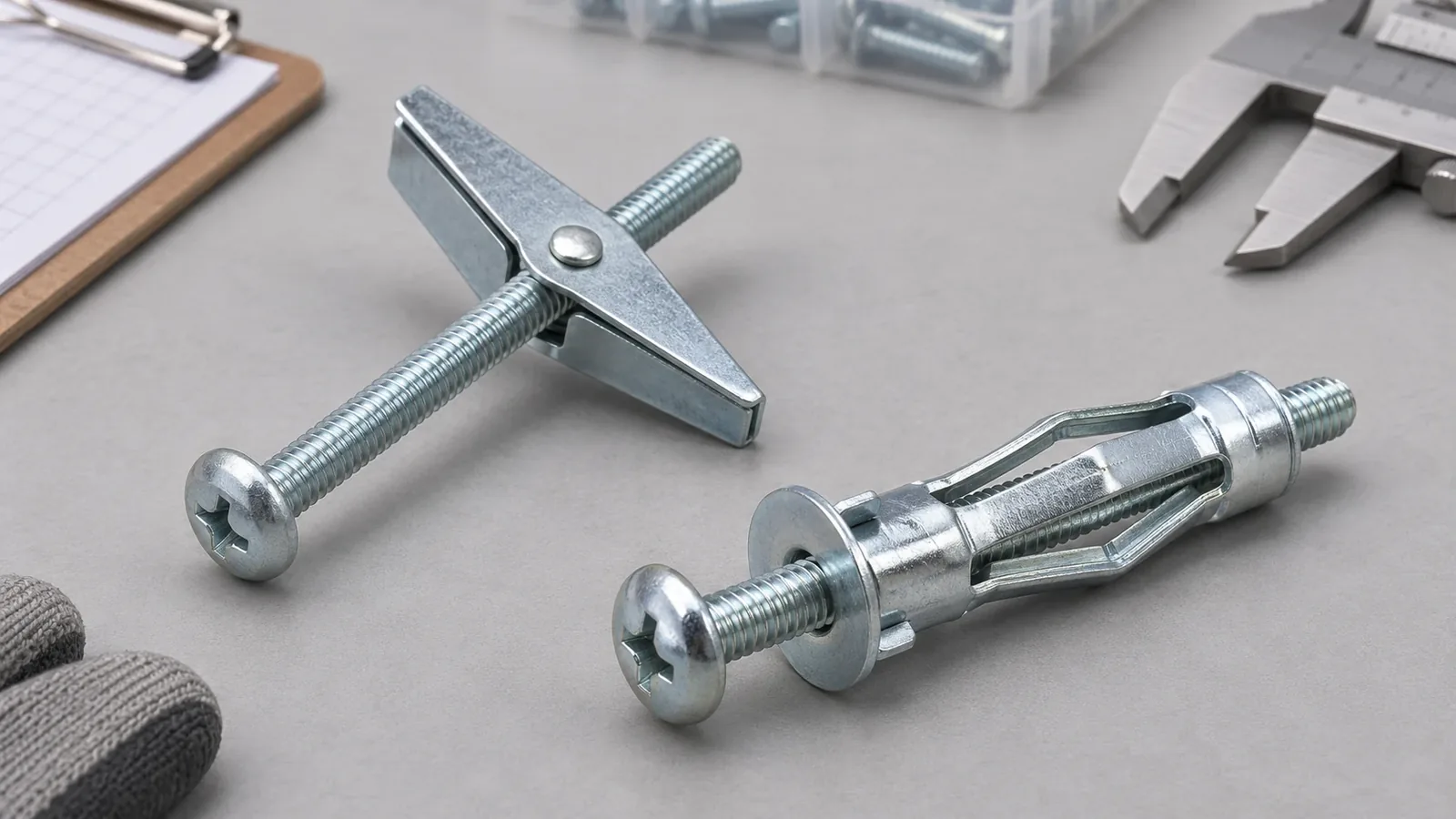
Toggle bolt vs molly bolt is a comparison between two different hollow-wall fixing mechanisms, not a universal contest in which one anchor is always stronger. A spring-wing toggle passes through an opening and opens behind a hollow panel, while a molly-style metal cavity anchor expands its sleeve or arms as it is set. For a bathroom accessory buyer, the right choice depends on the actual wall build-up, cavity space, fixture plate, screw system and maker’s installation instructions. Specify the anchor together with the surface and accessory interface, then approve the assembled sample before bulk packing.
What problem does this comparison help bathroom hardware buyers solve?
Importers often receive a towel ring, small shelf, tissue holder or storage accessory with a generic fixing kit. The package may identify a screw diameter but omit the wall panel thickness, required cavity clearance, anchor grip range, screw length or exact anchor model. A buyer who compares only the words “toggle” and “molly” can approve a kit that cannot deploy behind the intended panel or cannot clamp the fixture plate as designed.
This is a component-selection problem inside a wider product specification. The anchor is usually a purchased fastener, while the accessory manufacturer controls the metal plate, hole location, cover, mounting geometry and packaging configuration. Those responsibilities meet at the interface. The anchor has to pass through the plate opening, engage the wall system that the customer expects to use, and work with the supplied screw or threaded component. A compatible fixing is therefore not established by a product photograph alone.
The comparison also helps a buyer separate a product label from an installation requirement. “Molly” is commonly used for sleeve-style metal cavity anchors, but individual products differ in body construction and setting method. “Toggle” can describe a spring-wing anchor, a retained-channel design or another variant. Catalogues group product families differently. Use the maker’s part number, drawing and instructions for the exact item instead of assuming that every item sold under a familiar name behaves the same way.
For a bathroom or home-storage product, the consequences of a poor match can include a plate that does not sit flush, a screw that bottoms before the plate is clamped, a wing that cannot open, a setting tool that cannot reach the installation point, or an anchor that is difficult to remove as the package instructions suggest. These are plausible interface problems, not measured defect rates or claims about a specific customer. They show why an importer should review the wall assumptions and mounting detail before approving a production sample.
An anchor comparison is not a structural approval. This article does not establish suitability for grab bars, fall-prevention products, child-safety equipment, overhead loads or any other safety-critical installation. The anchor manufacturer’s product-specific instructions and the project’s qualified installer or engineer determine whether a proposed fixing is appropriate for a real wall and load case. Do not combine catalogue test values from different products into a rating for a finished bathroom accessory.
How should buyers evaluate toggle bolt vs molly bolt designs?
A traditional spring-wing toggle uses folded wings that pass through an appropriate hole and open on the far side of a hollow panel. A molly-style anchor uses a metal sleeve or arms that deform behind a suitable board as the anchor is set. For a buyer evaluating toggle bolt vs molly bolt options, the mechanism changes what must be confirmed: deployment space and wing position for a toggle, versus panel range, sleeve setting and the exact screw or thread system for a molly-style product.
In a spring-wing design, the folded assembly is introduced through an opening, then the wings spread behind the panel. The fixture and its plate sit on the room side; the selected screw passes through the fixture and engages the toggle component. The amount of available cavity and the shape of the opening matter because the wings must reach the back of the panel and deploy in the intended orientation. Some variants use a channel or retained feature rather than loose spring wings. They may have different removal behavior from a conventional toggle whose wings are separate behind the wall.
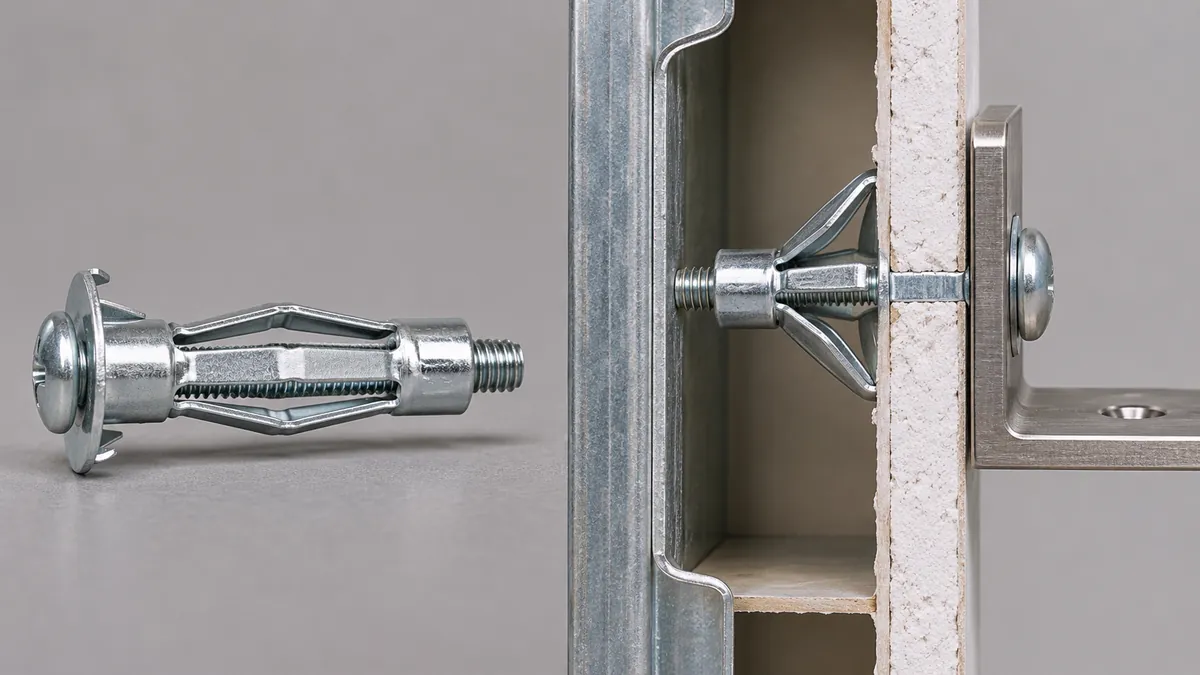
A molly-style fixing typically uses a cylindrical sleeve with legs, ribs or another expanding feature. A setting operation draws or compresses the anchor so the rear portion expands against the back of the board. Product-specific instructions may require pre-setting the anchor or may permit a different sequence. Some designs include an internal machine thread; others pair with a supplied screw. Do not infer the thread, setting tool or removal procedure from the word “molly.” Confirm the actual item and its instructions.
| Buyer question | Spring-wing toggle | Molly-style metal cavity anchor | What the buyer must verify |
|---|---|---|---|
| How does it engage the rear of a hollow wall? | Wings open behind the panel after passing through a suitable opening. | A sleeve or arms expand behind the board during the product-specific setting sequence. | Actual mechanism, wall construction and required access. |
| What space matters? | The wing envelope must fit through the opening and deploy in the cavity. | The anchor length, grip range and setting action must fit the board and cavity. | Cavity depth, obstructions, panel build-up and fixture thickness. |
| How is the fixture screw connected? | A screw or stud may engage the toggle assembly, depending on the variant. | A screw may engage an internal thread or a specified sleeve arrangement. | Supplier part number, thread, screw length and supplied components. |
| Can the fixing be removed and reused? | Behavior varies; some loose-wing toggles may drop behind the wall when the screw is removed, while retained systems differ. | Removal and reinstallation depend on the exact anchor design and its instructions. | Maker instructions for the actual product, not a generic label. |
| Does the name prove a safe load? | No. | No. | Product-specific evidence, wall type, installation and use case. |
The McMaster toggle-anchor catalogue describes spring-wing products and distinguishes specific retained and non-retained designs. Its product examples support a practical caution: removal behavior is tied to a selected design, not to every item called a toggle. TOGGLER’s product catalogue likewise separates its retained-channel product from other anchor families. These pages help identify product families; they do not establish a universal performance ranking.
The fischer HM metal cavity-fixing page illustrates the kind of product-specific information a buyer should read: the maker discusses board thickness selection, installation sequence, tool options and the internal thread for that family. Those details belong to that product. They are not generic molly-anchor requirements, and they should not be copied to a different supplier’s fixing without evidence.
What should importers check first before approving a fixing kit?
Start with the exact wall assumption and the physical fixture interface. Record whether the intended wall is a hollow board, masonry, solid concrete, tile over another substrate or a different assembly. A hollow-wall anchor is not automatically suitable for a tiled wall because the visible tile is only one layer of a build-up. The substrate behind the tile, the cavity and the installer’s method all affect the selection. If the wall system is unknown, the article or accessory seller should not present one anchor as a universal answer.
For a hollow panel, verify the panel material and thickness range listed for the actual anchor. Check whether the product’s grip range includes the total clamped stack, including panel layers, tile if applicable, spacer, mounting plate and any stand-off. A short grip may not engage correctly; an overly long body may be blocked by an obstruction or fail to sit as designed. The maker’s instructions define its permissible installation range. Do not replace that data with a general assumption based on nominal board thickness.
Then check the cavity. A spring wing needs enough room to pass and open. A cavity anchor’s body must fit within the panel and behind-wall space described by its manufacturer. Insulation, bracing, pipes, electrical services and other obstructions may limit access. Never advise drilling into an unknown wall or cutting an opening to a guessed size. The responsible installer should identify services and follow local safety requirements before installation.
The fixture itself needs its own dimensional review. Measure the mounting-plate thickness, hole diameter, countersink or counterbore, cover clearance, screw head and any keyhole slot or elongated opening. A screw that is too long may interfere with a component or extend into an unintended area; one that is too short may not engage the specified threads. A plate with oversized or misaligned holes can move even if the anchor is correctly selected. Buyers should compare the accessory drawing with the fixing supplier’s drawing and a physical sample.
Use a component record rather than a note that only says “toggle bolt” or “molly.” A useful RFQ or BOM entry identifies:
- Manufacturer and exact fixing part number.
- Anchor family and construction, supported by a supplier drawing or identifiable sample.
- Substrate and panel-thickness assumptions taken from the maker’s product data.
- Required opening, cavity and installation-tool access, confirmed from the actual instructions.
- Fixture plate thickness, hole geometry, spacer stack and cover clearance.
- Screw or stud diameter, thread form, length and supplied washer or sleeve components.
- Installation sequence and any product-specific setting or removal requirement.
- Required performance evidence for the actual application, if the project needs it.
- Version or date of the supplier instruction used during sample approval.
Those fields prevent a common purchasing error: the buyer’s drawing may specify the metal accessory but leave the purchased fixing kit open to substitution. If the fastener supplier changes the anchor, the thread, the head or the sleeve length, the kit may no longer fit the approved plate. Treat a change to the fixing as a controlled product change. Request a revised bill of materials, an updated installation sheet and confirmation that the interface still matches the approved product sample.
Which wall and mounting details should be compared?
| Interface detail | Evidence to request | Why it matters to the finished accessory |
|---|---|---|
| Visible wall finish and backing | Installation drawing or project-specific wall build-up | Tile, board and backing layers are not interchangeable substrates. |
| Total panel or wall thickness | Measured site condition plus anchor maker’s range | The anchor must clamp the intended stack within its stated range. |
| Cavity and obstructions | Installer review of the actual location | Wings or expanding parts need the space described in the instructions. |
| Mounting plate and hole | Accessory drawing and sample | The anchor head or screw must pass through and seat correctly. |
| Screw engagement | Matching thread and length from the exact kit | A generic screw may not engage the selected anchor or plate correctly. |
| Removal or service plan | Product-specific supplier guidance | Reuse or removal behavior varies between designs. |
How do the accessory plate, finish and packaging affect anchor fit?
The anchor works at a junction between the wall, screw and accessory; each layer affects the final fit. A buyer should therefore evaluate the accessory plate as part of the fastener system rather than treating it as a decorative cover. The plate’s thickness, hole shape, counterbore, screw head seat and stand-off dimension determine how the screw travels through the metal part before it reaches the anchor.
The order of assembly also matters. A finished towel ring or tissue holder can have an escutcheon, base plate or concealed bracket that limits driver access. An oversized screw head may not fit behind a cover. A mounting slot may allow adjustment but change where the screw bears. A spacer may be needed to avoid crushing a thin or curved part, but any spacer changes the clamped stack and therefore the anchor’s effective grip. These questions should be resolved on drawings and a physical sample, not after a carton has been printed.
Surface finish can affect the contact around the fixture plate. A thick or textured coating on a plate may change the fit at a close-tolerance recess; a soft gasket or protective layer may compress when tightened. Neither observation proves that a particular anchor is unsuitable. It means the buyer should compare the as-finished part, its intended stack and the maker’s instructions. If the project uses washers, bushings or insulating pieces, list them explicitly and confirm the assembly sequence.
Packaging is part of the product specification as well. A kit should keep its anchor and screw components identifiable and prevent them from scratching the visible finish during transit. Small loose fixings can escape from an unsealed bag, mix between SKUs or scuff coated parts. A buyer can ask for separate, labeled compartments or a sealed bag referenced to the SKU and installation sheet. The exact packaging option depends on the order and pack design; do not assume that a factory’s standard bag or a retailer’s accessory pouch is included in every quote.
For a private-label product, the mounting instructions should match the actual fixing supplied. If the carton includes one anchor model but the user guide describes another, the package may cause returns or installation confusion. The sample approval should therefore include the anchor, screws, plate, cover, printed instructions and inner packaging together. Capture photographs of the approved kit and record the version used for production. A later component substitution should trigger review of both the physical fit and the user-facing information.
Koitor Hardware’s approved manufacturing scope is the metal accessory and the related OEM communication: drawings or samples, plate structure, finish, assembly and packaging can be discussed for the project. The exact anchor may be a bought-in component from another supplier. Do not infer that Koitor manufactures a toggle or cavity anchor, certifies a wall assembly, or validates a load case just because a kit is assembled with the accessory. Clarify which party sources the fixing and which party provides its technical instructions.
What mistakes should buyers avoid when comparing anchors?
The first mistake is choosing by the name alone. A catalogue can place different mechanisms under a broad hollow-wall or toggle category. A proper comparison starts with the exact manufacturer part number, product drawing and instructions. A fastener name is a search term, not a complete installation specification.
The second mistake is treating one anchor’s data as transferable to another. A published load value, board thickness or application example belongs to a specific product under its stated test and installation conditions. It is not automatically a working-load rating for a towel rack, the same fixing in another panel, or a different anchor that looks similar. This article does not provide load values or claim that one family is stronger.
The third mistake is ignoring the fixture. An anchor may fit a wall but fail to seat through the accessory plate or allow the cover to close. Conversely, a plate can have enough room for a screw while the anchor does not fit the cavity behind the board. Approve the wall, anchor and plate as one interface. If a buyer wants a concealed mounting system, evaluate tool access and the completed cover after tightening.
The fourth mistake is assuming every toggle remains behind the wall after the screw is removed. A conventional loose-wing system and a retained-channel system do not necessarily behave the same way. The selected supplier’s instructions should say what happens during removal and whether the anchor can be reinstalled or reused. Never infer reuse from the fact that the screw can be loosened.
The fifth mistake is using a generic installation diagram across countries or substrates. Wall systems, product variants and instructions differ. The buyer should identify the intended market and the specific wall type in the installation literature. A picture that shows a hollow-board anchor should not silently be treated as approval for masonry or for tile with an unknown backing wall.
The sixth mistake is approving a bulk purchase on a photograph or dimensional note alone. Images can show a similar product but do not prove the thread, grip range, material, setting method, installation access or compatibility with the plate. Obtain the actual sample or a controlled technical document. Ask the supplier to identify any substitutions before the product reaches mass production.
The final mistake is promising an installation result that no one has verified. Avoid statements such as “fits every wall,” “will never loosen” or “supports any bathroom accessory.” The correct explanation is narrower: the anchor can be considered when its maker’s instructions, the wall build-up and the accessory interface match the project. A qualified installer must follow those instructions and local safety requirements.
How can an OEM factory help, and what belongs in the RFQ?
A small-batch OEM factory can help clarify the metal product interface before sampling, while the fixing supplier remains responsible for the anchor’s product-specific instructions. Koitor Hardware is a family-owned custom metal hardware factory focused on bathroom and home-storage hardware. Its approved work includes reviewing buyer drawings or physical samples, discussing mounting plate geometry and coordinating practical assembly and packaging details. This does not make Koitor the anchor manufacturer or an installation-testing laboratory.
For a custom towel ring, basket, tissue holder or related metal accessory, a buyer can provide the drawing, intended fixing kit, target wall assumptions, finish and packaging plan. The factory can review how the plate, screw access, cover and component stack appear in the product design before the sample is finalized. If a detail is unclear, the buyer and supplier can identify the missing interface information and direct the question to the party responsible for the fastener.
A practical RFQ should include the following information:
- Product type, target market and intended user-facing installation method.
- Drawing or physical sample with the mount locations, plate dimensions and hole geometry.
- Proposed anchor manufacturer, part number and current instruction sheet.
- Intended substrate and thickness range, provided by the buyer or project installer.
- Screw or stud details and any spacers, washers, caps or supplied tools.
- Finish and assembly references, including any coating or gasket that affects the stack.
- Required kit quantity per SKU, bag or compartment plan and installation-sheet version.
- Whether the project needs supplier-specific test or compliance evidence before purchase.
- Sample quantity, expected MOQ, logo and private-label packaging needs.
For early development, a drawing or physical sample helps the factory assess manufacturability and prepare a more useful quotation. Koitor’s MOQ can start from 100 pieces depending on product structure, finish and packaging; sample timing and bulk lead time depend on the confirmed project. Those ranges are planning guidance, not an unconditional promise. The buyer should confirm the schedule and responsibilities with the supplier before placing an order.
The sample review can be staged. First confirm the accessory’s plate geometry, mounting cover and finish. Next fit the exact proposed anchor and screw through the plate without altering the approved kit. Then review the assembly sequence and tool access. Finally check that all parts are present, protected and identified in the package. If the anchor maker requires a special setting tool or a specific installation sequence, include that detail in the user instructions or make clear which party supplies it. Record the approved toggle bolt vs molly bolt choice with the same revision as the mounting drawing so procurement and assembly are checking the same configuration.
Koitor can discuss custom bathroom hardware manufacturing and OEM home-storage hardware for the metal product scope. Buyers developing a private-label range should include a fixing-kit decision alongside the product drawing rather than leaving it until packaging artwork is complete. For project-specific scope, the contact page provides the appropriate route to share a drawing, sample or packaging requirement.
What should buyers put on an anchor and accessory checklist?
Before requesting a quotation or approving a sample, a buyer can use this checklist to confirm that the wall fixing has been specified as part of the complete product:
- [ ] Exact anchor manufacturer and part number recorded.
- [ ] Anchor construction identified from a supplier drawing or sample.
- [ ] Wall substrate and total thickness assumption stated.
- [ ] Cavity space and obstructions reviewed by the responsible installer.
- [ ] Anchor’s stated grip range checked against the complete fixture stack.
- [ ] Accessory plate thickness, hole, head seat and cover clearance checked.
- [ ] Screw or stud thread and length matched to the selected anchor.
- [ ] Setting sequence, tool access and removal behavior confirmed from current instructions.
- [ ] Any project-specific performance evidence requested from the responsible fixing supplier.
- [ ] Metal finish, spacer and gasket effects reviewed on an as-finished sample.
- [ ] Fixing kit separated and identified by SKU in the package.
- [ ] Installation sheet matches the exact components supplied.
- [ ] Substitution approval and revision control defined before bulk production.
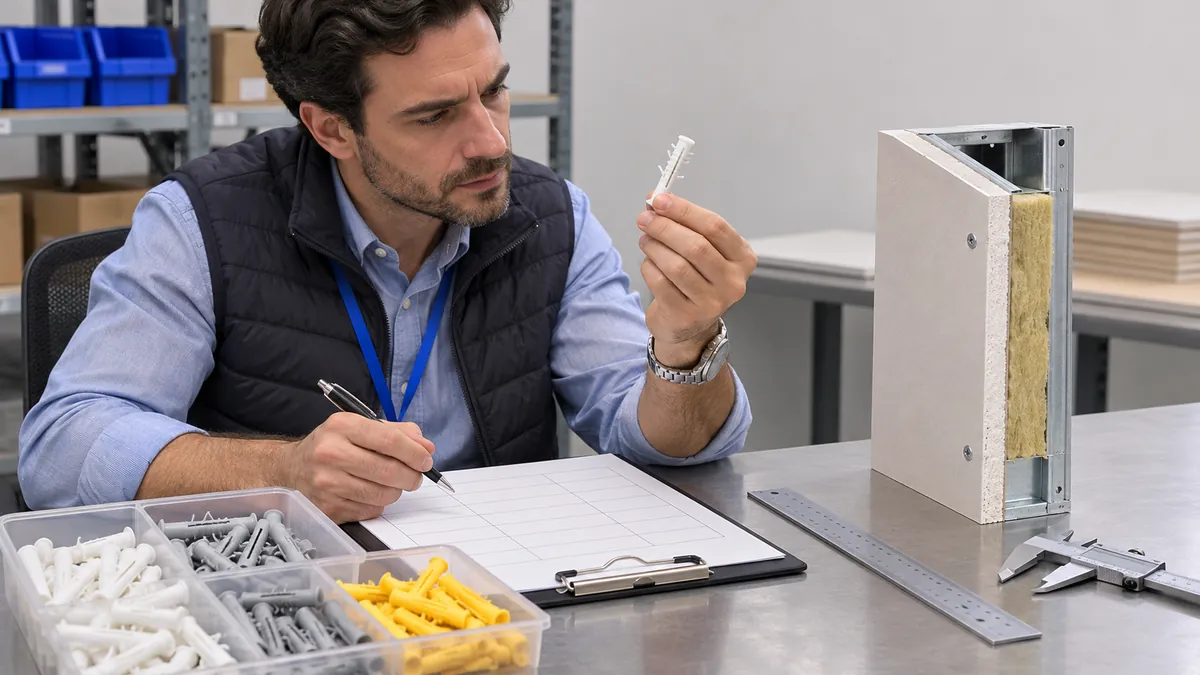
This checklist does not replace a maker’s instructions or a site assessment. It helps the importer identify unanswered specification fields before those fields become assumptions in an RFQ, quotation or user guide. If the wall type is not known, record that uncertainty and ask the project installer to resolve it; do not select a universal anchor by guesswork.
Frequently asked questions
Is a toggle bolt always stronger than a molly bolt?
No universal strength ranking follows from these names. The exact product, wall panel, installation, fixture geometry and supplier evidence determine whether a fixing is suitable. Do not compare load claims unless the test conditions and application are comparable and relevant to the real assembly.
Does removing the screw make every toggle fall behind the wall?
No. Some conventional loose-wing designs may release the wings behind the panel when the screw is withdrawn; retained-channel designs behave differently. Check the manufacturer’s instructions for the exact product and do not assume it can be reused.
Can a molly-style anchor fit every drywall thickness?
No. An anchor is suitable only within the thickness range and installation conditions stated for that specific product. Check total clamped thickness, including any tile, spacer or mounting plate that the manufacturer says counts toward the grip range.
Is the screw size enough to identify a replacement anchor?
No. The thread is one field in a larger compatibility record. A replacement also needs the correct anchor family, grip range, body length, setting method, fixture hole and supplier instructions. A similar screw diameter does not prove that two anchor systems are interchangeable.
Can the same anchor kit be recommended for towel racks and grab bars?
This guide does not approve any anchor for grab bars or other safety-critical hardware. The product type, substrate, installation and applicable requirements must be assessed by qualified parties using the selected manufacturer’s instructions and project-specific evidence.
Work With Koitor Hardware to Review a Mounting Plate
Share the accessory drawing, proposed fixing reference, mounting-plate detail and packaging plan. Koitor can discuss the metal product interface and small-batch OEM scope while the fixing supplier confirms anchor-specific instructions.
OEM / PRIVATE LABEL
Turn this sourcing guide into a product brief
Share your target product, size, finish, order quantity and packaging requirements. Your team receives a practical manufacturability review before quotation.
 English
 Español
 Português
 Français
 Deutsch
 العربية