
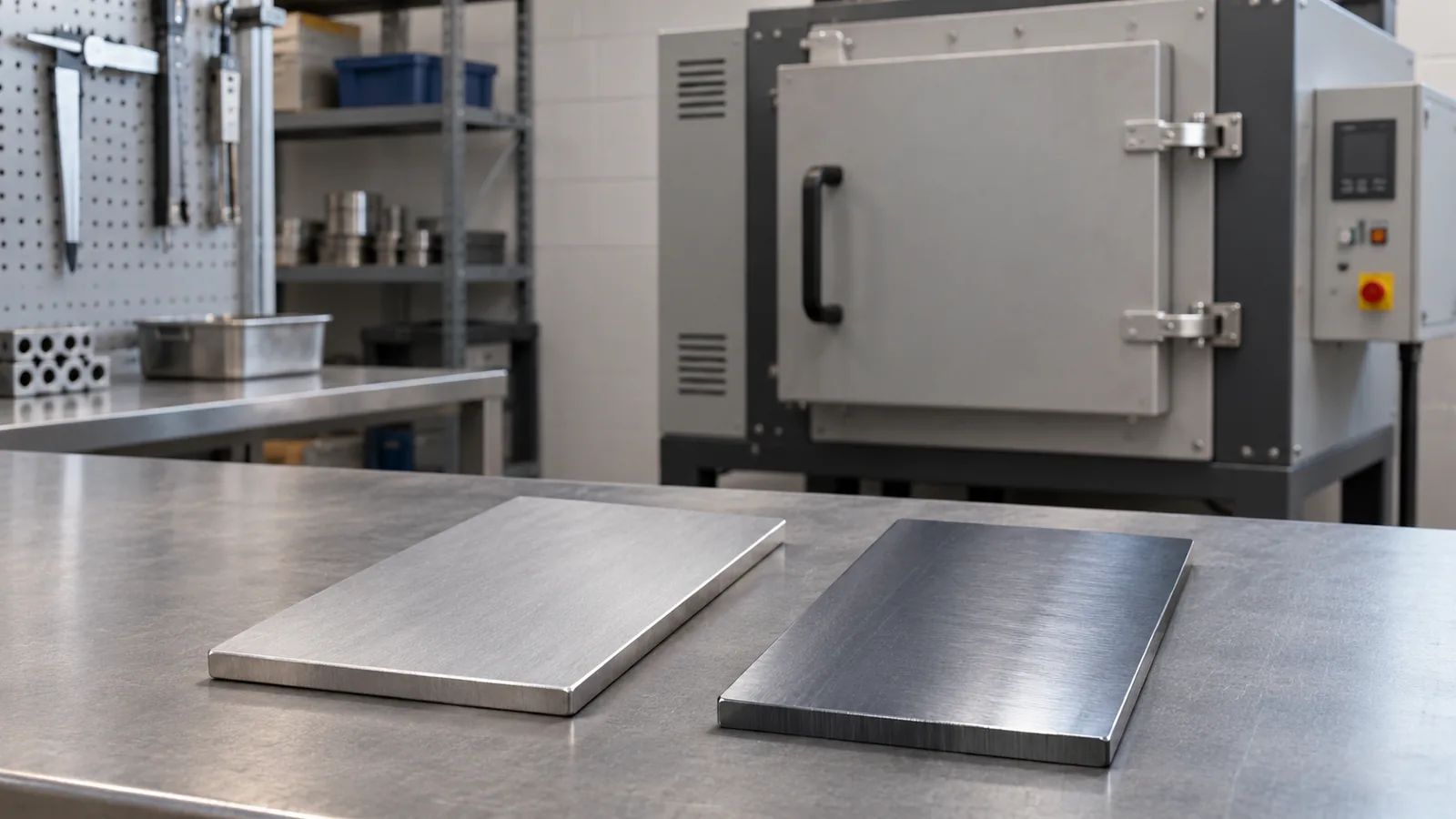
Annealing vs tempering is a comparison of different heat-treatment purposes, not two interchangeable ways to “heat and cool” metal. Annealing is a family of treatments used to obtain a desired material condition, such as greater workability or an adjusted stress state, depending on alloy and purpose. Tempering applicable steels is normally performed after hardening to adjust the resulting hardness and toughness balance. The buyer must identify the starting material and required final condition before approving a supplier’s treatment route; a process name alone does not define the finished property.
Start with the material and its condition
Heat-treatment terminology is meaningful only in context. Identify the material grade, product form, supplied condition and any prior processing that affects the part. A treatment suitable for one alloy or starting condition may not apply to another. If a quotation says only “anneal” or “temper,” the buyer still needs to know what result is intended and how that result will be verified.
Annealing is not one single universal recipe. The term covers treatments selected for a material and objective. A supplier may use annealing to change a condition for later fabrication or to achieve a specified result. The exact treatment depends on the alloy, prior condition, geometry and required properties. This article does not provide heating temperatures, cycle times or cooling rates; those belong to a qualified process specification for the material and application.
Tempering is commonly discussed for steel after hardening. Hardening can produce a high-hardness condition; tempering is then used to adjust the balance of properties for the intended application. The outcome depends on the starting hardened condition and the approved treatment. “Tempered” without a grade, initial state and required final property is incomplete for purchasing and quality control.
The words can be used differently across industries and materials. A drawing or supplier document should state the applicable material and specification rather than relying on a generic dictionary definition. The buyer should ask the heat-treatment provider or responsible engineer which treatment family applies to the actual component and why. Do not assume that a process name translates directly to a specific hardness, toughness or formability.
| Buyer question | Annealing | Tempering | What must be specified |
|---|---|---|---|
| What is the general role? | A family of treatments used to obtain a desired condition based on material and purpose | Commonly adjusts the condition of hardened steel after hardening | The material, starting state and intended outcome |
| Is it one fixed recipe? | No; route depends on alloy and objective | No; route depends on material and prior hardening condition | Approved process specification, not a generic internet recipe |
| Does the word define hardness? | No | No, not without a defined material and requirement | Required property, method and acceptance range where needed |
| Can appearance prove the result? | No | No; visible color is not reliable proof of a controlled condition | Suitable test or documentation specified by the contract |
| Can one substitute for the other? | Not by name alone | Not by name alone | Technical review of the part and required final state |
The table is a qualitative buyer aid. It intentionally avoids universal temperatures, cooling rules and property values.
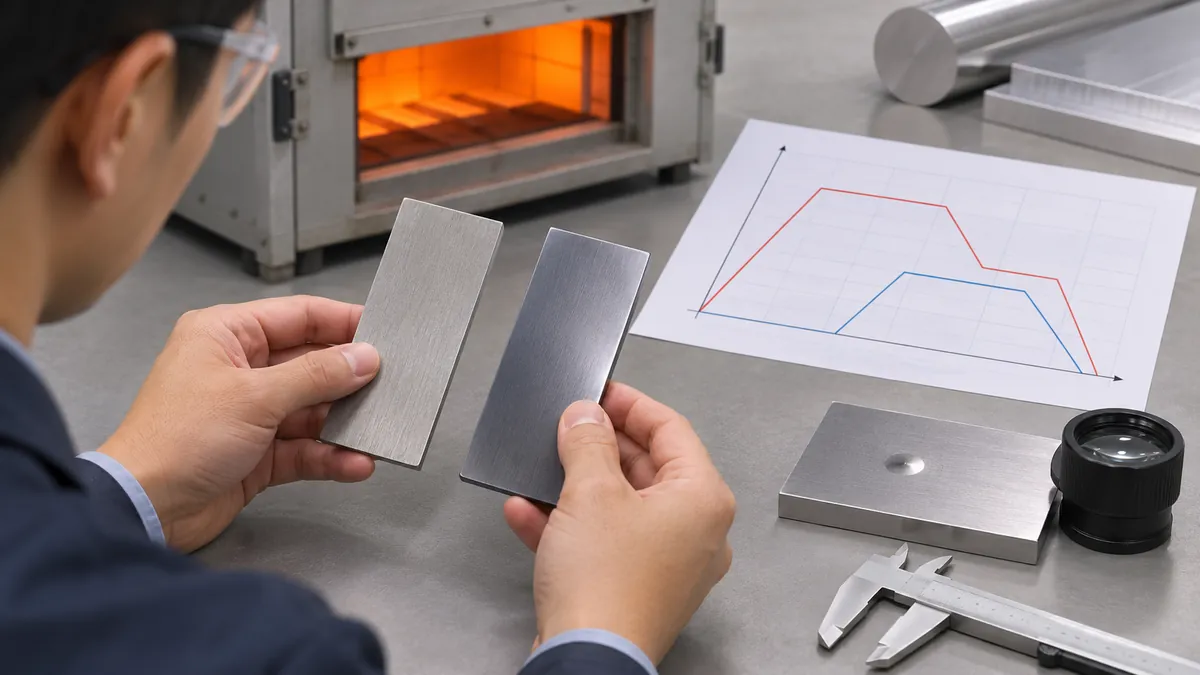
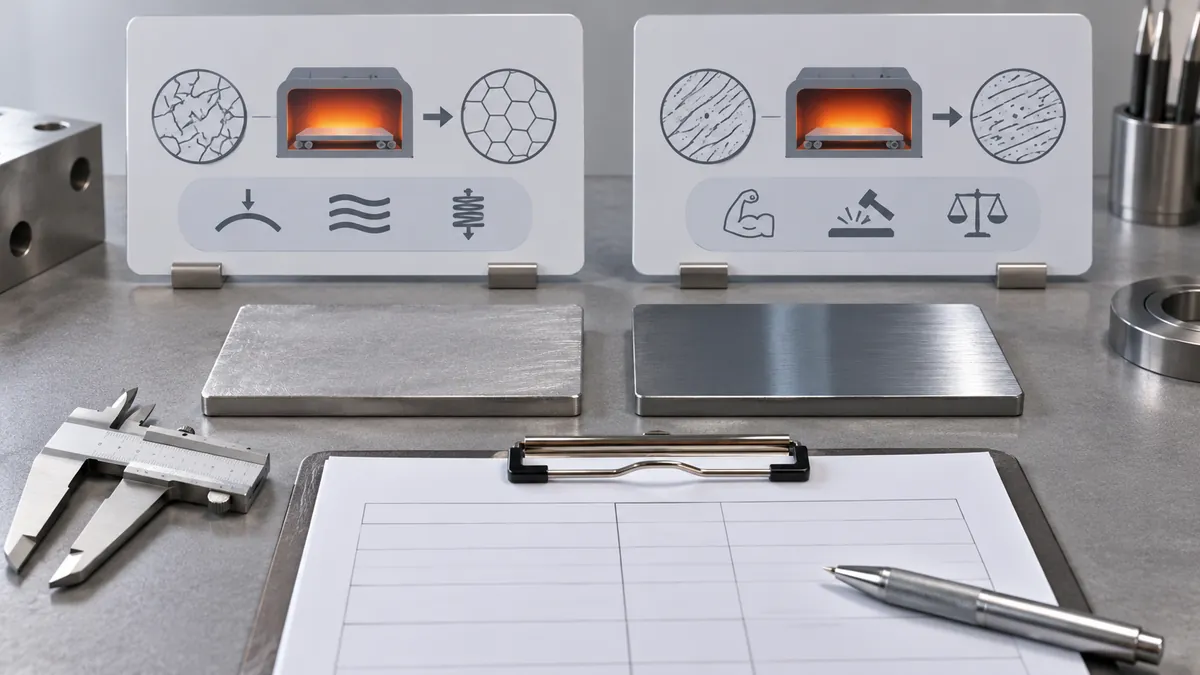
How annealing and tempering differ in purpose
Annealing: define the target condition
Annealing is selected to meet a material-specific objective. That objective may relate to workability, a condition before another fabrication step or an adjusted stress state. The word does not identify which annealing variant is intended or which measurable property should result. A product specification should state the required starting state and final acceptance basis, or the supplier should make a proposal for the design owner to approve.
For a part that will be formed, machined, welded or finished, the treatment sequence can matter. A condition chosen for fabrication may differ from the condition required for final use. Ask when the treatment occurs relative to cutting, forming and joining, and whether those steps change the condition that the buyer expects. This is a planning question for the responsible metallurgical or manufacturing specialist, not a universal instruction in this guide.
If the specification uses “annealed” as a purchasing shorthand, ask for the material specification and any required property or certification. The term may describe the supplied state, a processing step or a contractual condition. Those uses should not be confused. A material certificate may document composition or condition as specified, but the buyer should verify that it satisfies the required scope and lot traceability.
Tempering: consider the prior hardening route
Tempering is typically considered after hardening for applicable steels. The heat-treatment provider needs to know the grade and starting hardened condition to select an approved route. A generic statement that tempering “makes steel tougher” is too broad to define a part. The product owner must identify the property balance required by the design, and the process provider must explain how the treatment and verification meet the specification.
A supplier may describe a part as “hardened and tempered,” but that phrase still leaves questions: which material, what prior condition, which governing specification, what required final property and what evidence? If hardness is critical, define the measurement method and acceptance basis. If toughness or another characteristic matters, the design authority should specify the appropriate requirement and proof. This article does not infer values or prescribe tests.
The sequence also matters. Tempering applied to a hardened part is not simply an alternative name for annealing. If a supplier proposes changing the order or omitting a step, request a technical explanation and buyer approval before production. Do not infer that a part’s appearance or a single hardness reading proves the full treatment sequence was correct.
Identify the starting condition before comparing quotes
Two quotations cannot be compared reliably if one assumes soft incoming material and the other assumes a previously hardened part. Include the current condition of the stock, required treatment, intended final condition, quantity and part geometry. Ask the supplier to list assumptions about material source, treatment sequence and process scope.
If the component is already formed or welded, identify those operations in the review. Heat treatment can interact with geometry, distortion risk and finishing sequence, but the exact effect depends on material and procedure. The supplier should assess the actual design. Do not transfer a result from a different grade or a generic educational chart to the buyer’s part.
Specify the result, not only the treatment word
A robust purchase requirement links the treatment to an intended result and a verification method. Depending on the product, the relevant requirement could be a specified material condition, a property range, a certification record or an approved process. Only include what the design and contract actually require. A treatment label without an acceptance basis leaves the buyer unable to decide whether the delivered part conforms.
The specification should identify the part number and revision, material designation, product form, starting condition, required treatment, final condition and evidence. If treatment is outsourced, identify which supplier owns the record and how the lot is linked to the components. If the buyer does not need a proprietary furnace recipe, do not request it; request the documented evidence that supports the contract’s acceptance decision.
Visual appearance is not a substitute for material verification. Surface colors can vary with lighting, surface condition and process context, and they do not reliably establish a specific heat-treatment result. A supplier or internet source may show color charts for a particular procedure, but those are not universal acceptance standards. If a property is critical, use the agreed method and competent personnel rather than judging by color.
A test result also has boundaries. A report should identify the sample or lot, material, treatment, property, method and acceptance requirement. One measured property does not prove every other property or every part in a batch unless the sampling plan and test scope support that conclusion. Align the evidence to the requirement, and state which records must accompany a shipment or remain available for audit.
Coordinate heat treatment with fabrication and inspection
Heat treatment should be considered as one operation within the product’s manufacturing sequence. The timing relative to cutting, forming, machining, joining and finishing can affect what is possible and what the buyer needs to inspect. The exact effects are material- and process-specific, so the supplier and technical owner should review the actual part rather than assume a general sequence applies.
If the component is formed before treatment, confirm that the starting material condition is compatible with the planned fabrication route. If it is formed after treatment, confirm that the final geometry and surface condition remain acceptable. A change in sequence can affect handling, dimensions or the type of inspection required. This is not a claim that one order is always preferable; it is a prompt to include the whole part history when reviewing a proposal.
For a welded assembly, clarify whether the heat treatment applies to the whole component, a local area or the supplied stock before assembly. The specification should indicate which party owns the decision and what evidence is expected. A supplier may outsource the operation; if so, the buyer should know who is responsible for the applicable records and how the treated lot remains traceable to the parts. The buyer does not necessarily need the subcontractor’s proprietary instructions, but it should receive the documentation that the contract requires.
Surface finishing and inspection may also occur before or after treatment. If the appearance of a polished or coated face is important, state when the visual acceptance applies and whether treatment marks or later operations are included in the sample approval. Do not assume a heat-treatment record documents a cosmetic finish, or that a finish sample demonstrates the metal’s internal condition. Each record answers a separate question.
When a part has tight fit requirements, ask the responsible supplier whether the treatment sequence affects dimensions that control assembly. The answer should be specific to the material and process plan. If a feature is critical, identify it on the drawing and agree when it will be measured. If an intermediate operation can change the feature, inspection may be needed after that step or on the completed part. The appropriate control depends on the drawing and risk; this guide does not prescribe a universal tolerance or measurement frequency.
Define ownership of treatment records
The order should state which documents are required and who reviews them. A document may be a material certificate, a process record, a test report or a statement of conformity, depending on the contract. The buyer should verify that it identifies the relevant part or lot, material, treatment and specified result. A generic brochure describing a provider’s capabilities is not evidence that a particular purchase received the required treatment.
If the supplier purchases material in a stated condition and later sends it for another process, the records should connect those stages where traceability is required. A mismatch between the drawing, purchase order and treatment record should be resolved before accepting the part. Ask whether the mismatch is a clerical error, an alternate condition or a material substitution. Do not update the record by assumption; the responsible technical owner should confirm whether the delivered product meets the approved specification.
For repeat orders, retain the approved material and treatment basis with the current drawing revision. If a source, starting condition or subcontractor changes, assess whether the evidence remains representative. The review can be proportionate: a routine administrative change may only need a record, while a change to material or final property may require technical approval or a new sample. Document the decision to avoid relying on a past approval that may not apply to the new lot.
Compare quotations on equivalent scope
One supplier may quote material already in a required condition; another may include a separate treatment operation. A third may assume a different starting state. Those are not equivalent offers even if the line item uses the same word. Ask each provider to identify what is included, whether treatment is in-house or subcontracted if relevant to the buyer, which condition is supplied, what records are included and what the quote excludes.
Compare costs only after the technical basis is aligned. Material form, quantity, lot control, operation sequence, inspection and documentation can all affect price and lead time. A low quote may omit records or assume a different treatment; a higher quote may include more verification. Do not infer quality from price alone or transfer a generic process price from an article to the specific supplier’s offer.
If the design has not yet fixed the treatment, ask the engineering owner to define the required result before soliciting final production pricing. A supplier can propose a route during development, but the buyer should capture the approved condition and evidence in the controlled specification. This turns an early discussion into a reproducible production requirement rather than leaving the purchase dependent on an informal phrase.
A buyer workflow for heat-treatment proposals
- Identify the material. State grade, product form, dimensions and supplied condition.
- Describe the part’s role. Explain the function and which properties are design-critical.
- State the requested treatment. Use the approved specification and distinguish processing from final condition.
- Define the result. Identify required properties or documentation and how acceptance will be decided.
- Review the sequence. Note forming, machining, welding, finishing and assembly steps before or after treatment.
- Ask the provider to disclose assumptions. Confirm treatment scope, material lot and any proposed substitution.
- Approve a sample or test plan if required. Define what the evidence will demonstrate and its limits.
- Control process changes. Require review if material, starting state, route or final condition changes.
- Link records to the order. Keep reports and approvals with the part number, revision and batch.
This workflow helps purchasing avoid a common false choice: picking a process name before confirming the desired condition. The buyer may allow the supplier to recommend the treatment, but the responsible engineer should approve the resulting specification. If the supplier cannot meet the required evidence or the material condition is unknown, clarify the issue before the component enters production.
Hypothetical hardware example
Imagine a small steel component in a storage-product mechanism. The supplier quote states “tempered steel,” while the buyer’s drawing identifies only the alloy family and dimensions. The buyer should clarify whether the material is already hardened before the proposed tempering, what final condition the design requires and which evidence will be supplied. If the part needs to be formed before treatment, the sequence should be reviewed by the responsible process specialist.
A second supplier proposes annealing as part of its route. The buyer should not assume the two offers are equivalent. It should compare starting condition, treatment objective, final acceptance and process sequence. If the design owner wants a particular hardness or other property, that requirement should be specified and verified through an agreed method. The supplier’s verbal assurance or visible color does not settle the question.
This example is hypothetical. It is not a Koitor product, heat-treatment result, customer project or claim that Koitor provides annealing or tempering. It illustrates the information needed to compare a treatment proposal responsibly.
Common sourcing mistakes
An annealing vs tempering comparison should be made against the same material, starting condition, required property and documentation scope. If any of those differs between supplier offers, clarify it before comparing price or lead time.
- Treating annealing and tempering as synonyms. Identify the treatment purpose and required starting condition.
- Using “heat treated” without a result. State the final condition or property that matters.
- Assuming every tempering route applies to every alloy. Confirm grade, prior processing and approved specification.
- Comparing quotes with different starting states. Make the material condition explicit.
- Using a generic temperature or time recipe. Follow the qualified process specification for the actual material.
- Judging treatment by color. Use the defined property verification and documentation.
- Assuming a certificate proves all performance. Check what the document covers and which lot it identifies.
- Ignoring operations around heat treatment. Review forming, joining, machining and finishing sequence.
- Allowing a route change without review. Record approval against the part revision.
- Treating one sample as a production guarantee. Match evidence to the sampling and acceptance plan.
Frequently asked questions
What is the main difference between annealing and tempering?
Annealing is a family of treatments used to obtain a desired material condition based on alloy and purpose. Tempering is commonly applied after hardening in applicable steels to adjust the resulting condition. The exact process depends on material and specification.
Is tempering the same as hardening?
No. Tempering is commonly a follow-on treatment after hardening for applicable steels. A buyer should identify the full route and required final condition rather than treating the terms as interchangeable.
Does annealing always make metal softer?
That is too broad as a universal claim. Annealing includes different treatments and objectives; the result depends on material, starting condition and process. Specify the intended condition and verify it appropriately.
Can a supplier choose annealing or tempering instead of the other?
Not by name alone. The starting state, material and required final result determine whether a route is appropriate. A proposed substitution should receive technical review and buyer approval.
Can I tell heat treatment from color?
Color is not reliable proof of a controlled material condition or property. Use the agreed specification, test method and documentation.
What should I put in a heat-treatment RFQ?
Include material grade, product form, starting condition, requested treatment, required final property or condition, quantity, sequence and required inspection or certification records.
Does a heat-treatment certificate prove every part is acceptable?
It proves only the information and lot scope stated in the document. Confirm traceability, test method, sample coverage and how the certificate relates to the purchase requirement.
How can Koitor help with this material discussion?
Koitor Hardware is a family-owned custom metal hardware factory with approved drawing and sample communication. Buyers can share a part specification for project discussion. This does not claim Koitor provides heat-treatment services or material-property testing.
Sources and scope
- TWI: Annealing vs Tempering
- Bodycote: Tempering
- Metal Supermarkets: Difference Between Annealing and Tempering
Scope note: This buyer guide avoids treatment temperatures, cycle times, cooling recipes and generic property guarantees. Confirm the exact material, starting condition, treatment specification and verification plan with qualified technical personnel.
Clarify a material condition in a hardware drawing
Share the material grade, starting condition, required result and supplier treatment proposal. Koitor can discuss the surrounding custom metal hardware project within its confirmed scope.
OEM / PRIVATE LABEL
Turn this sourcing guide into a product brief
Share your target product, size, finish, order quantity and packaging requirements. Your team receives a practical manufacturability review before quotation.


 English
 Español
 Português
 Français
 Deutsch
 العربية