
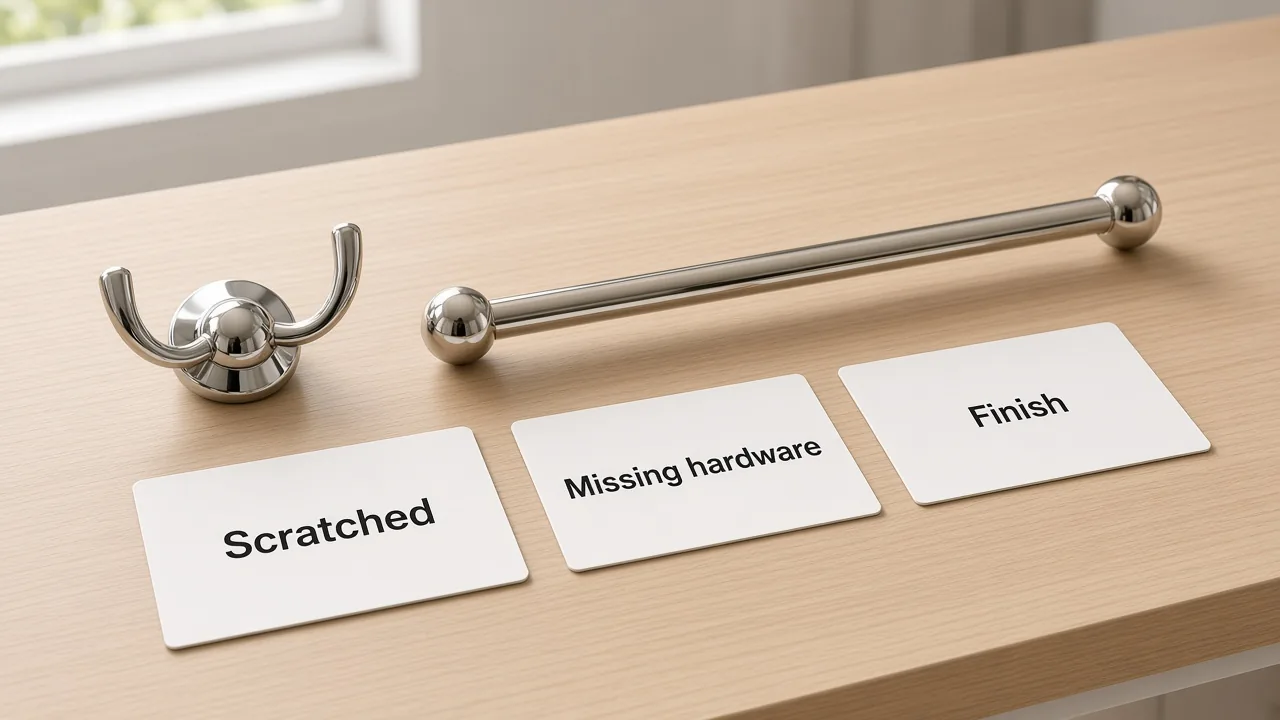
An Amazon bathroom hardware return reason CAPA map is a way to send each marketplace reason code to a process owner and a corrective-action type, instead of dropping every return into a generic “defective” bucket. Importers should write that map before the busy season, because a scratch, a missing screw, and a finish mismatch rarely have the same owner.
This page does not write legal warranty terms, does not promise a credit or a reinstatement, and does not replace a photo-evidence packet. A live neighbor page already covers warranty-claim photographs; it is not in the box internal-link file used here and is therefore not hyperlinked. Use that packet beside this map.
Investigating customer returns on metal storage hardware remains the method once goods are back in a warehouse. Cargo-damage evidence remains the carton packet when transit is likely. This file only maps Amazon reason language to factory owners and to the next evidence still needed.
What should a reason-to-owner map actually contain?
Start with the reason codes your account actually receives, not with a guessed official list. Codes and labels change, and a page that pretends to publish Amazon’s full dictionary will go stale. Copy the reasons from a recent export, group the near-duplicates, and name a process owner for each group.
Owners should be processes, not only people’s names: finishing, packing and kitting, mounting hardware, design or drawing, incoming inspection, and logistics. A “quality” owner for every row is the generic bucket in another shirt.
Each row should also say what evidence is still required before anyone argues cause: photos, lot mark, install context, carton shots, or a physical return. The map is not a decision to honor a claim. It is a routing and evidence list.
How should common bathroom-hardware reasons be routed?
Scratch and dent reasons often split between pack, handling, and finish. If the carton is gone, the map should still ask for product and lot identity, then point to the cargo-evidence neighbor when cartons exist. Do not let every scratch automatically become a plating complaint.
Missing screws, missing anchors, or a missing hex key usually belong to kitting and pack, not to the hook body. Finish mismatch and “color not as pictured” usually belong to finish control and to listing photography, which may also be a family-architecture issue if a plate or a shade drifted.
Loose or “does not stick” language on a screw-mounted product is often an install or kit issue, not a product body issue, unless the thread or the set screw is actually wrong. Read the reason, then look at the photos, then pick the owner. The words alone are not the diagnosis.
| Reason group (examples) | First process owner to consider | Evidence still needed | What not to assume |
|---|---|---|---|
| Scratched, dented, or damaged | Pack or logistics first if cartons exist; finish only if the mark is a coating issue | Room and close-up photos, lot mark, carton shots when available | That every scratch is a plating defect |
| Missing parts or missing hardware | Kitting and pack | Open-box layout, remaining kit, lot or bag mark | That the hook body is defective |
| Finish, color, or not as pictured | Finish control, and listing photography if the image is the standard | Shared-light photos of the set, lot marks, the listing image in the file | That the customer simply “expected a different shade” with no file check |
| Loose, wobbly, or difficult to install | Mounting kit and instructions first; machining or set-screw fit if the evidence shows a product issue | Wall or substrate context, screws and anchors, install photos | That a screw-mounted hook failed because it “does not stick” |
| Arrived damaged or box damaged | Logistics, using the cargo-evidence packet | Carton, inner pack, labels, product identity | That a crushed carton is automatically a factory finish claim |
| Defective or other | Do not leave this as a permanent bucket; split it after the first photos | At least a product photo and a lot or invoice identifier | That “defective” is already a root cause |
How should corrective action be written without promising a credit?
Corrective action on the factory side might be a pack change, a kit-count check, a finish-lot review, or a drawing clarification. Write the action type and the owner, and keep commercial gestures—credits, replacements, time limits—in a separate commercial file. This article does not authorize those gestures.
An Amazon bathroom hardware return reason CAPA map can include a column for “likely process” and a column for “containment on the next lot,” as long as those columns are filled from evidence, not from habit. Containment that always says “retrain the line” will not change a missing-screw kit.
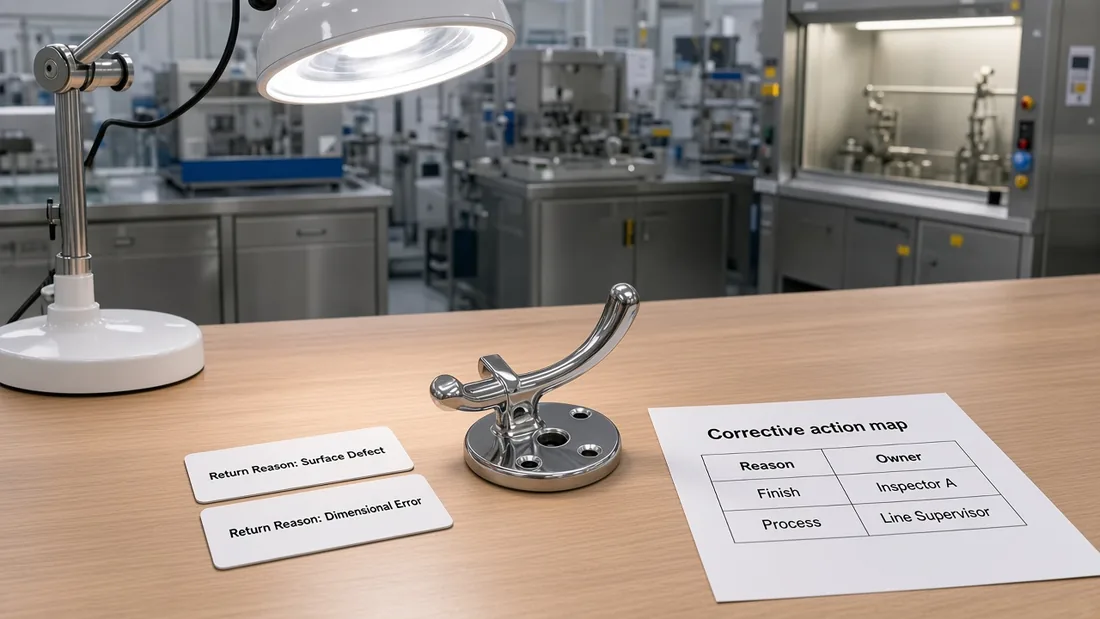
What the factory can do with the map, and what it cannot promise
A factory can help sort reasons, compare them with lot records, and propose process actions when the evidence is complete. Custom bathroom hardware manufacturing can also say when a row is still only a marketplace label.
The factory cannot honestly promise that a complete map will reduce a return rate by a stated percentage, or that Amazon will close a case. Koitor can review mapping as a family-owned China OEM manufacturer of bathroom and home-storage metal hardware; commercial and platform outcomes stay outside this file.
Keep the map updated when a new reason appears in an export. A frozen map from last year will recreate the generic bucket.
Buyer checklist for an Amazon bathroom hardware return reason CAPA map
Use this list when you first write the map and when you audit a month of reasons.
- Export the actual reasons your account received; do not invent a universal code list.
- Group near-duplicate labels and name a process owner for each group, not “quality” for every row.
- Record the evidence still needed, and keep photo-packet rules in their own file.
- Point transit-like reasons to the cargo-evidence checklist when cartons exist.
- Point warehouse-return method questions to the returns-investigation neighbor.
- Keep credits, replacements, and platform timelines out of this technical map.
- Split leftover “defective” or “other” rows after photos arrive; do not let them accumulate.
- Review the map when a new reason appears, and after a pack or finish change.
- Do not treat the map as proof of a root cause without the evidence listed in the row.
- Store the map with the SKU family and the date of the last export you used.

Worked example: a week of “scratched” reasons, half with no carton photos. The map should still route those rows to pack and logistics as the first question, and it should require the photo packet before finish is blamed. A plating review opened on a flash close-up alone will waste the week.
Worked example: “missing hardware” on a hook that uses a hex key. Count the kit in the retained pack standard, then check whether a nest or a bag change can spill keys. This is a kit owner, even if the hook face is also slightly scuffed.
Worked example: “color not as pictured” on a matte-black extension of a chrome hook. Compare the listing image, the sealed finish, and the hole-pattern family file. The owner may be photography, finish, or architecture. The reason label will not tell you which.
Seller-central language is often shorter than a factory’s failure language. Train aftersales to keep the original reason text in the file and to add the factory owner as a second field, not as a replacement that erases the marketplace words.
A map that is only in one person’s spreadsheet will die when that person is away. Put the current version in the quality file and date it. A chat screenshot of last quarter’s columns is not a controlled map.
Do not paste unofficial lists of Amazon reason codes from random blogs as if they were a Koitor standard. Use the codes you actually see. If a new official label appears, add a row; do not wait for a perfect industry table.
Bundle returns and single-unit returns should not share a silently merged row. A carton of mixed reasons needs a count by reason, or a pack issue will be hidden inside a finish row.
If a reason is clearly a customer install error, the map can still name an owner for instruction clarity or kit completeness. That is a process response, not a promise to refuse or to pay.
Platform appeals and account health are commercial and policy topics. This file can supply cleaner evidence and cleaner owners; it cannot write the appeal.
When the actual-code list, the owners, the evidence column, and the update rule are written, an Amazon bathroom hardware return reason CAPA map can run every month without recreating a generic defective pile. If the file only says “track Amazon returns,” the bucket is still generic.
Seasonal spikes should not pause the map. A holiday week is when missing-kit and crushed-carton reasons usually rise. Pre-assign those owners so a temporary agency team does not invent a fourth informal list.
If several SKUs share a kit, a missing-screw reason on one SKU should trigger a look at the others in the same pack standard. The owner is still kitting, but the containment may be wider than the first ASIN in the export.
A reason export that only shows the last thirty days can hide a slow finish drift that started two lots earlier. When a new shade or a new plate is introduced, pull at least one earlier period as well, so a delayed complaint is not treated as a brand-new mystery.
If a marketplace buyer returns a set, ask whether every piece in the set carried the same reason. A chrome hook returned “scratched” beside a matte bar returned “wrong color” is two rows, even if they arrived in one box. Merging them will send both to the wrong owner.
Store-brand teams sometimes copy a retail return code into the Amazon file. Those codes are useful only when they are translated. A store “cosmetic” code that covers both packing scuffs and plating pits should be split before it reaches the factory weekly meeting.
Do not let customer comments overwrite the official reason field. Comments can add install context or a photo hint, and they should be stored, but the map still starts from the reason code the platform recorded. Mixing the two in one column makes next month’s counts unreliable.
A lot mark that is only printed on the outer carton will disappear when a unit comes back without the box. If you want lot trace after a single-unit return, the map should note whether the lot also appears on a bag, a sticker, or a body mark, and that note belongs in the evidence column.
When several ASINs share a finish but not a kit, a color complaint can be a family issue, while a missing-key complaint is SKU-specific. The owner list should allow both widths. A one-line “all black hooks” owner will over-contain a kit problem and under-contain a finish problem.
If the same reason repeats on one inbound lot and is quiet on the next, the map should force a lot comparison before anyone writes a standing process change. A one-lot pack accident and a standing fixture issue look the same in a raw reason count.
Keep a short “do not route here first” note on rows that are frequently misread. “Does not stick” on a screw-mounted hook is one of those rows. The first owner is still the kit and the install context, not an adhesive process the product never used.
Returns that mention rust, pitting, or peeling should not be mixed with dry scratches. Those words often point to finish or substrate, but they still need photos and a time-in-use statement. This page does not invent a warranty clock or a corrosion guarantee.
If a third-party inspector is later asked to look at retained samples, the map should already say which process file they will need: pack standard, finish standard, or kit list. An inspector sent only a spreadsheet of reasons will not know which standard to open.
A fulfillment center may apply its own damage labels. Those labels are still marketplace language, not factory findings. Route them, collect photos, and only then decide whether the line, the carton, or the last-mile handler is the next conversation.
When a reason is “too small” or “did not fit,” the first owner may be listing dimensions, packing photos, or the mounting pattern, not the polisher. The map should not automatically send size language to machining. Read the photos against the published size and the drawing.
Private-label programs that sell the same hook under two listings should not keep two informal maps. One family map with two listing identifiers will show whether a reason is listing-specific photography or a shared finish issue.
After a pack change, add a date line to the missing-parts and transit-damage rows so later exports can be split before and after the change. Without the date, a good pack change will still look like a standing problem in a quarterly chart.
Keep legal and marketplace policy questions out of the process-owner cell. A cell that says “legal / appeal / refund” is not a process owner. Put commercial routing in a separate column if your team needs it, and leave this technical map readable by the factory.
If your warehouse already sorts returns into physical bins, label those bins with the same owner names the map uses. A bin marked “QA misc.” will rebuild the generic defective pile on the floor, even if the spreadsheet looks tidy.
A small brand can start with six reason groups and six owners. A larger catalog can add rows, but it should not add vague owners. More rows with the same “quality” label are not a better map.
When the buyer, the factory, and aftersales all use the same reason groups, weekly calls get shorter. The meeting can then spend time on evidence that is still missing, not on arguing what “defective” meant in last week’s export.
If a customer mentions a missing instruction sheet, route that to pack and document control, not to the product body. A missing sheet can also explain a later “difficult to install” reason on a different unit from the same lot. Those two rows may share one pack owner.
Do not count a cancelled order or an address-correction return as a product defect just because it appeared in the same export. The map can include a non-product group so those rows stay visible without distorting finish or kit rates.
When photos show a product that is the wrong SKU entirely, the owner may be pick-and-pack or listing mapping, not the hook designer. Record that as a substitution or mix-up group, and keep it out of the finish chart.
A repair or replacement unit that comes back a second time should keep a link to the first return. Closing the second file as a new “defective” row will hide a failed earlier action. The map is still a routing tool, but the file must show the history.
Importers who sell both retail cartons and Amazon units of the same hook should not assume the pack standards are identical. An Amazon reason about a thin inner card may be unique to that pack, even if the hook body is shared. The owner stays pack, and the containment stays with that pack standard.
Review the map with the factory after a tooling or finish change, not only after a spike. A quiet month can still be the first month a new contact mark or a new kit bag is in the field, and the evidence column should already name what to collect.
Finally, keep the language of the map boring and specific. “Look into quality” is not an owner. “Finish lot review after photos” or “kit-count check on the next pack run” is an owner and an action type the factory can actually start once the evidence is in the file.
Write those action types in the same words the weekly meeting will use, so the map and the minutes stay aligned from one week to the next without renaming the same owner twice in the same reporting quarter of that importer buyer returns program record file.
Frequently asked questions
Does a complete map mean a claim will be approved or refunded?
No. The map routes owners and evidence. Approval, credit, replacement, and platform outcomes are separate and are not promised here.
Can this page publish a full list of Amazon reason codes?
No. Use the reasons your account actually receives, and update the map when the export changes.
How is this different from a warranty photo checklist?
The photo file says which pictures to collect. This file says which process should look at them and what kind of action might follow. You need both.
Should every scratch be sent to the plating line?
No. Check pack and carton evidence first when it exists. Only move to finish when the mark looks like a coating issue.
What do we do with a reason labelled only “defective”?
Treat it as unsorted. Collect the evidence, then move the row into a real group. Do not build a yearly report on unsorted “defective” counts alone.
How often should the map be reviewed?
After each month’s export at first, and whenever a pack, kit, or finish change is approved. A yearly dusty chart is not enough.
Work With Koitor Hardware
Need a return-reason map reviewed as a routing file, not as a claim decision?
Send Koitor the reason-code list from a recent export and a sample of returns. Our team can review owners and evidence paths, and can also discuss the hardware construction and small-batch OEM options.
OEM / PRIVATE LABEL
Turn this sourcing guide into a product brief
Share your target product, size, finish, order quantity and packaging requirements. Your team receives a practical manufacturability review before quotation.


 English
 Español
 Português
 Français
 Deutsch
 العربية