

Roll forming makes a long profile by guiding strip through a sequence of roll stations, with each station changing the cross-section a little more. The changing intermediate shapes are often shown as a “flower” pattern. This progressive route is useful to understand when evaluating a constant-section rail or channel, but it does not mean every hole, cutoff, or end feature is made by the forming rolls. Buyers should separate the profile-forming operation from secondary features and confirm the proposed route for their actual drawing.
Roll Forming: buyer guide and process boundaries
A flat strip enters the forming sequence and is supported and shaped by sets of rolls. The rolls contact selected regions and bend the strip incrementally. Instead of forcing the entire final shape at one location, successive stations build the cross-section step by step. The final profile exits with a cross-section intended to remain substantially consistent along the length, subject to the product design and process plan.
The sequence matters. A severe bend attempted in one step can create different stresses and shape changes than a gradual progression. The designer of a roll-forming route selects intermediate shapes and roll geometry to manage the transformation. The exact route depends on the material, thickness, target profile, tolerances, and equipment. A buyer should not infer a specific number of stations, speed, or tolerance merely from the term roll forming.
Dallan’s overview describes roll forming as progressive shaping across successive stands and uses a flower pattern to show the changing section. The flower diagram is a process-planning representation: each drawing shows one intermediate cross-section. It is not a photograph of the production line and does not, on its own, establish the finished part’s mechanical properties or dimensional acceptance.
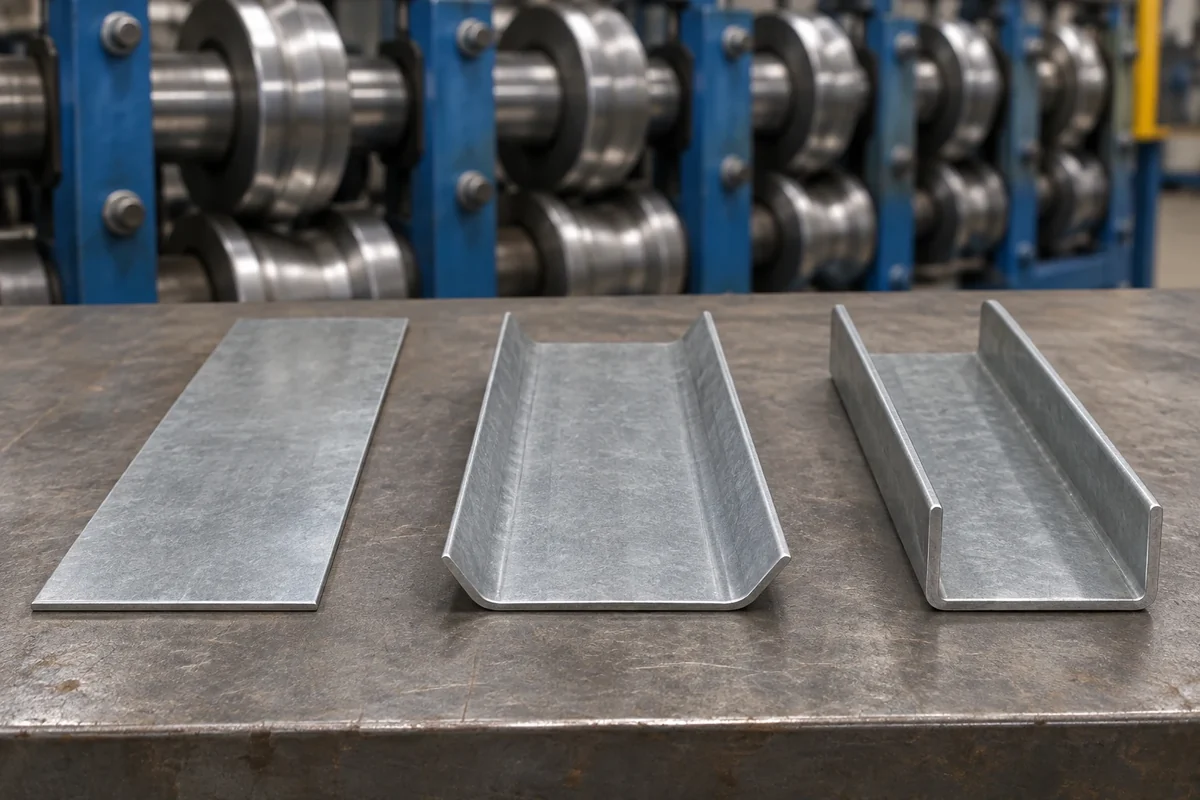
A simplified progression might show:
- Flat strip.
- A shallow first bend on each side.
- Higher side walls.
- A channel with a controlled opening.
- A finished constant-section profile.
This five-stage sequence is an explanatory example only. A real route may contain more or fewer operations and may use different sequences to avoid interference or reach the intended geometry. The drawing’s purpose is to help the buyer see how the shape evolves, not to prescribe tooling.
What the flower pattern tells a buyer
The flower pattern helps connect a final profile to the gradual deformations needed to create it. A buyer can use it to ask how the strip is formed, where bends develop, and whether any features are created before, during, or after the forming sequence. It can also reveal whether a requested feature is part of the continuous cross-section or a separate operation.
For example, a rail with a uniform channel section along its length has a different process question from a part whose cross-section changes halfway through. A continuous roll route is naturally organized around a repeated section along a strip. A localized step, tab, or changing section may call for another operation or a different manufacturing route. This is not an automatic rejection of the design. It is a prompt to clarify how the supplier proposes to create the feature and how it will be inspected.
A buyer reviewing a flower drawing can ask:
- Which drawing revision and material does the sequence represent?
- Which bends or edges are important to assembly or appearance?
- Are dimensions measured at each intermediate stage or on the finished profile?
- Where do holes, slots, cutoffs, tabs, or end treatments occur in the route?
- Does the drawing show the finished section and the relevant tolerances?
- Are there transitions or local features that cannot be made by continuous rolls alone?
- What inspection method will be used for the finished profile?
The answers may be brief, but they should attach to the actual component and its critical requirements. A generic flower image does not validate a product. It is a useful communication tool when it corresponds to the design being quoted.
Roll forming versus a press brake
Both processes can bend sheet or strip, but the work sequence differs. A press brake uses a punch and die arrangement to make a bend or series of bends in a workpiece. Successive roll passes uses successive roll stations to progressively change a continuous strip’s cross-section. The distinction does not tell a buyer which process is automatically better. The part geometry, length, profile continuity, volume, tooling, tolerances, and required features matter.
Use the available internal guide on press-brake air bending, bottoming, and coining when the buyer’s question concerns press-brake contact modes. That page owns the differences among those bending approaches. This article focuses on the progressive strip route and the profile’s intermediate cross-sections.
A profile that has a constant cross-section over a long length may invite discussion of successive roll passes. A shorter part with discrete bends might be evaluated with another process. These examples should not become a universal volume threshold. Tooling costs, design changes, material properties, line availability, secondary work, and batch size affect the comparison. The buyer should request a route proposal for the actual part rather than assume that the process name proves the economics.
The same word “rolling” appears in other forming contexts. Tube bending, for instance, changes the tube’s path along its length; successive roll passes changes the strip cross-section along a progressive route. See the separate guide on rotary draw versus roll tube bending radius. A supplier’s use of “roll” should be clarified by identifying the workpiece and the shape change being discussed.
The roles of punching, cutoff, and other secondary operations
Successive roll passes describes the profile-shaping route, not every operation that may appear in the finished part. Holes may be punched before, during, or after the profile is formed depending on the tool design and feature position. The strip may be cut to length as part of a line sequence or by separate equipment. End notches, tabs, slots, or joining details may use additional operations.
A buyer should not assume from a product photo that the rolls produced a hole or cutoff. The photo shows an outcome, not the full process sequence. Ask where each feature is introduced and how the finished geometry is controlled. A feature located on a flat flange may be easier to form or inspect at a different stage than a feature near a complex bend, but the precise route depends on the tooling and design.
A useful RFQ package can label:
- Overall length and finished cross-section.
- Material designation and supplied condition, when specified.
- Critical opening, flange, or leg dimensions.
- Hole and slot positions from clear datums.
- Edge condition and any visible cosmetic faces.
- Whether the part must mate with another component.
- Any end treatment, trim, or assembly operation.
- Inspection points that matter to fit or function.
These details do not specify a forming line or guarantee manufacturability. They give the supplier enough information to identify unknowns and return questions before the buyer approves a sample or tooling.
Constant section, changing section, and local features
The phrase “constant section” means the profile is intended to maintain a similar cross-sectional shape along its length. It does not mean the part is identical at every point. A product can include holes, slots, cuts, bends at the ends, or other features created by separate operations. What matters is which geometry is continuous and which is localized.
A buyer can mark a drawing with two visual layers:
- The repeated cross-section that defines the lengthwise profile.
- The localized features that need a separate process step or verification.
This visual separation can prevent a common misunderstanding: the supplier may quote the base profile, while the buyer assumes the quote includes all punched and trimmed details. A process map should identify which work is included in the quoted scope, which features are produced by the roll route, and which require another operation or supplied component.
If the cross-section changes along the length, ask how that transition is formed and whether it is compatible with the proposed route. Do not assume that all profile transitions require a particular machine or that the part is impossible. The supplier should state the proposed method and any design or tooling implications for review.
Keep the datum chain visible
When a profile has several connected dimensions, identify a stable datum rather than measuring each feature from a different edge. The drawing should make clear whether an opening is measured across the inside faces, outside faces, or from a defined centerline. If a mounting slot is positioned from the cut end, state whether the datum is the finished end or an earlier process reference. This prevents a discussion about a forming route from being mistaken for a disagreement about the target geometry.
For a supplier review, mark the dimensions that control mating, installation, or appearance. Do not label every dimension critical without a reason; that can make inspection harder to interpret. A buyer may identify a few fit dimensions, a visual surface, and a slot location as priorities, then confirm the measurement method with the supplier. The same drawing revision and datum scheme should appear in the quotation, sample review, and production acceptance records.
Coordinate secondary operations
Secondary operations need their own handoff. If slots are punched after forming, the buyer should clarify their position relative to the finished profile and which surface is used to locate the part. If punching occurs earlier, the forming route may change how the feature appears in the final component. These are questions for the proposed supplier route; they cannot be answered from the word “roll formed.”
Cutoff also affects delivered geometry. The buyer can specify finished length and end condition, while asking how length is controlled and what edge treatment is included. If the end is visible or mates with another component, the requirement should be explicit. This article does not prescribe a tolerance or cutting method because those depend on the product drawing and agreement.
Review every purchased operation
A component may pass through forming, punching, cutoff, surface finishing, inspection, and packaging. The quotation should say which party performs each stage. If finishing or another operation is external, the buyer can ask how the part is identified between operations and how a dimensional or cosmetic concern is recorded. This is not an assumption that outside processing is risky; it keeps responsibility and scope clear.
When a quotation separates tooling from piece price, request enough information to understand which design features the tooling supports and what changes require review. Do not assume that a tooling charge guarantees a particular service life or unlimited design revisions. The commercial terms should state what the supplier is providing and how a revised profile will be evaluated.
What a formed sample can and cannot show
A sample lets the buyer inspect the actual part against agreed references. It can show the section shape, fit with mating parts, visible surface condition, and dimensions selected for review. A sample can also help uncover drawing ambiguities or packaging needs.
It cannot automatically prove:
- That every production piece will match without a defined process and inspection plan.
- That a supplier has available line time for a later order.
- That all holes and cutoffs were made by the forming rolls.
- That a material grade is correct based only on appearance.
- That the profile will meet an unstated load or service requirement.
- That a future design revision will use the same route.
The buyer and supplier should identify what the sample represents. If it uses temporary tooling or a different operation, note the difference. If a critical dimension is not measured, do not treat a visual review as an inspection record for that dimension.
A practical route-review example
Imagine an importer wants a long metal channel used as part of a storage assembly. The drawing shows a repeated U-shaped cross-section, two mounting slots near one end, and a defined cut length. The buyer can ask the supplier to explain the progressive section changes, identify when the slots are punched, and state how the part is cut to length.
The buyer then reviews the proposed sample for:
- The opening width and side-wall geometry.
- Slot location from the agreed datum.
- Length and end condition.
- Fit with the mating component.
- Visible surface condition after any finishing step.
- Package protection against deformation or scratches.
This example does not claim the channel is suitable for any specific load or that successive roll passes is always the lowest-cost route. It demonstrates how a process explanation can be translated into buyer questions. A different product may use another route or require another inspection plan.

Questions that clarify a roll-forming quotation
Before approving a quotation or sample, clarify:
- Does the quoted scope include strip material, forming, punching, cutoff, finishing, assembly, and packing?
- Which drawing revision and material description are priced?
- Is the requested cross-section continuous along the part length?
- Which features are created by the rolls, and which use secondary steps?
- What datums will be used to inspect critical dimensions?
- Is there a sample or drawing showing the proposed finished section?
- Are there tooling, fixture, or process-development charges to review?
- How are design revisions handled if the profile changes after tooling?
- Which surface is cosmetic or visible after installation?
- What remains uncertain before the supplier can confirm the route?
Do not treat a process label as an answer to every commercial or technical question. A clear quotation should specify the product scope and identify assumptions. If the supplier needs additional information, record the request and update the drawing or specification before comparing quotations.
Avoiding common process-name assumptions
“It is roll formed, so every feature is made in one pass.” The profile is formed progressively, but the finished part may need punching, cutoff, end treatment, or assembly.
“A flower diagram proves the profile is correct.” The diagram illustrates intermediate shapes. The finished sample and appropriate dimensional review address the actual part.
“Successive roll passes is always faster or cheaper.” That conclusion depends on geometry, tooling, material, quantity, secondary operations, and the production route. Do not make a cost claim from the process name alone.
“A long profile must be roll formed.” Length may be relevant, but it is not sufficient to select a route. Consider the section, local features, tolerance, finish, volume, and supplier proposal.
“The process is the same as tube rolling.” Ask what is being changed: the cross-section of a strip or the path of a tube. The distinction matters when discussing tooling and geometry.
Manage a profile revision after sampling
A profile change should be reviewed against the sample and the process description, not treated as a harmless wording update. Changing a flange height can affect the final section, a hole reference, or how a mating component sits. Moving a slot can affect the punch operation and its locating datum. Changing material or thickness can also alter forming behavior, so the buyer should ask the supplier to review the proposed revision rather than assume the original sample remains representative.
A short change record can identify the old and new drawing revisions, the changed feature, the reason for the change, the affected sample or tooling, and the approvals required before production. The buyer can then ask whether the change affects price, process steps, inspection, delivery timing, or packaging. These are questions to be answered for the specific project; this guide does not presume that every revision affects every commercial term.
If a supplier offers an alternative route, compare the output and process scope on equal terms. One quote may include profile forming only while another includes punching, cutoff, finishing, and packing. A lower number cannot be compared fairly if the operations or assumptions differ. List included steps side by side and resolve any missing feature before selecting an option. This keeps the discussion focused on the delivered component instead of the name of the machine or process.
Buyer checklist for profile sourcing
Before approving the design:
- Show the finished cross-section and its datums.
- Mark continuous profile features separately from local features.
- Identify hole, slot, cutoff, and end-treatment requirements.
- State material and surface requirements at the correct level of detail.
- Ask for the proposed process sequence and sample basis.
- Confirm which operations are included in the quotation.
- Keep tooling and future revision questions visible.
- Review the sample against the features that actually matter to assembly.
- Avoid inferring capacity, output, or quality from a machine image.
If you are developing a custom metal storage component and want to discuss its section, drawing, and proposed operation sequence, share the scope with اتصل بـ «كويتور». Koitor can review a bathroom or home-storage hardware project against the supplied requirements and discuss an appropriate OEM next step.
Comparison table: keep the scope visible
| Review item | What to record | What it does not prove |
|---|---|---|
| Product and revision | The exact item being reviewed | Future revisions are unchanged |
| Process or method | The operation or measurement in scope | Every result or feature is covered |
| Evidence | The sample, record, or specification used | Unstated performance or acceptance |
When reviewing a profile, the buyer can compare the drawing section with a sample at more than one point along the length. The chosen checks should correspond to fit, assembly, or visible appearance requirements rather than an assumed universal inspection plan. A profile may include a long repeated section and localized holes or cuts, so the inspection should distinguish those features. If an end is trimmed after forming, the finished length and edge condition should be checked against the agreed reference. If the part is coated later, the buyer should also consider whether the finished measurement is taken before or after coating. These details are best agreed with the supplier because the route and inspection method depend on the component. They do not imply a specific process capability or a guaranteed tolerance.
الأسئلة الشائعة
What should a buyer confirm first?
Start with the exact product, process, or measurement scope and the applicable drawing or specification.
Does one sample or record prove every production condition?
No. Keep the part, revision, method, and evidence scope attached to each conclusion.
What if the requirement is unclear?
Record the open question and ask the responsible supplier or technical owner before approval.
For related buyer context, see sheet-metal RFQ file formats و the technical factory-audit guide.
Discuss a related hardware project with Koitor
Share the relevant drawing or sample, product revision, finish, order quantity, and packaging scope to clarify the manufacturing discussion. Confirm project-specific processes and evidence with the responsible supplier.
OEM / العلامة التجارية الخاصة
حوّل دليل التوريد هذا إلى موجز منتج
يرجى إطلاعنا على المنتج المستهدف، والحجم، والتشطيب، وكمية الطلب، ومتطلبات التغليف. وسيتلقى فريقك تقييمًا عمليًّا لإمكانية التصنيع قبل تقديم عرض الأسعار.


 English
 Español
 Português
 Français
 Deutsch
 العربية