
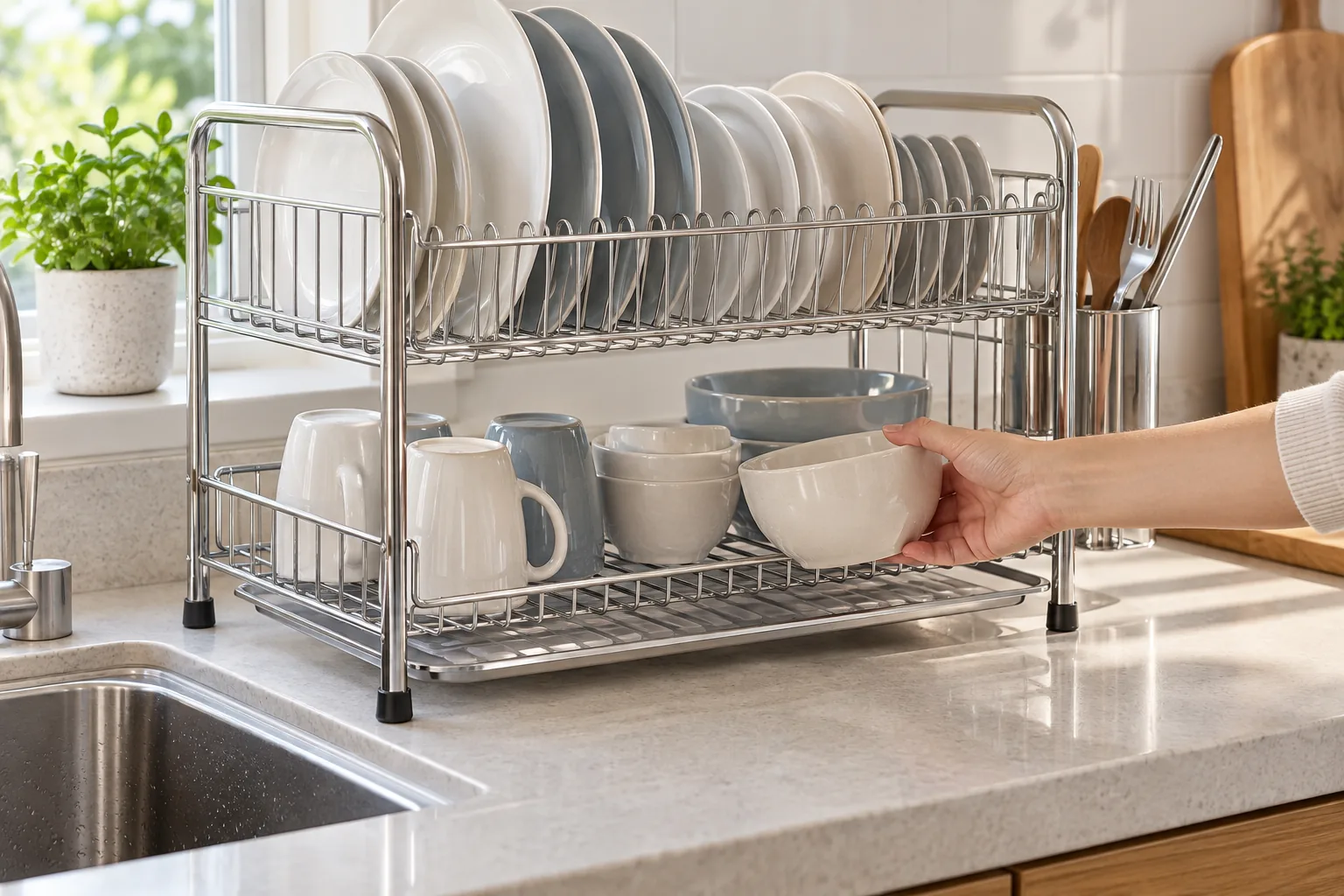
A two tier dish rack lower shelf access specification should answer a practical question: can the intended bowls, cups and other lower-level items be loaded, reached and removed while the upper tier is occupied? Buyers should define the item envelopes and hand path together, then check a production-relevant sample rather than assume that a second level automatically adds usable capacity.
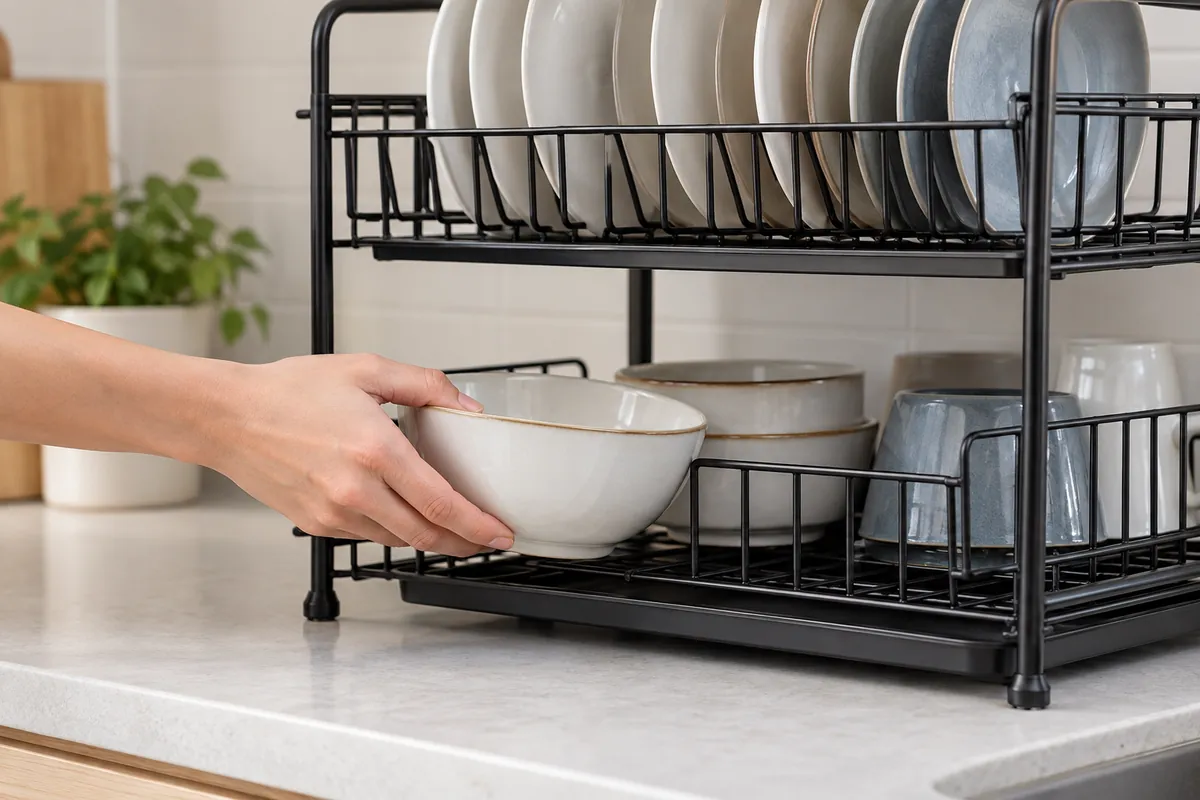
Why does lower-tier capacity differ from usable access?
A second tier can increase the number of places where dishes sit, but the lower shelf becomes a constrained space beneath another structure. A tall bowl may fit only when tilted. A mug handle may catch a vertical post. A user’s knuckles may contact the front rail while pulling an item forward. If the upper tier is loaded, it can reduce visibility and make the correct retrieval path less obvious. These are separate from drainage and plate-slot questions and deserve their own sample review.
The lowest point of the upper tier does not tell the whole story. Support wires, folded lips, attachments, cup hooks or removable trays may project downward. A lower-tier item may fit in an empty center bay but not near a post or accessory. Buyers should map the three-dimensional usable envelope and identify the zones affected by structural members. A top-down footprint alone can conceal a vertical collision, while a side view without vessel shapes can conceal handle interference.
Access also depends on how the rack is positioned on the counter. A wall, faucet, sink edge, backsplash or draining board can limit the direction from which a user approaches. If the rack has a removable upper basket, drain tray or utensil cup, those parts can alter reach and cleaning. The buyer should decide whether the project assumes front-only loading, side access, or removable components, then represent that arrangement in the drawing and sample assessment.
Which item and envelope data should be recorded?
List representative lower-tier bowls, cups and containers by maximum outside width, height, base shape and handle projection. For nested bowls, specify whether they are stacked or separated. Record how each item is oriented and the path by which it enters and leaves the bay. Use the upper-tier plates or trays that the product is meant to hold at the same time. The goal is not to catalogue every possible dish; it is to identify a realistic assortment that bounds the intended use.
Dimension the lower-tier floor to underside-of-upper-structure distance at several useful positions, not only one center point. Show front opening height and width, post locations, rail projections and any removable tray. If an upper accessory is optional, indicate both configurations. Buyers should distinguish nominal product dimensions from usable clearances after finish and assembly. The manufacturer can then identify which gaps are controlled by forming, welding, fixtures or assembly and which are simply open design space.
Also define how much movement is acceptable during retrieval. A bowl can be lifted vertically, slid forward or tilted through the opening; each path creates different clearances. State the intended motion and review it with a hand or a practical user simulation. A close fit may make the product appear compact in a render while creating frustrating access in use. The specification should capture the user’s actual path, not just a minimum opening number.
| Layout decision | Potential advantage | Risk to evaluate |
|---|---|---|
| More tier spacing | Accommodates taller lower vessels | Raises upper shelf and can enlarge product envelope |
| Open front | Direct approach to bowls and cups | Items may slide; review retention and loaded handling |
| Lower dividers | Separates or locates items | Can create bays too narrow for real assortment |
| Removable upper shelf | Flexible loading and cleaning | Removal path may collide with lower contents |
What layouts can a buyer compare?
A full-width lower basket can use the available footprint efficiently, yet posts and rails may break it into smaller zones. A divided lower tier can stop items shifting but may create narrow bays. An open front can make access easier but may allow items to slide outward. A removable lower tray can simplify cleaning and packout, but it may reduce vertical clearance or require a grip feature. Compare the intended vessel assortment, cleaning method and packaging before choosing a layout.
The height between tiers is a trade-off. More vertical space can accept larger bowls but raises the upper tier and overall center of the structure. A lower upper-tier position can make the rack compact while restricting access and trapping water or debris. Avoid choosing tier spacing by visual symmetry alone. Load the anticipated plates above and the intended bowls below, then check whether each item can be placed and removed without moving the other tier’s contents.
If the buyer considers a removable upper component, specify where it sits, how it is retained and how a user lifts it without contacting lower items. If the product includes a drain tray, check whether it can be removed while the rack is loaded and whether the lower shelf remains accessible. These functional questions are distinct from the broader [تصنيع رفوف تخزين مخصصة للمطابخ](https://koitorhardware.com/custom-kitchen-storage-rack-manufacturer/) supplier topic and should be resolved for the exact concept.
How should the buyer test actual loading and retrieval?
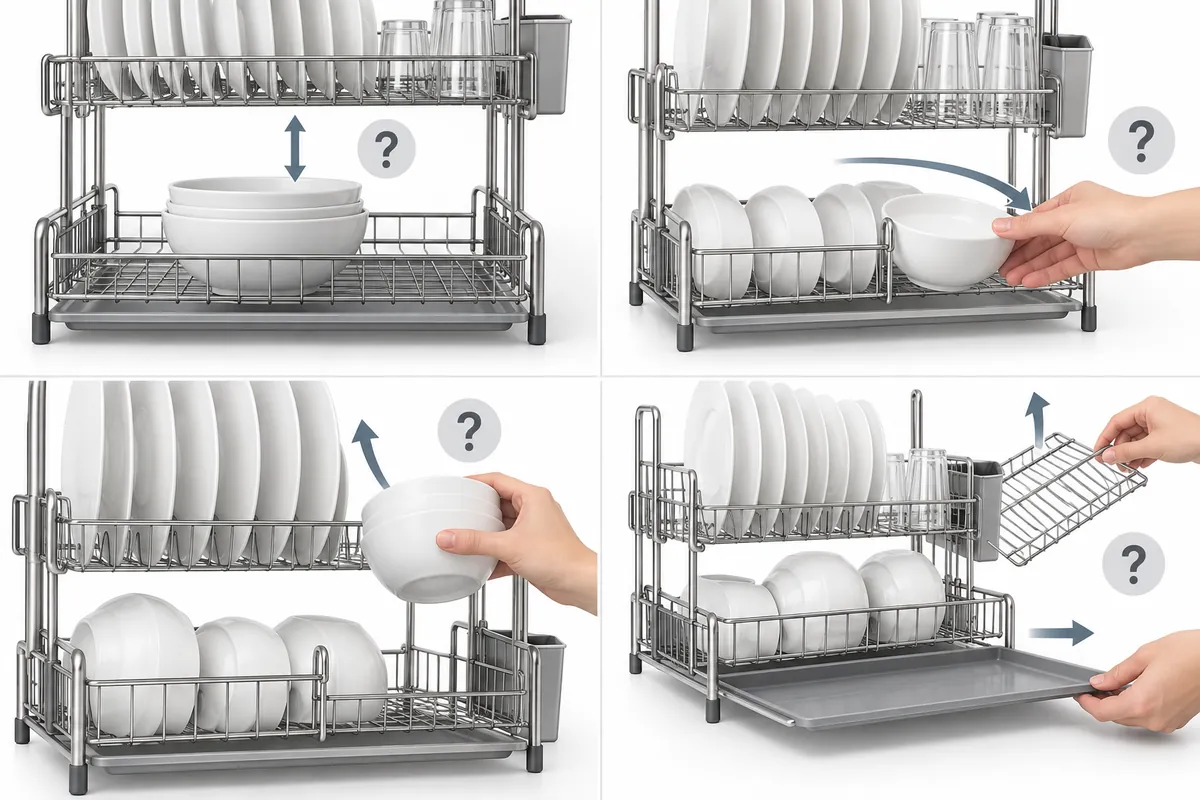
Set up the sample on a surface representative of the intended counter and install all specified accessories. Load the upper tier first with the agreed plates or trays, then place the representative bowls and cups below. Try each lower-tier location, including positions near the posts and corners. Remove and replace the largest item without shifting the upper dishes. Note the hand path, contact points and whether the user needs to tilt or rotate an item in a way that was not intended.
Repeat the review with the rack partially loaded and with the upper tier in the configuration expected for sale. This may reveal a different obstruction from a fully loaded photo. Check mug handles, bowl rims and tapered bases against the wire spacing. If accessories are removable, review the sequence for lifting, cleaning and reinstalling them. Document sample revision, load arrangement and the observed path so that a design change can be compared fairly.
Keep claims disciplined. A sample demonstration can show that a particular assortment was handled in a specified setup; it does not establish a universal capacity or a safety rating. If the project needs a load or stability requirement, define the test setup, measurement method, acceptance limits and responsible approver separately. Avoid copying a figure from a competitor listing unless its test method and relevance have been independently established for this product.
How can fabrication and finish preserve the opening?
The usable opening depends on the assembled geometry, not a single cut length. Wire forming and welding can influence the relative position of a rail, upright or upper tier. A fixture may help hold a frame during joining, but the buyer should confirm which dimensions are functionally important and how the production sample is checked. No exact manufacturing tolerance should be invented before the design, material form and process are agreed.
Finishing can affect perceived clearance at tight contacts, and assembly can shift detachable trays or racks. Inspect the completed unit after its final surface treatment. Check whether edges are smooth where hands and dish rims pass. Consider whether gaps trap water or food residue and whether a cleaning tool can reach them. These are product-design and maintenance questions, not a claim that one finish guarantees hygiene or corrosion resistance.
Packaging should protect the upper and lower tiers from rubbing while preserving the correct assembly orientation. If the upper tier is removed for shipping, the instructions need to show how it attaches and how the lower access opening is oriented. A small parts or drain-tray compartment should remain identifiable. Repeat orders should carry the approved drawing and sample revision so that a change to a post or rail does not silently narrow the opening. Koitor’s [OEM home storage hardware](https://koitorhardware.com/oem-home-storage-hardware-manufacturer/) information can support sourcing discussions without implying a confirmed exact model.
The two tier dish rack lower shelf access record should identify the actual load state that passed review. A photo of the bottom tier alone cannot show whether plates on top remain in place while a bowl is taken out. Keep an image or sketch of the loading arrangement with the sample number and drawing revision. If the intended assortment changes from mugs to taller handled cups, check both handle projection and the approach path again. A different retailer may also present a different combination of dishes even when the metal structure is unchanged. Treat that as an assortment decision, not as proof that the rack geometry was defective or universally suitable. A clear baseline lets the product team decide whether the change needs a new divider, a revised accessory, a changed tier opening or only updated instructions. That makes capacity discussions more specific and avoids unsupported claims based on a simple count of wire bays. Keep the two tier dish rack lower shelf access record tied to the sample number and upper-tier loading arrangement. If a new bowl or handled cup changes the approach path, repeat the lower-tier retrieval review before treating the older configuration as representative.
Before sample approval, list the target lower-tier vessels and their envelopes, the upper-tier load that remains in place, the tier spacing, post locations, front opening, side access and removable parts. Show the product in plan, elevation and a useful side section. Specify which accessories must be present during the access test. If the intended buyer sells several assortments, choose representative items that reflect the actual retail bundle rather than an imaginary universal dish set.
During review, load the upper shelf first and test the lower shelf at every meaningful position. Remove the largest bowl, a handled cup and a nested item if those are part of the assortment. Observe whether a hand, vessel or handle collides with a post or underside rail. Repeat with removable trays or accessories installed. Capture photos and notes against the sample revision, and distinguish a design preference from a required acceptance criterion.
At production release, confirm the finished dimensions, assembly sequence, surface treatment, drain parts, packout and user instructions. Decide which sample configuration becomes the reference for subsequent orders. If the buyer changes a vessel set or adds an accessory, recheck the lower access envelope before treating the old approval as valid. Clear change control helps maintain usable access while avoiding unsupported capacity promises.
Buyer approval checklist
- Representative bowls, cups, handles and upper-tier plates are defined.
- Usable lower-tier height, front opening and post positions are shown.
- Sample is reviewed with the upper tier loaded, not empty.
- Largest lower item is removed at corners and center without moving upper dishes.
- Accessories, finish, packout, cleaning and change control match the approved setup.
Frequently asked questions
Is lower-tier height the only access dimension?
No. Front opening, post location, hand path, vessel shape, upper-tier underside and approach direction all affect access.
Can buyers test with empty shelves?
An empty fit check is useful for geometry but does not represent the intended use. Review the expected upper load and representative lower items together.
Does a larger lower opening always improve the rack?
Not necessarily. A larger opening can reduce retention or change the structure. Compare access with item stability and the full product envelope.
Should each buyer send their own dishes?
For a custom assortment, real representative items are valuable. If physical items are unavailable, use controlled dimensional envelopes and confirm them during sample review.
Does this imply Koitor sells this exact two-tier dish rack?
No. It is an adjacent sourcing topic. Current manufacturing scope for an exact dish-rack model must be confirmed independently.
Koitor is a family-owned custom metal hardware manufacturer focused on practical OEM communication. For adjacent product concepts, confirm exact process scope, specifications and sample expectations with the production team before making a sourcing decision.
Plan a buyer-ready product specification
Share your drawing, target assortment or physical sample so the project team can review the relevant geometry and questions.
OEM / العلامة التجارية الخاصة
حوّل دليل التوريد هذا إلى موجز منتج
يرجى إطلاعنا على المنتج المستهدف، والحجم، والتشطيب، وكمية الطلب، ومتطلبات التغليف. وسيتلقى فريقك تقييمًا عمليًّا لإمكانية التصنيع قبل تقديم عرض الأسعار.
 English
  Español
  Português
  Français
  Deutsch
  العربية