
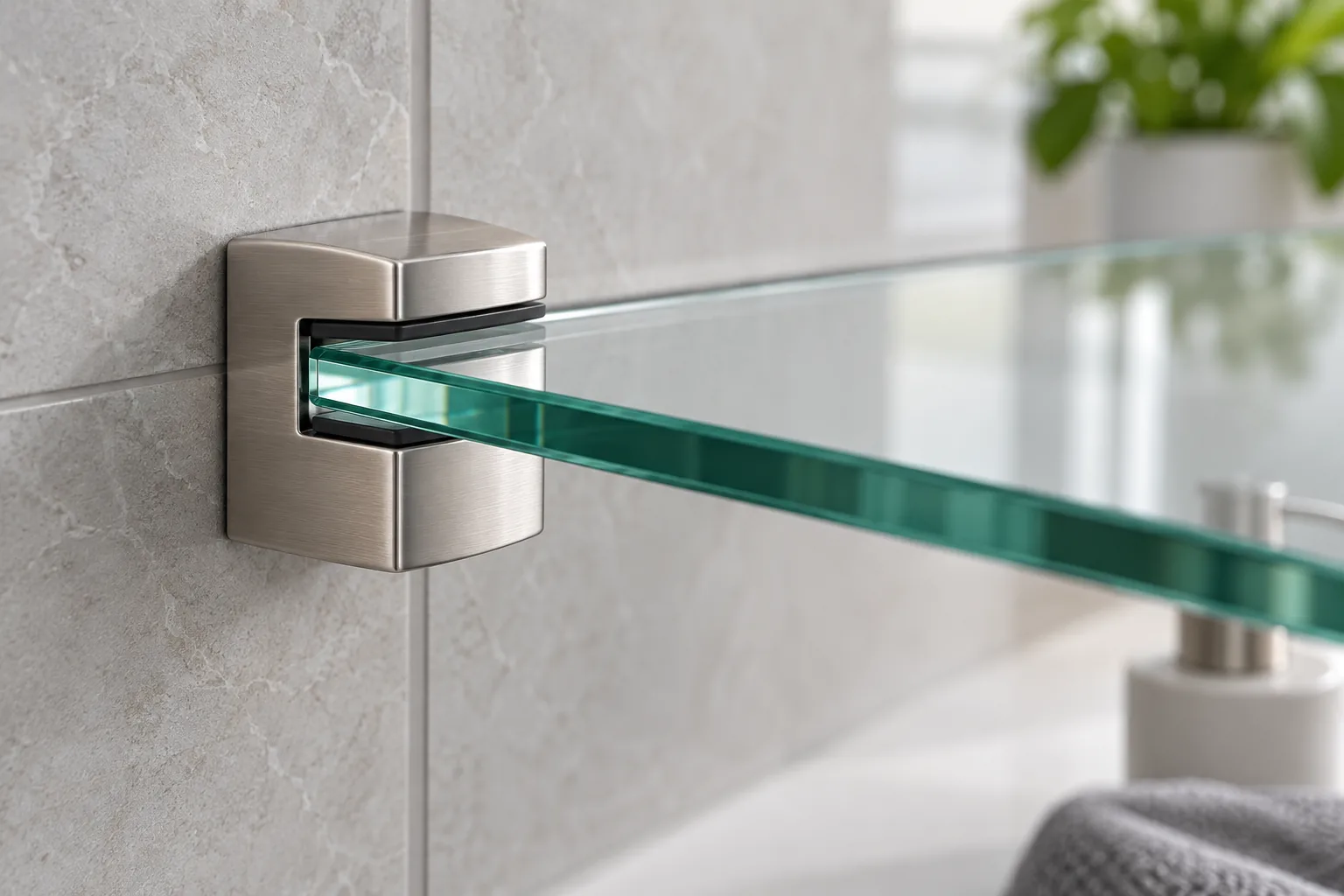
For a glass shelf clamp thickness gasket specification, buyers should state the actual shelf thickness range, the clamp’s usable throat and adjustment method, the gasket material and contact area, and the finished assembly that must be approved. A nominal clamp size or a soft pad shown in a product photo is not enough: the glass, clamp, gasket, wall substrate, shelf depth and installation method work together, so approve them as one project-specific interface.
This guide is for bathroom-accessory importers and product managers sourcing a glass-and-metal shelf assembly or a clamp component. It does not set universal glass tolerances, loads or safety rules. Instead, it turns the fit question into a drawing and sample-review process that makes supplier quotations comparable and helps prevent a sample that looks right but does not match the production configuration. Treat the phrase glass shelf clamp thickness gasket as a buyer’s search description for a combined interface question, not as a substitute for a controlled drawing or a supplier’s exact product specification.
Why can a clamp with the right nominal size still fit poorly?
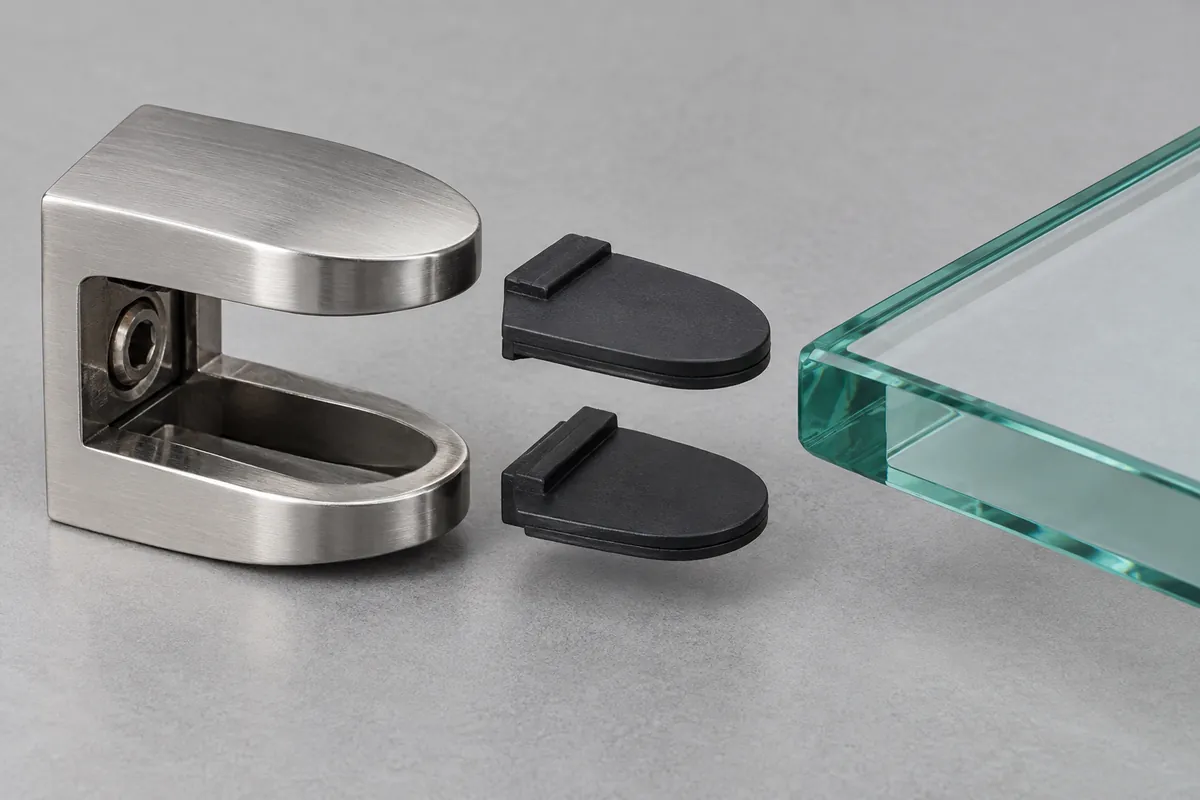
“Glass thickness” is only one dimension in the fit. A clamp may be described by a nominal range, but the buyer still needs to understand how its body retains the shelf, where an adjustment screw acts, whether the contact faces are parallel, and how the supplied gasket occupies the gap. Two products with the same nominal range can have different internal geometry and adjustment behavior.
The production interface is a stack of parts: the shelf edge, clamp body, gasket or liner, adjustment feature, mounting screw and supporting substrate. Each part changes the assembled position. A thick or folded pad can reduce the usable opening; a narrow liner may leave part of the metal face exposed; an adjustment screw can concentrate contact differently from a broad compliant pad. These are design questions to verify from the selected supplier’s drawing and sample, not assumptions that can be resolved from a listing title.
Shelf depth and overhang matter to the overall assembly review as well. They do not establish a clamp’s load rating, and buyers should not infer one from material appearance or from the fact that a product fits a piece of glass. The bracket supplier’s stated limitations, wall substrate and installation instructions apply to that exact configuration. A buyer should record the complete combination being quoted and avoid transferring a rating from another clamp or another installation.
This distinction is visible in supplier data. For example, CRL describes its DL631 adjustable shelf clamp for a specific thickness interval and shelf-depth configuration, includes a foam gasket and adjustment screw, and gives product-specific installation and weight information. That is an example of why specifications belong to an exact item and assembly; it is not a universal specification for glass clamps, nor a recommended design limit for another product. See CRL’s product-specific description.
What should the RFQ and drawing state?
Give each supplier the same controlled information. If a glass specification is still being selected, label it as a range or open item instead of letting suppliers silently assume different inputs. Ask the supplier to identify deviations and proposed alternatives in writing.
At minimum, include the following:
- Glass envelope: nominal thickness and the accepted incoming range, edge shape or finishing condition relevant to the contact area, shelf width and depth, and whether the glass is supplied by the buyer or another vendor.
- Clamp geometry: usable throat or opening, engagement depth, adjustment range where applicable, body dimensions, mounting-hole location, and orientation on the shelf.
- Contact interface: gasket/liner material as supplied, thickness or profile where controlled, coverage area, attachment method, replacement status and whether the pad is included in the quoted assembly.
- Support context: mounting surface and intended fastener interface, number and location of clamps, shelf projection, and any adjacent frame or tile feature that could interfere.
- Finish and handling: clamp finish, protected contact surfaces, packaging separation between metal parts and glass, and any cosmetic criteria visible after installation.
- Approval evidence: identified drawing revision, sample part numbers, photographs or measurements to return, and the acceptance method for a production-intent assembly.
Dimensions that affect fit should be called out on the drawing or a referenced specification, rather than left to an informal email. If the supplier uses a different measurement datum, request that it be shown. If the buyer does not yet have final glass, the sample plan should say what representative glass is being used and what remains unverified.
Use one controlled line item for the glass shelf clamp thickness gasket interface in the RFQ, then link that line to the drawing revision and sample record. This gives purchasing, product development and incoming inspection a common reference when comparing quotations or reviewing a later component change.
An RFQ should also separate facts from assumptions. Mark each entry as confirmed, supplier-proposed or pending. For example, “glass is approximately 8 mm” is not the same as an approved nominal and tolerance. “Soft pad included” is not enough to establish composition, thickness, coverage or replacement availability. This discipline prevents a sample from receiving approval simply because the missing requirement was never discussed.
How should buyers compare clamp and gasket approaches?
The right option depends on the product geometry and the evidence available from the supplier. This comparison is a sourcing framework, not a ranking of universal designs.
| Approach to evaluate | Potential buyer benefit | Questions and trade-offs to verify |
|---|---|---|
| Fixed opening with separate pad choices | Simple component definition when the glass envelope is stable | Does the exact pad close the gap without shifting, bunching or exposing the contact face? Are alternate pads controlled by part number? |
| Adjustable clamp with a supplied gasket | May accommodate a supplier-defined range without changing the body | What is the documented adjustment interval for this model? How does the adjustment act on the shelf? What installation limits accompany it? |
| Profiled liner or replaceable insert | Can create a defined interface and simplify part replacement | Is the insert retained consistently? Does the drawing define its profile, material and fit? Is it included in production packaging? |
| Custom clamp geometry | Can align the component to a specific shelf and frame envelope | What development, tooling, sample and approval steps are needed? Which dimensions are critical, and what supplier evidence will close them? |
Do not choose solely on the broadest advertised adjustment range. A broader range may not address shelf depth, side clearance, visual alignment or the actual contact profile. Likewise, do not assume that a thicker gasket is automatically more protective or more stable. Material, compression behavior, surface condition, retained position and assembly geometry all require product-specific confirmation.
When suppliers quote different constructions, normalize the comparison. Ask each one to state the included gasket, exact clamp item, glass envelope assumed, fastener arrangement, finish, packaging and approval sample configuration. That produces a like-for-like comparison and reveals cost changes tied to real design differences rather than to an unexplained unit price.
Also compare what is included in the sample and replenishment plan. A low component price can be misleading if pads are sourced separately, if a special profile needs a minimum order, or if the supplier’s quoted sample omits the production finish. Ask for itemized assumptions and identify who controls each component. Where glass and metal hardware come from separate suppliers, assign responsibility for interface questions and final assembly evidence before placing a trial order. These are commercial controls as much as technical ones: they reduce the chance that a buyer approves one configuration and receives another on a repeat order.
How do buyers qualify fit and surface contact on a sample?
The sample should represent the configuration that will be produced: same clamp revision, gasket or liner, finish, fasteners, and intended assembly method. A visually similar substitute is not a complete approval sample. Before evaluation, confirm that the glass piece represents the agreed envelope and edge condition. If it does not, record that limitation and keep approval conditional.
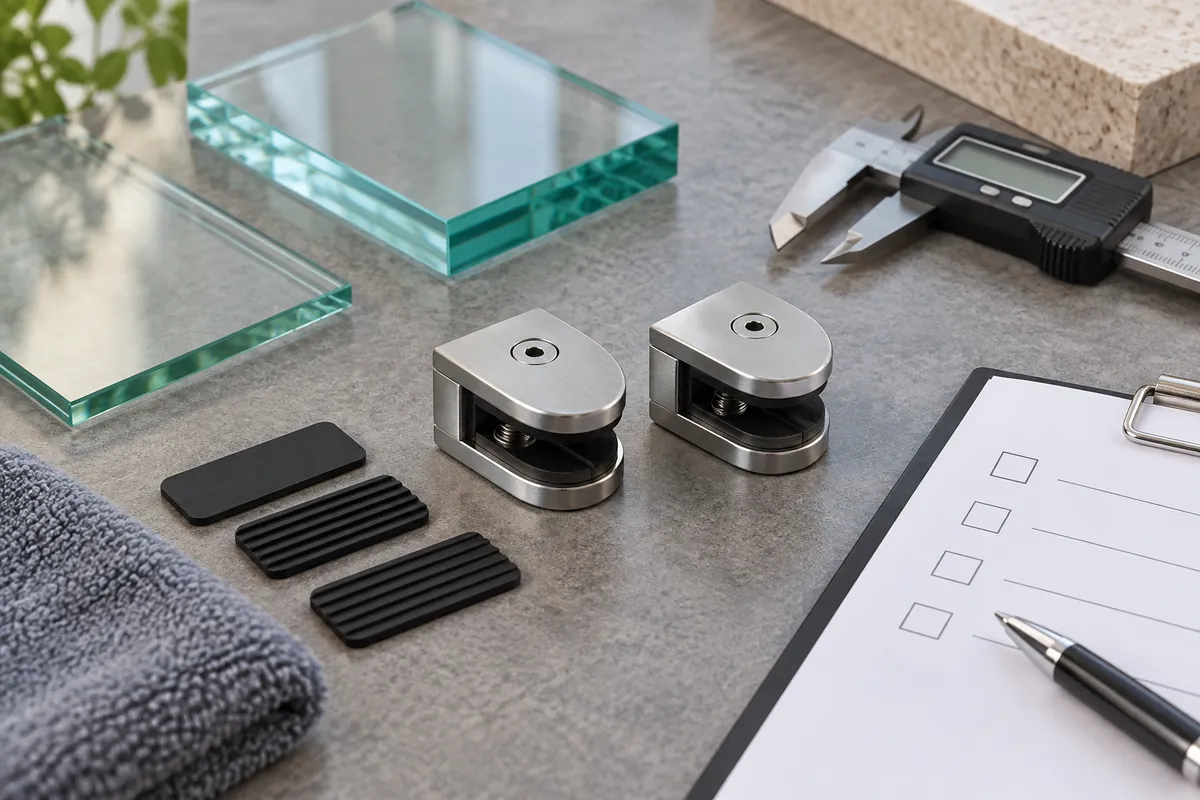
Use a repeatable inspection sequence. First, verify part identity and revision. Next, measure the relevant shelf and clamp dimensions using the agreed datums and method. Then assemble according to the supplier’s instructions, without adding unapproved tape, adhesive or packing material to make the fit appear acceptable. Observe whether the shelf enters and seats as intended, whether the gasket stays in position, whether the clamp closes as shown, and whether the assembled shelf aligns with the drawing.
Inspect contact areas before and after the agreed handling or installation evaluation. Look for exposed metal at intended protected contact faces, displaced pads, uneven seating, visible marking or interference. These observations are screening criteria; they do not certify glass strength or establish long-term performance. If there is a safety or structural requirement, use the applicable qualified engineering review and test plan rather than a visual pass/fail alone.
Record the outcome with photographs and measurements. Include the glass identification, clamp supplier and part number, gasket lot or revision if available, finish, assembly orientation and any deviations. This helps the buyer distinguish a fit problem from a sample that was built to a different configuration. It also creates a useful reference for production inspection without inventing statistical acceptance limits.
For custom metal hardware, a factory can review drawings or physical samples and discuss forming, punching, welding, polishing, finishing, assembly and packaging implications where relevant. Koitor is a family-owned custom metal hardware factory focused on bathroom and home storage hardware; that does not mean every glass clamp or glass-related test is a current Koitor product capability. Any specific clamp design, material, finish or validation route must be confirmed for the project.
What changes require a new fit review?
Treat the fit as revision-controlled. Re-review the interface if the glass supplier, nominal thickness, accepted range, edge condition, clamp body, adjustment feature, gasket profile/material, finish build, mounting surface, fastener, shelf depth or assembly instruction changes. A change that seems cosmetic can affect opening size or contact conditions, so ask the supplier to identify its effect instead of deciding from the change label alone.
For repeat orders, reference the approved drawing and sample configuration on the purchase specification. Require the supplier to notify the buyer before substituting a gasket, source, finish or clamp component. Define who approves the deviation and what evidence is needed. This is especially important when component vendors are separate: a clamp manufacturer may not control the glass specification, while the glass provider may not know which gasket the hardware supplier intends to use.
When a sample does not fit, avoid jumping to a single cause. Check whether the measured shelf matches the controlled drawing, whether the pad is the approved part, whether the clamp revision is correct, and whether the assembly orientation and adjustment match the instruction. A mismatch is a symptom; the cause needs evidence. Corrective action should address the verified cause and the relevant control, not simply ask for “tighter fit.”
Buyer checklist and FAQs
- Have we defined the glass nominal, acceptable range, edge condition and shelf depth?
- Does the drawing show the clamp opening, engagement, mounting geometry and measurement datums?
- Is the gasket identified by profile or part reference, material information available, and inclusion in the quote confirmed?
- Does the sample use the approved clamp, pad, finish, fastener and assembly instructions?
- Have we inspected fit, contact coverage, pad retention, alignment and visible marking against documented criteria?
- Are supplier-specific ratings and limitations tied to the exact model and installation rather than copied from another product?
- Have changes and production substitutions been connected to a reapproval process?
- Are unresolved glass engineering, safety or performance questions assigned to an appropriately qualified source?
Does matching the nominal glass thickness prove a clamp will fit?
No. Buyers should verify the usable opening, engagement, gasket stack and finished assembly for the exact clamp and glass configuration.
Should every clamp use the same gasket thickness?
No universal thickness follows from this guide. Use the clamp supplier’s product-specific design and confirm the selected liner against the approved interface.
Can a broad adjustment range replace a drawing review?
No. The range is only one product specification; body geometry, contact, shelf depth, mounting and installation still need review.
What should a supplier return with the sample?
Request the sample identity and revision, dimensional results for agreed characteristics, gasket identification, assembly instructions and a record of any deviations.
Does a fit check establish a load rating?
No. Fit inspection does not establish structural capacity or glass safety. Follow the exact product documentation and project-specific qualified validation requirements.
Need a Practical Review of a Custom Hardware Interface?
Send Koitor your drawing or sample, agreed material and finish details, target quantities and open fit questions. Our team can discuss manufacturability and sample planning for bathroom and home storage hardware; any glass-specific product or validation scope must be confirmed for the project.
OEM / العلامة التجارية الخاصة
حوّل دليل التوريد هذا إلى موجز منتج
يرجى إطلاعنا على المنتج المستهدف، والحجم، والتشطيب، وكمية الطلب، ومتطلبات التغليف. وسيتلقى فريقك تقييمًا عمليًّا لإمكانية التصنيع قبل تقديم عرض الأسعار.
 English
 Español
 Português
 Français
 Deutsch
 العربية