
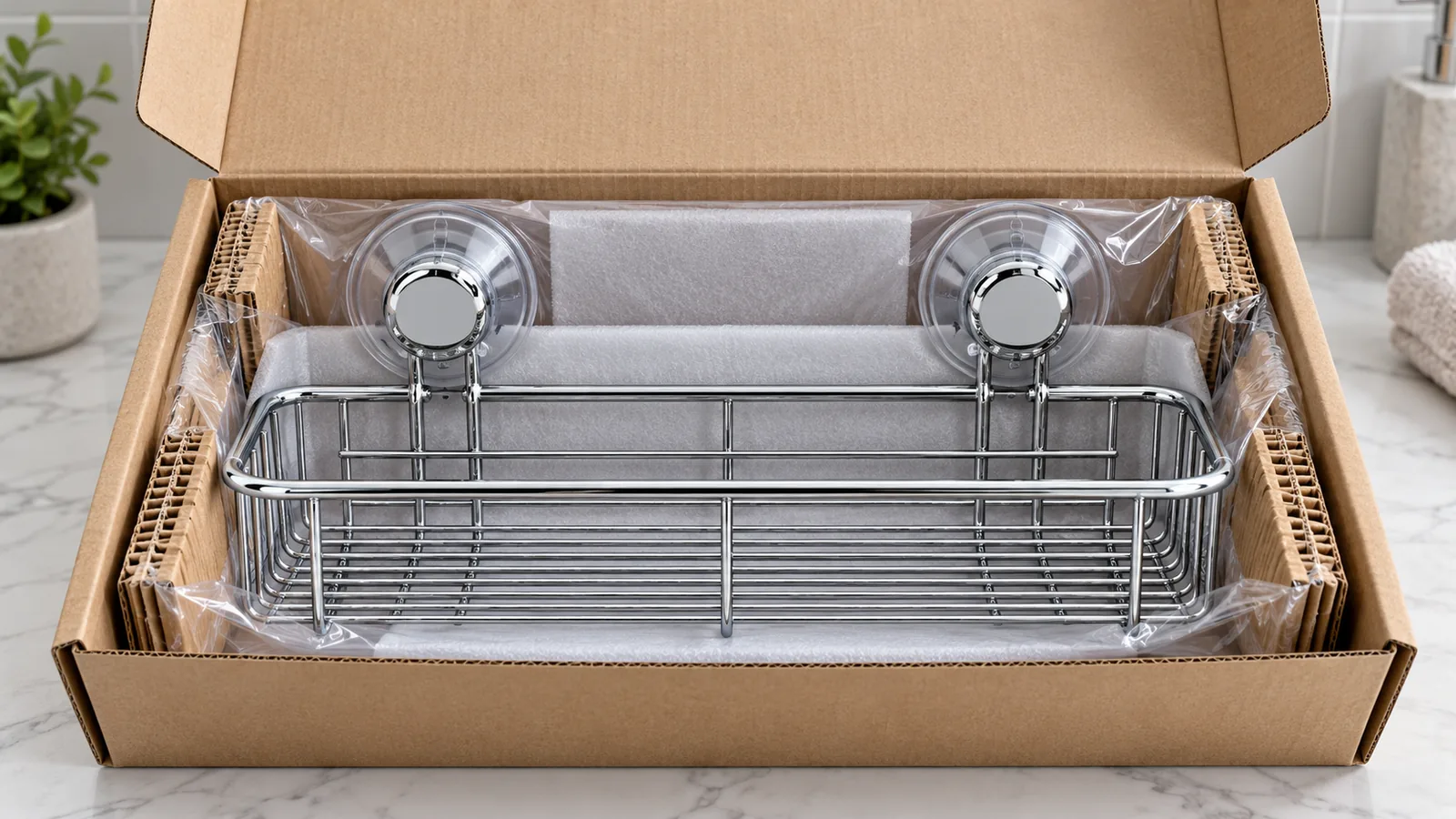
Stretch film puncture resistance wire rack protrusions should be evaluated as a product-and-packaging interface, not solved by increasing wrap tension alone. Buyers should review actual wire contact geometry, isolate vulnerable points with suitable protection, and compare a representative finished pack-out under agreed handling conditions. Film test data can help compare materials, but it does not by itself prove that a particular wrapped basket will arrive without damage.
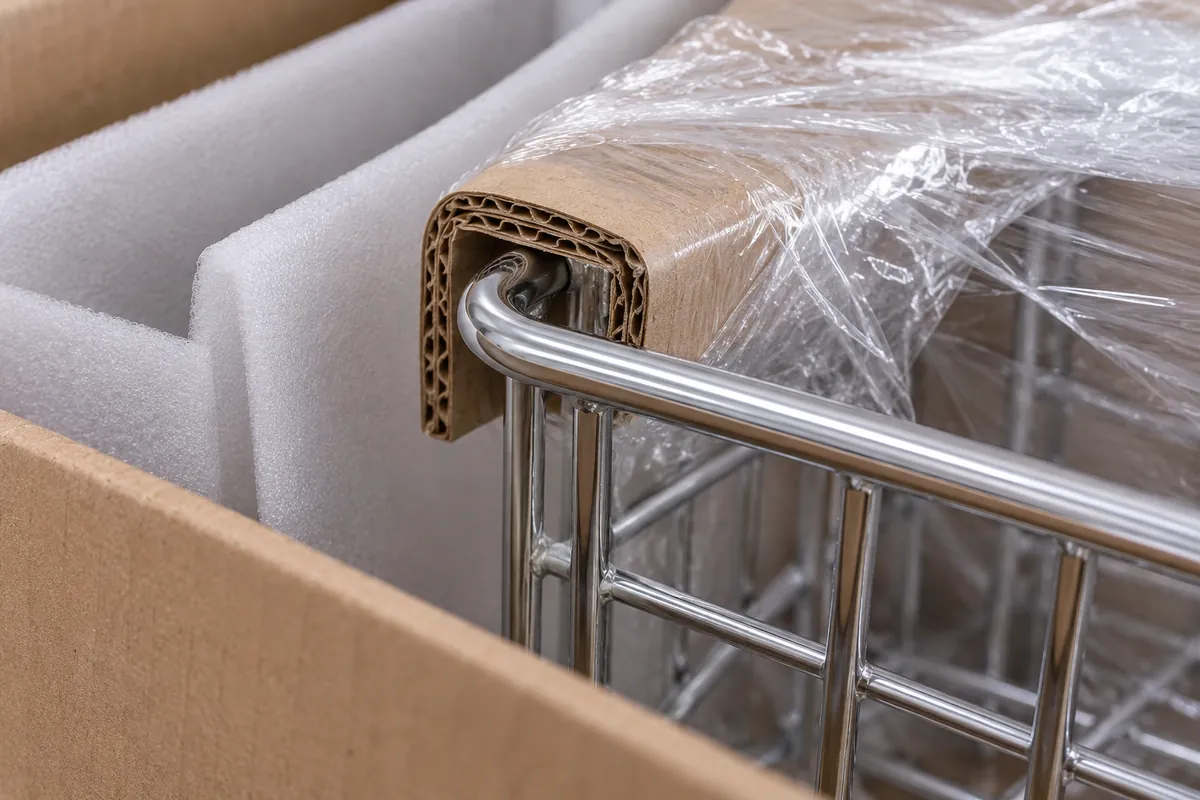
Why can a smooth-looking wire basket puncture stretch film?
Stretch film is pulled around a load and remains under tension. A rounded wire end, weld intersection, hook, mounting detail, or basket corner can concentrate contact as the load shifts. Even if a feature looks smooth to the eye, a small contact area may press repeatedly against the film during handling. The result can be a pinhole, tear, exposed metal, or film loosening around the product.
The useful packaging question is therefore not simply “Is the film thick enough?” It is “Which feature touches the film, how does that contact change during the shipment, and what stops the contact from cutting or stretching the film beyond its useful range?” The answers depend on the basket drawing, finish, orientation, unit-pack arrangement, carton support, pallet pattern, and route.
For bathroom storage products, check the basket rim, wire ends, weld junctions, hooks, suction-cup mounts, and any projecting bracket. A two-suction basket, for example, may have two circular mounting parts that need stable placement, while the wire perimeter still needs clearance from the wrap. The number and shape of contact points are product-specific; do not transfer a packaging setup from a visually similar rack without reviewing its geometry.

This is a packaging-design and supplier-approval issue, not proof that the metal part is defective. The product may be acceptable while the pack-out allows repeated film contact. Conversely, adding more film can conceal rather than correct a sharp burr or an inconsistent product feature. Keep product conformity and packaging protection as separate checks in the approval record.
What does a puncture-resistance test tell a buyer?
ASTM D5748 describes a method for measuring stretch-wrap film resistance to penetration by a probe under specified test conditions. Its published scope identifies measurements such as maximum force, force at break, penetration distance, and energy to break. The standard also notes that the method cannot reproduce every field condition; it can support comparison of film samples under controlled conditions. Buyers should consult the current standard and a qualified test provider for the complete method and interpretation.
That boundary matters. A film result characterizes a film specimen under a defined method; it does not directly rate a finished carton containing a wire basket. Real shipment contact may involve a different shape, direction, speed, temperature, tension history, number of wraps, vibration, stacking, and support. A supplier’s data sheet is useful input, not a substitute for checking the packaged product.
Use the test method as one evidence layer when comparing candidate films or investigating a recurring puncture. Ask which film construction and lot were evaluated, what test method and edition were used, whether the result represents the proposed supply, and what the reported values mean. Do not write a universal pass threshold into a purchase order unless the buyer and supplier have agreed on the method, sample conditioning, acceptance criteria, and responsibility for testing.
| Evidence or check | What it helps answer | What it does not establish by itself |
|---|---|---|
| Film puncture test report | How film samples compare under the stated test method and conditions | Whether the finished product pack-out survives a specific route |
| Visual review of wire features | Where contact or snag risks may exist on the product | Film performance or transit performance |
| Representative pack-out trial | Whether the agreed product, protection, and wrapping arrangement work together in the trial | Every carrier, route, climate, or handling event |
| Transit or distribution evaluation | How a defined packed configuration behaves in a selected distribution simulation or route | A guarantee for untested pack changes or different loads |
The best buyer decision uses evidence matched to the question. Do not compare numbers from different methods as if they were interchangeable. If the method, probe, conditioning, units, sample identity, or acceptance rule differs, ask for clarification before treating two reports as equivalent.
How should buyers inspect the product-to-film contact points?
Buyers evaluating stretch film puncture resistance wire rack protrusions should start with a released drawing or sample identifier and mark the features most likely to contact packaging. Inspect the actual production-representative sample rather than a hand-finished prototype alone. On welded wire hardware, include cut ends, welds, bends, hooks, rims, and accessory attachments. Record finish condition and orientation because polishing, coating, and assembly can affect both the contact surface and the package arrangement.
Use a repeatable visual review under agreed lighting and handling. Look for burrs, sharp cut ends, weld spatter, exposed edges, loose wires, or a projecting feature that differs from the approved sample. If a feature is questionable, route it to the responsible quality or engineering contact; do not disguise a product issue by wrapping it more heavily. The article does not assume that Koitor has a particular inspection instrument or that every surface can be judged by sight alone.
Then check the interface: where does the film touch the part in the carton, where can the product move, and can a separator or edge protector keep film away from a vulnerable point? Protection must stay in place during handling and must not create a new problem such as cosmetic abrasion, pressure marks, excessive carton size, difficult unpacking, or interference with assembly. A folded corrugated guard, molded separator, sleeve, or other material may be considered, but suitability must be confirmed for the actual part and distribution plan.
Photograph the pack-out before closing the carton. Include overall orientation and close views of each protected contact area. Identify the product revision, packaging revision, sample quantity, material/finish, and lot or sample ID in the review record. A photo without that context is difficult to use when the design or supplier changes.
How can a buyer validate a representative pack-out?
Build the trial around the real unit pack, not an improvised sample that differs from production. Specify the approved product revision, accessories, protective materials, bag or film, carton construction, packing orientation, closure method, and pallet or master-pack configuration where applicable. Record who supplied each packaging component and whether it is the proposed production source.
Agree in advance what the evaluation should reveal. For a puncture concern, the review may look for film tears, pinholes, slack or displaced wrap, direct metal-to-film contact, movement inside the carton, and cosmetic or functional damage to the product. If a formal distribution test is selected, define the protocol and acceptance criteria with the buyer, supplier, and qualified test provider. A test that does not reproduce the concern may create false confidence.
Compare the candidate pack-out against the approved configuration. Change one relevant variable at a time where practical—such as guard location, product orientation, separator design, or wrap application—so the team can understand what changed. This is a problem-isolation practice, not a promise that one-factor testing alone captures complex transport interactions. When several changes must be made together, document them and retain the samples and evidence.
Review the opened carton as well as the outside. The wrap may look intact while the product has shifted against a guard, or the product may remain protected while loose film ends snag. Record both external package condition and the contact points found after opening. If the shipment route includes pallet stretch wrapping, distinguish the unit-pack film from the pallet containment film; they serve different functions and require separate review.
What should the RFQ and approval record specify?
For a stretch film puncture resistance wire rack protrusions RFQ, a short, explicit packaging section prevents buyers and suppliers from using “puncture resistant” as an undefined promise. Link each requirement to the item, revision, sample, and evidence method. State whether the buyer is specifying the film, the pack-out, the test, or all three. If the final distribution route is not known, say so and define which assumptions remain open.
The specification can request film type or supplier reference when already selected; the applicable test method and edition if a film test is required; sample identification and conditioning; pack-out photographs; protection material and location; carton and pallet configuration; observed criteria; deviation handling; and approval-change triggers. Do not insert unsupported numeric values. Establish limits only from project evidence, buyer requirements, or an agreed standard-based procedure.
An approval record should connect the test result to the finished product. Keep the report, film identification, production sample, packaging bill of materials, pack-out photos, inspection notes, and decision together. Record whether a test was performed by the supplier, buyer, or independent provider. If there was no formal test, label the evidence accurately as a visual or pack-out review rather than implying laboratory verification.
For OEM development, include packaging early enough that product geometry and carton design can be considered together. A small change in wire routing or accessory placement may change contact risk; a packaging change may affect carton fit, protection cost, or packing labor. Buyers should ask the supplier to identify the change-control point at which a new sample or pack-out review is required. That is especially important before repeat orders, after tooling or drawing revisions, or when packaging materials are substituted.
Buyer checklist
– Identify the exact product, drawing revision, finish, and representative sample.
– Mark wire ends, welds, bends, hooks, rims, suction mounts, and other possible contact points.
– Separate product-surface acceptance from packaging protection acceptance.
– Identify the film sample, source, lot, test method, edition, units, and test conditions when test data is requested.
– Confirm that any reported test result is being used only for the conclusion its method supports.
– Document unit-pack orientation, separators, edge protection, carton, closure, and pallet arrangement as applicable.
– Agree on what constitutes a puncture, tear, displacement, cosmetic damage, or other failure for the project.
– Review the representative pack-out after evaluation and record internal contact evidence, not just carton appearance.
– Define who approves deviations and which product or packaging changes trigger re-review.
– Retain reports, photos, sample IDs, and the approved packaging revision with the order record.
Which changes should trigger a new review?
Revisit the approval when a change could alter contact geometry, film behavior, or load movement. Examples include a drawing or wire-end change, weld or finish change near a contact point, accessory substitution, product orientation change, new separator, film source or construction change, altered wrap application, carton revision, pallet pattern, or a materially different distribution route. These are review triggers to assess, not proof that every change requires an identical laboratory test.
Use a simple change record: what changed, why it changed, which previously approved evidence may no longer apply, and what new sample or comparison is needed. For instance, if a guard is moved, the question is whether it still isolates the same contact area after packing and handling. If the product revision changes but the package does not, confirm that the old protective locations still align with the new geometry.
Keep supplier claims proportional to evidence. “Film tested to a named method” is different from “this basket cannot puncture film.” “Pack-out reviewed with sample X” is different from “safe for every route.” Clear wording helps procurement, engineering, quality, and logistics teams make decisions without overstating what a single result proves.
الأسئلة الشائعة
Does a higher puncture-resistance result guarantee the basket will not tear the wrap?
No. It can help compare film specimens under a stated method, but finished-pack performance also depends on the contact shape, wrapping, product movement, carton support, and distribution conditions. Confirm the complete pack-out for the intended use.
Should buyers solve every puncture concern by using thicker stretch film?
Not automatically. First identify whether the cause is a product feature, contact location, movement, wrap application, or film selection. More film may add cost or conceal a product issue without correcting the contact mechanism.
Is a visual check enough to approve the packaging?
It may be suitable for an early sample review if the buyer’s risk and criteria support it, but it is not equivalent to a formal film or distribution test. Record exactly what was checked and what remains unverified.
Can ASTM D5748 results be used as an acceptance limit for the whole shipment?
The test method measures film puncture behavior under defined laboratory conditions; it does not itself set a universal finished-shipment acceptance limit. Agree on the project requirement and consult the current standard and qualified testing support.
What if the buyer has not selected a shipping route yet?
Document the assumed pack-out and route conditions, complete an initial sample review, and keep route-specific validation open. Do not describe a preliminary review as proof for unknown transport conditions.
What should be sent to a supplier for a packaging review?
Share the product drawing or approved sample, the packaging revision, intended pack quantity and orientation, any available film report, known route assumptions, and clear photos of the observed concern. Remove confidential customer information unless disclosure is authorized.
How can buyers prepare a supplier packaging review?
Koitor works with buyers on custom metal bathroom and home-storage hardware using drawings or physical samples. For an OEM discussion, share the product geometry, finish, packaging objective, and the evidence your team needs before approval. Requirements should be agreed for the specific product and route rather than copied from an unrelated package.
Discuss a hardware packaging review
Share the product drawing or sample, packaging revision, contact concern, and evidence your team needs for a project-specific discussion.
OEM / العلامة التجارية الخاصة
حوّل دليل التوريد هذا إلى موجز منتج
يرجى إطلاعنا على المنتج المستهدف، والحجم، والتشطيب، وكمية الطلب، ومتطلبات التغليف. وسيتلقى فريقك تقييمًا عمليًّا لإمكانية التصنيع قبل تقديم عرض الأسعار.

 English
 Español
 Português
 Français
 Deutsch
 العربية