

SEMS screws captive washer orientation assembly is a sourcing and approval question: does the preassembled screw-and-washer combination match the joint, remain correctly retained during handling, and arrive in the buyer’s kit under the right part identity? In a storage-rack hardware kit, a captive washer can simplify handling by arriving on the screw, but the buyer still needs to specify the washer configuration, fastener, intended bearing interface, and acceptance evidence. “Captive” does not by itself mean that every washer type, orientation, coating, or joint is suitable.
This guide focuses on purchased preassembled washer retention and bill-of-material identity for rack hardware kits. It is not a general bolt preload guide, a vibration calculation, or an installation manual. Semblex describes SEMS as washers preassembled onto a screw or bolt, held captive while free-spinning, and available in multiple washer configurations. That description explains the component concept; it does not establish the correct design for a particular rack joint. Buyers should make that decision from the actual assembly requirements and approved samples.
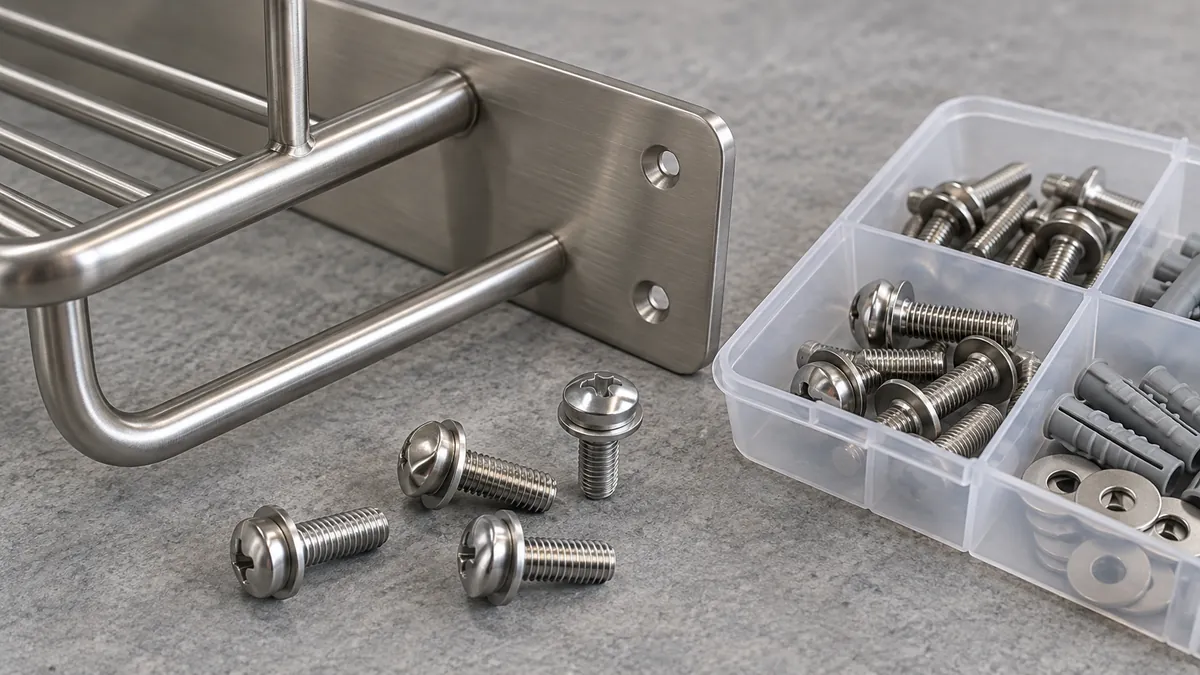
What does the captive washer solve—and what does it not solve?
A preassembled washer can reduce the number of loose pieces handled during assembly and keep the washer with its screw during kit packing. Depending on the washer design, the bearing surface may distribute contact over a wider area, protect a surface, or serve another defined joint function. The supplier should identify the washer type and the intended role; buyers should not infer a locking or load performance from the word “SEMS.”
The term commonly describes an assembly in which the washer is mechanically retained yet can rotate as designed. Confirm that the actual supplied configuration matches the drawing or approved sample. A washer that is missing, incorrectly stacked, trapped in an unintended position, or substituted with another type can alter how the kit assembles. Whether that affects function depends on the joint, substrate, finish, geometry, and specified installation method. For SEMS screws captive washer orientation assembly, the approved drawing and sample should describe this actual stack rather than relying on a shorthand catalog label.
The screw and washer should therefore be treated as one purchased assembly for identification, but the finished joint still has separate requirements. Thread form and length, head and drive, washer type and dimensions, mating-hole geometry, substrate, and finish condition are distinct inputs. A captive washer does not establish the appropriate screw length, tightening method, resistance to loosening, or suitability for a particular material pair.
Which drawing and BOM inputs should the buyer define?
Start with the assembly interface. Identify the part number and revision, the component being fastened, the hole or slot, and the surface under the washer. State whether the washer is meant to remain free to rotate, provide a bearing surface, or perform another specifically approved function. If the design requires a particular washer material, finish, shape, or stack, show it on the controlled specification rather than relying on a catalog image.
For the screw, record the governing product description and the features needed to distinguish it: thread and nominal size, length measured from the correct reference, head style, drive, material or grade where specified, and finish. The level of detail depends on the project drawing and applicable requirements. Do not add an unverified standard, strength class, coating, or tolerance merely to make the description look complete.
The bill of materials should say whether the item is a single preassembled screw-and-washer part number or separate components supplied together. If a supplier proposes a substitute or a different washer stack, the change should be reviewed against fit and function before the part number or kit content is changed. A buyer should be able to connect the drawing callout, BOM line, purchase order, sample, and shipped kit to the same approved configuration.
For private-label kits, also define quantity per product, permitted spares, packaging location, and any separation needed among similar screw types. If the kit contains visually similar but non-interchangeable fasteners, distinguish the compartments or labels in the packing specification. Keep labels and BOM descriptions consistent with the actual contents; a label cannot compensate for a mixed or incorrect supply.
How should buyers compare loose washers with a preassembled SEMS option?
The choice is an assembly-system decision, not an automatic cost reduction. A preassembled unit may simplify picking and reduce the chance of a washer becoming separated before use. Separate components can offer more flexibility in sourcing or replacement, but they require the buyer to control component identity and assembly/packing presentation. Consider handling, functional requirements, replenishment, and traceable part identity together.
| Buyer consideration | Preassembled screw with captive washer | Separate screw and washer | Evidence to request |
|---|---|---|---|
| Kit handling | Components arrive together as one fastener assembly | Washer and screw must remain correctly paired through packing/use | Sample kit and packing layout |
| BOM identity | Can be specified as one purchased assembly if the supplier supports that part definition | Usually requires separate component lines or an explicit kit relationship | Approved BOM and supplier part references |
| Washer configuration | Washer type and retention must match the approved design | Buyer can specify or source washer separately, then confirm the combination | Drawing, component identification, representative sample |
| Substitution control | Change to screw or washer may affect the assembly identity | Either component may be changed independently unless controlled | Change notification and re-approval triggers |
| Assembly suitability | Preassembly does not prove the joint is functionally correct | Separate parts do not prove the final combination is correct | Fit check against the actual mating parts and requirements |
This comparison does not establish that one option is universally cheaper or more reliable. Ask suppliers to quote the defined assembly and any alternative separately, with assumptions stated. Compare total procurement and handling implications only when the quantities, packing, component specification, and quality evidence are comparable.
What sample checks verify orientation and retention?
Sample review should start from the controlled specification. Confirm the screw identity and washer configuration against the drawing and BOM. Examine whether the washer is present, in the intended position, and retained as expected during normal kit handling. If the design calls for free rotation, verify that behavior only in a way consistent with the supplier’s component specification and intended joint; do not force a destructive test or apply an invented acceptance limit.
Then test the actual assembly interface with representative mating parts. Check seating, washer coverage of the relevant bearing area, head clearance, drive access, and whether the fastener can be installed in the intended orientation. If a slot or oversized hole is involved, verify that the washer covers the specified region under the approved assembly condition. The buyer’s design owner remains responsible for defining fit and performance criteria.

Record the sample identity, drawing revision, supplier part reference, washer configuration, and review result. Include photographs when useful for visual identification, but do not use a photograph alone to establish dimensions, material, or joint performance. If the supplier or buyer needs a defined measurement, state the method and acceptance criterion before evaluation. These records close the SEMS screws captive washer orientation assembly approval loop by tying the received kit to its approved configuration.
The approval should also identify the production condition represented. If a finish or other process is relevant to fit, appearance, or contact, assess parts in the condition required by the product specification. A sample from one configuration is not automatic approval for another screw, washer stack, supplier, or finish.
Which common sourcing failures should be prevented?
One failure is an ambiguous item description. “Screw with washer” may not distinguish a captive flat washer from another shape or stack. A vendor may supply a visually similar option that does not match the approved bearing interface. Use a drawing, controlled supplier part reference, or clear specification that identifies the intended combination.
Another risk is losing the relationship between the preassembled component and the kit BOM. If a supplier changes an upstream source or uses a different internal code, the buyer may have difficulty confirming which assembly was delivered. Agree how the supplier’s code maps to the buyer’s part number and what evidence accompanies a proposed substitution. This is an identity and change-control question, not a demand for a particular enterprise software system.
Packaging can also break the intended pairing at the kit level. Mixed compartments, unclear counts, or labels applied to the wrong bag can leave the customer with the wrong size or quantity even when the screw itself is correct. Review a representative packed kit and reconcile component count and identifiers against the BOM. Specify whether spares are included and how similar variants are separated.
Finally, a change can happen without meaningful re-approval if the purchase description is too broad. A change in washer design, screw dimensions, finish, source, or preassembly may affect what the buyer receives. Define which changes require notification and a new sample review, based on the product’s requirements. Do not presume that a supplier’s internal equivalence determination automatically replaces buyer approval.
What should the buyer request from the supplier?
Keep the request proportional to the order and risk. A buyer can request an identified sample, a drawing or product description for the fastener assembly, BOM mapping, and confirmation of the approved washer configuration. If the project requires material or finish documentation, inspection records, or a particular traceability record, define the exact scope and timing. Do not ask for a certification or test report unless the project actually requires it and the supplier can provide applicable evidence.
The RFQ or approval checklist can include:
- Buyer part number, drawing revision, supplier part number, and proposed source.
- Screw features and captive washer type/stack shown in the approved specification.
- Intended mating component and washer function, with acceptance criteria owned by the design authority.
- Quantity per product kit, pack-out, separation, and label requirements.
- Sample condition and evidence expected for identity, retention, fit, and kit count.
- Substitution, source, design, and process changes that require notification or re-approval.
These items help an importer or product developer compare offers without implying that Koitor manufactures SEMS fasteners. The fastener may be a purchased component in a broader metal-hardware project; its exact availability and supplier capability must be confirmed for the order.
الأسئلة الشائعة
Does SEMS mean the washer cannot rotate?
Not necessarily. Semblex describes its SEMS concept as a washer held captive while free-spinning for its intended design. Buyers should verify the actual product configuration and behavior against the supplied specification rather than generalizing to every captive-washer assembly.
Does a captive washer prevent a screw from loosening?
The term alone does not establish that function. Washer design and joint performance depend on the specified assembly and conditions. The buyer should request evidence relevant to the actual requirement and avoid treating the component name as a performance claim.
Should the screw and washer have one BOM number?
They may be represented as one purchased assembly when that matches how the supplier controls and ships the component. The BOM and purchase documents should make the relationship clear and preserve approval of the exact configuration.
Can the supplier substitute a similar washer?
Not without checking the approved design and change rules. Similar appearance does not establish equivalent function, dimensions, finish, or compatibility. Review the proposed change and sample evidence before revising the approved BOM.
What is the minimum useful kit sample review?
Identify the screw/washer assembly, confirm it against the drawing and BOM, test fit with representative mating parts using agreed criteria, and verify the pack-out quantity and labels. Record the sample and revision so the result is traceable to the approved configuration.
Does this guidance confirm Koitor supplies SEMS screws?
No. This is a sourcing framework for a buyer evaluating hardware kits. Any specific fastener source, available configuration, or supply capability needs confirmation for the project.
Source
Review a Rack Hardware Kit
Share the drawing, bill of materials, and kit configuration you need a supplier to review. Koitor can discuss manufacturing and sourcing questions within the confirmed project scope; the fastener configuration and acceptance criteria must be confirmed for the specific order.
OEM / العلامة التجارية الخاصة
حوّل دليل التوريد هذا إلى موجز منتج
يرجى إطلاعنا على المنتج المستهدف، والحجم، والتشطيب، وكمية الطلب، ومتطلبات التغليف. وسيتلقى فريقك تقييمًا عمليًّا لإمكانية التصنيع قبل تقديم عرض الأسعار.

 English
 Español
 Português
 Français
 Deutsch
 العربية