
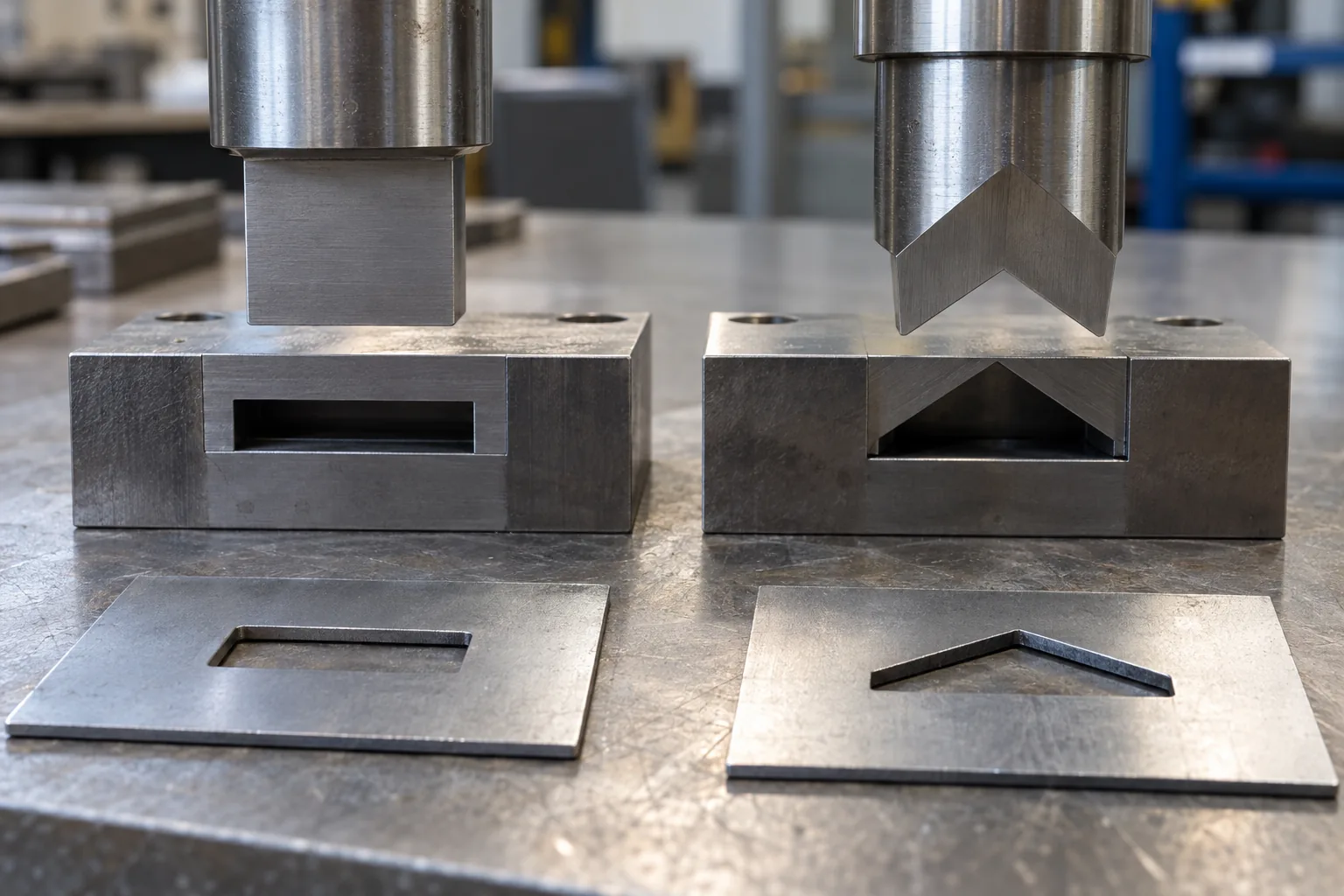
Punch shear angle roof top reduced force distortion decisions should be made with the tool designer and stamping supplier using the actual material, part shape and press conditions. An angled or “rooftop” punch face can make cutting progress across the edge instead of engaging the full edge at once, which may reduce peak force in some applications. The geometry can also change how the strip or part is supported and distorted, so buyers should approve the resulting component rather than assuming that a shear angle guarantees a better part.
What Problem Does This Article Help Buyers Solve?
When a flat punch engages a wide cutting edge simultaneously, the peak load can be demanding for a press or tool. A shear angle changes the sequence of engagement. A rooftop profile is one way to create progressive contact, but the right shape depends on the cut, stock, tool layout and press capability.
For a buyer, the issue is not choosing an attractive tooling shape. It is ensuring that holes, slots, tabs and cut edges remain dimensionally acceptable while the process runs reliably. A research paper on rooftop punch shape analyzes force reduction and dimensional accuracy in a particular modeled setup; it should be treated as case-specific engineering evidence, not a universal production guarantee. See the SAE technical paper listing.
What Should Importers Check First?
Identify which feature needs the shear geometry and why: peak press load, tool stress, vibration, cut quality or another constraint. Request a cross-section or tool drawing that shows the shear direction, angle profile, cutting edge, die opening and part support. Confirm whether the workpiece is retained, lifted, separated or remains connected to the carrier during each operation.
Then define the part’s critical dimensions and acceptable distortion. A lower peak force does not automatically mean lower total energy, less burr or better dimensional accuracy. Ask the supplier which part characteristics are measured on the first-off and approved samples, and whether the measurement is made in the free state or while restrained.
How Do Materials, Structure, and Tool Geometry Affect the Result?
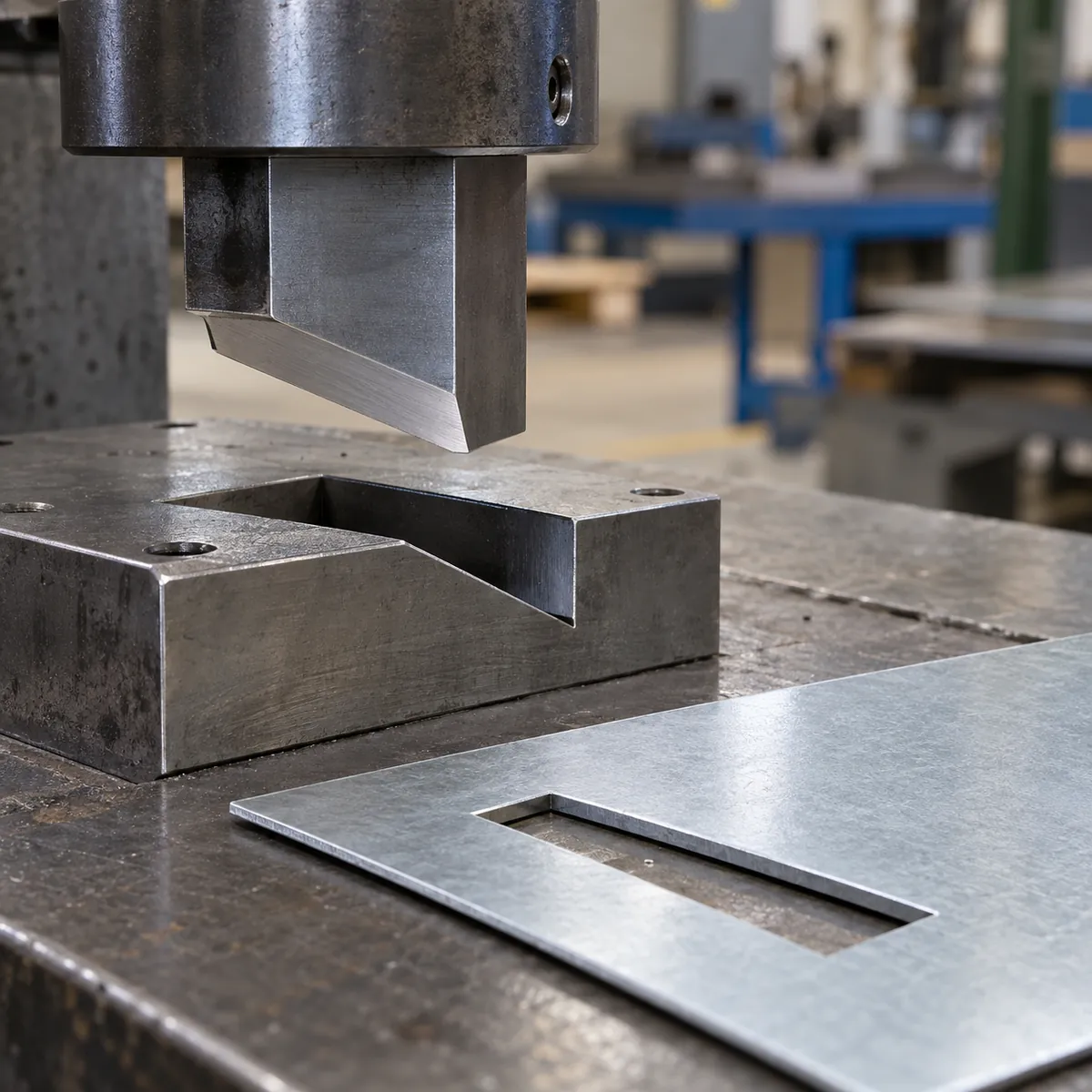
The shear angle changes how load is distributed over time and across the cutting edge. The actual effect depends on the stock’s thickness, strength, ductility, cutting perimeter, tool stiffness, clearance and press motion. If the tool cuts progressively, the workpiece may experience bending, lifting or twisting unless the design controls support and stripping. The feature can be useful in one tool layout and unsuitable in another.
For stamped hardware buyers, the relevant outcome is part condition. Check whether a flat mounting plate remains flat enough for assembly, whether slots and holes stay in position, and whether the cut edge meets the required appearance or deburring standard. Finishing, welding and assembly may further change the geometry, so critical dimensions should be verified at the state that matters to the product.
| متطلبات المشتري | What to Check | لماذا هذا مهم؟ |
|---|---|---|
| Reason for shear angle | Press load, tool stress or part quality issue | Makes the design choice testable |
| Tool geometry | Direction, face profile, die clearance and support | Controls engagement and part movement |
| Part features | Flatness, hole/slot position and cut edge | Captures buyer-facing consequences |
| Material | Grade, thickness and mechanical condition | Changes cutting behavior |
| Evidence | Representative samples and measurement condition | Avoids inferring performance from geometry alone |
How Should Buyers Compare Flat and Roof-Top Punch Faces?
A flat face may be appropriate when press capacity, tool design and part quality are adequate. A roof-top or other shear face can distribute the cut over an engagement sequence, potentially lowering peak force for some geometries. It may also complicate the setup, tool manufacturing and workpiece support. The supplier should explain the tradeoff for this part rather than presenting shear angle as a default upgrade.
| سؤال | Flat punch | Shear-angle / roof-top punch |
|---|---|---|
| Engagement | More of the edge can contact together | Contact progresses across the edge |
| Load profile | May create a higher instantaneous load in some jobs | May reduce peak load depending on design |
| Part movement | Depends on support and strip layout | Can introduce different bending or lifting forces |
| Buyer evidence | Sample dimensions and press/tool suitability | Same checks plus documented geometry and support |
What Are Common Mistakes When Sourcing This Product?
Do not assume a rooftop geometry always reduces force by a fixed amount or improves accuracy. Do not approve a tool concept without a part sample, especially where the cut feature affects assembly. A third mistake is comparing samples made from different material lots or measured with different restraint conditions.
Buyers should also distinguish a numerical study, a supplier’s machine setup and a validated production result. Ask what evidence is available for the actual stock and geometry, and make any claimed performance conditional on that specific job. If the buyer cannot access tool design files, request a clear process explanation and dimensional report for agreed features.
How Can a Small-Batch OEM Factory Help?
A custom metal hardware factory can help buyers identify which stamped edges, holes and mounting surfaces need to remain stable through fabrication and assembly. Koitor can discuss drawing review and sample checkpoints for its relevant metal-storage products; this is not a claim that Koitor uses rooftop punches or performs press-load engineering for every project.
During product development, provide the part geometry, material callout, order volume and assembly function. The stamping supplier can then propose tooling and explain any design tradeoffs. Confirm sample sign-off, first-order inspection and the change-control process if the punch profile or press setup is revised. For the Koitor product context, see the OEM hardware manufacturing page; send project details through the contact page.
Evaluate the Part, Not Just the Claimed Press-Force Reduction
A shear angle changes when different portions of the cutting edge engage the sheet. A roof-top or other angled punch face may spread engagement over a stroke, but the effect on force and part quality depends on geometry, material, thickness, support and tooling condition. Buyers should treat a supplier’s force-reduction statement as a process claim to be verified for the specific operation, not as a guaranteed outcome for every stamped part. The relevant commercial question is whether the method improves the required feature without creating unacceptable deformation, edge quality or cycle-time consequences.
Start with the geometry of the part. Identify the punch perimeter, narrow webs, nearby formed features, unsupported regions and the direction in which material can move. The amount and direction of shear affect the load path and may produce distortion in some designs. If the part has a broad flat profile or a tight positional tolerance, inspect those characteristics on samples from the proposed tooling. A single peak-force figure does not show whether the part remains flat or whether downstream forming and assembly still work.
Define how the part will be measured. Specify its free-state condition, support points, datum references, time after cutting if residual movement is a concern, and whether burr orientation matters. Thin components can relax or flex when removed from a fixture, so measurement under restraint may conceal the issue the buyer is trying to prevent. If flatness or distortion is critical, agree on the support and measurement method before production rather than deciding after parts disagree.
Qualification Trial and Trade-Off Review
Compare the proposed punch face with the current or reference process using the same stock lot and a controlled inspection plan where practical. Record material designation, thickness, lubrication, press setup, tool clearance and sample identification. These details help interpret a difference in force or geometry. If several variables change at once, the trial may show that the overall process changed but not which adjustment caused the result. The buyer need not prescribe the tool design, but can request enough traceability to support the engineering decision.
Inspect both the cut edge and the finished part. Edge rollover, burnish, fracture zone, burr and local distortion can influence later operations. If the part is bent or welded downstream, evaluate the assembled or formed component as well as the blank. A shear-angle adjustment that improves one punching characteristic may shift how the blank sits in a subsequent fixture. The supplier should therefore identify the quality characteristics expected to improve and the ones that will be watched for unintended effects.
Before approving a production change, agree on acceptance criteria and a rollback or correction path. The trial record should state the tool revision, sample quantity, inspection results and any limitations. If the supplier cannot provide a direct press-force trace, the comparison may instead focus on product outputs and process evidence that are available; do not invent a numeric benefit. Preserve the baseline sample so later lots can be assessed against the same functional requirements.
For ongoing production, review punch wear and maintenance because an angled face may not wear uniformly. The inspection frequency should reflect the geometry and the consequences of drift. Ask the manufacturer what dimensions are checked after sharpening and whether the face angle or cutting edge is restored to the approved specification. These are process-control questions, not assumptions about a particular factory’s equipment. A buyer should approve the required result and evidence while leaving the toolmaker to justify a feasible method.
Approving a Process Change Without Overclaiming
The buyer’s acceptance record should separate measured product outcomes from process claims. If a supplier says an angled punch face reduces force, ask what was measured, under which setup, and whether the value refers to peak load, average load or another measure. If no instrumented comparison is available, the supplier may still demonstrate a product-quality benefit, but the purchase file should not invent a force percentage. The claim should be limited to the evidence produced for the actual part.
Define a practical set of characteristics for the trial: critical dimensions, free-state flatness if specified, edge condition, burr direction, fit in the next operation and any visible distortion. Use the same inspection method for the baseline and proposed process. If a characteristic is not on the drawing but is important to assembly, agree on a temporary criterion before the test. Then decide whether it should become a permanent specification or remain a development observation.
Keep the approved setup traceable. Identify the punch revision, material lot, thickness, press setup and date of the sample run. If the angled face is later sharpened or reworked, confirm which geometry must be restored and what sample is required before normal production resumes. A process change may be valid for one product geometry but not transferable to a different profile or thickness, so scope the approval narrowly.
Use punch shear angle roof top reduced force distortion as a topic label for the investigation, while the controlled report states the part-specific result. This avoids turning a research phrase into a universal design rule. Buyers should ask the manufacturer to explain both the expected benefit and the potential trade-offs, then judge the change against the product’s functional requirements and documented evidence.
In short, punch shear angle roof top reduced force distortion should be assessed on the part and process evidence rather than assumed from tool geometry.
Buyer Checklist Before Requesting a Quotation
- State the process problem the proposed shear angle should address.
- Request a tool section showing shear direction and support.
- Identify stock grade, thickness and material condition.
- Define critical dimensions and the sample measurement condition.
- Check for flatness, distortion, burr and assembly fit.
- Require evidence on representative production material.
- Confirm what design or setup changes trigger reapproval.
الأسئلة الشائعة
Does a rooftop punch always lower press force?
Not in a universally predictable way. The result depends on geometry, material, tool layout and press conditions. A qualified tool designer should evaluate the actual job.
Can shear angle reduce distortion?
It may alter load timing, but it can also change bending and support forces. Measure the resulting part and assess its fit in the assembled product.
What should buyers ask to see before approving the tooling?
Ask for the proposed geometry, reason for the design, critical feature list and representative first-off samples. Define how the samples will be measured.
Does Koitor provide punch-tool engineering?
This article does not claim that service. Koitor can discuss product drawings and manufacturing requirements; the stamping supplier or tool designer should validate punch geometry.
اعمل مع شركة «كويتور» للأدوات
Reviewing a Stamped Part Design?
Share the drawing, stock specification and critical assembly dimensions. Koitor can discuss OEM metal hardware requirements and sample review; the stamping supplier should substantiate any tool-force or accuracy claim.
OEM / العلامة التجارية الخاصة
حوّل دليل التوريد هذا إلى موجز منتج
يرجى إطلاعنا على المنتج المستهدف، والحجم، والتشطيب، وكمية الطلب، ومتطلبات التغليف. وسيتلقى فريقك تقييمًا عمليًّا لإمكانية التصنيع قبل تقديم عرض الأسعار.

 English
  Español
  Português
  Français
  Deutsch
  العربية