
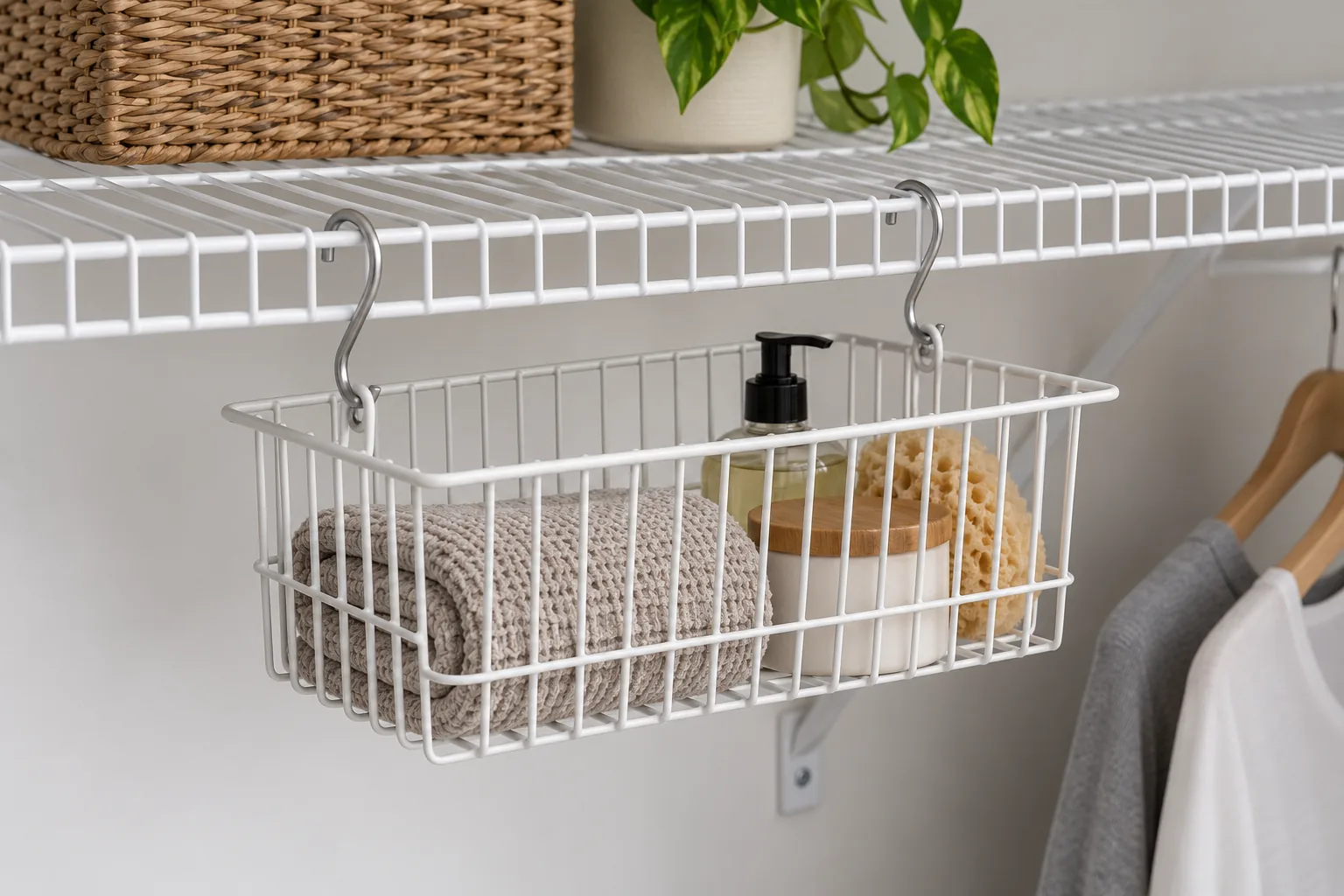
For wire shelving S hook add on units, confirm the rack profile, the support to which the accessory attaches, the intended position, and the exact accessory identity as one configuration. A hook that can be hung on a wire does not automatically fit every rack, remain in the intended location, or carry a rack’s published capacity. Buyers should review the selected accessory with the actual shelf and support system, and keep the supplier’s instructions and sample approval together.
What does an S-hook add-on change?
An S-hook is an accessory that uses a curved or hooked form to hang from a support and provide another hanging point. On modular wire shelving, the relevant interface may be a shelf wire, a frame member, a crossbar, or another support defined by the system supplier. The term “S-hook” describes a broad shape; it does not identify the exact mating wire, opening, orientation, finish, retention feature, or intended use.
The buyer’s decision is whether the chosen accessory is intended for the selected rack and whether it can be placed where the user needs it without interfering with shelves, adjacent products, or the rack’s own configuration. This is different from asking whether the hook is physically capable of hanging from some wire. The system supplier’s accessory documentation should identify what support is intended and how the part is assembled or repositioned.
Manufacturer accessory materials treat hooks and related add-ons as separate system information. That reinforces the need to evaluate the accessory with the rack, but it does not establish universal compatibility. For wire shelving S hook add on units, record the rack model, support profile, hook part number, intended application, and any system-specific instructions before the buyer places an order.
What should an importer include in the RFQ?
Identify the modular rack by supplier, model, and revision. Share a drawing or labeled sample showing the intended support and where the hook should sit. If the rack has multiple wire sizes or orientations, mark which one the accessory will engage. State the accessory’s intended use in practical terms—what it will hold or organize—without inventing a load or safety requirement that has not been defined by the buyer or system supplier.
Request the supplier’s accessory part number, compatible rack families, installation or repositioning instructions, and any exclusions. Ask whether the hook should engage one wire or a particular support feature and whether another component is required. Do not assume that a product image showing a hook on a rack is a compatibility statement for all rack widths or models.
| RFQ input | What to identify | Why it matters |
|---|---|---|
| Rack identity | Supplier, system, model, revision, and profile drawing | Defines the host system being evaluated |
| Mating support | Exact wire, rail, or support location and orientation | Shows where the hook is designed to attach |
| Accessory identity | Hook part number, revision, finish, and kit contents | Links quotation, sample, order, and package |
| Position and use | Intended location and organizer function | Helps evaluate access and interference |
| Instructions | Installation, repositioning, and removal guidance | Prevents improvised use outside the system design |
| Performance evidence | Any supplier statement relevant to the intended application | Prevents transfer of rack-level claims to one add-on |
If the host rack has not been selected, ask suppliers to propose a complete pairing and list their assumptions. For mixed-brand sourcing, share drawings between the rack and accessory suppliers and ask them to identify who confirms the interface. A buyer should not treat a general accessory category as approval of a third-party combination.
How should accessory proposals be compared?
Compare identified configurations. One proposal may be a system-listed accessory for the selected rack; another may be a visually similar third-party part. A third proposal may attach to a different support point or require a separate adapter. These alternatives can have different assembly and use conditions, so a price comparison is meaningful only after the buyer understands what is included and how each part mates with the rack.
| Proposal type | What to check | Required record |
|---|---|---|
| Rack-system listed hook | Does the listing identify the exact model or system family? | Current supplier accessory reference and instructions |
| Alternate hook from the same supplier | What profile, position, or mounting condition changes? | Marked drawing and representative sample |
| Third-party hook | Have rack and accessory suppliers reviewed the mating interface? | Both part identities and written compatibility scope |
| Hook requiring an adapter | Is the adapter part of the approved set and who supplies it? | Assembly drawing, kit list, and revision control |
Do not infer that an S-shaped profile provides the same retention or movement behavior across designs. The dimensions, wire profile, orientation, and contact points matter to the interface. Do not infer that a hook inherits the storage rack’s stated capacity. Capacity or performance claims need to identify the tested assembly and conditions from the responsible supplier; this article does not provide or transfer any such values.
When the buyer needs hooks in more than one location, show each support point on the layout and ask whether the accessory can be repositioned as proposed. If the supplier permits multiple placements, preserve its guidance. If it does not, mark the intended position as a buyer requirement and request approval. This prevents a catalogue photograph from becoming an undocumented installation instruction.
How should the shared-support layout be reviewed?
Assemble the rack according to its instructions, then add the specified accessory at the marked location. Confirm that the hook is attached to the intended support—not a neighboring wire chosen only because it is convenient. Check whether it sits in the specified orientation and whether it can move or rotate in a way that affects the intended use. Do not modify the rack or bend a hook to make it fit unless the responsible supplier approves the change.
Review the area around the accessory. Determine whether it blocks a shelf opening, contacts an adjacent product, projects into a user’s path, or interferes with another hook or rack component. These are configuration observations, not general product defects. The buyer should decide which conditions matter for the intended layout and document acceptance or required correction.

If the accessory is shared across a multi-shelf rack, inspect the proposed shared-support layout from the front and side. An attachment that works on one support may be crowded when several accessories are installed together. The system supplier should confirm any spacing or placement limitation it specifies. A buyer should not assume that the rack’s overall rating remains valid after accessories are added or that the same conditions apply to every shelf.
Use a sample matching the production rack and hook revisions. If a demonstration uses an alternate wire, temporary frame, or different support, identify it clearly and state which interface remains unverified. A rendered illustration can explain the question, but only an identified component assembly and appropriate supplier information can support the actual purchasing decision.
What should the representative sample prove?
The sample review should establish part identity and interface fit for the intended location. Check the hook’s supplier, part number, revision, and finish against the quotation. Confirm the rack model and support profile. Assemble the parts using the current instructions and record any adapter or accessory included in the kit. If the package label does not identify the component, resolve that gap before approval.
Observe whether the hook engages the specified support and whether its position matches the drawing. Check the intended installation and removal sequence. Note any movement, interference, or access issue that the buyer has decided is relevant. Do not add an unagreed pull force, load test, or safety threshold to the review. If those metrics matter, agree with the supplier on the method, conditions, and acceptance rule before testing.
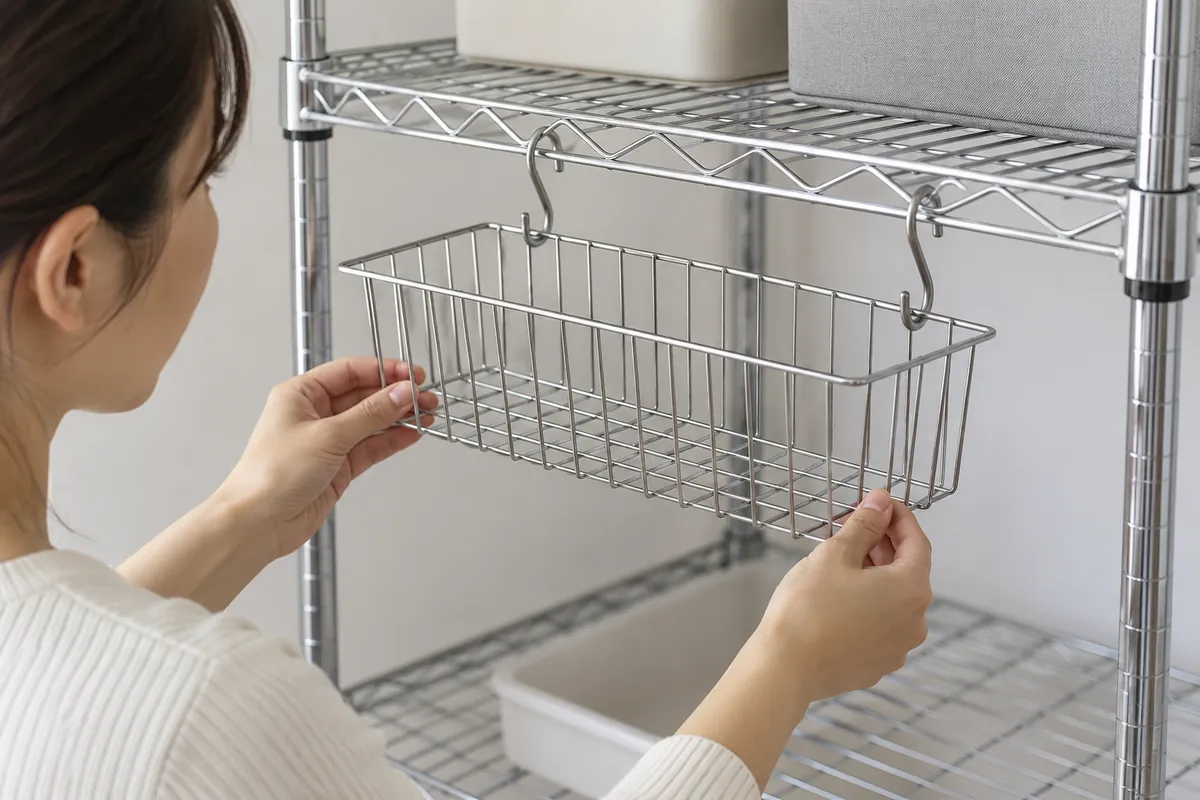
Record the rack and hook revisions, sample condition, instructions, placement, observed interface, and any deviations. Identify who approves the combined configuration and what was outside the sample review. Tie the record to the SKU, product image, packaging list, and purchase order. If the hook ships separately, verify that its identity and quantity remain linked to the rack order.
The sample does not prove that every rack model or support is compatible. It does not establish an assembly-level load rating or long-term performance. The approval covers the tested pairing and stated conditions. Keep that boundary explicit so the result is not copied into a broad catalogue statement that exceeds the evidence.
What controls are useful for repeat orders?
Keep a compatibility matrix that lists rack system, support profile, hook identity, intended position, installation instruction, and approval status. Mark unreviewed combinations as unverified. If the product range uses multiple support profiles or revisions, separate the rows rather than using one generic “fits wire shelf” label.
Link the accessory part number to the rack SKU and package content. For private-label assortments, align the product page, instruction sheet, carton, and order line so buyers know whether the hook is included, optional, or sold separately. If the product image shows multiple accessories, confirm that the shipment includes them or label the image as a configuration illustration. Avoid misleading a distributor about the exact set received.
Define what changes require a new review. A different rack profile, hook geometry, finish, adapter, or support position may alter the interface. Ask the supplier whether the previous approval still applies. Preserve its written response and any revised drawing. If a supplier substitutes a component due to availability, do not treat it as automatically equivalent; compare the part identity and approve the alternative under change control.
During receiving, check model and package identities against the order. A receiving check can confirm that the correct accessory was shipped, but it cannot establish compatibility for a new rack revision that was not previously approved. Keep receipt checks, sample evaluation, and performance evidence as separate records with clear purposes.
Which buying assumptions should be avoided?
Do not assume that any S-shaped hook fits any wire shelf. Do not assume the support wire, hook opening, and installation direction are universal. Do not assume that an accessory listed for one rack series transfers to another. Do not assume that the rack’s capacity applies to the hook or a combined arrangement. Each statement needs product-specific support from the responsible supplier.
Avoid buying based on a product photo alone. Ask for part numbers and compatibility information. Avoid adding hooks to a shared support without reviewing spacing and interference. Avoid describing a hook as part of the package if it is optional or sold separately. Avoid changing the hook or rack at installation without approval and documentation.
When the supplier cannot confirm a mixed-brand combination, treat that as an unresolved item rather than silently accepting it. The importer can decide to proceed with a representative fit review or select a system-listed accessory. The record should identify who owns the decision and which configurations have been reviewed.
How does this relate to Koitor’s storage hardware?
Modular wire racks and add-on hooks may appear together in broader home-storage assortments. This article covers the buyer’s selection and approval process for a purchased accessory; it does not claim that Koitor manufactures this specific S-hook or rack system. Koitor can discuss metal products and interfaces within its verified scope, while the rack supplier remains responsible for its system instructions and accessory compatibility.
Buyers can review Koitor’s OEM home-storage hardware و custom metal storage rack manufacturing pages for related metal-product sourcing context. If a project combines a purchased rack accessory with a separately sourced metal basket or rack, clarify which drawing belongs to each supplier. A clear component boundary makes an RFQ more actionable and avoids implying that a general OEM metal factory approves all accessories in an assortment.
For an interface question, share the rack model, support profile, hook part number, and intended placement. State whether the buyer needs a compatibility check, a package-content confirmation, or a review of a related metal product. That scope helps suppliers answer within their responsibilities and makes the final approval traceable.
الأسئلة الشائعة
Does any S-hook fit a wire rack?
No. Confirm the rack profile, support location, hook part number, and supplier instructions for the exact system.
Do wire shelving S hook add on units share the rack’s load rating?
Do not assume so. A rating applies only to the product and test conditions identified by the responsible supplier. Ask for evidence covering the exact assembly if a claim is needed.
Can a hook be installed on any shelf wire?
Only if the supplier identifies that position and profile as suitable. Review the actual support and instructions rather than selecting a wire based on appearance.
What information should accompany an S-hook quotation?
Request the hook model, compatible rack family, intended support, installation guidance, and whether the accessory is included or optional.
Can I use a third-party hook with a branded rack?
Do not presume compatibility. Compare drawings and obtain confirmation or review the combined assembly with the suppliers responsible for each component.
What should a sample check cover?
Verify part identity, support engagement, orientation, placement, installation sequence, and any interference relevant to the intended configuration.
Does a sample check prove long-term retention?
No. It records the fit and conditions observed. Any retention or durability claim needs separate agreed criteria and supplier evidence.
Should hooks be shown on the product page if optional?
Only with clear disclosure that they are optional or sold separately. Images and package descriptions should match what the buyer receives.
When should compatibility be checked again?
Recheck after changes to rack profile, hook model, adapter, support position, or supplier revision that could affect the interface.
Who approves a shared rack and accessory layout?
The system supplier confirms its accessory conditions; the buyer approves the intended assortment and records the exact tested combination.
Clarify an add-on accessory interface
Share the wire rack model, intended hook position, and related metal-product drawing so the purchasing boundary is explicit.
Clarify the rack accessory pairing
Send the rack profile, accessory identity, and intended layout so each component supplier can confirm its scope.
OEM / العلامة التجارية الخاصة
حوّل دليل التوريد هذا إلى موجز منتج
يرجى إطلاعنا على المنتج المستهدف، والحجم، والتشطيب، وكمية الطلب، ومتطلبات التغليف. وسيتلقى فريقك تقييمًا عمليًّا لإمكانية التصنيع قبل تقديم عرض الأسعار.


 English
 Español
 Português
 Français
 Deutsch
 العربية