
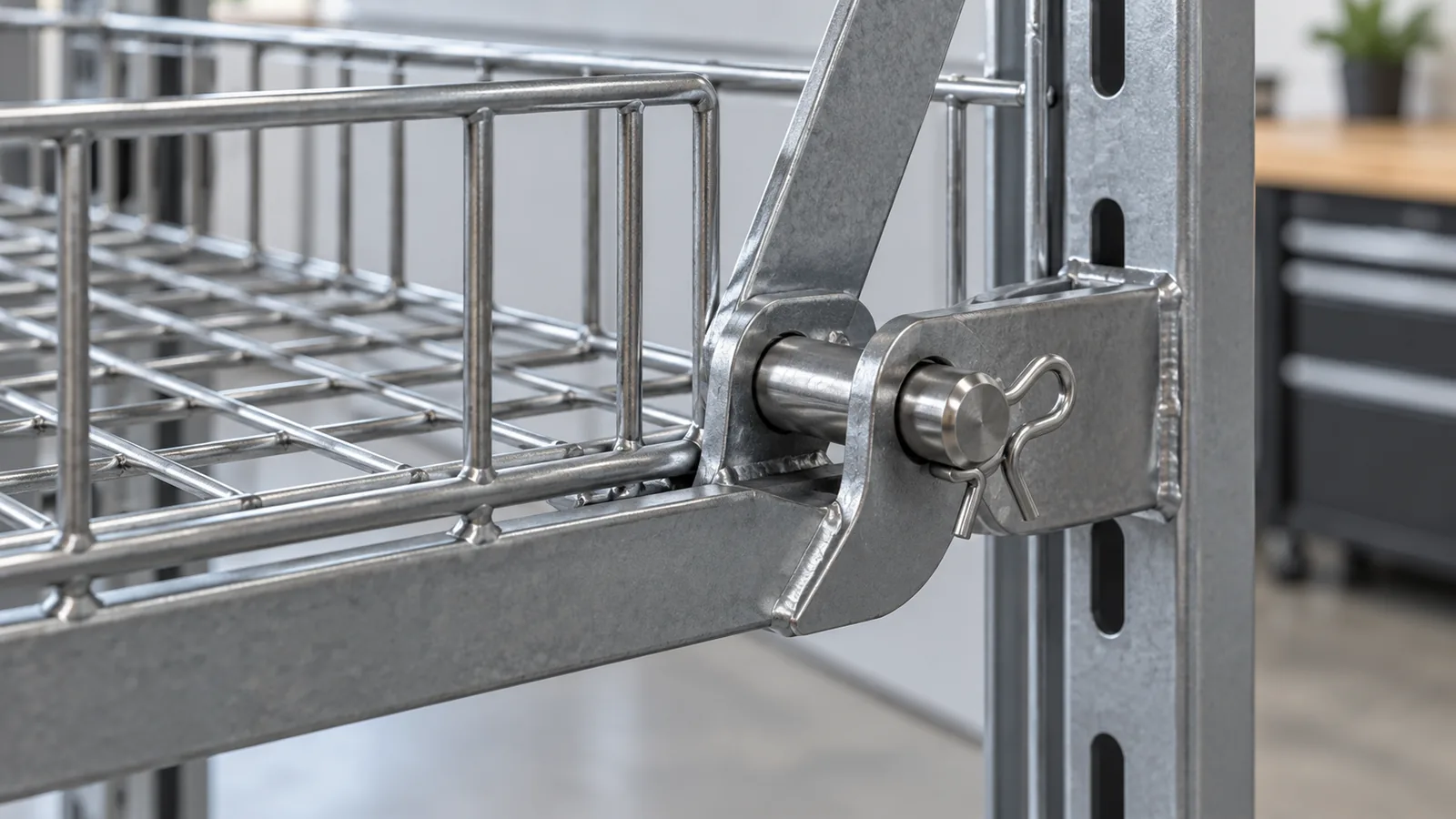
For clevis pin cotter pin retaining clip assembly retention on a folding shelf or basket pivot, the buyer should specify the complete pin-and-retainer arrangement, intended release behavior, mating geometry and sample acceptance—not just the pin diameter. A manufacturer may offer a clevis pin with a cotter pin, a groove-mounted retaining clip, a safety retainer or another configuration. These are different assemblies and should not be treated as interchangeable without checking the pivot design and the required user action.
Pinstructure’s clevis-assembly reference lists several arrangements, including fork joint + clevis pin + washer + cotter pin and fork joint + clevis pin + retaining clip. Its retaining-clip page describes a clip used in the clevis-pin groove and notes that the lip makes installation and removal straightforward. Those are product examples, not universal design rules or a performance rating. See the clevis assembly options و retaining clip product description.
For an OEM buyer, the key decision is the joint’s intended behavior. Is the pin a pivot axle that stays installed during normal folding, or should a user remove it for knock-down or service? Which feature stops the pin from walking out? Can the retainer be installed and inspected after the joint is assembled? The answers belong on the product drawing and sample checklist.
Treat clevis pin cotter pin retaining clip assembly retention as an interface specification, not a shopping-list phrase. The drawing should identify the exact pin feature that receives the retainer, the direction of assembly, the accessible side and any washer or spacer in the stack. A buyer can then compare supplier proposals on the same basis and catch a substitution that appears similar but changes installation or service access. Record the selected arrangement against the approved revision and sample so production and reorder teams can identify what was actually accepted.
Specify the whole pivot, not a loose pin
A clevis joint is an assembly of connected parts. The pin passes through aligned joint features, while the retainer helps keep the pin in its intended position. The surrounding bracket, basket wire, pivot ears, washers, clearance and folding path all influence whether the selected arrangement can be assembled and serviced as intended.
Start by identifying the product and pivot location: folding shelf, storage basket, hinged frame or another mechanism. Show the closed and open positions, the parts that rotate, the pin axis and the accessible side of the joint. If the frame has two pivot points, indicate whether both use the same pin and retainer configuration. A generic parts list cannot communicate whether a person can reach the retainer once the frame is welded or installed.
The buyer should define whether the pivot is intended to remain assembled through normal use or to be intentionally disassembled. For a retained pivot, the user should not need to remove the retainer each time the shelf folds. For a serviceable joint, define who can release it, which tool or action is expected, and how the parts are restored. Avoid vague terms such as “quick release” unless the user action and the restraint function are both specified.
Compare cotter pins, retaining clips and other retainers
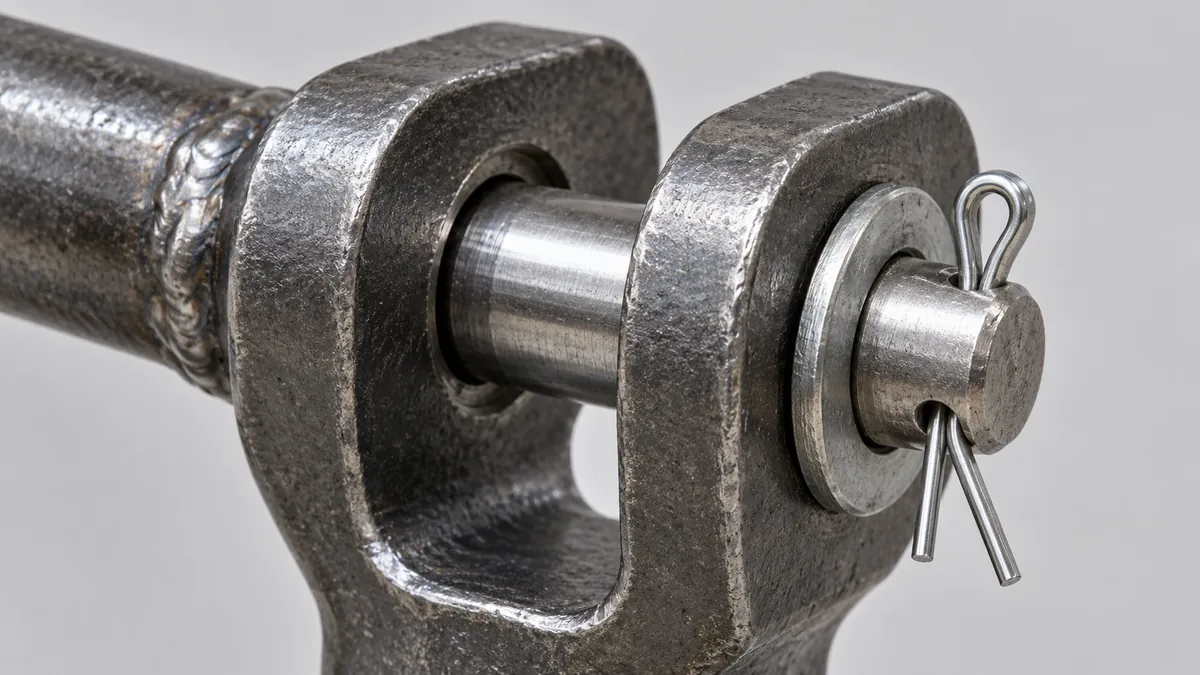
A cotter-pin assembly and a groove-mounted retaining clip can retain a clevis pin in different ways. A cotter pin is paired with a suitable hole in the clevis pin; a retaining clip product may engage a groove. A safety retainer or other mechanism may use a different interface. The buyer should review the supplier’s drawing and instructions for the actual selected component rather than infer fit from component names alone.
| Assembly option | Interface to identify | Buyer decision | Sample evidence |
|---|---|---|---|
| Clevis pin with cotter pin | Pin cross-hole, cotter size/type, washer stack if used, access for insertion and removal | Whether the selected configuration matches the joint and intended maintenance action | Correct parts assembled in the pivot; retainer presence and installation state visible for inspection |
| Clevis pin with retaining clip | Pin groove, clip profile, seating surface and approach direction | Whether the clip is intended for the specific pin groove and can be installed/removed as designed | Clip seated in the intended location; joint checked through its normal movement without the clip contacting adjacent parts |
| Safety retainer or alternative | Supplier-defined interface, release action and compatible pin geometry | Whether the mechanism meets the buyer’s user and service requirement | Drawing, instruction and assembled sample demonstrate the agreed action |
This is not a strength ranking. A product catalog may offer several assemblies in one family, but a buyer must match the selected variant to the pin, fork, washer and pivot geometry. A ball-lock pin is another mechanism with a different retention principle; it is not automatically equivalent to a cotter pin or a groove clip. If that alternative is being considered, compare it as a separate design and review the specific locking action and owner requirements.
Define retention intent and inspection points
Write down what the retainer is meant to prevent: unintended axial movement of the pin, loss of a removable component, or a different defined condition. Do not convert that into an unverified statement such as “cannot come out.” The relevant acceptance rule depends on the mechanism, the pivot’s use and any product-level test agreed by the buyer and supplier.
Identify visible inspection points on the drawing. For a cotter-pin configuration, the pin cross-hole and installed cotter must be accessible enough for assembly and inspection. For a retaining clip, specify the groove location and what full seating looks like according to the supplier’s approved component drawing. If a washer is part of the assembly, show its position and explain whether it is a spacer, bearing surface or simply included in the quoted set; do not leave its role implicit.
The inspection should distinguish “part present” from “part correctly seated.” A photo of the completed pivot may show a retainer but hide whether it is fitted in the intended hole or groove. Ask the supplier for an assembly view or a sample angle that exposes the retention feature. Agree how missing, deformed, loose or mis-seated retainers will be recorded and dispositioned.
Check movement, access and removal on the sample
Review the complete frame with the retainer installed. Fold and unfold the product through the intended path, checking whether the pin rotates or remains fixed according to design, whether adjacent members interfere and whether the retainer contacts the bracket or basket during motion. These checks should use the actual assembled geometry; the loose pin alone does not represent the pivot.
If the user is expected to remove the pin, perform that specific action on the sample. Record the tool or hand action, access side, sequence, and whether the retainer can be removed without damaging surrounding parts. If it is not intended to be removed during consumer use, make sure the instructions and packaging do not imply routine disassembly. The same configuration can be acceptable for one service model and confusing for another.
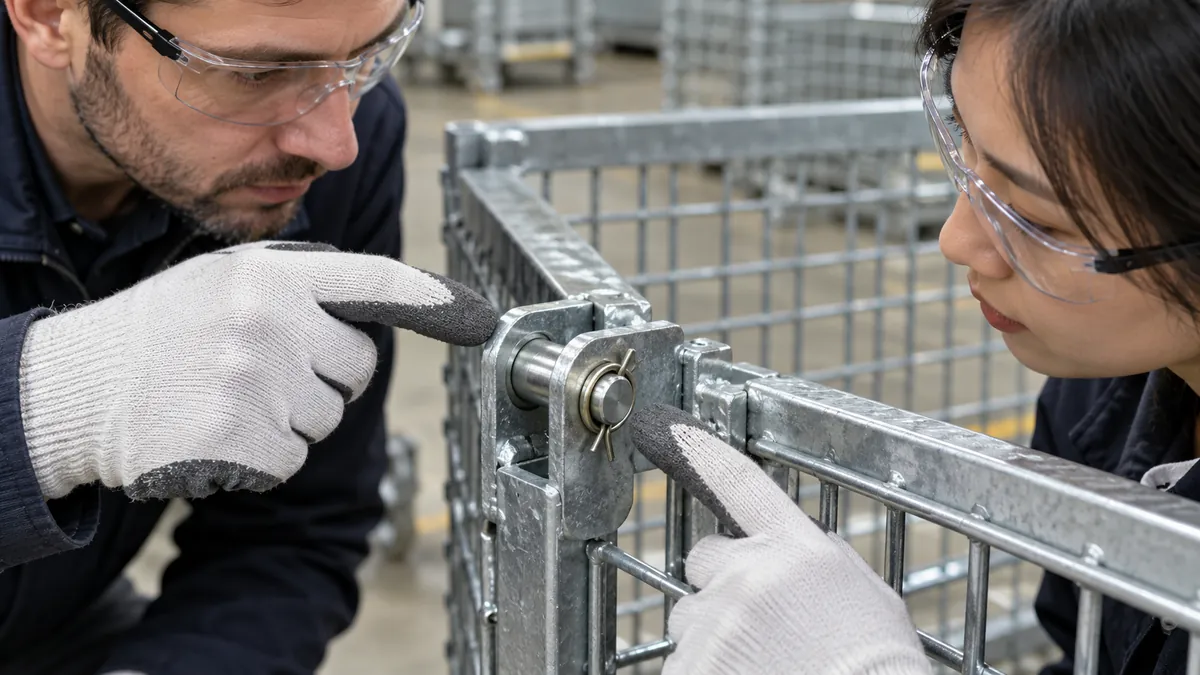
Do not infer a load rating or fatigue life from a successful fold demonstration. A movement check confirms only what was observed on that sample, under the stated conditions. If a project needs a pivot load, cycle, vibration or retention test, define the method, specimen, conditioning, pass criteria and record requirements separately. The public assembly examples cited here do not provide performance limits for a particular folding basket.
Document the sample ID, drawing revision, pin and retainer identifiers, washer stack, assembly state and any test or observation performed. If the sample uses a different pin supplier, surface finish or clip material than planned production, list the difference and decide whether the production component still needs verification.
What to include in the RFQ and drawing
Give suppliers a consistent design basis so quotes describe comparable assemblies:
- Identify product, pivot location, drawing revision and intended open/closed motion.
- Name the selected retainer type or ask the supplier to propose compatible alternatives as separately priced configurations.
- Show the pin axis, joint/fork dimensions, mating thicknesses, any pin cross-hole or groove, and washer placement.
- State whether the joint should remain installed in normal use or be removable for service or packing.
- Define access needed to install, inspect and remove the retainer, with the required user or service action.
- Identify which parts are supplied together and who owns assembly at the factory or downstream.
- Request an assembled sample and a photo or record showing the retention feature installed.
- Define any load, cycle, retention or environmental test separately; include the method and acceptance rule.
- Require a review if pin, retainer, groove/hole, bracket thickness or pivot geometry changes.
Ask the supplier to identify assumptions about the component grade, coating, corrosion exposure or reusable status. If the joint will be in a bathroom or other moisture exposure, specify the environment and material/finish requirements through the appropriate product requirements; do not assume the same pin finish or retainer material will suit every environment. Material claims and corrosion life need substantiation for the actual material, finish and exposure.
How to control component substitutions and reorders
Small parts are easy to substitute because they look similar in a purchasing list, but the interface can differ. A cotter pin of another wire form, a clip with a different lip, a pin with a shifted groove or a washer with a different thickness can alter the assembly or access. Require notification and buyer review for changes to the pin, retainer, groove/hole location, mating bracket or assembly sequence.
The approval record should make the component combination traceable. Note the supplier part number or drawing reference for each element, the approved sample or assembly photo, and the packaging/labeling expectations if loose parts ship with the product. If the hardware is preassembled, record the inspection point used to confirm the retainer is installed. If it ships as a kit, list the required count and instruction diagram responsibility.
For a clevis pin cotter pin retaining clip assembly retention change, repeat the relevant interface review before authorizing production. That does not necessarily mean repeating every product test; the responsible engineer or buyer should identify which requirement is affected by the changed feature and what evidence closes it. A documented, targeted check is more useful than a general “same as before” note when the component interface has changed.
How can Koitor support a metal pivot discussion?
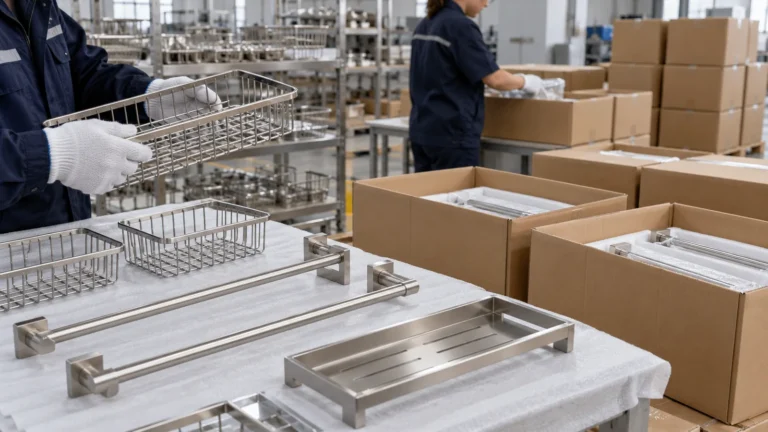
Koitor’s approved scope includes metal storage hardware fabrication, assembly, drawing/sample development and packaging. This supports a buyer discussion about the frame, pivot interface, assembly access and sample review. Purchased pins, cotters, retaining clips and product-specific ratings must be confirmed for the individual project; this article does not claim Koitor manufactures these components or has validated a particular folding-shelf pivot.
For an OEM conversation, visit Koitor’s home-storage hardware manufacturing page أو اتصل بـ «كويتور». Share a pivot drawing or sample, intended release behavior, component list, use environment and any test requirement. The team can then distinguish frame and assembly questions from supplier evidence that must come from the component source.
الأسئلة الشائعة
Is a retaining clip the same as a cotter pin?
No. They are distinct retainer options with different interfaces. A cotter pin is used with a pin feature such as a cross-hole; the cited Pinstructure retaining clip is described for a groove in a clevis pin. Confirm the actual supplier drawing and parts.
Can a ball-lock pin replace a clevis pin and cotter pin?
Only if the pivot is deliberately designed and approved for that different mechanism. Ball-lock pins use a different release/retention arrangement and should be evaluated as a separate design, not assumed equivalent based on name or appearance.
What should the inspector check on a finished pivot?
Check that the specified pin and retainer are present, fitted at the intended interface, accessible for inspection and clear of adjacent moving parts. Any functional test needs its own agreed method and criteria.
Does a successful folding demonstration prove the pivot’s rated capacity?
No. It shows only the sample’s observed movement under the demonstration conditions. Capacity or endurance claims require an agreed test method and evidence for the specific assembly.
اعمل مع شركة «كويتور» للأدوات
For a folding metal storage product, share the pivot drawing and retainer choice so the frame interface, assembly access and component evidence can be discussed together.
Developing a folding metal storage product?
Share the pivot drawing, selected retainer and sample requirements for an OEM assembly discussion.
OEM / العلامة التجارية الخاصة
حوّل دليل التوريد هذا إلى موجز منتج
يرجى إطلاعنا على المنتج المستهدف، والحجم، والتشطيب، وكمية الطلب، ومتطلبات التغليف. وسيتلقى فريقك تقييمًا عمليًّا لإمكانية التصنيع قبل تقديم عرض الأسعار.
 English
 Español
 Português
 Français
 Deutsch
 العربية