
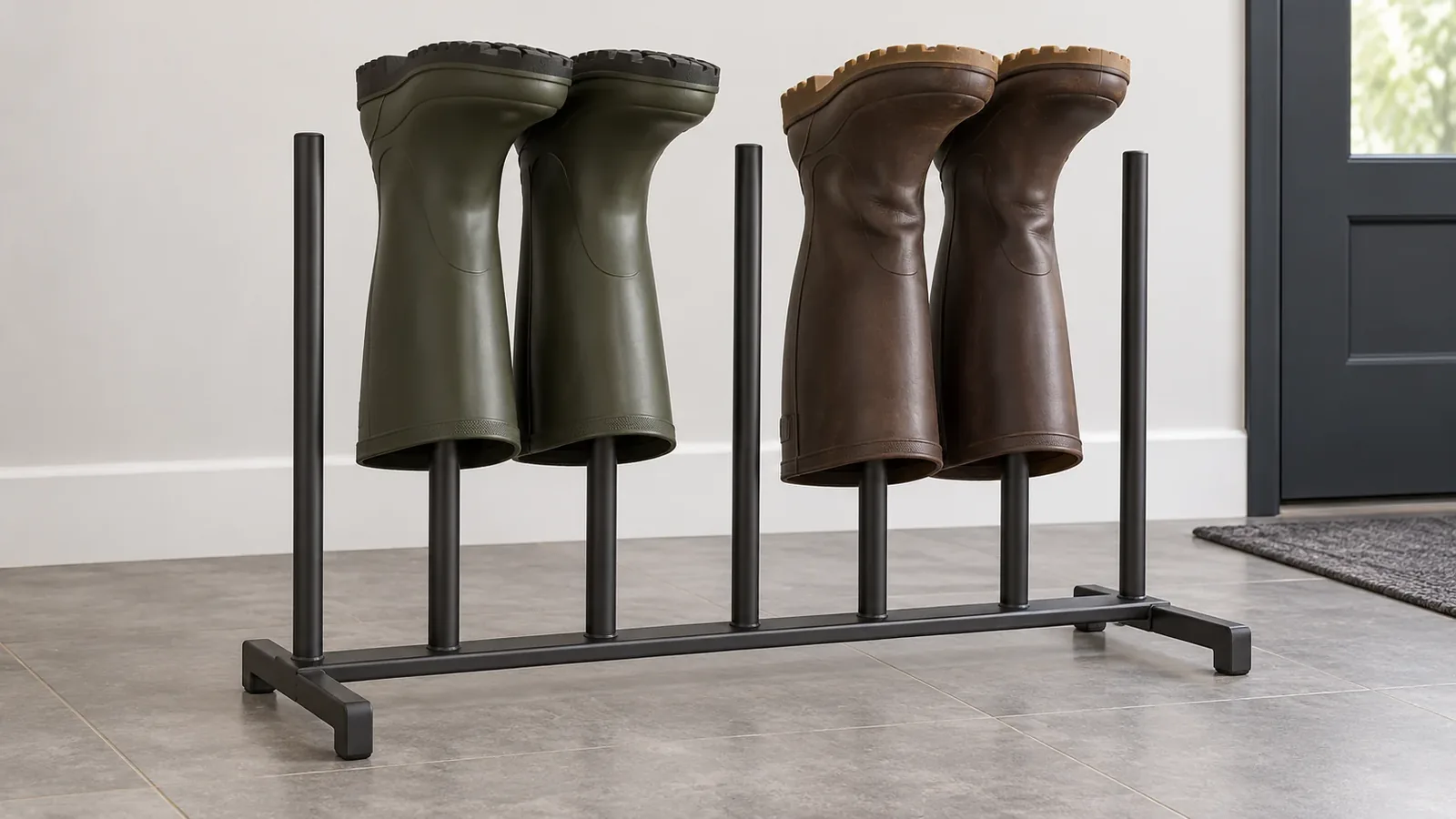
An upside down boot rack should be specified around the boots it must hold, the way the rack contacts each shaft opening, and the path a user follows to place and remove a pair. For importers, the useful sample question is not simply how many pairs fit: it is whether representative boots sit in the intended position without unwanted contact, interference, or an awkward removal sequence. A smooth metal post and a soft holding loop are different design approaches, and neither can be called universally better without testing against the target assortment.
What Should an Importer Define Before Choosing a Rack?
Start with the assortment rather than a generic product image. “Tall boot” covers different shaft heights, opening shapes, materials, stiffness, lining and decorative details. Those differences affect how a boot approaches a support, how far it settles, and what touches the rack. A specification based only on a nominal pair count can miss the most important fit issue.
Build a small reference matrix from the products the rack is meant to serve. Include the shortest and tallest relevant shafts, representative opening widths or shapes, and any especially soft or structured shaft construction. If the assortment includes boots with buckles, pulls, straps, or prominent seams near the opening, identify them as distinct cases. Do not assume a single sample represents every boot in a retail assortment.
Record the intended orientation and storage arrangement. Is each boot supported independently, or do two boots share a support? Are supports arranged in a row, on a rail, or in multiple levels? Does the rack sit on a floor, attach to a wall, or fit inside a cabinet? These are not interchangeable configurations: stability, usable clearance, installation and packaging depend on the actual architecture. A reference rack photograph may not reveal how the product is secured or assembled, so ask for a drawing or a sample that shows the complete structure.
The target environment is another input. An entryway rack may encounter occasional damp footwear, cleaning products, dust and repeated handling, while a retail display may prioritize appearance and access. Those environments can influence the requested material and finish, but they do not establish a universal corrosion result. State the intended use, cleaning routine and finish expectation explicitly, then agree how the sample will be reviewed.
A practical pre-RFQ brief can include:
- Intended boot categories and representative physical samples.
- Shaft height and opening variation the product must accommodate.
- Pair count and the arrangement of boots on the rack.
- Whether metal posts, loops or another contact design is being evaluated.
- Installation or freestanding requirements and available footprint.
- Finish, color, cosmetic faces and any contact surfaces needing special review.
- Packaging format, retail presentation and private-label requirements.
- Target quantity, sample expectation and target market.
How Do Post and Loop Contacts Differ?
A metal post supports the boot through a relatively small, defined contact area. The post’s position, top shape, diameter, finish and relationship to the rack determine where the shaft rests. A rounded cap or end treatment may be specified to avoid a sharp exposed edge, but its actual effect must be reviewed on the intended boot samples. A drawing should identify whether the cap is welded, press-fitted, screwed on, or supplied as a separate component; each arrangement raises different questions about retention, replacement, appearance and assembly.
A loop supports a larger portion of the shaft opening and may distribute contact differently. It also introduces a separate component and its own dimensional and retention requirements. Buyers should identify who supplies the loop, the material and surface characteristics required, its attachment method, and how the revision will be controlled. Do not assume a soft loop is automatically more suitable: fit, loop shape, stiffness, wear, color, cleaning and attachment all need review for the specific product.
The research examples show that the market includes both rod-based contacts with spherical tips and welded structures using soft loops. These examples demonstrate alternatives, not a performance ranking. A manufacturer’s product description cannot establish that the same geometry works for your boots, or that it prevents creases, protects every material or produces another footwear-care outcome. Use the sample to establish the buyer’s own acceptance criteria.
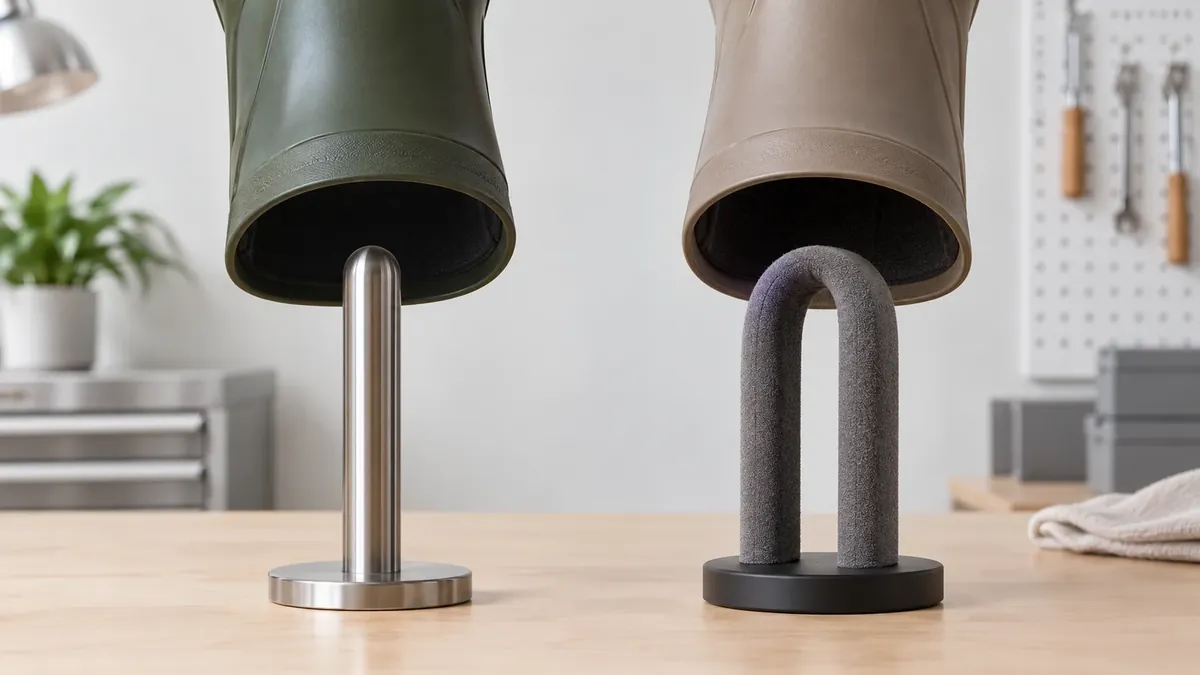
For either approach, inspect the area that touches the boot and the load path through the rack. On a post, check the tip and all exposed transitions for burrs, sharp edges, weld spatter, coating defects or an abrupt diameter change. On a loop, inspect seams, edges, attachment points and any movement where it meets the supporting frame. The relevant acceptance limit depends on the material and use case; define it with the supplier and buyer rather than relying on the word “smooth.”
Then review the structure behind the contact. A post can be straight yet sit at the wrong spacing or angle. A loop can have an acceptable outline but shift, twist or detach at its joint. Ask how the support attaches to the cross rail, whether the connection is visible on a cosmetic face, and how the chosen joining and finishing sequence affects the final surface. These are common product-development questions for formed and welded metal hardware, but the exact process route must be confirmed for the design.
Which Reference-Boot and Clearance Checks Matter?
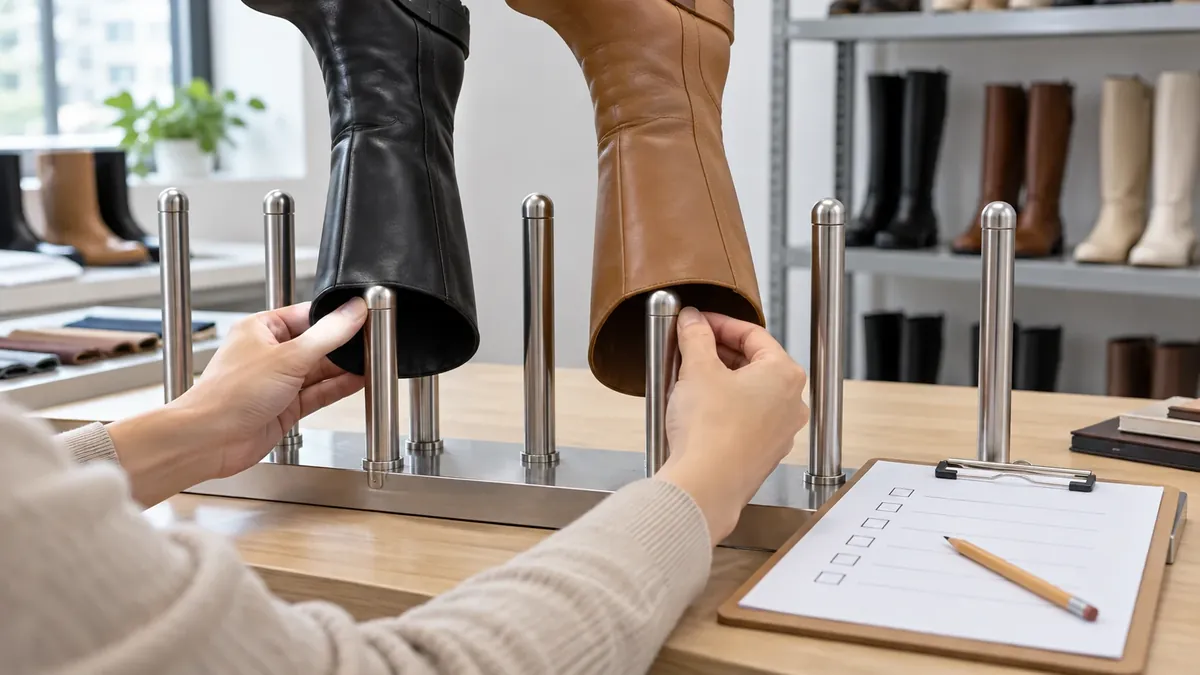
For an upside down boot rack, a useful fit review combines measurements with actual placement. Measure the boots and rack features that define fit, but do not substitute a single opening measurement for an observation of the complete interaction. An oval, tapered or flexible opening can behave differently from a rigid circular gauge. Record the boot model or sample identifier, its key dimensions, and the support position tested so a later sample can be compared consistently.
Check at least four stages:
- Approach: Can the user align the opening with the post or loop without forcing the shaft into an unintended angle?
- Placement: Does the boot settle to the intended depth and orientation? Does a shaft edge, pull tab, seam or decoration catch on another part?
- Stored position: Do adjacent boots touch each other, a frame rail, a wall or a neighboring support in a way the buyer did not intend?
- Removal: Can the user lift and clear the support without snagging, twisting the rack, or needing to move an adjacent boot first?
The tests should reflect how the product will actually be merchandised or used. If the rack is marketed for a particular range of shaft heights, try both ends of that range. If multiple boot sizes are stored together, test the combination rather than testing each boot only in isolation. If the design relies on a cap or loop, include the production-intent component: a bare prototype post does not verify the final contact condition.
Clearance is a system property. The distance between supports matters, but so do post height, boot shaft shape, rack footprint, wall spacing and the direction in which a boot must be lifted. Where two supports are close together, a wide shaft or decorative hardware may interfere even if each boot fits on its own. Where a rack has multiple levels, check hand access and removal path around the upper structure. Capture a side view and a plan view of the sample arrangement so the approved geometry is not left to interpretation.
The review need not promise a specific duration or prove long-term footwear-material effects. Instead, agree on a repeatable sample procedure: identify the boots, place them as intended, observe contact and interference, remove and replace them, and document any marks or movement that the buyer considers unacceptable. If the buyer needs a material-specific footwear-care assessment, that requires suitable specialist evidence beyond a rack fit check.
How Should Buyers Compare Samples and Control Revisions?
A sample comparison is useful only when the buyer controls what is being compared. If the post diameter, cap material, loop source, finish or spacing changes between samples, label each configuration. A short test record can include:
| Sample item | What to record | Buyer decision |
|---|---|---|
| Reference boot | Style/model, shaft height, opening shape and special details | Which assortment items must fit? |
| Contact geometry | Post or loop shape, position and exposed-edge condition | Which contact and surface are acceptable? |
| Placement | Alignment, insertion depth and any catching | Is normal placement straightforward? |
| Stored clearance | Boot-to-boot, boot-to-frame and wall clearance | Is the intended arrangement maintained? |
| Removal path | Required movement and contact with adjacent items | Can the pair be removed in the expected sequence? |
| Component revision | Cap/loop material, attachment and supplier identification | Is the approved part traceable? |
| Appearance | Finish, weld visibility, color and cosmetic faces | Does the sample match the approved reference? |
Use photographs from consistent angles and mark the tested boot positions on the drawing. If a part is supplied by another vendor, identify the part number or revision in the approval record. A visually similar replacement cap or loop can have a different shape, stiffness or attachment interface. “Same as sample” is weak change control unless the sample is uniquely identified and retained or documented in a controlled way.
Set acceptance criteria before the review. Examples include a defined range of boot styles, an agreed maximum visible gap, no exposed sharp edges, no unintended shaft snagging during the agreed placement sequence, and no contact with neighboring parts under the sample arrangement. These examples are prompts, not universal tolerances. The buyer and supplier should agree measurable limits where the feature can be measured and a clear pass/fail observation where it cannot.
A prototype may help validate fit and layout, but a production-intent sample is needed to review the actual finishing, joining, caps or loops and assembly. If tooling, material, weld position, coating, component source or packaging changes after approval, identify whether the change affects fit, appearance or contact. Recheck the affected points before treating the old approval as applicable.
What Manufacturing and Packaging Details Affect the Specification?
For a metal rack, the product drawing should communicate support spacing, height, orientation, frame dimensions, joint locations, finish and cosmetic faces. The material and section size should be specified by design requirements rather than by “heavier is better.” A larger or thicker component can change cost, weight and appearance, and may not address a poorly positioned contact or an unstable frame. Ask the supplier to identify any design conflict before the sample is approved.
The support-to-frame joint deserves special attention because it may carry load while remaining visible. Define which faces are cosmetic and what weld or joint appearance is acceptable. A weld may require grinding or finishing, and those operations can influence geometry and surface appearance. The correct process depends on the material, section and design; do not assume that a particular welding method or a visually hidden joint proves a particular strength. If performance is important, define a suitable test and acceptance procedure for the complete rack.
Finishing should be reviewed on the real sample, including the contact area. Coating or plating can change dimensions and edge appearance, and a finish that looks uniform on a broad frame may behave differently around joints, caps or narrow features. State the requested finish, color, appearance standard and handling expectations. Do not equate a visual inspection with a corrosion test, and do not infer a service life from a coating name alone.
Packaging is part of product fit and condition at receipt. Identify whether posts or loops can press against neighboring parts inside the carton, whether the rack needs to be disassembled, and whether a cap can loosen or a finish can rub during transit. The packaging plan should protect exposed contact surfaces and preserve assembly components without making an unsupported claim that a particular carton guarantees damage-free shipping. Buyers can review the packed sample, identify the likely contact points, and agree the packing orientation, separators and component bagging.
For a private-label launch, drawings and sample approvals should align with the carton contents, instructions, labels and SKU identification. If a cap or loop is a purchased component, make its inclusion and spare-part treatment explicit. If the product is sold as a set, confirm the count and assembly tools or fasteners. Clear responsibilities prevent the buyer from assuming that a supplier manufactures or validates an accessory that is actually sourced elsewhere.
What Mistakes Commonly Weaken an Importer’s Decision?
- Approving from pair count alone. Capacity says little about which boot shapes fit or how users remove them. Test actual reference styles.
- Testing one ideal sample. A stiff, wide-opening boot may behave differently from a soft or tapered shaft. Select boundary cases from the intended assortment.
- Choosing a contact by appearance. A polished post or soft loop can look suitable but still interfere with placement or removal. Evaluate the complete sequence.
- Treating a cap or loop as an incidental detail. A change in purchased component can alter dimensions, contact and retention. Control its source and revision.
- Ignoring adjacent items. Two boots may each fit alone but collide when stored together. Test the intended pair arrangement and rack clearances.
- Assuming a prototype equals production. The finish, joint, component fit and packaging can differ. Approve a sample that represents the intended production configuration.
- Accepting vague language. Terms such as “smooth,” “strong” and “fits all boots” do not define a verifiable requirement. Translate them into a specific sample range and observation.
- Assuming storage proves a care benefit. A rack-fit check does not establish that leather will not crease, that footwear will dry faster, or that every material is unaffected. Avoid making those claims without appropriate evidence.
- Leaving changes undocumented. A different spacing, finish or component source can invalidate a previous comparison. Record approved revisions and re-evaluate affected features.
These checks are more useful than an arbitrary claim of universal compatibility. The goal is not to test every possible boot on earth; it is to define the target assortment honestly, test representative and boundary examples, and state any known exclusions clearly in product information.
How Can an OEM Supplier Support Product Development?
A qualified metal hardware supplier can review drawings or physical samples for manufacturability, including support spacing, bent-rod geometry, joint access, finishing and assembly sequence. Koitor Hardware is a family-owned factory focused on bathroom and home storage hardware, with experience relevant to custom metal forming, welding, finishing and assembly. The current evidence does not establish that Koitor manufactures this exact boot-rack design or supplies soft loops and caps, so those product and component responsibilities must be confirmed for each program.
For an adjacent home-storage project, a buyer can share the intended arrangement, reference boots, drawings, target finish and packaging expectations to begin a technical discussion. A supplier review can identify questions such as whether a support is practical to form, whether a joint is accessible for finishing, or whether a purchased cap needs a defined interface. These are discussion points rather than a guarantee that a concept will pass a particular performance test.
Small-batch customization can be relevant when a buyer is evaluating a new assortment or private-label configuration. The commercial scope, MOQ, sample timing and production lead time depend on the product, quantity, finish and packaging; confirm them against the actual program. Koitor’s broader OEM home storage hardware manufacturing page provides context about its product-development scope. A boot rack should be treated as a project to qualify, not as a listed capability unless the factory confirms it.
Buyer Checklist and Frequently Asked Questions
Before requesting a quotation or approving a sample, prepare:
- Target boot categories and the physical reference boots.
- Height, opening shape and important variations in shaft construction.
- Rack layout, support count, spacing, height and installation method.
- Preference for post, cap, loop or another contact architecture.
- Required surface, component supplier and attachment details.
- Placement, stored-clearance and removal checks the buyer will observe.
- Material, finish, cosmetic-face and packaging expectations.
- Drawing, target quantity, private-label requirements and target market.
- Sample identification, approval record and revision-change procedure.
Is a post or a soft loop better for an upside down boot rack?
Neither is universally better. A post and a loop create different contact geometries and component requirements. Compare production-intent samples with the actual boot assortment, including placement, stored position and removal.
How many boot styles should buyers test?
There is no universal count. Select representative styles and boundary cases based on the assortment, including meaningful differences in shaft height, opening shape, stiffness and nearby hardware. Record which styles were included so the claim on the final product listing remains accurate.
Does an inverted rack prevent creases or protect all boot materials?
A rack sample check cannot establish that. Footwear material, construction, condition, storage environment and contact geometry vary. Avoid universal care claims unless suitable footwear-specific evidence supports the exact statement.
Does a sample approval guarantee mass-production consistency?
No. Approval documents a configuration and acceptance criteria. Buyers should also define revision control, component identification and the applicable production inspection plan. If a key dimension, process, finish or purchased component changes, assess whether reapproval is needed.
What should be on the drawing?
Show the complete frame, support count, post or loop geometry, positions, dimensions, joints, finish, cosmetic faces, component details and packaging-related assembly needs. Include tolerances for dimensions that affect fit and agree inspection methods for the features that matter.
Discuss a Home-Storage Metal Hardware Sample
Share your drawing, reference boots, contact concept and intended packaging to discuss the metal product scope. Boot-rack production and any cap or loop component supply must be confirmed for each project.
OEM / العلامة التجارية الخاصة
حوّل دليل التوريد هذا إلى موجز منتج
يرجى إطلاعنا على المنتج المستهدف، والحجم، والتشطيب، وكمية الطلب، ومتطلبات التغليف. وسيتلقى فريقك تقييمًا عمليًّا لإمكانية التصنيع قبل تقديم عرض الأسعار.
 English
 Español
 Português
 Français
 Deutsch
 العربية